The Cherokee Rose, page 28
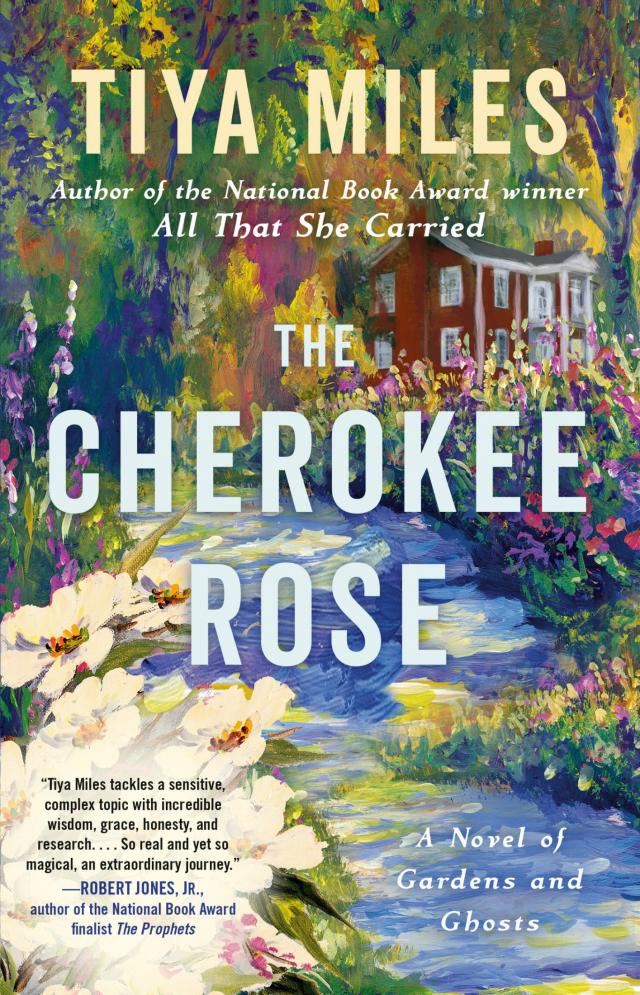


The specific personal and communal history that I would eventually wrap around that woman—who turned out to be Ruth, the daughter of an abused and murdered mother—and her peers, was inspired by primary research and the vivid image of an enslaved woman that I first read about in the archives and then imagined on plantation grounds over a decade later while researching my second history on slavery in the Cherokee Nation. Some of the richest firsthand accounts on this topic were the letters and diaries penned by Christian missionaries from the Moravian Church who had traveled to Cherokee country, in what is now Georgia, to start a school and mission on the land of a wealthy Cherokee slaveholder named James Vann. In the small basement reading room of the Moravian Archives (Southern Province) in Old Salem, North Carolina, I had immersed myself in translations of the old German missionary script, reading about Vann, his family members, his missionary associates, and the enslaved people owned by both Cherokees and the Moravian Church. A woman named Pleasant stood out to me in these records. Pleasant was an enslaved mother of a young mixed-race boy, Michael, brought by the missionaries from North Carolina to the Cherokee Nation. The missionaries criticized Pleasant for cursing at them when they gave her orders, and carrying out her assigned tasks slowly and belligerently. Although the missionaries who sought to extract her labor saw Pleasant as a lazy, ungodly nuisance, I saw her as a person of remarkable inner fortitude. She exhibited intelligence, bravery, and creativity throughout her time in the Cherokee Nation by pushing back against her missionary-masters’ wishes, seeking to protect her son from sale, forming bonds with other enslaved Blacks as well as Cherokees, and growing a garden that others in her community envied.
Pleasant had been enslaved on the Vann plantation, an estate that was known as Diamond Hill in the 1800s, and, by the 1950s, was preserved, marked, and open to the public. I walked those grounds (the Chief Vann House State Historic Site, operated by the Georgia Department of Natural Resources) several times while working on my book about the family that had owned the estate and the people they had enslaved. It was during one of these visits in the sticky heat of July that the second seed of The Cherokee Rose sprouted.
I was walking among the trees by a live spring once considered sacred by Cherokees, and which had also inspired the name of the former Moravian Cherokee mission station on the grounds: Springplace. A generous senior colleague, Dr. Rowena McClinton, accompanied me. She was an expert on Moravian documents and a translator of the Springplace Mission diaries, who often sent me loose sheaths of translated pages in the mail when she came across Pleasant’s name.[5] I was discussing research with Rowena and feeling the soft, welcome breeze beside the waterway, when I let my mind wander. I looked up at the trees, through the canopy of leaves filtering the day’s languid light, and I imagined that I saw Pleasant there, sitting astride a sturdy branch and demanding my notice beyond distant academic interest. Glimpsing Pleasant by the spring that day, I felt moved by a sense of the untold stories of the more than a hundred enslaved people who had lived on that land alongside her, and pushed to try to capture revelations about their lives that were perhaps unprovable, but nevertheless true to the human experience.
I do not say that I saw a ghost that late summer afternoon. I do say that I saw a figment—a figment of the historical record augmented by my imagination once it had been set free. Seeing Pleasant on that branch in her calico dress and headscarf unveiled for me a living sense of the past, and a means of connecting to that past beyond the realm of my accustomed mode: academic history writing. Pleasant, the historical person held captive by missionaries, became the character Faith in The Cherokee Rose. The spectral woman in the tree transformed into Mary Ann, the spirit guide to Jinx, Ruth, and Cheyenne, who was modeled on a Creek historical figure whom I had uncovered in a Native American history research seminar taught by the Ojibwe historian Jean O’Brien.[6] I hoped that by writing the stories of women who lived in the past in a way that allowed for a deeper emotional connection than is often possible in historical writing, I could prepare the ground for a richer understanding of their struggles and strengths with women readers who enjoy climbing inside of stories and who feel that the histories we inherit make us who we are today.
I knew for years that I should heed Pleasant’s call, but knowing and doing are entirely different enterprises. I was an academic with three young children, classes to teach, articles to publish, and no time to spare for creative writing. Soon after my youngest child was born, I attended an annual conference of the Native American and Indigenous Studies Association in Minneapolis. One evening, I wandered into a fairy-tale-like bookstore in the Uptown neighborhood where the bookseller happened to be dressed like Mother Goose. With my four-month-old son in the stroller beside me, I browsed the shelves and came across a book by Walter Mosley, my stepfather’s favorite crime novelist. This Year You Write Your Novel was the book’s title. I bought it and tucked it inside my diaper bag. By the time that academic year of 2008–2009 ended, I was ready to follow Mosley’s prescription.
My family moved to Montana for the summer while my husband was engaged in wellness intervention research in a community partnership on the Blackfeet Reservation. During the days, I snatched time around caring for our five-year-old twin daughters and eight-month-old son to start the creative endeavor that Pleasant’s visage had sparked years earlier. The project before me was daunting, but a single question guided my thinking, enabling me to cross the (arguably fluid) boundary between historical and fictional narrative construction. I had by then conducted extensive primary research on the Diamond Hill plantation. My book on the history of that place and its residents was in production at the University of North Carolina Press. I knew that the owner of that plantation, the legendary Chief James Vann, had been murdered under mysterious circumstances. His unknown assailant had never been apprehended, but historians believed that the perpetrator was his compatriot-turned-enemy. Knowing what I did of the lives of enslaved women, as well as Cherokee women, on Diamond Hill, I thought that in a world of my own creation, a fictional world, an alternate scenario was entirely plausible. Who killed James Vann? This became the mystery, the question around which I might weave a story. And my answer would be that the women of the Vann plantation, acting in an alliance built of love and necessity, had taken this abusive man’s life in collective self-defense. I needed, then, to craft a story that realized that version of events, made it believable, and showed its relevance to the lives of women in our contemporary society, women that I knew and loved, like my family, friends, and the readers in a mystery book club that I had briefly joined during a parental leave after our twins were born.
I felt a devotion to this story that pushed me through the difficult moments when time was scarce, children were noisy, and faith in my ability to complete the thing wavered. But writing fiction after fifteen years of writing academic history proved the most challenging part of this enterprise. I had been trained to accurately render the past as best as I could reconstruct it, to offer my analyses backed by evidence fairly and rationally interpreted. Over the course of my professional career, I had labored to build narratives that I could reasonably and responsibly support through primary and secondary sourcing. Now that I was trying to write fiction set in both the past and present, in a real place where historical lives had unfolded in ways I had already documented, I had a tough time letting go of the “known” past. In my initial efforts I adhered so closely to historical dates and events that I gave myself no room to develop a new plot. I had to resist a gravitational pull to write in footnotes (and settled for an Author’s Note that explains the background for the story). Finally, I found my way out of a data-bound tunnel when I reread the evocative, detail-rich diary of missionary Anna Rosina Gambold. Although I had read pages of her diary many times before when mining them for historical information, now I read decades of her daily journal straight through while sitting outside in the sunshine. Her observations were so sharp, her turns of phrase so captivating, that I became absorbed by her world. Anna Rosina Gambold, herself a writer of diaries, letters, and botanical papers with a literary quality, opened the door to fiction writing for me. I began anew by free-writing new entries of her diary in my best estimation of her voice. At first these diary pages adhered to the originals, duplicating the missionary’s recorded dates, locations, and words. But before I realized a shift had occurred, the entries that I was writing, in the voice of a character modeled on Anna Rosina, took on a life of their own.
The historical Pleasant had inspired me to write this story about the Vann plantation and its inhabitants. The historical Anna Rosina had guided me into the heart of that story’s pages. Shaping the lives of the wholly manufactured contemporary characters—Jinx, Ruth, Cheyenne, Adam, and Sally—was an extremely challenging second phase of the creative process. I struggled with making these characters real as people, with giving them things to do and words to say that were not mere reenactments and recitations of the historical information that I sought to share with readers. In the end, with the feedback of editors and fiction-writing workshop leaders who helped the manuscript along, I was able to enliven these characters, although I realize that my skills in dialogue and plotting are far from mature. By the time I finished the final draft of The Cherokee Rose, more than five years after stumbling across This Year You Write Your Novel, I wanted to travel back in time to 2009 and visit my characters at their restored and repurposed historic site. The fiction had worked on me. I nearly believed that they lived on the former Vann estate, making new relationships and histories.
While I was completing an early draft of the novel and, coincidentally, spending time in Detroit for research on a different project, I learned about the practice of tending memory gardens. I picked up on this idea while hearing gardeners in the city talk about planting gardens in memory of loved ones who had moved away, as the city’s population began its steep decline. A friend might care for the old garden of someone who had moved and left a vacant yard behind. A relative might transplant flowers from a departed loved one’s garden into her own, or a daughter might replicate the shape and colors of her mother’s previous plantings. Even if a loved one was long gone—having relocated to a new city, or even a place farther away, like heaven or the deep, star-dusted universe—a plant would bloom in that person’s cherished memory. A plant would be the reminder of that loved one’s life and stories. This beautiful notion of the memory garden became an essential element in the novel as I revised.[7] I finally completed and published the book in 2015, my willingness to let the story go and to take the ensuing professional risk having been encouraged by the life-changing gift of a MacArthur Fellowship.
Now, I like to think of myself as the keeper of a memory garden, too, in the form of new seeds in the soil and new pages on the past. As a first novel, and as a suspension bridge between my dutiful work as a historian and my fever dreams as a fiction writer, The Cherokee Rose contains many flaws.[8] Still, I hope that by sharing in the experiences of these characters and finding inspiration there, readers can bend their own lives toward care, remembrance, and justice, and, like the flowers in the rose garden: grow.
Notes
Introduction
Tiya Miles, The House on Diamond Hill: A Cherokee Plantation Story (Chapel Hill: University of North Carolina Press, 2010). This book, my second, was awarded prizes by the National Council on Public History, the Georgia Historical Society, and the American Society for Ethnohistory.
BACK TO NOTE REFERENCE 1
I have written more extensively, in various essays and a book, about how I think plantations where enslavement was practiced might be constructively interpreted for the public. See Tiya Miles, Tales from the Haunted South: Dark Tourism and Memories of Slavery from the Civil War Era (Chapel Hill: University of North Carolina Press, 2015). Tiya Miles, “What Should We Do with Plantations,” The Boston Globe, August 8, 2020. Hannah Scruggs and Tiya Miles, “A Way Forward for Plantation Sites: Reimagining Space and Relations in the Wake of Black Lives Matter,” in Revisiting the Past in Museums and at Historic Sites, eds. Anca I. Lasc, Andrew McClellan, Änne Söll (New York: Routledge University Press, 2021). Tiya Miles and Rachel Miller, “Critical Place-Based Storytelling: A Mode of Creative Interaction at Historic Sites,” in Bending the Future: 50 Ideas for the Next 50 Years of Historic Preservation in the United States, eds. Max Page and Marla R. Miller (Amherst: University of Massachusetts Press, 2016).
BACK TO NOTE REFERENCE 2
The history scholars in this cohort that I became part of included Claudio Saunt, Celia Naylor, Barbara Krauthamer, and David A.Y.O. Chang. I learned a great deal about historical methods from them, as we often collaborated and crossed paths at conferences. For reasons that are still unclear to me, most scholars working on the topic of Black presence in Native nations in the late 1990s and early 2000s were other Black women, including Naylor and Krauthamer, as well as Fay Yarbrough.
BACK TO NOTE REFERENCE 3
Tiya Miles, “Uncle Tom Was an Indian: Tracing the Red in Black Slavery, in Confounding the Color Line: Indian-Black Relations in Multidisciplinary Perspective, ed. James F. Brooks (Lincoln: University of Nebraska Press, 2002).
BACK TO NOTE REFERENCE 4
Audre Lorde, “Eye to Eye: Black Women, Hatred, and Anger,” in Sister Outsider: Essays and Speeches (Berkeley: Crossing Press, 1984).
BACK TO NOTE REFERENCE 5
Lindsey Bark, “Cherokee Nation Removes 2 Confederate Monuments from Capitol Square,” Cherokee Phoenix, June 16, 2020, https://www.cherokeephoenix.org/news/cherokee-nation-removes-2-confederate-monuments-from-capitol-square/article_dec30c2c-52c2-5ff1-a837-c56158ff2f96.html.
BACK TO NOTE REFERENCE 6
“Osiyo: Voices of the Cherokee People,” Wherever We Are, 2022 Freedmen Edition, https://youtu.be/JXfqobn0elM.
BACK TO NOTE REFERENCE 7
Gardens of Memory: Ghosts, Grounds, and the Archives
Pauline E. Hopkins, Contending Forces: A Romance Illustrative of Negro Life, North and South (1900; reprint: Schomburg Library of Nineteenth-Century Black Women Writers, New York: Oxford University Press, 1988). Pauline E. Hopkins, The Magazine Novels of Pauline Hopkins (reprint: Schomburg Library of Nineteenth-Century Black Women Writers, New York: Oxford University Press, 1988). Frances E. W. Harper, Iola Leroy, or Shadows Uplifted (1892; reprint: Schomburg Library of Nineteenth-Century Black Women Writers, New York: Oxford University Press, 1990). Frances Smith Foster, ed., Minnie’s Sacrifice, Sowing and Reaping, Trial and Triumph: Three Rediscovered Novels by Frances E. W. Harper (Beacon, 1994).
BACK TO NOTE REFERENCE 1
Octavia E. Butler, Kindred (1979; reprint: Beacon, 2004).
BACK TO NOTE REFERENCE 2
Tiya Miles, The House on Diamond Hill: A Cherokee Plantation Story (University of North Carolina Press, 2010). Also see Tiya Miles, “Showplace of the Cherokee Nation: Race and the Making of a Southern House Museum,” The Public Historian vol. 33, no. 4 (November 2011): 11–34.
BACK TO NOTE REFERENCE 3
For a detailed description of my experience of writing fiction as a way of doing public history, as well as the anxieties, risks, and fallout involved, see Tiya Miles, “Edges, Ledges, and the Limits of Craft: Imagining Historical Work beyond the Boundaries,” National Council on Public History Keynote Address 2015, The Public Historian vol. 38, no. 1 (February 2016): 8–17.
BACK TO NOTE REFERENCE 4
Rowena McClinton, ed., The Moravian Springplace Mission to the Cherokees, Vols. I and II, 1814–1821 (University of Nebraska Press, 2007). Also see Rowena McClinton, ed. The Moravian Springplace Mission to the Cherokees, Abridged (University of Nebraska Press, 2010).
BACK TO NOTE REFERENCE 5
For more on my research on the historical figure of Mary Ann Battis, see Tiya Miles, “The Lost Letter of Mary Ann Battis: A Troubling Case of Gender and Race in Creek Country,” Notes from the Field, Native American and Indigenous Studies vol. 1, no. 1 (Spring 2014): 88–98.
BACK TO NOTE REFERENCE 6
In draft form, I had titled the novel “Our Mothers’ Gardens,” inspired, of course, by Alice Walker’s classic work of womanist theory. My literary agent, Deirdre Mullane, suggested the new title of The Cherokee Rose, also fitting and more immediately explanatory for readers regarding the subject matter. Alice Walker, In Search of Our Mothers’ Gardens (Harcourt, Brace, Jovanovich Publishers, 1983).
BACK TO NOTE REFERENCE 7
The Cherokee Rose, though imperfect, was named “A Book All Georgians Should Read” by the Georgia Center for the Book. It was a finalist for a Lambda Literary Award in the category of Lesbian Fiction, and a winner of a Bronze Medal in Multicultural Fiction, Independent Publisher Book Awards.
BACK TO NOTE REFERENCE 8
A Q&A WITH TIYA MILES
What inspired you to write fiction after a decade of writing histories?
While doing research on my second work of history, I immersed myself in letters and diaries penned by Moravian missionaries who had traveled to Cherokee country in the early 1800s to evangelize. These missionaries brought an enslaved woman named Pleasant along with them as they settled on the grounds of the wealthy Cherokee slaveholder James Vann. The missionaries saw Pleasant as a belligerent, incompetent laborer who drove them mad with her back talk. But I saw Pleasant as a woman who persistently showed courage, intelligence, and creativity. Despite the vulnerability of her circumstances, she consistently spoke up for herself and her son, and was sometimes able to further her own ends.