The Cherokee Rose, page 29


Pleasant never left my mind as I read those records and visited the Chief Vann House State Historic Site in Georgia. On one such visit, I was walking among the trees by a clear flowing spring when I let my mind wander. I looked up at the trees, through the thick leafy canopy filtering the day’s languid light, and I imagined that I saw Pleasant seated on a high branch, demanding that I notice her. That fleeting vision led me to feel that I had to tell the stories of Pleasant and her community members—even if that meant looking beyond the facts available in the historical record.
Seeing Pleasant sitting there in her headscarf unveiled for me a living sense of the past and a means of connecting to that past outside the realm of my accustomed mode of academic research and writing. Pleasant, the historical person, the figure in the tree, became the character Faith in The Cherokee Rose. My experience of sighting her became Ruth’s experience of encountering the ghost of Mary Ann. By writing fiction about women who experienced slavery, I hoped to capture emotional struggles and strengths that can be difficult to access in historical writing, and to share those elements with readers who feel the histories we inherit make us who we are today.
How did you go about turning history into fiction?
As a scholar, I had not been happy with how the real story ended for enslaved women and Cherokee women on the Vann plantation, many of whom faced lifelong exploitation, familial separation, and domestic violence. But as a novelist, I had the opportunity to write my own ending. In The Cherokee Rose, the weak are strong, and the ne’er-do-wells get their comeuppance. As Jinx suggests indirectly at the end of the novel when she plays music by the Indigenous jazz group Poetic Justice, making the leap from history to fiction gave me the chance to achieve poetic justice for women who saw little or no social justice in their lifetimes. In the historical record, the legendary Chief James Vann of the Cherokee Nation had been murdered under mysterious circumstances. I started this novel by posing the question “Who killed James Vann?” and allowing myself to invent an answer. That invention was the creation of a plantation world in which diverse women constructed an alliance built at first of necessity, and then of love.
How did you develop the characters in The Cherokee Rose?
The characters in the nineteenth-century story line are all based on historical figures that lived in the Cherokee Nation or the Creek Nation during the heyday of the Diamond Hill plantation, owned by James Vann, on which the Cherokee Rose Plantation is based. These were individuals whose hard lives and creative means of survival captured my imagination while I was conducting historical research on the intersections of African American and Native American histories. The characters in the modern-day story line of the novel are composite characters inspired by my observations, and in some cases my experience, of the complexities of Black, Native, mixed-race, and “Black Indian” identity, particularly where these complexities have included dynamics of gender and women’s issues. Jinx’s character was influenced by a tribal historian whose story I had the privilege of hearing about, and also by the many talented graduate students who struggle with questions of professional calling. Ruth was inspired by family and friends who have suffered domestic violence, as well as by a brief time I spent working at a domestic violence shelter on an Indian reservation after college. And as one reader of the novel joked on Twitter, every Black woman knows a Cheyenne.
Is the plantation house itself a character?
The house has a life of its own in the novel; it has eyes (windows), an austere personality, and a sense of place on its hilltop. The house is animated by both the materials that make it up, derived from nature (such as the bricks fashioned by enslaved people), and by the spirits of residents who have gone before. I was inspired to describe a living house by a number of sources, including the creative work of the Creek poet and musician Joy Harjo (her book A Map to the Next World, and her work with the jazz ensemble Poetic Justice), whose words open Part II of the novel; and by my own sense of the closeness of history when I enter very old structures. Places that humans construct, as much as natural places on the land, shape our lives and take on lives of their own.
Why are gardens so important in this book? Have they always been important to you?
Many of us have grown up with gardens. When I was a girl, I spent time working with my grandmother in her vegetable garden alongside the house that she had worked thirty years to purchase. Working in the garden soothed my grandmother’s soul, brought us closer together, and also produced essential nourishment for the family. Later in life, I read Alice Walker’s classic book In Search of Our Mothers’ Gardens and was captivated by her depiction of Black women’s gardens as sites of creativity. In fact, my original working title for this novel was “Our Mothers’ Gardens.” In the history that I researched, gardens also played a prominent role. The Cherokee plantation mistress kept a garden, as did the Moravian missionary diarist and the enslaved woman possessed by the missionaries. Gardens were important to these historical women who occupied vastly distinct social positions; plants were a potential form of interpersonal connection for them. I wanted gardens to be important, as well, to the women in the contemporary story line. This comes out most strongly in Ruth’s personal history and arc of change. It is also apparent in the life of Ruth’s mother and Jinx’s great-aunt. The love of the garden and recognition of its healing power was something that I thought could bring the women together in both the historical and contemporary timelines.
What role does the ghost play in The Cherokee Rose? What purposes do ghosts serve in real life?
Although this novel was inspired by the flash across my imagination of an enslaved figure on the grounds of the Vann House historic site, the first draft did not include a ghost. Ghosts are tricky to pull off in fiction; plus, the symbol of a ghost of the Middle Passage had already been perfected in Toni Morrison’s classic novel Beloved. My ghost, the figure of an Afro-Native adolescent girl, became a character only after I began a study of ghost tours at historic sites in the South. I was finding that many of these ghost tours included stories of Black slave ghosts, which was intriguing because ghosts often represent the past in popular culture and encourage engagement with history for popular audiences. However, my research (detailed in the book Tales from the Haunted South) indicated that these enslaved ghosts were often resigned to the system of slavery rather than resistant to it. My findings led me to want to create a fictionalized ghost at a historic plantation site that undercut the romanticization of slavery and represented the need for justice. My plantation house ghost represents history in the story, serves as a vehicle for the contemporary characters’ connection to the past, and stands as an indictment to the abuse of Black women in slavery.
QUESTIONS FOR FURTHER DISCUSSION
Have you ever researched your family tree? What is your most precious family document or heirloom? Why do you cherish it? What have you learned about yourself from your family’s oral stories?
If you could go back to a past time and place to learn about the history of your family or social group, where would you go? What would you hope to find there?
Have you ever visited a house museum or historic home on the state or national register? What was that experience like for you? Do you feel citizens or governments have a duty to protect historical sites like the Cherokee Rose?
What aspects of the history presented in the novel surprised you most? Do you think fiction is a good tool for teaching about lesser-known people and events of the past? What can fiction achieve that a work of history, perhaps, cannot?
The main characters in the contemporary story line of this novel have something in common: they are all women of color. And yet, there are key differences in their experiences that have shaped their identities and act as barriers to their connection. What differences keep the characters apart? How do they begin to recognize and break down those differences?
Members of marginalized groups—such as African Americans, Native Americans, women of all racial backgrounds, people of non-heteronormative sexual orientation or gender expression, and people with a disability—experience collective and individual pain connected to devaluation and discrimination in mainstream society. In what ways, big and small, do you see the characters experience or confront prejudice based on their race, class, gender, sexuality, or physical ability? How do they recover from these painful experiences?
Part of the psychological weight that each woman carries in this novel is linked to trauma that took place in a past time in her own life or the lives of her forebears. How would you define historical trauma? How can individuals and groups heal from historical trauma?
Who should own the Cherokee Rose Plantation? Adam? Cheyenne? The state of Georgia? The Cherokee Nation of Oklahoma? What does the battle over ownership in the novel suggest about Indigenous places and the return of land in contemporary American society?
The Cherokee Rose includes traces of a Southern past that is fading away in the face of suburban development and corporate expansion: a family fruit stand, a summer camp for African American youth, a preserved plantation home, and natural forested landscapes. What does the loss of these places mean for memory and identity, as well as for the environment that makes the American South special?
By Tiya Miles
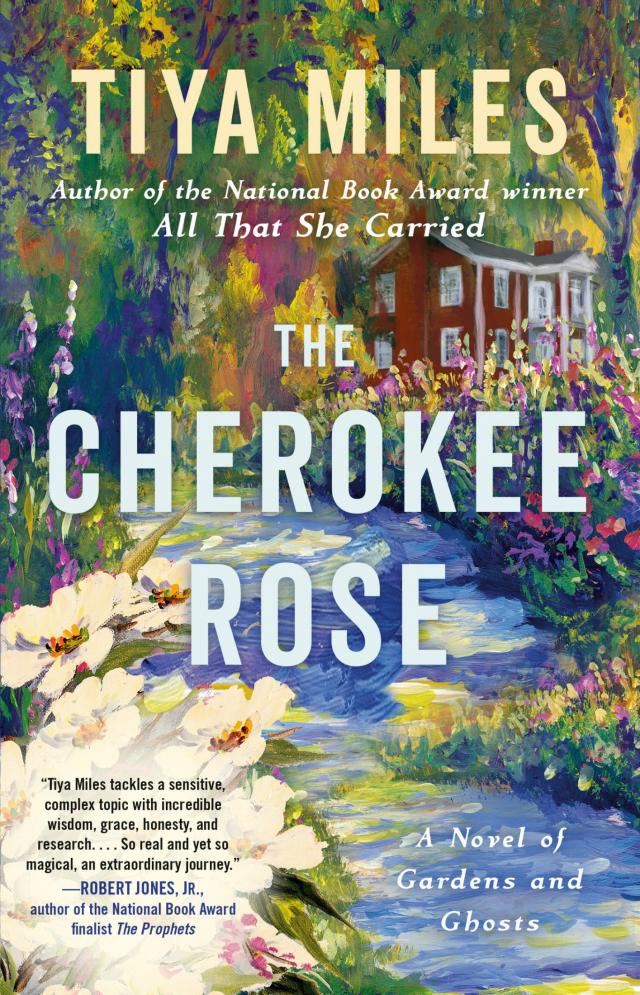
The Cherokee Rose
All That She Carried
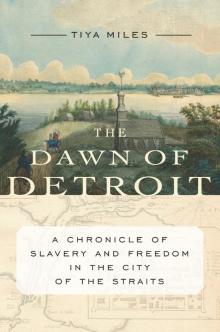
The Dawn of Detroit
Tales from the Haunted South
The House on Diamond Hill
Ties That Bind
About the Author
Tiya Miles is the Michael Garvey Professor of History and Radcliffe Alumnae Professor at Harvard University, and the author of All That She Carried, a New York Times bestseller that won the National Book Award for Nonfiction, the PEN/John Kenneth Galbraith Award for Nonfiction, and several other historical and literary prizes. She is a recipient of the MacArthur Foundation Fellowship Award, the Hiett Prize in the Humanities from the Dallas Institute of Humanities and Culture, and fellowships from the Mellon Foundation and the National Endowment for the Humanities. Her recent book The Dawn of Detroit received the Hurston/Wright Legacy Award in Nonfiction, an American Book Award, and a Frederick Douglass Book Prize, among other historical prizes. Additionally, Miles is the author of Ties That Bind, The House on Diamond Hill, and Tales from the Haunted South.
What’s next on
your reading list?
Discover your next
great read!
Get personalized book picks and up-to-date news about this author.
Sign up now.
_143797785_
Tiya Miles, The Cherokee Rose