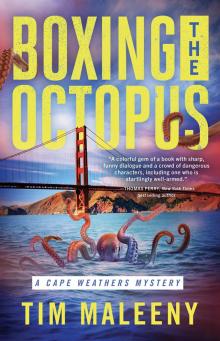
Boxing the Octopus, page 28


Sally could tell no one was inside the tower even before she glanced over the low wall. The energy felt dormant. A cursory perusal of the walls and ceiling for trip wires or optical sensors revealed nothing, but the lacquered box resting on the floor signaled the real puzzle still awaited.
Sally stepped inside the tower and knelt before the box, its mahogany surface almost invisible against the black floor. It was three feet wide and shallow, only ten inches across and less than six inches high. An ornate hasp of bronze was latched by a metal pin as wide as Sally’s palm. She began to slide the pin to the left but stopped before the latch was released.
Sally spun the long box clockwise so she would be positioned behind it when it was opened, as if presenting a gift to an imaginary friend. She slid the pin from the hasp and grabbed the top of the box, hands shoulder-width apart, and slowly raised the lid.
A barely audible twang preceded a series of thunks as a flock of darts flew into the ceiling. They were smaller versions of the deadly barbs that Sally deployed in her apartment.
Not exactly a box of chocolates.
Sally spun the box around and looked inside to find…another box. The second was walnut with a cinnamon finish. Sally lifted it free of the first box with deliberate slowness, as if handling nitroglycerin.
Chinese nesting boxes were an ancestor of Russian nesting dolls, decorative storage and visual puzzles that adorned homes for centuries. Sally knew there should be a minimum of three boxes in a nest. She followed the same routine with the second box and was rewarded with the gift of a baby scorpion scuttling its way to freedom. Sally was on her feet in an instant, the insect crunching under her heel like a corn chip forgotten on the living room floor.
The third box was made of cherrywood, a rich red pattern in the polished grain. Both the color red and number three were considered lucky, but what was lucky for one person might be unlucky for another.
The only thing that emerged when Sally opened the lid was the smell of jasmine. She spun the box and smiled, realizing what she would find.
The sword of Tomoe Gozen was nestled in a bed of flower petals, the gently curved blade of the nagitana a wistful smile.
This wasn’t a trap. It was a goodbye.
Sally lifted the sword reverently and rotated it to catch the light. The waves in the tempered steel made it seem alive. Just like Sally and An, it was a perfect weapon, crafted to assure victory in any battle.
An must have planted a forgery inside the museum when she stole the sword. Sally wondered if they would ever notice. She felt a stab of regret she hadn’t gotten a present for An, until she realized that she had.
Sally had let her walk away.
She placed the sword carefully inside the box and noticed a simple card beneath the jasmine petals. The handwriting was meticulous. The address was in Hong Kong. An open invitation or a dare, or maybe a little of both.
A journey for another day, when Sally had time to kill.
77
“I haven’t had time to kill you, which is the only reason you’re still alive.”
Beau loomed over Cape’s hospital bed like a storm cloud. He glowered until positive that Cape was fully alert, then proceeded to stomp around the bed as if fighting an army of spiders.
Stomp—step—stomp—step.
Cape tried to follow Beau’s circumlocution, but his neck protested at every turn of his head. “How long have I been out?”
“Long enough for my foot to fall asleep.”
“You’ve been watching over me,” said Cape, his voice hoarse, strange to his own ears. “That’s sweet.”
“Been waiting on you,” said Beau. “There’s a difference.” He gestured at the partially open window, beige curtains rustling in the breeze. “Pretty sure Sally’s been checking on you, though.”
Cape started to sit up but the room shifted on its axis, so he kept his head firmly ensconced in the pillow. He had a vague memory of regaining consciousness in this bed before and wondered if it would stick this time. His side throbbed as if fire ants were throwing a rave inside his gut. Reaching for the button on the rail that controlled the bed’s elevation, he noticed there was an IV in the back of his right hand.
“What did I miss?” asked Cape.
“I’ll tell you what you didn’t miss, Annie Oakley,” said Beau. “You didn’t miss the ceiling with that hand-cannon of yours. You almost turned Pier 39 into Atlantis.”
“That’s hearsay,” said Cape.
“Only because you hear me saying it.”
“Who’s the tattletale?”
“Suspect from the armored car robbery that we’ve been looking for since, well, forever,” said Beau.
“Lou?”
“Found him bobbing in the bay as the tide went out—halfway to Alcatraz before a tour boat fished him out of the water.” Beau smiled at the thought. “Soon as he gets back to the pier, goes up to the first police officer he finds, and turns himself in. Says he’ll tell us everything, as long as we lock him up someplace far, far away from the ocean.”
“He only knows about the robbery,” said Cape. “I don’t think he can tell you anything about the rest of it.”
“As far as SFPD is concerned, the robbery is the only thing I’m investigating.”
Cape took a breath and decided to let Beau ask another question. He had questions of his own but wasn’t quite ready to hear the answers.
“Why not shoot the guy who was about to shoot you?” asked Beau.
“I wanted to cause a distraction, not a tsunami,” said Cape. “I didn’t know the players or the teams, and there were too many guns in play.”
“How many?” asked Beau. “A corpse with a spear souvenir in its chest scared the crap out of some tourists, broke the surface near the sea lions—been ID’d as the guy running the aquarium.”
“Lou shot Cragg,” said Cape. “In case he hasn’t already confessed.”
“Said it was self-defense.”
“I’d call it temporary insanity,” said Cape. “Or PTSD.”
“He said Cragg was a co-conspirator in the heist.”
“I think the pirate was playing all the angles,” said Cape. “Cragg was also involved with—”
“—your client.”
“I was going to say he was involved in the bigger conspir—”
“—I know what you were going to say,” replied Beau. “But that’s not what I said.”
Cape’s felt like he was caught in a whirlpool and wondered if it was vertigo or just denial. He closed his eyes and let the room spin another minute. “I was getting to that.”
“Well, get to it.” Beau was giving him the cop stare.
Cape started at the beginning, then jumped ahead, skipped back, drifted sideways, and finally got back on track, right up until the moment his client was pointing a gun at him. He described this penultimate betrayal with as much lurid detail as he could muster, but Beau remained impassive.
Cape ended his narrative by saying, “So in summary, I just want to thank you and Vinnie for getting me involved with her in the first place.”
Beau finally blinked. “You wouldn’t…”
“…hurt a friend?” Cape raised his eyebrows and spread his hands, the picture of noncommittal assurance. “How much trouble am I in?”
Beau blew out his cheeks and sat heavily in the chair, holding Cape’s eyes hostage for a full minute before losing his composure and bursting into laughter. It was infectious, and Cape laughed until his ribs ached.
“You’re such an asshole,” said Beau.
“Is that a crime?”
“In this city, it’s the secret to success.” Beau rubbed his hands together. “The SFPD have what they want, a known felon linked to the armored car heist, willing to testify. You were at the scene when it all went down, but other than breaking and entering, you could claim you were just trying to protect your client.”
It was time for Cape to ask the question he’d been avoiding. “You said Lou confessed—is Vera talking?”
“No,” said Beau. “She’s missing.”
The news came with emotional strings attached that Cape didn’t feel like pulling. There would be time for that later.
He visualized Vera landing on a mountain of stuffed animals while he crashed through a window. He guessed she’d never lost consciousness. Even with a few toes missing, she could be anywhere. “She mentioned having a place in Oregon. “
Beau shrugged. “Out of my jurisdiction, but the Feds might be interested.”
“I thought this was your backyard.”
“Money laundering is a federal crime.”
“You said you only cared about the robbery.”
“That was my job,” said Beau. “But that’s not me. Those printouts you gave me, the ones that looked like a Jackson Pollock painting?”
“What about them?”
“They’re in the hands of a federal agent I know.”
“You’re full of surprises. And where did you say the printouts came from?”
“Someone left them on a table at a diner where I was having breakfast, and I picked them up.” Beau grinned. “So I didn’t lie. But if I got more specific, you might be cuffed to the rail of that bed.”
“Thanks,” said Cape. “I guess.”
“Don’t mention it,” said Beau, “and don’t mention that your felonious client was referred by the SFPD…to anyone.”
“Deal,” said Cape. “What about the others?”
“I was going to ask you,” replied Beau. “Lou only knew Cragg and Vera, and the only suspects we can account for physically are Lou and Cragg.”
A tentacled terror rose from the depths of Cape’s memory. “I think the doctor’s dead.”
“What about the other two?” asked Beau. “Know anything about them?”
Cape reflected on what he knew. Russian accents, a familial resemblance, and a pair of nesting dolls that saved his life. “Can’t say that I do.”
Beau looked at his friend and started to say something but let it go.
Cape felt himself sinking into the bed, as if underwater once more. A concussive current ran from his head to the base of his spine and back again.
Beau stood to leave. “You’ll probably forget we had this conversation.”
“Have we had it before?”
“I can’t remember,” said Beau. “But remember when I told you how to box an octopus?”
“You said cut off its arms.”
“I think you did one better,” said Beau. “You tore out its heart.”
78
Cape tore the IV from the back of his hand the next day, against the protestations of two nurses and the resident physician.
Cape mollified them by promising to rest at home and under no circumstances operate any heavy machinery or get behind the wheel of a car. He went straight home from the hospital, took a shower and changed into fresh clothes, then climbed behind the wheel of his convertible and started driving.
The trip to Oregon took ten hours. It would have taken eight, but Cape stopped at a diner, intending to grab lunch. He took a nap in his car instead.
The scenery was simultaneously beautiful and monotonous, rolling hills and narrow strips of highway utterly empty for long stretches, except for the occasional logging truck or family camper. The air was crisp when Cape arrived at Vera’s house.
The house sat at the end of a long drive, most of the homes in this area set back from the road and apart from each other. Cape noticed a blue sedan a quarter mile before he turned off the road and wondered how long the Feds would keep up surveillance. No doubt they’d been through the house, from attic to basement.
The house was a single-floor ranch with a gable roof and a locked front door. Cape didn’t think getting inside would be much of a challenge, but he decided to walk the grounds first.
He found the graves in the backyard.
About thirty yards away from the house, two matching headstones sat under the shade of an oak tree. Both were gray stone, unadorned and two feet high.
The one on the left had a date of birth and death that made it clear this was the grave of a child. Cape ran his fingers over the letters and realized he had never asked Vera the name of her daughter. Now he knew.
Vera’s name was carved into the headstone on the right, and the date of death was the same. She had died the day she buried her daughter.
Cape dragged his foot across the ground in front of Vera’s headstone. It was loosely packed, soil of different textures churned and packed flat, with no grass growing. The grass in front of her daughter’s headstone was thick and green.
Cape walked back to his car and popped the trunk. The folding shovel was under a tangle of jumper cables.
He broke ground in front of the headstone, careful not to disturb the stone itself. Four inches down the shovel hit something metallic, the vibrations running up his arms into his elbows.
He was filthy by the time he got his fingers under the box and pulled it free, and his side felt like a soldering iron was hidden under his shirt. The bullet had passed through, missing his kidney and anything vital, but there wasn’t supposed to be a hole there and it hurt like hell.
The dispatch box was a black rectangle with a simple latch of stainless steel.
Inside was a pile of cash resting on a piece of fabric. Cape thumbed through the bills and did the math, then reflected on the number of days since he first met Vera. Based on his day rate, the total was the exact amount that she owed him, if Vera’s last official day as a paying client was the day she shot him. Cape set the money aside and looked closer at the cloth underneath.
It was a red sock.
There was a jagged hole in the toe of the sock, the edge rimmed with dried blood, black against the red fabric. Cape held his hand next to the hole and estimated he could easily fit his index and middle fingers through the hole.
Cape figured they were even.
He looked at the two headstones and thought about what Vera had lost, but also what she had taken, and from whom. And what it had cost in the end.
This case had been messy from the start, with heroes and villains changing places in his mind even now. Cape sometimes felt his own moral compass spinning like a weather vane.
He took the money but placed the sock back in the box, then buried it where he had found it. As he patted the earth into place he traced the letters of Vera’s name on the headstone. She might not be dead, but she was dead to him.
Cape climbed into his car and checked his moral compass one more time. Satisfied that it still pointed north, he drove south toward San Francisco as fast as he could.
79
A few days after Cape returned to San Francisco, he invited Sally to go for a walk on the pier to watch the sunset.
Sally met him by the main entrance near the hot dog stand. They strolled past the Hard Rock Café and Boudin Bakery until the aquarium loomed over them. It was still cordoned off with orange pylons and yellow tape, signs saying the aquarium was under construction and would re-open soon.
“You must be very proud,” said Sally. “That’s probably a personal best for property damage.”
On their left, a one-story shack was being framed in two-by-fours on a newly repaired section of the pier. Blackened boards that defined the edges of the old donut shack were still visible.
“In my defense,” said Cape. “I did not destroy the donut shack.”
A sign proclaimed that a new donut shack would be opening next month.
“Eva’s Donuts,” said Sally. “They’re changing the name.”
“Maybe it’s under new management.”
“Maybe Dave retired.”
“Maybe there was no Dave,” said Cape.
“Then who made the donuts?”
“Another mystery,” said Cape, “for another day.”
“Speaking of which,” said Sally, “what’s happening with the judge?”
“Beau says he gave enough evidence to unleash the Feds on everybody.”
“Not everybody,” said Sally. “They’ll never get close to the Triads, nobody does. The bank manager already got transferred back to Hong Kong.”
“Maybe they won’t take down the consortium,” said Cape. “But they’ll scare off any new investors, put a politician or two in jail if they can.”
“Maybe they should lock up all politicians,” said Sally. “Just to be safe.”
“Now you’re talking.”
“Where are we going?”
“It’s a surprise.” Cape skirted past the T-shirt shop to the nearest stairs leading up to the second level. They walked past a jewelry store on their right and came abreast of Vera’s shop.
A sign in the window: Sorry We’re Closed. Most of the inventory had been cleared out, but decorations remained on the wall, playful murals evoking an idyllic childhood that never was.
Cape didn’t break his stride as he passed the store, his footfalls echoes of regret. Sally glided alongside him like a stray thought on ice skates.
“I can’t believe you let her seduce you,” said Sally.
“How do you know I didn’t seduce her?”
“Really want me to answer that?”
Cape frowned. “Turn here.”
The walkway turned left then continued toward the back of the pier. Over the railing they could see the carousel, a small stage, and the banana stand. Directly ahead was a store with casement windows and a door with both English and Cyrillic writing on it. As Cape opened the door inward, a small brass bell chimed overhead.
A young woman behind the counter started to greet them, but the words caught in her throat at seeing Cape. Standing in front of the counter was a young man who recovered more quickly. The family resemblance between the two was unmistakable. He welcomed Sally to the store and then nodded at Cape.