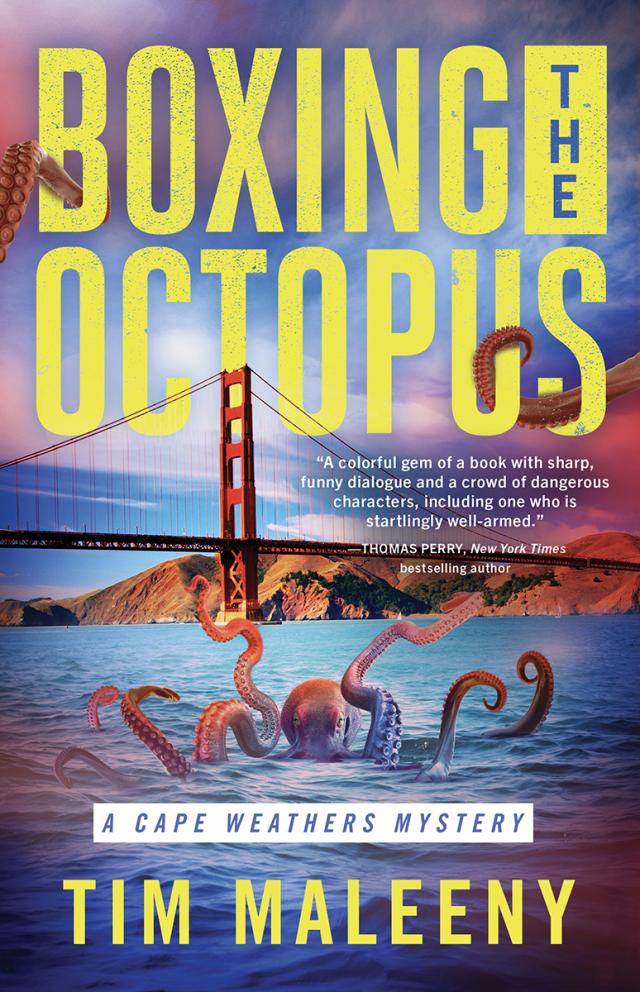
Boxing the Octopus, page 12


Hank might as well have been stuck on that wall next to the whale.
Vera wondered how the detective was doing and where his search would lead. She felt a pang of anxiety over what lay ahead as she visualized the man she had hired. Despite herself, another smile swam just below the surface of her grief, trying to breach.
The detective was so different from what she’d anticipated. A man without a plan but with a clear sense of purpose. Less jaded than expected, with the open curiosity of a child she might find in her store. But there was something in his eyes, a restless undercurrent that convinced her she’d made the right choice.
The detective was going to make waves, and that was all she wanted right now. Sitting still and doing nothing had never been an option for her.
Vera let her thoughts drift to Lou, a lousy friend to Hank. He was out there somewhere, probably not giving her or Hank a moment’s thought. Maybe he was dead, but Vera seriously doubted it. She wondered when the police would track him down.
She assumed the detective would report anything serious to the police, but Vera suspected Cape didn’t know what he was getting into, and neither did she. She just knew that the people behind all this cared more about money than human life. She didn’t doubt the detective’s tenacity, but she wondered at his capacity for violence.
Vera knew that when bad things happen to good people, bad people are usually involved.
33
“Sometimes bad people are just good people on the wrong side of history.”
Cragg caught the bewildered expressions and wondered if any of these hormonal hooligans were listening. Sixth grade field trips were always a disaster.
“Pirates did dreadful things,” he continued unabated. “Raided private vessels, plundered, murdered anyone who got in their way.” Cragg shook his head in mock disapproval.
A few students were following his monologue, but most were horsing around, ignoring the pleas of their teacher. It was the first tour of the day, thirty kids and one hapless teacher in her late twenties. Cragg thought the student-teacher ratio would be better in San Francisco, but public schools had gone to shit everywhere. It was criminal.
Another reason he didn’t pay taxes.
“So, were they criminals?” His voice was a righteous growl. “Consider Francis Drake, a pirate who was knighted by Queen Elizabeth.” No matter how many tours he gave, Cragg never tired of talking about Drake. In another life, they would have been shipmates. “Knighted, you say, and for what? For committing acts of piracy against the Spanish Armada and cutting down the Queen’s enemies.” Cragg drew his sword in a dramatic flourish, which brought gasps from the kids in front and quieted the others for a moment. “Drake brought piracy to the Americas when he sailed the Pacific—he was even a slaver, but the rogue gets himself a knighthood! So you see, as long as you’re on the right side of history, you can do anything you want.”
The teacher smiled uncertainly at the moral ambiguity of the lesson. Most of the kids started talking again while several snapped pictures with their phones.
That was another thing that made Cragg want to dance the hempen jig. The damn cell phones. Who gives an eleven-year-old a smartphone when it’s hard enough to get their attention? A national epidemic of ADHD, millions of prescriptions filled, when the root cause was sitting in the palm of their hands.
No wonder the youngsters lacked any social skills. Hardly their fault, thought Cragg. It was the parents who should be thrown overboard. Cragg might have violated marine animal protection laws and arguably had a hand in several untimely deaths over the years, but at least he could sleep at night knowing he’d never bought a kid a six-hundred-dollar phone.
The group was almost at the gangway leading to the undersea tunnel. Once the students got a glimpse of Oscar, they might stop their palaver and give him their undivided attention. Cragg shifted his focus to the teacher, a fetching brunette of robust proportions. He knew women loved poetry, and he loved an audience.
“Pirates were still considered villains until 1814, when George Gordon, otherwise known as Lord Byron, wrote his poem The Corsair. Sold ten thousand copies at a time when only one out of ten people could read. And why?”
The teacher smiled expectantly and shushed her students.
“Byron was a romantic, and so was his pirate. His corsair was an outlaw more akin to Robin Hood than Blackbeard.” Cragg had his back to the tunnel but knew the grotto was only seconds away. He decided to end his tour with a flourish. “Would you care to hear a few lines?”
The teacher nodded eagerly, and Cragg didn’t wait for the students to dissent.
‘“O’er the glad waters of the dark blue sea, our thoughts as boundless, and our souls as free.’” As his feet crossed the threshold of the undersea chamber, Cragg took a breath and belted out the next stanza. ‘“Far as the breeze can bear, the billows foam, survey our empire and behold our home!’”
Cragg spread his arms and bowed dramatically. He didn’t expect applause but was taken aback by the screaming.
A young girl to the left of the teacher, mesmerized by the shifting lights of the glass tunnel, had been the first to see Oscar. His bulbous head and gelatinous eyes might have given her a start, but what Oscar held in his eight arms got her yelling at the top of her lungs.
Oscar’s tentacles encircled the bloated corpse of a man.
Cragg recognized him immediately.
Marty the security guard looked very surprised to have visitors, and terribly disappointed to be dead upon their arrival.
Marty’s swollen face pressed against the overhead glass, cheeks spotted with red rings from the suckers on Oscar’s arms, exploratory kisses from Oscar smelling and tasting his new toy. Oscar preferred his prey alive, so Marty was more of a curiosity than a delicacy. Nonetheless, Oscar didn’t look inclined to let go.
Since Marty went missing the same night he visited Lou’s apartment, Cragg had assumed he’d surface eventually but didn’t expect him to end up below the surface of the bay, in plain view of a class of hysterical kids.
Marty was wearing his uniform, the Pier Security patch vaguely ironic under the circumstances. His left eye was loose in the socket, so with every passing wave or flexing of Oscar’s arms, it moved as if Marty was captivated by his visitors’ panicked attempts to escape their underwater prison.
The exit signs glowed red, but before Cragg could leverage his baritone bark to bring order to the chaos, the teacher lunged past him, dragging two of the nearest kids by the arms and shoving them toward the nearest door. The entire class surged forward when the shouting began, and now they were all crashing into each other, crying and pushing toward their teacher, and stealing horrified glances at Oscar, whose stare followed them impassively. The tips of his tentacles moved up and down with the current, as if Oscar was waving goodbye and sad to see them go.
A burly eleven-year-old boy shouldered a girl out of the way and lurched toward the door, catching Cragg broadside and knocking him onto his back. The boy dropped his backpack onto Cragg’s face and sprinted for the exit. Cragg felt the girl’s shoe use his stomach as a springboard, and the wind left his lungs as another set of tiny feet leapt from thigh to chest before clipping his jaw on their way to freedom.
Cragg saw stars as the conveyor crawled forward, dragging him along.
Another scramble, a kick and a fading scream, followed by the galloping sound of feet on metal stairs, and Cragg knew the last of them had escaped. He idly wondered how bad the publicity would be, and if the aquarium might get sued every time one of these kids became hysterical when they were served calamari.
He tried to focus as the conveyor inexorably pulled him along. A school of silver fish moved in a looping pattern along the left wall, detouring around Oscar as they headed toward the surface. Green kelp shifted hypnotically on either side of the chamber, daring Cragg to lose consciousness.
He blinked and sat up, his eyes on the corpse.
Marty had gotten himself killed, but he didn’t die here. He wasn’t Oscar’s type, and why would a security guard climb into the tank in the first place? Oscar looked as nonplussed as Cragg.
This was clearly a message, but Cragg didn’t know who sent it. And if Oscar knew, he wasn’t going to talk.
He might be an octopus, but Oscar wasn’t a rat.
34
“Nobody likes rats,” said the Doctor. “That’s why nobody gives a shit when they die.”
The Doctor glanced at his passenger to see if he was paying attention, but the act of turning his head caused the Doctor to swerve wildly into the right lane, so the only reaction he got was a look of blind terror. The man from the pharmaceutical company placed both hands on the dashboard in a gesture of pure supplication.
“Relax, Ken.” The Doctor straightened out the car. “I’m just not used to the controls on your little rocket.”
Ken grimaced, wondering why he’d allowed this lunatic behind the wheel of his car. His boss told him to pick up the Doctor at the airport, but Ken didn’t know what to say when the guy demanded the keys and slipped behind the wheel. Actually, he knew just what to say—but knew he’d be fired if he said it.
“I love driving in the States.” The Doctor moved to the inside lane and passed a truck on his left. “What kind of car is this anyway?”
“Yaris,” replied Ken, checking to make sure his seatbelt was adjusted at the right height. Get that wrong and get beheaded when the car slammed into that truck. “It’s a Toyota…it has good safety features.”
“It better, considering how fast it goes. Did they just squeeze the engine from a Camry into this baby? It’s like half the car with twice the power.” The Doctor adjusted his hands to ten and two o’clock as they bounced over a broken patch of asphalt. “I’m surprised we’re not airborne.”
I’m surprised we’re not getting pulled over, thought Ken. Then he repeated the sentiment, this time as a prayer, but no flashing lights or sirens came to his salvation.
“Rats,” muttered Ken.
“What?” asked the Doctor, swerving briefly onto the shoulder. “Oh, yeah, you asked about drug testing.”
“Mm-hmm.”
“Lab rats are useless for the same reason they were useful,” said the Doctor.
“I don’t understand.”
“Why have rats and mice been used in experiments for hundreds of years?” asked the Doctor. “And, yes, that was a rhetorical question.” He accelerated into a turn as Route 101 arced gracefully northward, the bay a mirror in the late afternoon sun. “Four reasons.” The Doctor eased off the gas at the top of the crest, letting the car settle into a constant but still supersonic velocity.
“Four?” Ken figured if he could keep the Doctor talking, maybe he’d be less likely to seek distraction by stomping on the accelerator.
“One,” said the Doctor, “they have naturally short life spans, so any changes to their metabolism occur very quickly. Two, rats breed like, well—like rats—so getting more rats is as easy as turning your back and playing a little Earth, Wind & Fire long enough for the little fuckers to get it on.” The car shimmied to the left, as if the Doctor was about to change lanes but changed his mind instead and forgot to tell one of his hands. “Three, and this is the most important, they lack a gag reflex.”
“What?” As someone who thought he was going to puke at any moment, Ken found this hard to believe.
“You don’t know this?” The Doctor cut off a school bus as he moved to the center lane. “That’s why big pharmaceutical companies like yours love the little pink-eyed bastards. You can force them to ingest anything, and as much of it as you want, and they won’t vomit.”
“That’s horrible.”
“That’s useful,” said the Doctor, “if you want to force a lifetime’s worth of carcinogens down their throats in one day. And big labs like to prove things cause cancer.”
“They do?”
“Cancer is God’s last weapon against humanity,” said the Doctor, his tone almost reverential. “We’ve cured most of the big plagues.”
“What about Ebola?”
“That’s just God telling us to get the fuck out of Africa,” said the Doctor. “People don’t belong in Eden—we were banished after that original indiscretion with the snake, for which I am eternally grateful. But we didn’t listen.”
“You’ve been to Africa?”
“Many times,” said the Doctor. “It’s a hellhole.”
“But you said—”
“The country’s beautiful,” said the Doctor, “but the people, well, they’ve made a mess of the place. Humanity took a dump in God’s backyard.”
“I didn’t realize you were religious,” said Ken.
“I’m not,” said the Doctor. “But that doesn’t mean I’m not willing to pitch in.”
“Pitch in?”
“For God,” said the Doctor. “I mean, somebody has to.”
The Doctor jerked the wheel to the left and swooped around a station wagon that was stubbornly remaining within the speed limit. As he zoomed along the inside lane, the Doctor flipped off the other driver, a middle-aged mom with two kids in the backseat.
“Jesus,” said Ken.
“Exactly,” said the Doctor. “Anyway, if you live long enough, cancer always gets you in the end. Might be your lungs if you’re a smoker, or your liver if you drink, or your pancreas, even though nobody knows where their pancreas is. If you’re a woman, your breasts become your enemies, and if you’re a man, your prostate might explode any minute. Point being, in the end your cells run amok until one day—when you least expect it—a UPS truck shows up at your door with a box full of tumors.”
“But the rats—”
“—the rats get cancer if you look at them funny,” said the Doctor. “Because there’s no way you or I could ingest two metric tons of, say, lima beans, could we?”
“Um…”
“Of course not, but a rat could eat an amount equivalent to their body mass and not spit any of it out,” said the Doctor. “And you know what? It turns out uncooked lima beans contain high levels of cyanide.”
“Poison?”
“You bet,” said the Doctor. “And if lima beans were an artificial food, they would’ve been banned years ago. But since we live in an age when anything natural is considered wholesome, lima beans get a pass. Just rinse them, steam them, clean them up and you’ll be fine, because to really kill yourself you’d have to gorge like a rat to ingest enough poison to do any damage. You following, Ken?”
“I’m not—”
“Rats can prove whatever you want them to,” said the Doctor, “but they don’t tell you shit. Not really. Because they’re not human. Hell, they’re not even monkeys. I’m not interested in tests, I’m interested in results.”
The Doctor shocked Ken by letting the car coast until the speedometer dropped to seventy. They were less than ten minutes away from the overpass that would branch downtown.
“Nobody gives a shit about rats,” continued the Doctor. “That’s the fourth thing. Sure, they’re cute, but they’re not dog cute, or cat cute. Lab rats are such an accepted part of science, even most animal lovers give drug companies a pass.”
Ken took a breath and forced himself to remember why he’d agreed to pick this man up in the first place. This unhinged NASCAR driver who hijacked his car represented ten years of R&D to his company. “My supervisor mentioned you were ready to start trials.”
“We already started trials,” replied the Doctor. He kept his eyes on the road as he added, “How long you been in the game, Ken?”
“At the company? Almost three years.”
“You must know ninety-two percent of all drug testing is done overseas.”
“Sure,” said Ken, hoping the tremor in his voice didn’t reveal his ignorance. He made a mental note to do some reading over the weekend. What was it with this guy, one minute Speed Racer and the next a secret shopper, checking up on him? Doctors were supposed to be looking for expensive dinners, tickets to a show, and maybe a hand job at the strip club—not giving pop quizzes designed to see if the pharma rep was paying attention. “But we still need the FDA to authoriz—”
“Sure.” The Doctor laughed harshly. “You ever been to China?”
“No, not yet.”
“It’s the Wild West out there in the Far East.”
“Perhaps,” said Ken, “but here in the U.S. it can take years.”
Ahead and on their left was a hillside with white brick letters embedded in the ground, visible from miles away: South San Francisco, The Industrial City. The once-proud exclamation looked like an S-O-S from a community lost in time, stranded only miles away from a shining city on a hill, where tech companies fueled a new economy that didn’t have any use for manufacturing or industrial traditions.
As the hillside disappeared in the rearview, the Doctor nodded as if considering Ken’s counsel. “I like history, especially the history of medicine, but if that’s not your thing, you might not know that during the Cold War, our own government tested biological agents on U.S. citizens without their consent.”
“You’re not serious.”
“In 1950, right here in San Francisco,” said the Doctor. The highway branched to the right, bringing the first solid glimpse of the city skyline. “Our military brain trust decided the Russians might use biological weapons against cities instead of wasting one of their precious nukes on a civilian population. So the scientists did some homework and determined that the combination of strong wind patterns and thick fog made San Francisco an excellent target. Then they ran some tests.”
“Simulations?”
“Nope, field tests,” said the Doctor. “It was spring, so the winds were strong when a Navy minesweeper sailed along the coast for six days. Servicemen were ordered to aim giant hoses at the city and spray Serratia marcescens all over the city. Ever hear of it?”