Boxing the Octopus, page 24
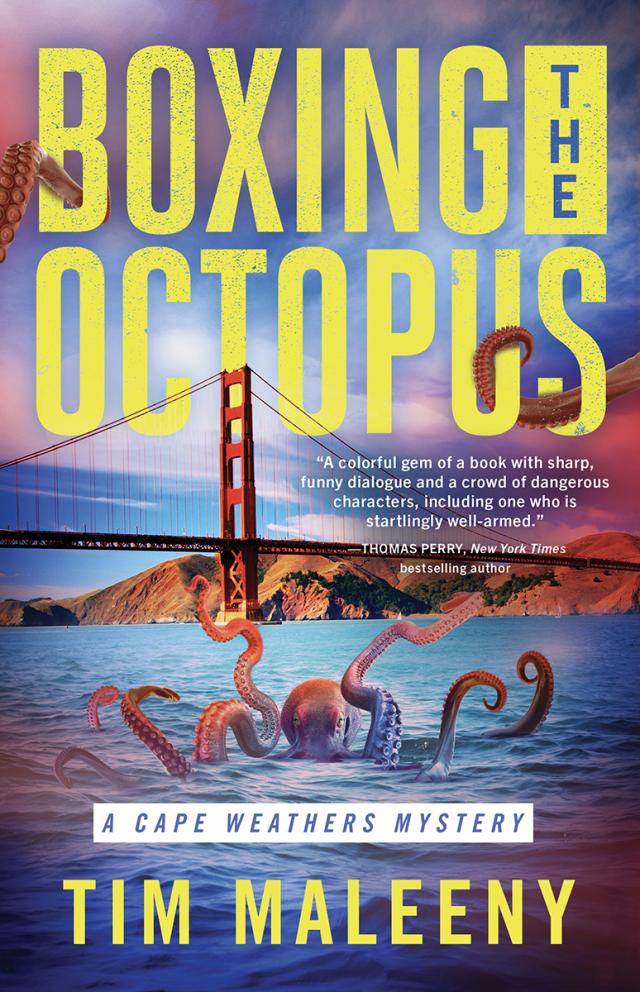


At the center of this unholy flower was the beak, more reminiscent of a parrot than a pocket-sized sea monster.
“Joy, you’re up.”
Joy cautiously placed her left hand on the counter, gloved fingers extending over the nearest arms of the octopus as she brought the syringe forward with her right hand. Peering closely at the tissue around the mouth and beak, she picked a spot and inserted the syringe. The blue rings on the octopus went full neon and the mottled skin shifted from light to dark like an angry Rorschach test.
“Venom extracted,” Joy announced.
A collective sigh from the lab. Joy moved out of frame to inject the neurotoxin into a test tube. The Doctor leaned back and released the breath he’d been holding. Chris wiped sweat from his eyes and smiled broadly.
Then Stewart made a terrible mistake.
He wasn’t a trained marine biologist, or he would have handled the creature more roughly. The flesh was so gelatinous, the texture so squishy, he worried about crushing the animal if he squeezed too hard. And the octopus was so tiny, barely wider than his hand. He was being cautious but naturally assumed it lacked the strength to free itself from his grip.
A marine biologist would have known that even a one-pound octopus was capable of lifting forty pounds if it gained enough leverage. So, when Stewart relaxed his grip, the octopus sensed its chance, and instinct took over.
Two of the arms wriggled free of Stewart’s left hand and writhed in the air, looking for purchase. Without thinking, Stewart moved his right hand to contain them, which let another two arms slide from underneath his fingers. It was like squeezing Jell-O just hard enough to keep it in your hands, but not so hard that it oozed through your fingers. Panicking, Stewart changed his grip again as all four arms on the right side escaped.
The octopus swung its free tentacles sideways with enough momentum to flip itself onto Stewart’s left wrist, where it landed heads-up like a bad penny.
Stewart still had a feeble grip on half the arms, but the rogue tentacles wrapped themselves around his left wrist just below the cuff of his mesh glove.
“Oh, that’s not good.” The Doctor watched, mesmerized, as Stewart started to shout.
“Get it off…get it off… get it off me!”
“Easier said than done,” muttered the Doctor.
Joy saw what was happening and ran into frame, then stopped short. Chris stood on the opposite side of the counter, rigid with fear, his mouth agape. Stewart waved his arm back and forth, but the octopus held fast.
Stewart realized he was still clutching half the tentacles, so he opened his left hand and swung his arm wide. Like a seat belt that locks into place from the physics of a crash, the octopus didn’t budge until Stewart bent his elbow for the backswing and momentum reversed, then halted. At that instant the creature slid up past the glove, and Stewart screamed as the beak found the soft flesh of his forearm.
He whipped his arms like a stuntman on fire, and this time the octopus decided to let go. It flew across the counter like a giant ball of snot, tentacles akimbo.
It smacked Chris squarely in the face.
The tentacles snapped around Chris’ skull on impact, two latching onto his ears with gymnastic precision. The bulbous head of the octopus landed directly over his gaping mouth. Somehow Chris remained standing, like a boxer taking a punch to the face, too stunned for his brain to get a message to his legs that it was a knockout.
Over the tinny speakers of his laptop, the Doctor heard a gargled scream followed by an aquatic gagging sound before Chris fell backward out of frame.
Joy’s face ballooned onto the screen, her eyes huge as she looked into the camera pleadingly, as if she could summon the Doctor to teleport through the webcam.
The Doctor reflexively shifted to lecture mode.
“Victims may experience dizziness,” he said, “or a feeling of intoxication. A common side effect is sudden fatigue, followed by muscle paralysis and shortness of breath.”
The Doctor realized he sounded like the mandatory warning heard at the end of every drug commercial ever made, a litany of side effects so dreadful that it was a wonder anyone took a single pill. The drug industry had finally learned what Las Vegas casinos knew a long time ago, that people would play the odds, even though everybody knows the house always wins in the end.
In the lower quadrant of the screen two legs kicked spastically, the shoe flying off the right foot. The next instant, the legs disappeared.
“I don’t think Chris is doing too well,” said the Doctor.
Joy looked to her left reluctantly.
“The octopus remains on his face,” she said. “But at least Chris has stopped kicking.” Joy narrowed her gaze and shook her head disconsolately. “Actually, he might have stopped breathing.” She stepped out of frame and then returned, her expression one of resignation. “He’s dead.”
On the far side of the counter Stewart was turning as blue as the rings on the octopus. He had been holding his left wrist with his right hand, as if covering the wound might cause it to heal, but now he moved his right hand to his throat while steadying his trembling frame against the counter. Joy and the Doctor stared with morbid fascination as both arms went rigid, then Stewart fell sideways like a redwood at a lumberjack camp.
“He’s done,” said the Doctor. “That’s the tetrodotoxin shutting down his nervous system, the active ingredient in the venom you extracted. You did get the venom, didn’t you?”
Joy finally blinked, in disbelief at the question. It took her a moment to find any words before she simply said, “Yes.”
“Thank God,” said the Doctor.
Joy looked as pissed as he’d ever seen her.
The Doctor conjured an earnest expression and added, “I meant thank God, but at what cost…”
“That is not what you meant.”
Behind her, the octopus was moving up the side of the counter.
Against the white cabinets, its skin was paler than before. With tenacious determination, it suckered along with surprising alacrity. A slimy tarantula ascending Everest.
“Turn around,” said the Doctor.
Joy started and took a quick step backward but kept her cool, considering the circumstances. The octopus perambulated across the counter until it reached the tank. Extending two tentacles, then a third and fourth, it pulled itself forward and up, up, and up the glass column. Moments later it was drifting placidly in the water, a sated vulture on the wind.
“Hey, Joy,” asked the Doctor, “remember when I said it has nine brains?”
Joy sighed. “We took every precaution—”
“—but you know what it doesn’t have?” The Doctor paused for dramatic effect. “Opposable thumbs.” He wiggled his thumbs at the webcam. “That gives us the upper hand, so to speak.”
“Understood.”
“So next time,” said the Doctor, “cut its fucking arms off.”
Joy nodded but didn’t say anything.
“Run the tests,” said the Doctor. “And call me when you have the results.”
“I’m a bit short on lab assistants.”
“Remember, we’re trying to save lives.”
Joy was nonplussed.
“It wasn’t your fault,” added the Doctor reassuringly. “This kind of thing always happens when you strive for the greater good.”
“What always happens?” asked Joy.
“Somebody dies.”
62
“Everybody dies,” said Sally.
“Exactly,” said Cape. “That’s what I’m worried about.”
“That doesn’t make any sense.” Sally pressed the headphones further into her ears. She was still on the roof across from Chen’s apartment and couldn’t tell if the background noise was on her end of the call. “Are you driving?”
“Yes.”
“With the top down?”
“How’d you guess?”
“Because I’m asking you to repeat every other sentence.” Sally took her hand away from her ear and sat down on the edge of the roof, legs dangling over the side of the building. “I said the banker hasn’t moved.”
“And I said I don’t care about the banker!” Cape raised his voice against the wind. “Well, I do, but at the moment I want the—” A rush of wind, static and then, “—udge.”
“Fudge?”
“What?”
“You just said you wanted fudge.”
“That’s not what I said.”
“I’ve just never known you to crave sweets.”
“I said judge.” Cape was yelling into the phone. “The priority is the judge, not the banker.”
“Why?”
“You said the banker is in on this.”
“Whatever this is, yes.” Sally visualized Chen’s triangle tattoo. “He’s all in.”
A rush of wind answered her, followed by, “—dead!”
“What?” asked Sally. “First everybody dies, and now somebody’s dead?”
“Who’s dead?” asked Cape. “Did you kill someone?”
Sally looked at Cape’s name on her phone. “I’m thinking about it.”
“What?”
Sally counted to ten. “Can you put the top up?”
“I’m driving.”
“Pull over.”
“Talk louder.” A whoosh and a horn preceded Cape adding, “—think they killed his son.”
“Whose?”
“The judge,” said Cape as a truck horn reverberated. “As a warning.”
“Why now?”
“He must’ve threatened to go to the police, or the press,” said Cape, “when things started to go sideways on the pier.”
“Things went sideways the minute that truck went into the bay.” Sally looked across the rooftops for a moment before adding, “This isn’t your fault, you know.”
The wind in her headset was the only reply.
“This judge,” said Sally. “Married?”
“A widower,” said Cape. “I had Linda check—but he’s got a daughter and grandkids in San Mateo.”
“So that’s the threat,” said Sally. “Spill your guts to the press—”
“—and everybody dies,” said Cape. “I said that already.”
Sally stood up and glanced across the street at the apartment building. “He might find another way out, if he’s desperate enough.”
“Beau says the cops haven’t told the judge about his son yet.”
“The bad guys might have told him,” said Sally. “Or sent him a photo.”
“That’s why I’m calling,” said Cape. “The papers don’t have a name yet, but the police are contacting the judge today, asking him to ID the body.”
“What do you want me to do?”
“Get to his house—it’s the weekend so he’s not in court—before he has any other visitors, welcome or otherwise,” said Cape. “Just get there before they do.”
“And?”
“Take him off the board.”
Sally listened to the rushing of the wind and wondered if it was the blood coursing through her veins. “You sure?”
“He’s already dead,” said Cape. “It’s him or his daughter.”
Sally studied the front door of Chen’s building and considered the possibility of a rear entrance. An had been inside long enough, and her blatant dare might have been a ruse. Get Sally thinking An wanted to be followed, when in reality she’d already left.
“I’m on my way.” She started moving toward the fire escape on the far side of the roof before asking, “What are you going to do?”
“I’m going to visit an aquarium.”
63
“Welcome to the Aquarium by the Bay!”
Cragg bowed with a flourish and waved his arm as if doffing a hat, though his tangled hair was uncovered. He smiled like a shark who just heard that the all-you-can-eat buffet was open late tonight.
Eva resisted the urge to curtsy and merely nodded. Instinct told her this was a dangerous man, but experience taught her that he was still just a man. Men weren’t complicated, even when they were strange.
“I like your outfit, lassie.”
Of course you do, thought Eva. That’s why I dressed this way. “I came to talk business, not fashion.”
“Fair enough,” said Cragg. “I won’t say a word about your dungbie, but I’m guessing you do want to talk about our lost booty.”
“I understood about half of that,” said Eva curtly. “Prekratit’ igrat’ v igry.”
“Come again?”
“See, it’s frustrating, like someone speaking a foreign language.” Eva put a hand on her hip, suspecting she resembled a model for Captain Morgan rum. “After all, it’s not September 19th, is it?”
“What’s that got to do with anything?”
“That’s International Talk-like-a-Pirate Day,” said Eva. “I looked it up.”
“There’s a day for that?” Cragg seemed genuinely surprised. “Like Mother’s Day?”
“You’re saying you didn’t know there’s an official day on the calendar for talking like a pirate?”
Cragg shrugged. “Every day is talk like a pirate day.”
“There’s also a national popcorn day,” said Eva. “A day for bittersweet chocolate. Darwin Day, Pi Day, clean-out-your-closet day, nap day, paper airplane day, and on and on. There’s even a national day for telling jokes.”
“You know any good jokes?”
“Knock-knock,” said Eva.
“Who’s there?”
“A bunch of Russians.”
“A bunch of Russians who?”
“A bunch of Russians who think you’re trying to rip us off.”
Cragg smiled with one side of his mouth. “That’s not very funny.”
Eva let her hand slide off her hip. “I agree.”
Cragg turned on his heel and walked slowly toward the hall of jellyfish. Eva fell into step beside him but kept an arm’s length away.
“Where are all the people?” asked Eva, scanning the empty floor and listening for distant footsteps. Groups of tourists had been moving away from the aquarium when she arrived, but she hadn’t paid much attention. “The tourists?”
“Didn’t I mention we closed early?” asked Cragg. “Chased all the visitors away when I heard you were coming, cut the day short. Didn’t want us to be interrupted.”
“I see.”
Cragg gestured reflexively at the glowing tanks but didn’t provide any commentary. The jellyfish bobbed and undulated with indifference. Without breaking stride, Eva angled her foot so the switchblade pressed against her calf reassuringly.
“There’s a sign on the door saying repairs are commencing in the undersea tunnel—the grotto—and we’re closed till tomorrow.” Cragg raised a hand in greeting to one of the jellyfish, a blue and yellow apparition eight inches across. “Not entirely untrue. We’re overdue for an inspection of the Plexiglas and support structure under Oscar, so we’ll to take a look.”
“Oscar?”
“He’s the real star of the aquarium, I’m just the sideshow,” said Cragg. “Come on, let me introduce you.”
They reached the top of a narrow flight of stairs. Standing at the bottom of the stairs was a man with a gun.
“I’d like you to meet the Doctor,” said Cragg. “Doctor, this is Eva, one of our erstwhile business partners.”
The Doctor nodded in greeting. He had an average build, a forgettable face, and a semiautomatic pistol in his right hand.
Eva braced a hand against the railing but remained at the top of the stairs.
“Chert poberi,” she said sullenly. “I thought we were going to parley.”
“Oh, we are, we are,” said Cragg.
“Just being cautious,” said the Doctor. “You never know whom you can trust.”
Eva looked from the Doctor to Cragg. “Is this what you did to Dave?”
“Who the hell is Dave?” asked the Doctor.
“Dave?” said Eva. “Dave’s Donuts?”
“Oh, that Dave,” said Cragg. “There is no Dave.”
Eva nodded. “Sergey was right.”
“I guess I’m Dave,” said Cragg. He gestured at the Doctor. “So is he…and you, for that matter…if you take my meaning.”
“Well, Dave,” said Eva, in a tone as flat as she could manage. “Our donut shack exploded.”
“You know anything about that, young lady?”
Eva scowled the way she had seen Nastya do a thousand times. “I came here to ask you the same question,” she said testily. “That shack was where you distributed our product, and I want to know what the Hell you’re doing about it.”
The Doctor lowered the gun but held it loosely at his side. “I like her, Cragg.”
“So do I,” said Cragg. “But can we trust her?” He gestured down the stairs and looked pointedly at Eva. “Let’s have that parley, shall we?”
As Eva took the first step, Cragg put a hand on her shoulder, as if helping her down the stairs with an avuncular gesture, but his fingers slid abruptly down her back, and before she could react, he snatched the gun from under her shirt.
“Give that back,” said Eva.
“Oh, I will.” Cragg weighed the compact pistol in his hand, then dropped it into his coat pocket. “Don’t hang the jib, missy. I’ll give it back as soon as we finish our business, I promise.”
Never trust a pirate.
Eva realized she was more pissed-off than afraid. Pissed at herself for losing the gun, pissed at her family for taking a backseat to a bunch of faceless criminals. And pissed that she finally met a pirate, but he turned out to be just like every other man she’d grown up with. All smiles and charm until you got behind closed doors.