Strangers on a Pier, page 1
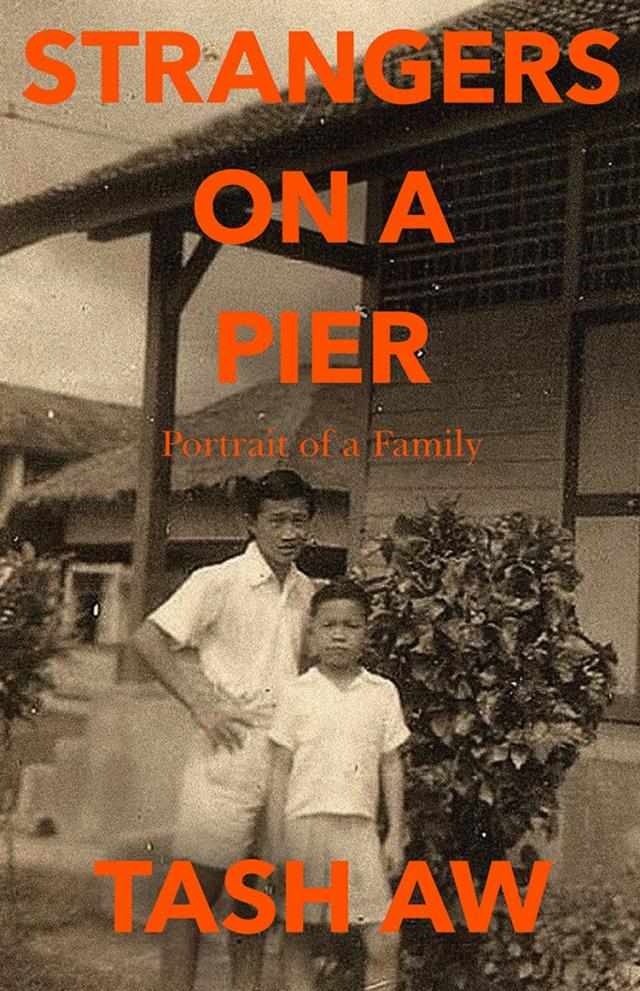


STRANGERS ON A PIER
PORTRAIT OF A FAMILY
TASH AW
Copyright
4th Estate
An imprint of HarperCollinsPublishers
1 London Bridge Street
London SE1 9GF
www.4thEstate.co.uk
HarperCollinsPublishers
1st Floor, Watermarque Building, Ringsend Road
Dublin 4, Ireland
This eBook published in Great Britain by 4th Estate in 2021
Originally published as The Face: Strangers on a Pier in the United States by Restless Books in 2016
Copyright © Tash Aw 2016, 2021
Cover design by Jo Thomson
Cover photograph © Tash Aw
Tash Aw asserts the moral right to be identified as the author of this work
A catalogue record for this book is available from the British Library
Information on previously published material appears here.
All rights reserved under International and Pan-American Copyright Conventions. By payment of the required fees, you have been granted the non-exclusive, non-transferable right to access and read the text of this e-book on-screen. No part of this text may be reproduced, transmitted, down-loaded, decompiled, reverse engineered, or stored in or introduced into any information storage and retrieval system, in any form or by any means, whether electronic or mechanical, now known or hereinafter invented, without the express written permission of HarperCollins
Source ISBN: 9780008421274
Ebook Edition © September 2021 ISBN: 9780008421281
Version: 2021-08-20
Contents
Cover
Title Page
Copyright
I: The Face
One
Two
Three
Four
Five
Six
II: Swee Ee or Eternity
About the Author
Also by Tash Aw
About the Publisher
I
THE FACE
Pom mai ben Thai. Watashi no nihonjinde wanaidesu. Jaesonghaeyo, han-guk saram ahniaeyo. Bukan orang Indonesia. Ma Nepali ta hoina.
_____________
Ways to say what we are not, and to begin the story of what we are.
ONE
I am in a taxi in Bangkok. My companion – European, white – speaks fluent Thai, but every time he says something the taxi driver turns to me with the reply. I shake my head. Pom mai ben Thai. I’m not Thai. Not Thai. He continues to address me, not my friend. I am the passive conduit for this strange tripartite conversation.
I am in Nepal, in the hills west of Pokhara. A village schoolteacher insists that I am a Gurung, an ethnic group of sheep herders and soldiers. I’m from Malaysia, I demur. You sure? Maybe your father was a Gurkha soldier who fought against the Malayan communists. Later, I stare at my face in a mirror for the first time in a week: my cheeks are rosy and sunburned from long days trekking at altitude, my eyes narrowed against the brilliant light. In my eyes, I look like a foreigner – or rather, like a local. Maybe I am a Gurung.
I am boarding a Cathay Pacific flight from Shanghai to Hong Kong. The Mainland Chinese attendants at the boarding gate bid me goodbye in Mandarin but twenty yards further on, the Hong Kong Chinese air crew waiting at the door greet me in Cantonese. (Most of the other ethnic Chinese passengers do not get this bifurcated treatment, I notice.)
It has to do with my face. My features are neutral, unpronounced, my skin tone changeable – pale in sunless, northern climates but tanning swiftly within a day or two of arriving in the tropics. My face blends into the cultural landscape of Asia: east of India, my identity becomes malleable, moulding itself to fit in with the people around me. Sometimes, I wonder if I aid this process unconsciously by adjusting my movements and behaviour to blend in; at a literary festival in Tokyo last year I realised that I was nodding respectfully as someone gave me directions in the street, when in fact I didn’t understand a single word they said. I wonder if, on some level, I enjoy being mistaken for a local as much as I am frustrated that no one seems to know, or care, where I’m from. In some countries, like Thailand, where I can string a few basic sentences together, I find myself mimicking the local accent, which further confuses people. But it makes them happy, too. Same-same like Thai people, they respond cheerily when my identity is finally revealed. They draw their index finger around their face: my face is their face.
Same-same like me. Maybe it isn’t to do with our faces, but with our wish for everyone to be like us. We want the stranger to be one of our own, someone we can understand.
TWO
Both my grandfathers lived on the banks of wide, muddy rivers deep in the Malaysian countryside, one on either side of the thickly forested mountain range that divides the country in two. One was a shopkeeper, the other a village schoolteacher. One lived in Perak, in a small town called Parit, not far from Batu Gajah, in turn not far from Ipoh, the state capital; the other had a more peripatetic existence, moving from a series of remote jungle towns – Tumpat, Temangan – before settling in Kuala Krai, in the heart of the Islamic state of Kelantan on the remote north-eastern coast of Malaysia. One was Hokkien, a min-nan hua speaker from Fujian province, the other from Hainan island, the southernmost territory of China, almost halfway down the coast of Vietnam and a mere few days by boat across the South China Sea to Malaysia.
(A quick aside: Hokkien, Hainanese; to these, add Cantonese, Hakka, Teochew. The differing regional roots of Chinese immigrants in South East Asia. Keep them in mind; they’re important to this story.)
Both my grandfathers had, at some point in the 1920s, made the hazardous boat trip from southern China to the Malay Peninsula. They were mere teenagers when they made the voyage, fleeing a China ravaged by famine and fragmenting into civil war. I doubt their families would have known much about China’s political confusion during the Warlord Era. They might have known that the Qing dynasty had recently come to an end, that they no longer had an emperor. But they would not have understood what it meant to live in the fresh ruins of a thousand years of Imperial rule, would not have understood the intricacies of the increasingly bitter conflict between Chiang Kai-Shek’s nationalist Kuomintang and the swelling power of the Communist Party. They did not know they were living in momentous times, an era to end all eras, the beginning of a novel whose middle chapters we are only just approaching today. Theirs was a time that would set China on a course to dominate the world’s imagination a hundred years later; but they would never see their country become the world’s factory, the world’s largest consumer of luxury goods, the world’s second largest economy, respectful only of the might of the United States. In those few years, contemplating adulthood, they wanted only to escape crushing poverty.
And in those times the routes to salvation led, almost inevitably, to the warm, fertile lands that lay spread out across a vast archipelago south of China, where the Chinese emperors had established a centuries-old network of trading routes and an ancient relationship based on vassal and tributary states, with the ports of Singapore and Malacca at its epicentre. This was a place of promise, known to the Chinese as Nanyang, the Southern Oceans.
Sometimes, when I arrive in New York or Shanghai – old harbour cities that have drawn generations of immigrants – I find myself reimagining my grandfathers’ arrival at the docks in Singapore, an unknown place whose sights and sounds must have been inexplicably comforting nonetheless. The temperature: hot and humid, exactly the same as the long summers of their homelands. There will be no cool season here, no brief respite from the heat and the rain, but they do not know this yet. The landscape: broad-leafed evergreen trees and waterways, the proximity of the sea. Again, much like home. The smell: of wet earth and rotting vegetation; of food, of possibility. But above all, it is the people who make them feel that they can live here. This is a British colony, but it is a city of free trade, then as now. Foreigners arrive easily, they find work easily; they stay. Built on eighty years of Chinese immigration since the establishment of British administration and the development of natural resources by the colonial government, Singapore is full of Chinese – labourers, dockside coolies, descendants of indentured workers in Malayan tin mines and plantations, but also merchants and tradesmen, artists, writers. There are Chinese newspapers, Chinese shops with Chinese signs painted in elegant traditional characters, Chinese schools, even a Chinese bank – the Overseas Chinese Bank. My grandfathers are not alone, and in fact, they are several generations away from being pioneers.
From here they seek out the person whose name and address they have been given. They keep it on a piece of paper, their dearest possession. All the other people on the boat have a similar piece of paper bearing the name of a relative, or maybe a person from their village who has left sometime in the past and established a home somewhere in Nanyang. But where to go, how to find these contacts? No one is sure of the geography of this foreign-but-familiar place yet; no one knows how far Kota Bharu is from Singapore, or whether Jakarta is closer to Malacca than Penang. Bangkok is somewhere north of here, but how far? They stand by the docks, figuring out where to go next.
Strangers, lost on a pier.
I think of this image often. For example, a few years ago, when I was in Morocco, speaking to a young man in Marrakech. He had no job and no hope of getting one. He wanted to go to New Jersey; he had an uncle there. The plan was to get to London, somehow, and then ‘just … jump across’ to America. Or the taxi
My grandfathers. Strangers lost on a pier.
Now, those regional identities – Hokkien, Cantonese, Teochew, Hainanese – this is where they are crucial to the new migrant from China. They are not about identity – not yet, anyway – but about survival. Their home village and the dialect they speak will ensure they don’t perish in these new lands. Later, they will influence the direction of their new lives, and very likely those of their children, and perhaps even grandchildren too. For the person whose address they are now seeking is going to be a fellow Hokkien or Cantonese, someone who will provide them with a bed and food in the first instance, and then a network of contacts that will help them find a job. If they aren’t true blood relatives, they will come to act as an extended family to the fresh-off-the-boat migrant. For the rest of their lives, these new arrivals will not forget their adoptive families, will not forget the kindness that was extended to them in those first days. Uncle, Auntie – this is what they will call the older members of the clan, a traditional Chinese practice carried on with particular zeal out here in Nanyang, so that two generations later, their grandchildren won’t really know whether someone is an actual uncle or aunt, or just a stranger who once took in their grandfather.
Much later on, like the ramshackle houses they now live in, these large piecemeal clans will start to fracture and move on. There will be family feuds and people will start saying things like, we’re not really even related to her. Families drift apart, their offspring marry and move to Canada, Australia, the States, and they no longer know how to address their elders, don’t know which honorific title to use for someone one generation above or below them, can’t speak the dialect that marked their clan as distinct, don’t even know what Teochew food is, certainly can’t place Xiamen on a map, and worst of all, can’t read their own names in Chinese. They come back from college and greet a young uncle – not a true uncle but a generational one nonetheless, maybe someone who babysat the younger kids while the parents were out working – they will greet him with a casual ‘hey dude’. They will probably convert to Christianity. Might even marry a Muslim. It will be a struggle to remind them that they’re Hokkien, or Hakka, or whatever, and they will say it doesn’t really matter, which is fine, now they are living in Sacramento, or Vancouver, or Melbourne, except that one day they will meet a white kid who’s just graduated from Asian studies and spent a Junior Year Abroad in Beijing and asks them, So what dialect do you speak at home? And this kid talks to them in fluent Mandarin full of witty idioms they vaguely recognise as chengyu, those four-word aphorisms that hover, fog-like, on the edge of their consciousness. And suddenly their brains kick into automatic-translate mode, searching for the same words in Cantonese, only the meaning never emerges from the gloom and their heads are left in a real mess, constantly searching, searching like the spinning pizza of death that freezes the computer screen of their memory and doesn’t give them the answers they need. They will think of Skyping their parents to ask, which will be awkward because frankly they’ve never made any attempt to speak the dialect, but now they have no choice because – guess what? – Google Translate doesn’t do Teochew. So in the end they do call, but their parents don’t answer, they’re hopeless at technology, can’t work their new iPads, and then Game of Thrones is on, and the moment is lost.
Still, though, that cloudiness remains in their thoughts, brooding, constant.
But for now, things are simpler. You know who you are, so you seek your own people; your kin, your kakinang, will help you. Find them, stick to them, and things will be OK.
Both my grandfathers must have had a name and address on a piece of paper. But who were these people? Who was the Hokkien guy who had given instructions to my grandfather, via friends or relatives, to make his way up the Malay Peninsula to the Cantonese-dominated town of Ipoh, nestled in a limestone valley pockmarked with tin mines? Who was the original Hainamnang who had set up home in a remote town on the edge of a jungle in the Islamic heartlands of the far north-eastern, where the Malay territory bled into Siam? We just don’t know. Maybe the uncle of the grandfather of one of my childhood ‘cousins’, but maybe someone else – I’ll – we’ll have to ask.
It’s always like this. I ask someone, they ask someone who asks someone else, but the response is always the same: we don’t know.
THREE
I am sitting on the balcony of my parents’ apartment in Kuala Lumpur, chatting with my father about his childhood. This is a rare occurrence. Not so much the chatting, though that is also a recent phenomenon, like an expensive luxury we have acquired in recent years, now that we are both older, less antagonistic. Gentle conversation between us, with no specific purpose or time limit, is something we are not yet fully accustomed to, something to be savoured only occasionally, and with great care.
What is truly precious in its rarity is his talking about the past – about his past. We are modern in our views, outwardly even westernised; but fundamentally, we are a traditional Chinese family, and this is no more clearly seen than in the way we interact with one another, in the things we reveal about ourselves. We do not admit weakness or sadness. Romantic heartbreak, depression, existential doubts – those are topics of conversation that belong to different cultures and younger generations, educated people who know about Freud and psychotherapy and organic vegetables. Vulnerability is shameful, even taboo; and in the spectrum of human shortcomings, poverty is the greatest frailty. All that is broken must remain in the past.
The harnessing of the customary Asian characteristics of discretion and silence to suit a contemporary middle-class existence is what marks us as both traditional and truly modern inhabitants of Asia. For this is what happens all around us, not just in Malaysia but the whole of East Asia. Now that we are rich, we do not talk about the past; to study history is backward-looking, and we are only concerned with the future. Maybe this is how China deals with something as monumentally, catastrophically devastating as the Cultural Revolution, I suggest to my father. (I am skirting around the subject of his own past for the moment: talking about someone else’s historic traumas might be a better way to broach the subject of his own life.) Perhaps the Cultural Revolution was so painful for the people who lived through it that it seems easier just to suppress memories of it, rather than digest all that it entailed, for unpacking all that baggage would fill their entire consciousness and leave them no space for anything else? So for them it’s easier just to rejoice in the riches they have now, the handbags and apartments and travel and education and restaurants. The past is painful, the present is easy. It’s a question of practicality: they just want to get on with their lives.
‘No,’ my father replies. ‘It’s not practicality. It’s shame.’
His answer makes me pause. I’m not used to this directness, especially since it seems to contain a confessional undertone, a prelude to greater openness. As a child, I used to wish that we could be more frank and touchy-feely with our parents, the way American families were in The Cosby Show and other programmes we saw on TV, but now I feel suddenly uncomfortable, as if I have intruded into a space that was better left unexplored. A part of me wants to reach for my iPhone and record what my father is about to say, but I don’t, I just sit there, waiting; there is a fragility in the air.
My father tells me about his earliest memories – of growing up with distant relatives in those remote towns on the edge of the northern jungles while his father moved around the country searching for work and his mother lived elsewhere looking after his younger siblings. She didn’t have the time or resources to look after him, the eldest of her four children, and he was by now just about old enough to live away from the family. He was seven, eight – no, nine, ten. He honestly can’t remember.