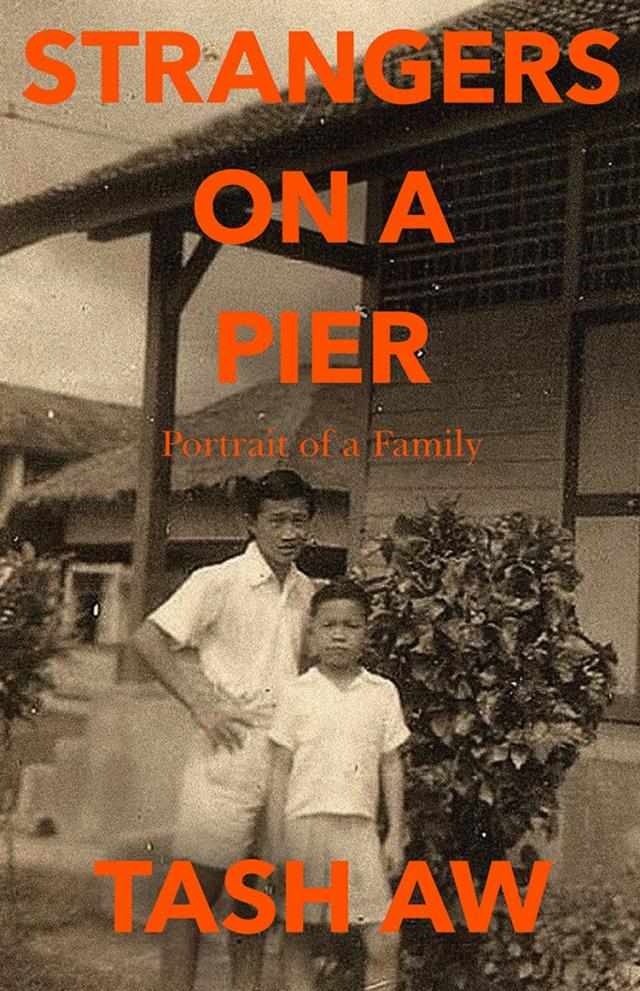
Strangers on a Pier, page 7


You smile and say in English, Very nice! and walk away, leaving me to contemplate the last images on the screen, swirling and multicoloured, as if obscured by hallucinogenic smoke.
*
I was on a bus in Singapore recently, pulling on my hoodie against the chill of the air-conditioning. The woman in the seat in front of me was looking at the screen of her phone, and although I tried not to look it was impossible not to notice what was going on. There was no one on the screen, just an empty room, though the phone was set to speaker mode and I could hear an adult voice in the distance. A child, a small boy, appeared in the frame, holding a plastic toy of some sort, offering it to the camera before setting it down and playing with it. He was concentrating on the toy and didn’t look up; it was as if the woman in the bus didn’t exist. The woman said something in Tagalog but the child continued to play, disappearing after several seconds before returning with another toy. I realised that the woman was covering her face to hide the fact she was crying.
I tried to concentrate on my book, but it was impossible to ignore the woman’s voice, even though she was speaking softly. Mahal ka ni mommy, she said; and again, more insistently. Mommy loves you. The child wasn’t listening, he had drifted off camera again.
Stories of parents forced to leave their children in search of work were so much part of my consciousness that I never thought of them as unusual. In fact they weren’t even stories, but mere mentions, as if this sort of separation was a universal fact of life. I was sent to live with my aunt for a few years; we left our baby with my sister for a year or two. The casual vagueness of these incidental tales, summed up in a quick sentence, is relevant for it speaks not only of the normality of separation, but of the pain that it produces, so deep that it can’t be spoken of in any other way than perfunctorily. I never wanted to know how that pain looked, the precise way it carved its shape into the soul; it was so common to me that I could ignore it the way I did with floods in the monsoon season and water shortages in Selangor. Shit happens, and usually in the background to our lives. We look elsewhere, or invent short-form explanations to brush the complexity away. That’s just life, isn’t it?
But on that bus I saw, played out in the starkest terms, how you must have felt – you, my mother, my father, numerous aunts, uncles, cousins – when your parents had to leave you, and when you, in turn, would have to leave your children for many months at a time. When I asked my parents why they left their six-month-old baby with relatives while they looked for work, they mumbled something about having no choice. We did it so that you would never have to do the same.
For our family and others like us, separation is an expression of love. Not just in the physical sense, but in the way we think. We want our children to have an education and a job, to experience life in the way we never could, knowing that everything they gain will make them more distant from us. Loving someone means separating yourself from them. The future is lived vicariously through their achievements: their lives must follow an upward trajectory. They must not fail. That is what social mobility means in Asia today.
When I look at you now, frail but strong enough to talk over the high-pitched whistling of your hearing aid, which has never worked very well, I am struck by how all the distance between us has never made us feel closer. I know you can hear me over that infernal mechanical whining. You’ve always been able to.
The light is fading and you’re starting to stumble over your words. You laugh as you recount episodes from my childhood, my misdemeanours and illnesses, things we’ve all heard many times before. Your eyes are glassy and your voice is hoarse. When you take a sip of water some of it dribbles down your chin, blotting your blouse.
My mother and Uncle C appear. Granny is tired, she should rest now, she’s talked enough.
You keep talking to fill the space, but we all know that time is up. You have to go to sleep now and I must leave, as I always do.
Stay a while more, you say. I’ll take you to Pusing, treat you to your favourite Hokkien mee. Come, I belanja you.
Next time, Granny. Next time.
About the Author
Tash Aw was born in Taipei to Malaysian parents. He grew up in Kuala Lumpur before moving to Britain to attend university. He is the author of four critically acclaimed novels – The Harmony Silk Factory (2005), which won the Whitbread First Novel Award and a regional Commonwealth Writers’ Prize; Map of the Invisible World (2009), Five Star Billionaire (2013) and We, The Survivors (2019). His novels have been twice longlisted for the Man Booker prize and have been translated into 23 languages.
Also by Tash Aw
FICTION
The Harmony Silk Factory
Map of the Invisible World
Five Star Billionaire
We, the Survivors
About the Publisher
Australia
HarperCollins Publishers Australia Pty. Ltd.
Level 13, 201 Elizabeth Street
Sydney, NSW 2000, Australia
www.harpercollins.com.au
Canada
HarperCollins Canada
Bay Adelaide Centre, East Tower
22 Adelaide Street West, 41st Floor
Toronto, Ontario M5H 4E3, Canada
www.harpercollins.ca
India
HarperCollins India
A 75, Sector 57
Noida, Uttar Pradesh 201 301, India
www.harpercollins.co.in
New Zealand
HarperCollins Publishers New Zealand
Unit D1, 63 Apollo Drive
Rosedale 0632
Auckland, New Zealand
www.harpercollins.co.nz
United Kingdom
HarperCollins Publishers Ltd.
1 London Bridge Street
London SE1 9GF, UK
www.harpercollins.co.uk
United States
HarperCollins Publishers Inc.
195 Broadway
New York, NY 10007
www.harpercollins.com
Tash Aw, Strangers on a Pier