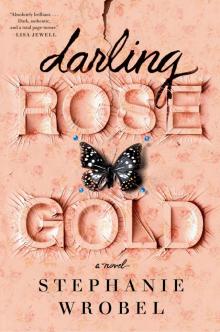
Darling Rose Gold, page 29


To Mako Yoshikawa, my first reader, my thesis chair, and my mentor. You believed in this book back when only three chapters of it existed. Your feedback shaped Rose Gold’s voice, you taught me the importance of causation in fiction, and perhaps most importantly, you urged me to keep going. This book owes its existence to you.
To Rick Reiken, my thesis reader and former professor, who went above and beyond what was required for workshop, gave me brilliant craft advice, and helped me navigate the publishing industry. Were it not for you, I might still be languishing with that (awful) first draft. Thank you for gently helping me realize I had to start again.
To Steve Yarbrough, who was my first-ever workshop professor and kept encouraging me even though my stories in his class were . . . rough. Week after week, I soaked up as much of your wisdom as I possibly could. I hope at least a little bit of it comes through in these pages.
To Emerson College, who supported this novel as my MFA thesis project. Thank you to the faculty for making me a better writer; to the college for your generous program fellowship, which afforded me a single-minded focus on writing; and to my classmates, especially Beth Herlihy, who read early drafts of this story and cheered me on.
To the following people and texts for helping me understand the medical history and psychological impact of MSBP: Julie Gregory’s Sickened: The Memoir of a Munchausen by Proxy Childhood; Michelle Dean’s Buzzfeed article covering the story of Dee Dee and Gypsy Blanchard; and Marc Feldman’s Playing Sick?: Untangling the Web of Munchausen Syndrome, Munchausen by Proxy, Malingering, and Factitious Disorder. Any errors are my own.
To Dr. Jim McKee, DDS, for your time and expertise on all things teeth-related.
To Ashley Chase, Ray Ciabattoni, Sarah Coffing, Guy Conway, Maddy Cross, Lauren Hefling, Annie and Todd Hibner, Christy Holzer, Jen and Tristan Kaye, Dave and Sara McCradden, Ali O’Hara, Dave Pfeiffer, Kelsey Pytlik, Shiv Reddy, Tara Reddy, and Savs Tan, for your unwavering love and support on this book and in everything I do.
To Allison Jasinski, for all those long chats on the blue couches at our Geneva Terrace apartment. You ignited my interest in psychology and obsession with society’s outliers. Thank you for always believing in me.
To the Wichrowskis: Sheila, Taylor, and Paul, for being some of my earliest readers and the first book club to discuss my novel! These last few years, I’ve asked for your opinions so many times—on my query, the back jacket copy, the cover design, the list is endless—and you were always ready with the smartest comments. Your excitement during this process has meant the world to me. I am beyond lucky to be part of your family.
To my grandparents, Pat and Jim Soukup. Thank you for always loving me and for fostering my fondness of reading. For thirty-plus years, every time I’ve gone to your house, one or both of you has had a book in hand. I am so proud to be your granddaughter.
To the Malichs: Jackie, Matt, and Cadence, for your tireless encouragement. Jackie, thank you for being one of my first readers. Thank you for the hours we spent discussing twists—the good, the bad, and the predictable. Thank you for answering hundreds of uncomfortable questions about pregnancy, being a new mom, and every other facet of motherhood. You continue to blow me away with your strength and love. And thank you, Cadence, for gracing us with your presence—you are the sweetest baby I’ve ever known. It is one of life’s great honors to call you my niece. Please do not read this book for a very, very long time.
To Vicki Wrobel, for helping me get my Colorado geography right; for weighing in on all the things, big and small; for making me laugh and having my back, always. Thank you too for believing you saw a Toys “R” Us in Mom’s belly—you will officially never live that story down. I am so lucky to have you for a sister.
To Mom and Dad. You knew long before I did that I would write books someday, so it’s only fair I state it for the record: you were right. From The Girl Who Got Lost in the Zoo to Accelerated Reading to Adventures of Misty Creek and beyond, no one has bolstered my love of reading and writing more than you two. Your constant support made writing this book easier, but your parenting made creating Patty’s character harder—because I have no idea what it’s like to have parents who are anything but loving, selfless, and one hundred percent behind me. Dad, thank you for being the only person who thought writing a book and training for a marathon at the same time was a good idea! Your drive pushes me to work harder and get better. You told me a million times when I was a kid that it didn’t cost any more to dream bigger. I guess you finally got through. Mom, I would be hopeless without you. You’ve printed, FedExed, and hunted jewel-toned tops—no task was ever too big of an ask (and there have been a lot of asks). Thank you for never batting an eyelash at the dozens of weird questions I asked during book research. I feel your love an ocean away. I love you both so, so much.
To Moose. People sometimes ask if I feel isolated working by myself all day, but I haven’t been lonely since the day we brought you home. That said, I wouldn’t hate it if you stopped farting under my desk.
To Matt. For being my partner. For moving to Boston so I could go to grad school. For supporting us while I got my MFA. For thinking this novel was a good idea. For arguably the best joke in the book. For Drip Feed (the only time you will see it in writing). For celebrating the highs and weathering the lows. For being the first person I want to tell everything, even after all these years. On our first date way back in 2011, I confessed I had this crazy dream of writing a book someday. Your eyes lit up, and you leaned in, wanting to know more. You have been leaning in every day since.
READERS GUIDE FOR
DARLING ROSE GOLD
Questions for Discussion
Who is the victim? Who is the perpetrator? What does it mean to be a victim in the context of this story?
Who did you most empathize with throughout the book? Did your sympathies change chapter to chapter? If so, how?
Patty’s actions are attributed to Munchausen syndrome by proxy, a mental health disorder. Should she have gone to prison if her behavior was caused by an illness beyond her control?
Do Patty and Rose Gold love each other? How did your view of their relationship change throughout the book?
Toward the end of the book, Rose Gold says, “Nobody wants to hear the truth from a liar.” Did you trust either of the narrators? At what points, if any, was that trust shaken?
What did you think of Rose Gold’s final decision not to fix her teeth? To shave her head? How do societal beauty standards affect Rose Gold throughout the book?
How much of our personalities are shaped by nature vs. nurture? Do you think Rose Gold and Patty would have committed their crimes had their childhoods been different?
“Some of us cannot forget and will never forgive.” Do you think Rose Gold will ever be free of her mother’s influence? Were Rose Gold’s actions justifiable? What do you imagine her future will hold?
What role did the residents of Deadwick play in the story? What characters had the biggest impact on Patty and/or Rose Gold? Why do you think Patty was able to keep her actions hidden for so long?
Does Patty know she’s lying or has she convinced herself she’s telling the truth? What makes you think so?
About the Author
Stephanie Wrobel grew up in Chicago but has been living in the UK for the last three years with her husband and dog, Moose Barkwinkle. She has an MFA from Emerson College and has had short fiction published in Bellevue Literary Review. Before turning to fiction, she worked as a creative copywriter at various advertising agencies.
What’s next on
your reading list?
Discover your next
great read!
Get personalized book picks and up-to-date news about this author.
Sign up now.
Stephanie Wrobel, Darling Rose Gold