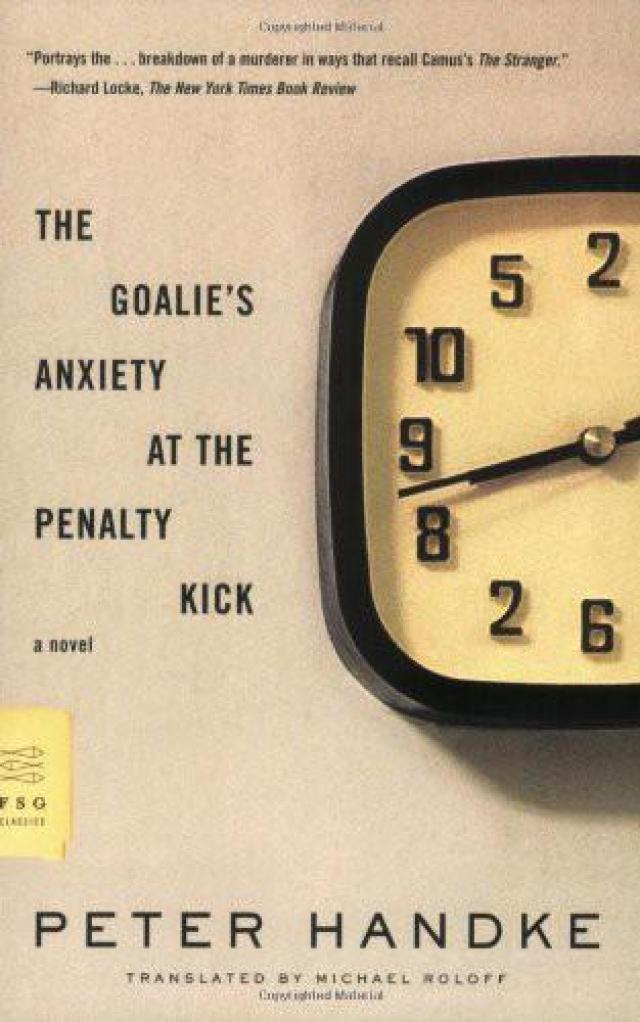
The Goalie's Anxiety at the Penalty Kick: A Novel, page 9


On the street he opened the umbrella; the rain immediately rattled so loudly that he did not hear whether she had answered him. The guard came running along the wall of the house to get under the umbrella, and they started off.
They were only a few steps away when the light in the tavern was turned off and it became completely dark. It was so dark that Bloch put his hand over his eyes. Behind the wall that they were just passing he heard the snorting of cows. Something ran past him. “I almost stepped on a hedgehog just then!” the guard exclaimed.
Bloch asked how he could have seen a hedgehog in the dark. The guard answered, “That’s part of my profession. Even if all you see is one movement or hear just one noise, you must be able to identify the thing that made that movement or sound. Even when something moves at the very edge of your vision, you must be able to recognize it, in fact even be able to determine what color it is, though actually you can recognize colors only at the center of your retina.” They had passed the houses by the border by now and were walking along a short cut beside the brook. The path was covered with sand of some kind, which became brighter as Bloch grew more accustomed to the dark.
“Of course, we’re not kept very busy here,” the guard said. “Since the border has been mined, there’s no smuggling going on here any more. So your alertness slips, you get tired and can’t concentrate any more. And then when something does happen, you don’t even react.”
Bloch saw something running toward him and stepped behind the guard. A dog brushed past him as it ran past.
“And then if somebody suddenly steps in front of you, you don’t even know how you should grab hold of him. You’re in the wrong position from the start and when you finally get yourself right, you depend on your partner, who is standing next to you, to catch him, and all along your partner is depending on you to catch him yourself—and the guy you’re after gives you the slip.” The slip? Bloch heard the customs guard next to him under the umbrella take a deep breath.
Behind him the sand crunched. He turned around and saw that the dog had come back. They walked on, the dog running alongside sniffing at the backs of his knees. Bloch stopped, broke off a hazelnut twig by the brook, and chased the dog away.
“If you’re facing each other,” the guard went on, “it’s important to look the other guy in the eyes. Before he starts to run, his eyes show which direction he’ll take. But you’ve also got to watch his legs at the same time. Which leg is he putting his weight on? The direction that leg is pointing is the direction he’ll want to take. But if the other guy wants to fool you and not run in that direction, he’ll have to shift his weight just before he takes off, and that takes so much time that you can rush him in the meantime.”
Bloch looked down at the brook, whose roaring could be heard but which could not be seen. A heavy bird flew up out of a thicket. Chickens in a coop could be heard scratching and pecking their beaks against the boards.
“Actually, there aren’t any hard-and-fast rules,” said the guard. “You’re always at a disadvantage because the other guy also watches to see how you’re reacting to him. All you can ever do is react. And when he starts to run, he’ll change his direction after the first step and you’re the one whose weight is on the wrong foot.”
Meanwhile, they had come back to the paved road and were approaching the edge of town. Here and there they stepped on wet sawdust which the rain had swept out to the street. Bloch asked himself whether the guard went into so much detail about something that could be said in one sentence because he was really trying to say something else by it. “He spoke from memory,” thought Bloch. As a test, he himself started to talk at great length about something that usually required only one sentence, but the guard seemed to think that this was completely natural and didn’t ask him what he was driving at. So the guard seemed to have meant what he said before quite literally.
In the center of town some people who had been taking a dance lesson came toward them. “Dance lessons”? What did that phrase suggest? One girl had been searching for something in her “purse” as she passed, and another had been wearing boots with “high tops.” Were these abbreviations for something? He heard the purse snapping shut behind him; he almost closed up his umbrella in reply.
He held the umbrella over the customs guard as far as the municipal housing project. “So far I have only a rented apartment, but I’m saving up to buy one for myself,” said the guard, standing on the staircase. Bloch had come in too. Would he like to come up for a drink? Bloch refused but stood still. The lights went off again while the guard was going up the stairs. Bloch leaned against the mailboxes downstairs. Outside, quite high up, a plane flew past. “The mail plane,” the guard shouted down into the dark, and pushed the light switch. It echoed in the stairwell. Bloch had quickly gone out.
At the inn he learned that a large tourist group had arrived and had been put up on cots in the bowling alley; that’s why it was so quiet down there tonight. Bloch asked the girl who told him about this if she wanted to come upstairs with him. She answered, gravely, that that was impossible tonight. Later, in his room, he heard her walk down the hall and go past his door. The rain had made the room so cold that it seemed to him as if damp sawdust had been spread all over. He set the umbrella tip-down in the sink and lay on the bed fully dressed.
Bloch got sleepy. He made a few tired gestures to make light of his sleepiness, but that made him even sleepier. Various things he had said during the day came back to him; he tried to get rid of them by breathing out. Then he felt himself falling asleep; as before the end of a paragraph, he thought.
He woke up gradually and realized that somebody was breathing loudly in the next room and that the rhythm of the breathing was forming itself into sentences in his half-sleep; he heard the exhale as a long-drawn-out “and,” and the extended sound of the inhale then transformed itself inside him into sentences that—after the dash that corresponded to the pause between the inhale and the exhale—in—variably attached themselves to the “and.” Soldiers with pointed dress shoes stood in front of the movie house, and a vase was on the TV set, and a truck filled with sand whizzed past the bus, and a hitchhiker had a bunch of grapes in his other hand, and outside the door somebody said, “Open up, please.”
“Open up, please.” Those last three words did not fit at all into the breathing from next door, which became more and more distinct while the sentences were slowly beginning to fade out. He was wide awake now. Somebody knocked on the door again and said, “Open up, please.” He must have been wakened by that, since the rain had stopped.
He sat up quickly, a bedspring snapped back into place, the chambermaid was outside the door with the breakfast tray. He hadn’t ordered breakfast, he could barely manage to say before she had excused herself and knocked on the door across the hall.
Alone in the room, he found everything rearranged. He turned on the faucet. A fly immediately fell off the mirror into the sink and was washed down at once. He sat down on the bed: just now that chair had been to his right, and now it was to his left. Was the picture reversed? He looked at it from left to right, then from right to left. He repeated the look from left to right; this look seemed to him like reading. He saw a “wardrobe,” “then” “a” “wastebasket,” “then” “a” “drape”; while looking from right to left, however, he saw , next to it the , under it the , next to it the , on top of it his ; and when he looked around, he saw the , next to it the @ and the . He sat on the , under it there was a , next to it a . He walked to the : :
. Bloch closed the curtains and went out.
The dining room downstairs was filled with the tourists. The innkeeper led Bloch into the other room, where the innkeeper’s mother was sitting in front of the TV set with the curtains closed. The innkeeper opened the curtains and stood next to Bloch; once Bloch saw him standing to his left; then, when he looked up again, it was the other way around. Bloch ordered breakfast and asked for the newspaper. The innkeeper said that the tourists were reading it just now. Bloch ran his fingers over his face; his cheeks seemed to be numb. He felt cold. The flies on the floor were crawling so slowly that at first he mistook them for beetles. A bee rose from the windowsill but fell back immediately. The people outside were leaping over the puddles; they were carrying heavy shopping bags. Bloch ran his fingers all over his face.
The innkeeper came in with the tray and said that the newspaper still wasn’t free. He spoke so softly that Bloch also spoke softly when he answered. “There’s no hurry,” he whispered. The screen of the TV set was dusty here in the daylight, and the window that the schoolchildren looked through as they walked past was reflected in it. Bloch ate and listened to the show. The innkeeper’s mother moaned from time to time.
Outside he noticed a stand with a bag full of newspapers. He went outside, dropped a coin into the slot next to the bag, and then took out a paper. He had so much practice in opening papers that he read the description of himself even as he was going inside. He had attracted a woman’s attention on the bus because some change had fallen out of his pocket; she had bent down for it, and had noticed that it was American money. Subsequently, she had heard that similar coins had been found beside the dead cashier. No one took her story seriously at first, but then it turned out that her description matched the description given by one of the cashier’s friends who, when he called for the cashier in his car the night before the murder, had seen a man standing near the movie house.
Bloch sat back down in the other room and looked at the picture they had drawn of him according to the woman’s description. Did that mean that they did not know his name yet? When had the paper been printed? He saw that it was the first edition, which usually came out the evening before. The headline and the picture looked to him as if they had been pasted onto the paper; like newspapers in movies, he thought: there the real headlines were also replaced by headlines that fitted the film; or like those headlines you could have made up about yourself in penny arcades.
The doodles in the margin had been deciphered as the word “Dumm” and, moreover, with a capital at the beginning; so it was probably a proper name. Was a person named Dumm involved in the matter? Bloch remembered telling the cashier about his friend Dumm, the soccer player.
When the girl cleared the table, Bloch did not close the paper. He learned that the gypsy had been released, that the mute schoolboy’s death had been an accident. The paper carried only a school picture of the boy because he had never been photographed alone.
A cushion that the innkeeper’s mother was using as a backrest fell from the armchair onto the floor. Bloch picked it up and went out with the paper. He saw the inn’s copy lying on the card table; the tourists had left by now. The paper—it was the weekend edition—was so thick that it did not fit into the rack.
When a car drove past him, he stupidly—for it was quite bright out—wondered why its headlights were turned off. Nothing in particular happened. He saw the boxes of apples being poured into sacks in the orchards. A bicycle that passed him slid back and forth in the mud. He saw two farmers shaking hands in a store doorway; their hands were so dry that he heard them rustling. Tractors had left muddy tracks from the dirt paths on the asphalt. He saw an old woman bent over in front of a display window, a finger to her lips. The parking spaces in front of the stores were emptying; the customers who were still arriving came in through the back doors. “Suds” “poured” “over” “the doorsteps.” “Featherbeds” “were lying” “behind” “the windowpanes.” The blackboards listing prices were carried back into the stores. “The chickens” “pecked at” “grapes that had been dropped.” The turkeys squatted heavily in the wire cages in the orchards. The salesgirls stood outside the doors and put their hands on their hips. The owner stood inside the dark store, absolutely still behind the scale. “Lumps of yeast” “lay” “on the counter.”
Bloch stood against the wall of a house. There was an odd sound when a casement window that was ajar next to him opened all the way. He had walked on immediately.
He stopped in front of a brand-new building that was still unoccupied but already had glass in its windows. The rooms were so empty that the landscape on the other side could be seen through the windows. Bloch felt as though he had built the house himself. He himself had installed the wall outlets and even set in the windowpanes. The crowbar, the sandwich wrapping, and the plastic food container had also been put on the windowsill by him.
He took a second look: no, the light switches stayed light switches, and the garden chairs in the landscape behind the house stayed garden chairs.
He walked on because—
Did he have to give a reason for walking, so that—?
What did he have in mind when—? Did he have to justify the ‘“when” by—? Did this go on until—? Had he reached the point where—?
Why did anything have to be inferred from the fact that he was walking here? Did he have to give a reason for stopping here? Why did he have to have something in mind when he walked past a swimming pool?
These “so thats,” “becauses,” and “whens” were like regulations; he decided to avoid them in order not to—
It was as if a window that was slightly ajar was gently opened beside him. Everything thinkable, everything visible, was occupied. It was not a scream that startled him but a sentence upside down at the top of a series of normal sentences. Everything seemed to have been newly named.
The stores were already closed. The window displays, now that nobody was walking back and forth in front of them any more, looked too full. Not a single spot was without at least a stack of cans on it. A half-torn receipt hung out of the cash register. The stores were so crowded that …
“The stores were so crowded that you couldn’t point to anything any more because …” “The stores were so crowded that you couldn’t point to anything any more because the individual items hid each other.” The parking spaces were now completely empty except for the bicycles of the salesgirls.
After lunch Bloch went to the athletic field. Even from far away he heard the spectators’ screaming. When he got there, the reserves were still playing a pregame match. He sat on a bench at the sidelines and read the paper as far as the supplements. He heard a sound as if a chunk of meat had fallen on a stone floor; he looked up and saw that the wet heavy ball had smacked off a player’s head.
He got up and walked away. When he came back, the main match had already started. The benches were filled, and he walked beside the playing field to the space behind the goal. He did not want to stand too close behind the goal, and he climbed up the bank to the street. He walked along the street as far as the corner flag. It seemed to him that a button was coming off his jacket and popping on the street; he picked up the button and put it in his pocket.
He started talking to some man who was standing next to him. He asked which teams were playing and about their standings in the league. They shouldn’t play the ball so high in a strong wind like this, he said.
He noticed that the man next to him had buckles on his shoes. “I don’t know either,” the man answered. “I’m a salesman, and I’m here for only a few days.”
“The men are shouting much too much,” Bloch said. “A good game goes very quietly.”
“There’s no coach to tell them what to do from the sidelines,” answered the man. It seemed to Bloch as though they were talking to each other for the benefit of some third party.
“On a small field like this you have to decide very quickly when to pass,” he said.
He heard a slap as if the ball had hit a goalpost. Bloch told about how he had once played against a team whose players were all barefoot; every time they kicked the ball, the slapping sound had gone right through him.
“In the stadium I once saw a player break his leg,” the salesman said. “You could hear the cracking sound all the way up in the top rows.”
Bloch saw the other spectators around him talking to each other. He did not watch the one who happened to be speaking but always watched the one who was listening. He asked the salesman whether he had ever tried to look away from the forward at the beginning of a rush and, instead, to look at the goalie the forwards were rushing toward.
“It’s very difficult to take your eyes off the forwards and the ball and watch the goalie,” Bloch said. “You have to tear yourself away from the ball; it’s a completely unnatural thing to do.” Instead of seeing the ball, you saw how the goalkeeper ran back and forth with his hands on his thighs, how he bent to the left and right and screamed at his defense. “Usually you don’t notice him until the ball has been shot at the goal.”
They walked along the sideline together. Bloch heard panting as though a linesman were running past them. “It’s a strange sight to watch the goalie running back and forth like that, without the ball but expecting it,” he said.
He couldn’t watch that way for very long, answered the salesman; you couldn’t help but look back at the forwards. If you looked at the goalkeeper, it seemed as if you had to look cross-eyed. It was like seeing somebody walk toward the door and instead of looking at the man you looked at the doorknob. It made your head hurt, and you couldn’t breathe properly any more.
“You get used to it,” said Bloch, “but it’s ridiculous.”
A penalty kick was called. All the spectators rushed behind the goal.
“The goalkeeper is trying to figure out which corner the kicker will send the ball into,” Bloch said. “If he knows the kicker, he knows which corner he usually goes for. But maybe the kicker is also counting on the goalie’s figuring this out. So the goalie goes on figuring that just today the ball might go into the other corner. But what if the kicker follows the goalkeeper’s thinking and plans to shoot into the usual corner after all? And so on, and so on.”
Bloch saw how all the players gradually cleared the penalty area. The penalty kicker adjusted the ball. Then he too backed out of the penalty area.