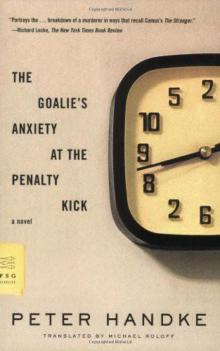
The Goalie's Anxiety at the Penalty Kick: A Novel, page 2


Bloch grew nervous. If the pressure of everything around him when his eyes were open was bad, the pressure of the words for everything out there when his eyes were closed was even worse. “Maybe it’s because I just finished sleeping with her,” he thought. He went into the bathroom and took a long shower.
The tea kettle was actually whistling when he came back. “The shower woke me up,” the girl said. Bloch felt as if she were addressing him directly for the first time. He wasn’t quite himself yet, he replied. Were there ants in the teapot? “Ants?” When the boiling water from the kettle hit the bottom of the pot, he didn’t see tea leaves but ants, on which he had once poured scalding water. He pulled the curtain open again.
The tea in the open canister seemed—since the light reached it only through the small round hole in the lid—oddly illuminated by reflection from the inner walls. Bloch, sitting with the canister at the table, was staring fixedly through the hole. It amused him to be so fascinated by the peculiar glow of the tea leaves while inattentively talking to the girl. Finally he pressed the cap back on the lid, but at the same time he stopped talking. The girl hadn’t noticed anything. “My name is Gerda,” she said. Bloch hadn’t even wanted to know. He asked whether she had noticed anything, but she’d put on a record, an Italian song with electric-guitar accompaniment. “I like his voice,” she said. Bloch, who had no use for Italian hits, remained silent.
When she went out briefly to get something for breakfast—“It’s Monday,” she said—Bloch finally had a chance to study everything carefully. While they ate, they talked a lot. Bloch soon noticed that she talked about the things he’d just told her as if they were hers, but when he mentioned something she had just talked about, he either quoted her exactly or, if he was using his own words, always prefaced the new names with a hesitant “this” or “that,” which distanced them, as if he were afraid of making her affairs his. If he talked about the foreman, say, or about a soccer player named Dumm, she could say, almost at once, quite familiarly, “the foreman” and “Dumm”; however, when she mentioned someone she knew called Freddy or a bar called Stephen’s Dive, he invariably talked about “this Freddy?” and “that Stephen’s Dive?” when he replied. Every word she uttered prevented him from taking any deeper interest, and it upset him that she seemed so free to take over whatever he said.
From time to time, of course, the conversation became as natural for him as for her: he asked a question and she answered; she asked one and he made the obvious reply. “Is that a jet?”—“No, that’s a prop plane.”—“Where do you live?”—“In the Second District.” He even came close to telling her about the mugging.
But then everything began to irritate him more and more. He wanted to answer her but broke off in mid-sentence because he assumed that she already knew what he had to say. She grew restless and started moving about the room; she was looking for something to do, smiling stupidly now and then. They passed the time by turning records over and changing them. She got up and lay down on the bed; he sat down next to her. Was he going to work today? she wanted to know.
Suddenly he was choking her. From the start his grip was so tight that she’d never had a chance to think he was kidding. Bloch heard voices outside in the hall. He was scared to death. He noticed some stuff running out of her nose. She was gurgling. Finally he heard a snapping noise. It sounded like a stone on a dirt road slamming against the bottom of a car. Saliva had dripped onto the linoleum.
The constriction was so tight that all at once he was exhausted. He lay down on the floor, unable to fall asleep but incapable of raising his head. He heard someone slap a rag against the outside doorknob. He listened. There had been nothing to hear. So he must have fallen asleep after all.
It didn’t take him long to wake up; as soon as his eyes were open, he felt exposed; as though there was a draft in the room, he thought. And he hadn’t even scraped his skin. Still, he imagined that some kind of lymph fluid was seeping out through all his pores. He was up and had wiped off everything in the room with a dish towel.
He looked out the window: down below, somebody with an armful of coats on hangers was running across the grass toward a delivery truck.
He took the elevator, left the house, and walked straight ahead for a while. Then he took the suburban bus to the streetcar terminal; from there he rode back downtown.
When he got to the hotel, it turned out that his briefcase had already been brought downstairs for safekeeping, since it looked as if he wouldn’t be back. While he was paying his bill, the bellboy brought the briefcase from the checkroom. Bloch saw a faint ring on it and realized that a damp milk bottle must have been standing on it; he opened the case while the cashier was getting his change and noticed that the contents had been inspected: the toothbrush handle was sticking out of its leather case; the portable radio was lying on top. Bloch turned toward the bellboy, but he had disappeared into the checkroom. The space behind the desk was quite narrow, so Bloch was able to pull the cashier toward him with one hand and then, after a sharp breath, to fake a slap against his face with the other. The cashier flinched, though Bloch had not even touched him. The bellboy in the checkroom kept quiet. Bloch had already left with his briefcase.
He got to the company’s personnel office in time, just before lunch, and picked up his papers. Bloch was surprised that they weren’t already there ready for him and that some phone calls still had to be made. He asked to use the phone himself and called his ex-wife; when the boy answered the phone and immediately launched into his rote sentence about his mother not being home, Bloch hung up. The papers were ready by now; he put the income-tax form in his briefcase. Before he could ask the woman about his back pay, she was gone. Bloch counted out on the table the money for the phone call and left the building.
The banks were also closed for the lunch break by now. Bloch waited around in a park until he could withdraw the money from his checking account—he’d never had a savings account. Since that wouldn’t take him very far, he decided to return the transistor radio, which was practically brand-new. He took the bus to his place in the Second District and also picked up a flash attachment and a razor. At the store they carefully explained that the goods couldn’t be returned, only exchanged. Bloch took the bus back to his room and also stuffed into a suitcase two trophies —of course, they were only copies of cups his team had won, one in a tournament and the other in a championship game—and a gold-plated pendant in the shape of two soccer boots.
When no one came to wait on him in the junk shop, he took out his things and simply put them on the counter. Then he felt that he’d put the things on the counter too confidently, as though he’d already sold them, and he grabbed them back off the counter and hid them in his bag; he would put them back on the counter only after he’d been asked to. On the back of a shelf he noticed a china music box with a dancer striking the familiar pose. As usual when he saw a music box, he felt that he’d seen it before. Without haggling, he simply accepted the first offer for his things.
With the lightweight coat he had taken from his room across his arm, he had then gone to the South Station. On his way to the bus stop, he had run into the woman at whose newsstand he usually bought his papers. She was wearing a fur coat while walking her dog. Even though he usually said something to her, staring all the while at her grimy fingernails, when she handed him his paper and his change, here, away from her stand, she seemed not to know him; at least she didn’t look up and hadn’t answered his greeting.
Since there were only a few trains to the border each day, Bloch spent the time until the next train sleeping in the newsreel theater. At one point it got very bright and the rustling of a curtain opening or closing seemed ominously near. To see whether the curtain had opened or closed, Bloch opened his eyes. Somebody was shining a flashlight in his face. Bloch knocked the light out of the usher’s hand and went into the men’s room. It was quiet there; daylight filtered in. Bloch stood still for a while.
The usher had followed him and threatened to call the police. Bloch had turned on the faucet, washed his hands, then pushed the button on the electric dryer and held his hands under the warm air until the usher disappeared.
Then Bloch had cleaned his teeth. He had watched in the mirror how he rubbed one hand across his teeth while the other, loosely clenched into a fist, rested oddly against his chest. From inside the movie house he heard the screaming and horseplay of the cartoon figures.
Bloch remembered that an ex-girlfriend of his ran a tavern in some town near the southern border. In the station post office, where they had phone books for the entire country, he couldn’t find her number; there were several taverns in the village, and their owners weren’t listed; besides, lifting the phone books —they were all hanging in a row with their spines out—soon proved too much for him. “Face down,” he suddenly thought. A cop came in and asked for his papers.
Looking down at the passport and then up at Bloch’s face, the cop said that the usher had lodged a complaint. After a while Bloch decided to apologize. But the cop had already returned the passport, with the comment that Bloch sure got around a lot. Bloch didn’t watch him go but quickly tipped the phone book back into place. Somebody screamed; when Bloch looked up, he saw a Greek workman shouting into the phone in the booth right in front of him. Bloch thought things over and decided to take the bus instead of the train; he turned in his ticket and, after buying a salami sandwich and several newspapers, finally made it to the bus terminal.
The bus was already there, though of course the door was still closed; the drivers stood talking in a group not far away. Bloch sat on a bench; the sun was shining. He ate the salami sandwich but left the papers lying next to him, because he wanted to save them for the long ride.
The luggage racks on both sides of the bus remained quite empty; hardly any of the passengers had luggage. Bloch waited outside so long that the back door was closed. Then he quickly climbed in the front, and the bus started. It stopped again immediately when there was a shout from outside. Bloch did not turn around; a farm woman with a bawling kid had got on. Inside, the kid quieted down; then the bus had taken off.
Bloch noticed that he was sitting on a seat right over a wheel; his feet slipped down off the curve the floor made at that point. He moved to the last row, where, if necessary, he could comfortably look out the back. As he sat down, his eyes met the driver’s in the rearview mirror, but there was nothing important about it. The movement Bloch made to stow away the briefcase behind him gave him a chance to look outside. The folding door in the back was rattling loudly.
While the passengers in the other rows of seats all faced the front of the bus, the two rows directly in front of him were turned around to face each other; therefore, most of the passengers seated behind one another stopped talking almost as soon as the bus started, but those in front of him started talking again almost immediately. Bloch found the voices of the people nice; it relaxed him to be able to listen.
After a while—the bus was now on the road leading to the highway—a woman sitting next to him showed him that he had dropped some change. “Is that your money?” she asked as she fished a single coin out from between the seat and the backrest. Another coin, an American penny, lay on the seat between them. Bloch took the coins, explaining that he’d probably lost them when he’d turned around. But since the woman had not noticed that he had turned around, she began to ask questions and Bloch went on answering; gradually, although the way they were sitting made it uncomfortable, they began to talk to each other a little.
Between talking and listening, Bloch did not put the change away. The coins had become warm in his hand, as if they had been pushed toward him from a movie box office. The coins were so dirty, he said, because they had been used a little earlier for the coin toss during a soccer game. “I don’t understand those things,” the woman said. Bloch hastily opened his newspaper. “Heads or tails,” she went on, so that Bloch had to close the paper again. Earlier, when he had been in the seat over the wheel, the loop inside his coat collar, which had hung over a hook next to him, had been ripped off when he had abruptly sat down on the dangling coattails. With his coat on his knees, Bloch sat defenseless next to the woman.
The road was bumpier now. Because the back door did not fit tightly, Bloch saw light from outside the bus flash intermittently into the interior through the slit. Without looking at the slit, he was aware of the light flickering over his paper. He read line by line. Then he looked up and watched the passengers up front. The farther away they sat, the nicer it was to look at them. After a while he noticed that the flickering had stopped inside. Outside, it had grown dark.
Bloch, who was not used to noticing so many details, had a headache, perhaps also because of the smell from the many newspapers he had with him. Luckily, the bus stopped in a district town, where supper was served to the passengers at a rest stop. While Bloch took a stroll, he heard the cigarette machine crashing again and again in the barroom.
He noticed a lighted phone booth in front of the restaurant. His ears still hummed from the drone of the bus, so the crunch of the gravel by the phone booth felt good. He tossed the newspapers into a trash basket next to the booth and closed himself in. “I make a good target.” Once in a movie he had heard somebody standing by a window at night say that.
Nobody answered. Out in the open, Bloch, in the shadow of the phone booth, heard the clanging of the pinball machines through the drawn curtains of the rest stop. When he came into the bar, it turned out to be almost empty; most of the passengers had already gone outside. Bloch drank a beer standing up and went out into the hall: some people were already in the bus, others stood by the door talking to the driver, and more stood farther away in the dark with their backs to the bus. Bloch, who was getting sick of such observations, wiped his hand across his mouth. Why didn’t he just look away? He looked away and saw passengers in the hall coming from the rest rooms with their children. When he had wiped his mouth, his hand had smelled of the metal grips on the armrest. “That can’t be true,” Bloch thought. The driver had got into the bus and, to signal that everybody else should get aboard, had started the engine. “As if you couldn’t understand him without that,” Bloch thought. As they drove off, sparks from the cigarettes they hastily threw out the window showered the road.
Nobody sat next to him now. Bloch retreated into the corner and put his legs up on the seat. He untied his shoes, leaned against the side window, and looked over at the window on the other side. He held his hands behind his neck, pushed a crumb off the seat with his foot, pressed his arms against his ears, and looked at his elbows in front of him. He pushed the insides of his elbows against his temples, sniffed at his shirtsleeves, rubbed his chin against his upper arm, laid back his head, and looked up at the ceiling lights. There was no end to it any more. The only thing he could think of was to sit up.
The shadows of the trees behind the guard rails circled around the trees themselves. The wipers that lay on the windshield did not point in exactly the same direction. The ticket tray next to the driver seemed open. Something like a glove lay in the center aisle of the bus. Cows were sleeping in the meadows next to the road. It was no use denying any of that.
Gradually more and more passengers got off at their stops. They stood next to the driver until he let them out in front. When the bus stood still, Bloch heard the canvas fluttering on the roof. Then the bus stopped again, and he heard welcoming shouts outside in the dark. Farther on, he recognized a railroad crossing without gates.
Just before midnight the bus stopped at the border town. Bloch immediately took a room at the inn by the bus stop. He asked the girl who showed him upstairs about his girlfriend, whose first name—Hertha—was all he knew. She was able to give him the information: his girlfriend had rented a tavern not far from town. In the room Bloch asked the girl, who was still in the doorway, about the meaning of all that noise. “Some of the guys are still bowling,” the girl answered, and left. Without looking around, Bloch undressed, washed his hands, and lay down on the bed. The rumbling and crashing downstairs went on for quite a while. But Bloch had already fallen asleep.
He did not wake up by himself but must have been roused by something. Everything was quiet. Bloch thought about what might have wakened him; after a while he began to imagine that the sound of a newspaper opening had startled him. Or had it been the creaking of the wardrobe? Maybe a coin had fallen out of his pants, hung carelessly over the chair, and had rolled under the bed. On the wall he noticed an engraving that showed the town at the time of the Turkish wars; the townspeople strolled outside the walls; inside them the bell was hanging in the tower so crookedly that it had to be ringing fiercely. Bloch thought about the sexton being yanked up by the bell rope. He noticed that all the townspeople were walking toward the gate in the wall; one child apparently was stumbling because of the dog slinking between his legs. Even the little auxiliary chapel bell was pictured in such a way that it almost tipped over. Under the bed there had been only a burned-out match. Out in the hall, farther away, a key crunched again in a lock; that must have been what had roused him.
At breakfast Bloch heard that a schoolboy who had trouble walking had been missing for two days. The girl talked about this to the bus driver, who had spent the night at the inn before, as Bloch watched through the window, he drove back in the almost-empty bus.