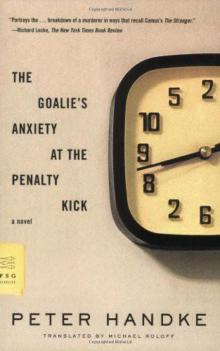
The Goalie's Anxiety at the Penalty Kick: A Novel, page 8


No wonder the children hadn’t even learned to read by the time they left school, the janitor said suddenly, slamming the ax into the chopping block and coming out of the shed: they couldn’t manage even to finish a single sentence of their own, they talked to each other almost entirely in single words, and they wouldn’t talk at all unless you asked them to, and what they learned was only memorized stuff that they rattled off by rote; except for that, they couldn’t use whole sentences. “Actually, all of them, more or less, have a speech defect,” said the janitor.
What was that supposed to mean? What reason did the janitor have for that? What did it have to do with him? Nothing? Yes, but why did the janitor act as if it had something to do with him?
Bloch should have answered, but he did not let himself get involved. Once he got started, he would have to go on talking. So he walked around the yard a while longer, helped the janitor pick up the logs that had been flung out of the shed during the chopping, and then, little by little, wandered unobtrusively back out onto the street and was able to make his getaway with no trouble.
He walked past the athletic field. It was after work, and the soccer team was practicing. The ground was so wet that drops sprayed out from the grass when a player kicked the ball. Bloch watched for a while, but it was getting dark, and he left.
In the restaurant at the railroad station he ate a croquette and drank a couple of glasses of beer. On the platform outside, he sat on a bench. A girl in spike heels walked back and forth in the gravel. A phone rang in the traffic supervisor’s office. A railroad official stood in the door, smoking. Somebody came out of the waiting room and stopped again immediately. There was more rattling in the office, and loud talking, like somebody talking into a telephone, could be heard. It had grown dark by now.
It was fairly quiet. Here and there someone could be seen drawing on a cigarette. A faucet was turned on sharply and was turned off again at once—as though somebody had been startled. Farther away people were talking in the dark; faint sounds could be heard, as in a half-sleep: ah ee. Somebody shouted: “Ow!” There was no way to tell whether a man or a woman had shouted. Very far away someone could be heard saying, very distinctly, “You look worn out.” Between the railroad tracks, just as distinctly, a railroad worker could be seen standing and scratching his head. Bloch thought he was asleep.
An incoming train could be seen. You could watch a few passengers getting off, looking as if they were undecided whether to get off or not. A drunk got off last of all and slammed the door shut. The official on the platform could be seen as he gave a signal with his flashlight, and then the train was leaving.
In the waiting room Bloch looked at the schedule. No more trains stopped at the station today. Anyway, it was late enough now to go to the movies.
Some people were already in the lobby of the movie house. Bloch sat with them, his ticket in his hand. More and more people came. It was pleasant to hear so many sounds. Bloch went out in front of the theater, stood out there with some other people, then went back into the movie house.
In the movie somebody shot a rifle at a man who was sitting far away at a campfire with his back turned. Nothing happened; the man did not fall over, just sat there, did not even look to see who had fired. Some time passed. Then the man slowly sank to one side and lay there without moving. That’s the trouble with these old guns, the gunman said to his partner: no impact. But the man had actually been dead all the time he sat there at the campfire.
After the movie he rode out to the border with two men in a car. A stone slammed against the bottom of the car. Bloch, who was in the back seat, became alert again.
Since this had been pay day, he could not find a single empty table at the tavern. He sat down with some other people. The landlady came and put her hand on his shoulder. He understood and ordered drinks for the whole table.
To pay, he put a folded bill on the table. Somebody next to him unfolded the bill and said that another one might be tucked inside it. Bloch said, “So what?” and refolded the bill. The man unfolded the bill again and pushed an ashtray on top of it. Bloch reached into the ashtray and, underhand, threw the butts into the man’s face. Somebody pulled his chair out from under him, so that he slid under the table.
Bloch jumped up and in a flash slammed his forearm against the chest of the man who had pulled away his chair. The man fell against the wall and groaned loudly because he couldn’t catch his breath. A couple of men twisted Bloch’s arms behind his back and shoved him out the door. He did not fall, just staggered around and ran right back in.
He swung at the man who had unfolded the bill. A kick hit him from behind, and he fell against the table with the man. Even while they were falling, Bloch slugged away at him.
Somebody grabbed him by the legs and hauled him away. Bloch kicked him in the ribs, and he let go. A few others got hold of Bloch and dragged him out. On the street they put a headlock on him and marched him back and forth like that. They stopped in front of the customs shed with him, pushed his head against the doorbell, and went away.
A guard came out, saw Bloch standing there, and went back inside. Bloch ran after the men and tackled one of them from behind. The others rushed him. Bloch stepped to one side and butted his head into somebody’s stomach. A few more people came out from the tavern. Somebody threw a coat over his head. He hit him in the shins, but somebody else was tying the arms of the coat together. Then they swiftly beat him down and went back into the tavern.
Bloch got loose from the coat and ran after them. One of them stopped but did not turn around. Bloch charged him; the man just walked away, and Bloch sprawled on the ground.
After a while he got up and went into the tavern. He wanted to say something, but when he moved his tongue, the blood in his mouth bubbled. He sat down at one of the tables and pointed with his finger to show that he wanted a drink. The waitress brought him a bottle of beer without the glass. He thought he saw tiny flies running back and forth on the table, but it was just cigarette smoke.
He was too weak to lift the beer bottle with one hand; so he clutched it with both hands and bent over so that it didn’t have to be lifted too high. His ears were so sensitive that at times the cards didn’t fall but were slammed on the next table, and at the bar the sponge didn’t fall but slapped into the sink; and the landlady’s daughter, with clogs on her bare feet, didn’t walk through the barroom but clattered through the barroom; the wine didn’t flow but gurgled into the glasses; and the music didn’t play but boomed from the juke box.
He heard a woman scream in fright, but in a tavern a woman’s scream didn’t mean anything; therefore, the woman could not have screamed in fright. Nevertheless, he had been jolted by the scream; it was only because of the noise, because the scream had been so shrill.
Little by little the other details lost their significance: the foam in the empty beer bottle meant no more to him than the cigarette box that the man next to him tore open just enough so that he managed to extract a single cigarette with his fingernails. Nor did the used matches lying loose everywhere in the cracks between the floorboards occupy his attention any more, and the fingernail impressions in the putty along the windowframe no longer seemed to have anything to do with him. Everything left him cold now, stood once more in its place; like peacetime, thought Bloch. The stuffed grouse above the juke box no longer forced one to draw conclusions; and the flies sleeping on the ceiling did not suggest anything any more.
You could see a man combing his hair with his fingers, you could see girls walking backward as they danced, you could see men standing up and buttoning their coats, you could hear cards sloshing as they were shuffled, but you didn’t have to dwell on it any more.
Bloch got tired. The tireder he got, the more clearly he took in everything, distinguished one thing from another. He saw how the door invariably stayed open when somebody went out, and how somebody else always got up and shut the door again. He was so tired that he saw each thing by itself, especially the contours, as though there was nothing to the things but their contours. He saw and heard everything with total immediacy, without first having to translate it into words, as before, or comprehending it only in terms of words or word games. He was in a state where everything seemed natural to him.
Later the landlady sat down with him, and he put his arm around her so naturally that she did not even seem to notice. He dropped a couple of coins into the juke box as though it were nothing and danced effortlessly with the landlady. He noticed that every time she said something she added his name to it.
It wasn’t important any more that he could see the waitress clasping one hand with the other, nor was there anything special about the thick curtains, and it was only natural that more and more people left. They could be heard as they relieved themselves out on the street and then walked away.
It got quieter in the barroom, so that the records in the juke box played very distinctly. In the pause between records people talked more softly or almost held their breath; it was a relief when the next record came on. It seemed to Bloch that you could talk about these occurrences as things that recurred forever; the course of a single day, he thought; things that you wrote about on picture postcards. “At night we sit in the tavern and listen to records.” He got tireder and tireder, and outside the apples were dropping off the trees.
When nobody but him was left, the landlady went into the kitchen. Bloch sat there and waited until the record was over. He turned off the juke box, so that now only the kitchen light was still on. The landlady sat at the table and did her accounts. Bloch approached her, a coaster in his hand. She looked up when he came out of the barroom and looked at him while he approached her. It was too late when he remembered the coaster; he wanted to hide it quickly, before she saw it, but the landlady looked away from him and at the coaster in his hand and asked him what he was doing with it, if perhaps she had written a bill on it that hadn’t been paid. Bloch dropped the coaster and sat down next to the landlady, not doing one thing smoothly after the other but hesitating at each move. She went on counting, talked with him while she did, then cleared away the money. Bloch said he’d just forgotten about the coaster in his hand; it hadn’t meant anything.
She asked him to have a bite with her. She set a wooden board in front of him. There was no knife, he said, though she had set the knife next to the board. She had to bring the laundry in from the garden, she said, it was just starting to rain. It wasn’t raining, he corrected her, it was only dripping from the trees because there was a little wind. But she had gone out already, and since she left the door open, he could see that it was actually raining. He saw her come back and shouted that she had dropped a shirt, but it turned out that it was only a rag for the floor, which had been lying in the entryway all along. When she lit the candle on the table, he saw the wax dripping on a plate because she had tilted the candle slightly in her hand. She should watch out, he said, wax was dripping onto the clean plate. But she was already setting the candle in the spilled wax, which was still liquid, and pressed it down until it stood by itself. “I didn’t know that you wanted to put the candle on the plate,” Bloch said. She started to sit down where there was no chair, and Bloch shouted, “Watch out!” though she had just squatted to pick up a coin that had fallen under the table while she was counting. When she went into the bedroom to take care of the girl, he immediately asked for her; once when she left the table he even called after her to ask where she was going.
She turned on the radio on the kitchen cabinet; it was nice to watch her walking back and forth while the music came out of the radio. When somebody in a movie turned on the radio, the program was instantly interrupted for a bulletin about a wanted man.
While they sat at the table, they talked to each other. It seemed to Bloch that he could not say anything serious. He cracked jokes, but the landlady took everything he said literally. He said that her blouse was striped like a soccer jersey and wanted to go on, but she asked him whether he didn’t like her blouse, what bothered him about it. It did no good to assure her that he had only made a joke and that the blouse went very nicely with her pale skin; she went on to ask if her skin was too pale for him. He said, jokingly, that the kitchen was furnished almost like a city kitchen, and she asked why he said “almost.” Did people there keep their things cleaner? Even when Bloch made a joke about the estate owner’s son (he’d proposed to her, hadn’t he?), she took him literally and said the estate owner’s son wasn’t available. He tried to explain, using a comparison, that he had not meant it seriously, but she took the comparison literally as well. “I didn’t mean anything by it,” Bloch said. “You must have had a reason for saying it,” the landlady answered. Bloch laughed. The landlady asked why he was laughing at her.
The little girl called from the bedroom. She went in and calmed her down. When she came back, Bloch had stood up. She stood in front of him and looked at him for a while. But then she talked about herself. Because she was standing so close to him, he could not answer and took a step backward. She did not follow him, but hesitated. Bloch wanted to touch her. When he finally moved his hand, she looked to one side. Bloch let his hand drop and pretended that he had made a joke. The landlady sat on the other side of the table and went on talking.
He wanted to say something, but then he could not think of what it was he wanted to say. He tried to remember: he could not remember what it was about, but it had something to do with disgust. Then a movement of the landlady’s hand reminded him of something else. He could not think of what it was this time either, but it had something to do with shame. His perceptions of movements and things did not remind him of other movements and things but of sensations and feelings, and he did not remember the feelings as if they were from the past but relived them as happening in the present: he did not remember shame and nausea but only felt ashamed and nauseated now that he remembered without being able to think of the things that had brought on shame and nausea. The mixture of nausea and shame was so strong that his whole body started to itch.
A piece of metal knocked against the windowpane outside. The landlady answered his question by saying that it was the wire from the lightning rod that had come loose. Bloch, who had seen a lightning rod at the school, immediately. concluded that this repetition was intentional; it could be no accident that he ran across a lightning rod two times in a row. Altogether he found everything alike; all things reminded him of each other. What was the meaning of the repeated appearances of lightning rods? How should he interpret the lightning rod? “Lightning rod”? Surely that was just another word game? Did it mean that he was safe from harm? Or did it indicate that he should tell the landlady everything? And why were the cookies on the wooden plate fish-shaped? What did they suggest? Should he be “mute as a fish”? Was he not permitted to talk? Was that what the cookies on the wooden plate were trying to tell him? It was as if he did not see any of this but read it off a posted list of regulations.
Yes, they were regulations. The dishrag hanging over the faucet told him to do something. Even the cap of the bottle left on the table, which by now had been cleared, summoned him to do something. Everything fell into place: everywhere he saw a summons: to do one thing, not to do another. Everything was spelled out for him, the shelf where the spice boxes were, a shelf with jars of freshly made jam … things repeated themselves. Bloch noticed that for quite a while he had stopped talking to himself: the landlady was at the sink gathering bits of bread out of the saucers. You had to clean up after him all the time, she said, he didn’t even shut the table drawer when he took out the silverware; he just left books he had looked through open, he took off his coat and just let it drop.
Bloch answered that he really felt that he would let everything drop. It wouldn’t take much for him to let go of this ashtray in his hand, it even surprised him to see that the ashtray was still in his hand. He had stood up, still holding the ashtray in front of him. The landlady looked at him. He stared at the ashtray a while, then he put it down. As if in anticipation of the insinuations all around him, which repeated themselves, Bloch repeated what he had said. He was so helpless that he repeated it once more. He saw the landlady shake her arm over the sink. She said that a piece of apple had slipped up her sleeve and now it didn’t want to come out. Didn’t want to come out? Bloch imitated her by shaking his own sleeve. It seemed to him that if he imitated everything, he would stay on the safe side, so to speak. But she noticed it immediately and mimicked his imitation of her.
As she did that, she came near the refrigerator, on top of which there was a bakery carton. Bloch watched her as she, still mimicking him, touched the carton from behind. Since he was watching her so intently, she shoved her elbow back once more. The carton began to slip and slowly tipped over the rounded edges of the refrigerator. Bloch could still have caught it, but he watched until it hit the floor.
While the landlady bent down to pick up the carton, he walked one way and then another; wherever he stopped he shoved things into the corner —a chair, a lighter on the stove, an egg cup on the kitchen table. “Is everything all right?” he asked. He asked her what he wanted her to ask him. But before she could answer, something knocked on the window in a way the wire from a lightning rod would never knock against a pane. Bloch had known it a moment beforehand.
The landlady opened the window. A customs guard was outside asking to borrow an umbrella for the walk back to town. Bloch said that he might as well go along with him, and the landlady handed him the umbrella which hung under the work pants on the doorframe. He promised to bring it back the next day. As long as he hadn’t brought it back, nothing could go wrong.