Season of the Dragon, page 38


Saga of Ilkay: Quen’s favorite story, and the only bound book she owned. Her copy had been her mother’s.
Santu’s Stand: A permanent trading post in the village of Solia in Sulmére Province, and the largest general good store in the Sulmére. Owned by Quen’s father, Santu.
sayari ale (sah-YAR-ee): A homebrewed liquor that’s not a true ale, but distilled from an agave-like plant. Our nearest equivalent would be a cross between sotol and tequila.
Ser Chervais (SHAIR-vey): Wine merchant from Bardivia.
skins: Dynasty currency is used throughout Indrasi, but in the Sulmére, people largely rely on trade rather than currency. The nomadic herders trade mainly in animal skins, either “raw” (unworked), or tanned/worked skins. People trade other items too, but most count the value of an item in terms of how many “skins” it’s worth.
slints: A type of Nixan, or shapeshifter. Slints are feared and reviled and said to take children in the night and eat them. Though Nixan are known to be real creatures, many believe Slints are a type of shapeshifter created in stories to frighten children into not venturing away from their parents/herdclan tents.
sol’dishi (sol-DEE-shee): A term of endearment in the Sulmére.
Solia (soh-LEE-ah): Quen’s home village. The unofficial capital of the sparsely populated Sulmére Province.
Soliberian (SOH-li-bair-ee-uhn): Ancient language spoken by the Dragos Sol’iberi dragomancers.
Solis (SOH-lee): 1. Collective term for the two suns in the Menauld solar system. 2. Generally, refers to sun, light of the sun, or the celestial sun gods.
Steps of Infinite Light: Steps leading to the Palace di Solis.
Straits of Minea (min-EY-ah): Narrow sea channel between Partha and Qülla
Suab’hora Province (SOO-ab-HOR-ah): Northernmost province in Indrai, home to both the capital, Qülla, and Val’Doka Pillar.
suda (SOO-dah): A curse word, equivalent to shit or merde.
Sulmére Province: Also called the “Sea of Sands,” the vast, arid Sulmére is home to nomadic herdclans and Val’Vatra Pillar.
sunginare: A word of the ancient tongue used in the Pillars. The word translates as “blood.”
TazūZaj (TAH-zoo-ZAHZH): The vast mountain chain that cuts across the center of Indrasi.
The Staves: A rock formation in the Sulmére, north of Solia.
The Trinity: The three primary celestial gods under Vaya di Solis: Hiyadi, Niyadi, and Lumine.
thukna (THUK-nah): Ubiquitous herd animals in the Sulmére, like a cross between a wildebeest and a buffalo.
Tide di Solis: A Sulmére festival around the time of the longest day of the year and in honor of the Brothers. Marks the end of the spring trading season, and herdclans return to roaming.
Tikli Province (TEEK-lee): Small province in Indrasi, between Sulmére to the south and Suab’hora to the north.
Tilaj Gate (TEE-lahzh): The taxation and guard station near the border of Suab’hora and Tikli Provinces.
Tilvani (til-VAH-nee): A member of the Dragos Sol’iberi.
Timeframe of the Story: The Indrasian calendar begins with year 1 NT, being the year commonly believed that Indrasian Kovan slayed the Winter Dragon and united the continent under a common rule. Season of the Dragon takes place in year 1449 NP, Third Era, and the fifth year Xa’Vatra’s rule.
Tinox: Continent to the north of Indrasi.
Val’Doka, Val’Enara,Val’Qüira, and Val’Vatra: See Note below about the Pillars.
Vas O’Nai (VAZ-oh-NAHY): Oft-quoted prophet of Vaya di Solis.
Vatra (VAH-trah): The element of fire. Vatra refers to both the god of fire, and the Menaris school or “way” of fire. Seen as the most aggressive and warlike of the four Corners, Vatra is associated with the Orrokan art of war and defense.
Vay’Nada (VAHY-nah-dah): Vay’Nada is both an entity, the “Shadow,” and where the shadow dwells, aka the “Void.”
Vaya di Menaris (VAHY-yah dee men-AIR-is): “Way of Magic.”
Vaya di Solis: (VAHY-yah dee SOH-lee): “Way of the Two Suns.” Vaya di Solis is the “Word” of the “Way,” the scripture and religious portion of the Way. See “A Note About Religion and Magic, below).
Vindaô Province (VIN-dow): Western province in Indrasi, home to the prosperous city-state of Bardivia, prized vineyards in the Vign Gadon Region, and the desolate, sparsely populated Dajianta Forest and Lenxofré geyser fields in the southeast.
Volenex (VOHL-en-ex): At the southernmost tips of Indrasi in an extinct volcano caldera and home of the Dragos Sol’iberi. Nearly impossible to reach on land due to the Phisma tar pits to the northeast, and the Lenxofré geyser fields and haunted Dajianta forest to the northwest.
Waloo (WAH-loo): One of the herdclans in the Sulmére.
Yindril (YIN-dril): A magical creature from continent of Tinox, with features of both plant and animal. Though unable to cast spells or manipulate the Menaris, Yindrils are known to enhance the powers of human mages.
Yulina (yoo-LEE-nah): Owner of the alehouse in Solia.
Zal Kovan (ZAL KOH-van): Xa’Vatra’s grandfather.
Zenith: The highest level of study and mastery at the Pillars.
Zhijnatu (ZHISH-nah-too): Translates as “be still and obey,” from the ancient Soliberian.
Zhishni (ZHISH-nee): A root vegetable. Long in shape like a carrot, but with a flavor and texture more like a sweet potato.
Zhongdu Sea (ZHONG-doo): A vast sea on the eastern side of Indrasi, said to be home to all manner of fearsome sea creatures.
A Note About Religion and Magic
Vaya di Solis
Vaya di Solis is the main religion in Indrasi. It is often referred to as “the Way.” Followers believe in a creator god, “Doj,” with both feminine and masculine aspects: Doj’Madi (“Great Mother”), and Doj’Badi (“Great Father”). Followers of the Way believe this dual-aspect godhead created the cosmos. Doj’Madi and Doj’Badi are “hands off” gods, while the Trinity (see below), and elemental gods and spirits are considered the intermediaries in human affairs.
The primary gods believed to influence the world are the Trinity: Hiyadi, personified by the larger of the two suns; Niyadi, the smaller sun; and Lumine, the moon. There are ballads, poems, and stories throughout Indrasi about the Trinity. Views differ depending on the region. In the Sulmére, the primary belief is that Hiyadi and Niyadi are warring brothers, fighting for the love of the fair Lumine.
While there are numerous gods and spirits, the elemental gods and spirits are most important to the theology of Vaya di Soli. Each of these elemental gods/spirits rule a “Corner,” and people are said to “belong” to a Corner, meaning they pray to that Corner the most, or find the teachings of a particular Corner most relevant to them.
The Corners are:
Enara—Water/Ice—Associated with Winter
Doka—Wood/Plants—Associated with Spring
Vatra—Fire—Associated with Summer
Qüira—Rock/Ground—Associated with Autumn
There is a fifth aspect of Air/Sky, the Æther, ruled by an unpredictable trickster spirit known as Juka. In the lore, it is said that Juka refused to be bound by humanity, and so she does not have a Corner of her own, but rather is omnipresent.
Vaya di Menaris
Vaya di Solis predates humans wielding magic. Once humans began manipulating magical energies—the Menaris—Vaya di Soli brought magic under its wing. Thus, at the Pillars (see below), students learn about the teachings of the prophets and scholars of Vaya di Soli as well as learning about Menaris. Thus, in Indrasi, magic is not shameful, shunned or feared, but a vital part of the teachings of religious life.
One might think of mastering Menaris like playing an instrument or other artistic endeavors. Anyone can create notes on a violin (or put paint to canvas), but one becomes adept only through years of daily practice. Even then, no matter how much a person studies and practices, most will never be virtuoso. The same holds true regarding mastery of Menaris arts. So while all people are born with an innate ability to manipulate Menaris energies on at least some level, most are unable to tap into this ability either because of lack of training or simply being unable to open their mind to the possibility.
Additionally, most people have an affinity for one “school” or Corner of magic—Enara, Doka, Vatra, or Qüira. Ascended Masters who study at the Pillars often have a working understanding of all four elements, but mastery of only one. Rarely, a person has natural ability to master multiple Corners. (Though, it should be noted, some believe this is due to how Vaya di Menaris is taught, i.e. spitting up into Corners so that the focus is on one element.)
It is important to note that Menaris is the magic of people, not dragons or magical creatures. From a dragon’s perspective, human magic is weak as it relies on the intermediation of gods and spirits, while dragons pull magical energies directly from elemental gods/spirits, from Menauld (the world), or even from the Void (the shadow realm).
The Pillars
In Indrasi, the Pillars are the great schools of
Vaya di Soli, and where future mages are taught magic, and where future generals and leaders are also taught the Orrokan arts of war, battle, strategy, and martial arts.
Each Pillar has an Archon, the spiritual leader of that Corner not only for the Pillar, but for all Indrasi—like the “pope” of that Corner. To handle the administration of the Pillar, each Archon appoints a Prelate. The Prelate is the “face” of the Pillar, and thus the Corner, to most of the world as Archons often spend much time in quiet study and mediation. An exception to this currently is the Vatra Pillar, where Prelate Vidar sits on the Conclave in the capital leaving the administration of the Pillar to Archon Utu.
There are four Pillars in Indrasi:
Val’Enara
Location: Tikli Province, nestled in the foothills of the TazuZaj mountain range
Archon: Kine
Prelate: Hrabke
Elemental Corner: Enara (water, ice, steam)
Associated Season: Winter
Patron Spirit/God: Lumine
Known For: Astrology, Astronomy, and deep thinking. The most well-rounded of the Pillars, but also the most secluded and selective making it the most mysterious of the four.
Val’Doka
Location: Vindaô Province, southwest of Lac’Azuro
Archon: Séchen (SAY-shen)
Prelate: Chigaru (SHEE-gah-roo)
Elemental Corner: Doka (wood, plants)
Associated Season: Spring
Patron Spirit/God: Wopang, a forest spirit
Known For: Healing arts. Corner favored by farmers and vintners in Vindaô Province.
Val’Vatra
Location: Sulmére Province, southwest of Solia
Archon: Utu (OO-too)
Prelate: Vidar
Elemental Corner: Vatra (fire, sun energy, heat)
Associated Season: Summer
Patron Spirit/God: Hiyadi
Known For: Orrokan Arts, training of warriors and generals, and training mages in battle magic
Val’Qüira
Location: Suab’hora Province, the northern rocky coast
Archon: Altair
Prelate: Vesia
Elemental Corner: Qüira (earth, soil, ground, rock)
Associated Season: Autumn
Patron Spirit/God: Ben-dry’naia, a spirit of stone
Known For: Favored by miners and smiths. Also trains heavily in Orrokan arts, though not as much as Vatra Pillar.
ACKNOWLEDGMENTS
Gratitude to early readers and editors including Jane Friedman, Ann Kroeker, Lindsay Ribar, and especially to Dario Ciriello. A huge thank you to Adam Bassett for designing the amazing maps of Menauld and Indrasi. Thank you to Braken (@DrawBraken) for the fabulous cover art, and to Streetlight Graphics for designing the covers, and thank you to Irene S. at RedAdept for final proofreading.
A huge thank you to my pal and podcasting partner, Robyn Dabney. There’s no one else I’d rather be in the trenches with than you. Thank you for being a sounding board for both ideas and rants, for being an unmitigated force of tenacity, and an inspiration to both write—and live—to my fullest.
Thank you to all the readers who have hung in there with me waiting for this new release. A special shoutout to Ngtasha and Elisa. You ladies never fail to show support and encouragement, and it is so appreciated.
As always, thanks to my boys. To my sounding board, partner in life, and patron of my art, JRF; and to the light of my life and my favorite muse, FF.
Thank You Readers
Thank you for spending valuable time in Indrasi! I hope you enjoyed Season of the Dragon. Watch for an illustrated companion storybook, The Saga of Ilkay and Collected Stories, coming Nov. 2023.
The Dragos Primeri series will contain four more main volumes plus additional companion novellas or short story collections. Search for the Spring Dragon, Dragos Primeri #2, is slated for release in early 2025. To ensure you never miss a new release and be first for cover reveals, etc., become a Subscriber.
SUBSCRIBE

If you enjoyed Season of the Dragon, I appreciate it if you tell your friends, family, colleagues, and book clubs. Thank you to readers who have suggested the series to their local librarians and booksellers. If you love a book, the most helpful thing you can do to spread the word is to leave honest reviews at retail sites but also websites where readers gather like Goodreads and BookBub. Thank you!
CAMPFIRE WRITING
Want to dive even further into Dragos Primeri? I’ve been invited to be among the first to publish a new story and worldbuilding experience on Campfire. It’s like Kindle, Pinterest, and Wikipedia had a love child for readers! If you love maps, character backgrounds, story art, backstories, and a direct connection with author, you’ll love Campfire Reading. I hope to see you there. Hika!

ABOUT THE AUTHOR

A former divorce attorney, Natalie now writes stories that transport readers to epic worlds of magic, myth, lovable misfits—and dragons! She’s the author of SEASON OF THE DRAGON, a silver medal winner in the 2023 Readers’ Favorite Awards, and a BookLife Editor’s Pick. Natalie is also the author of the award-winning Young Adult Sci-Fi series, H.A.L.F., and Emily’s House with over 2.1 million reads on Wattpad. She is also a judge in the NYC Midnight international short story writing contest.
Natalie is also a judge for the NYC Midnight international short story writing challenge, and is a pro member of the Science Fiction and Fantasy Writers Association (SFWA). She appears frequently on panels for fiction writers and fans at events such as the Nebula Conference, Publisher’s Weekly’s BookLife author forum, and other festivals and conventions.
In addition to her writing activities, Natalie also co-hosts a popular SFF podcast, “Tipsy Nerds Book Club: The best of Science Fiction & Fantasy—with a Twist.” The show features Sci-Fi and Fantasy book discussions and has frequent author guests such as Hugh Howey, Martha Wells, Garreth Powell, Darynda Jones, and more.
In her spare time, Natalie enjoys international travel, hiking in the desert, and playing fantasy RPGs for Xbox (Skyrim and Dragon Age Inquisition are two of her favorites). She lives with her husband and two cat overlords in Arizona, and frequently visits her college-age son in NYC.
BOOKS & PUBLICATIONS BY NATALIE WRIGHT
Dragos Primeri Series
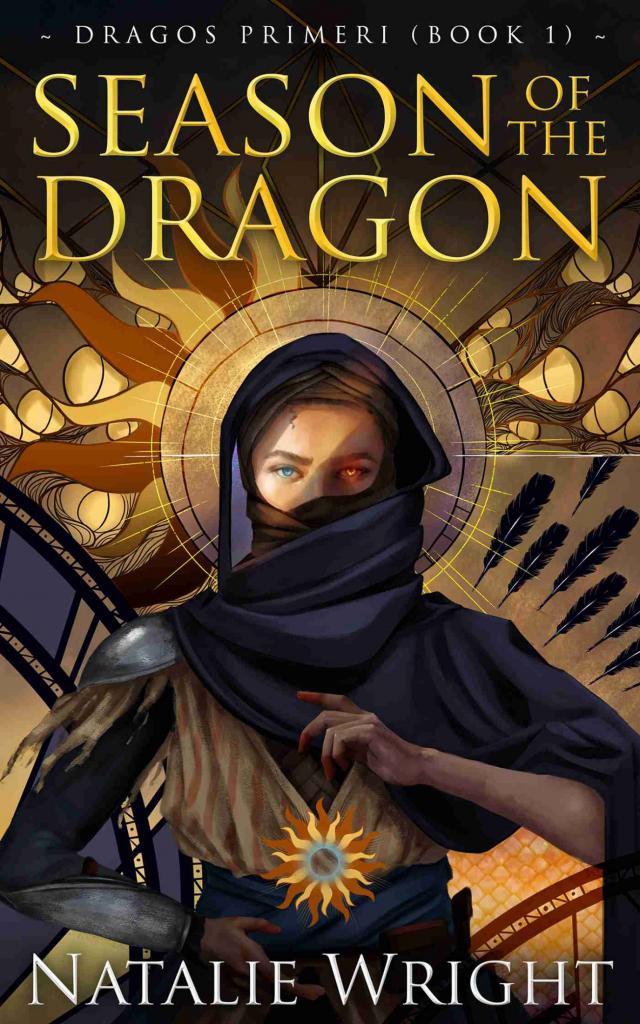
Season of the Dragon (Dragos Primeri #1, 2023)
The Sage of Ilkay and Collected Stories (Dragos Primeri 1a, 2023)
H.A.L.F. Series
H.A.L.F.: The Deep Beneath (H.A.L.F. #1, 2015)
H.A.L.F.: The Makers (H.A.L.F. #2, 2016)
H.A.L.F.: ORIGINS (H.A.L.F. #3, 2017)
The Akasha Chronicles
Emily’s House (Akasha #1, 2011)
Emily’s Trial (Akasha #2, 2012)
Emily’s Heart (Akasha #3, 2014)
Other Publications:
25 Servings of SOOP, vol. ii (Anthology, Something or Other Publishing, Nov. 2021
Story: Sunshine Acres
Natalie Wright, Season of the Dragon