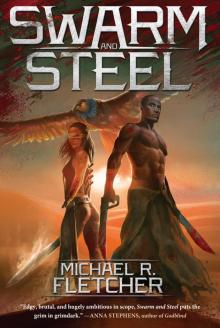
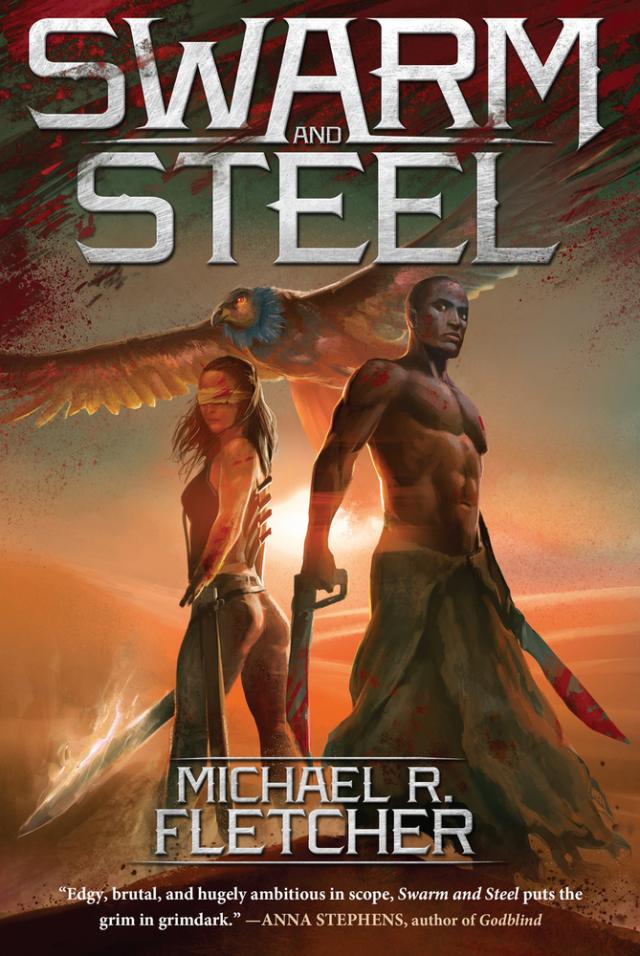
Swarm and Steel, page 24


Aas checked the names on the stores around him. New businesses rose and fell faster here than in any other city-state. The same businesses lined the street he’d last seen before entering Nimmer’s residence. He hadn’t been gone long, weeks at most.
A lot could happen in a few weeks.
A Geisteskranken could crumble under the weight of her delusions in a fraction of that time.
Aas collapsed in on himself like a tower undermined by sappers as he twisted into a condor. Stretching his wings wide, he leapt to the sky. All around people scattered, fleeing his display of rampant insanity and ravaged reality. He clawed his way into the air, wings driving him ever upward.
Did Hölle live, or had Pharisäer already replaced her?
He’d have to return to the church to find out. Catching a hot updraught blowing in from the desert, Aas sailed the chaotic currents of Geld. Able to avoid the twisting streets and alleys and the shoulder-to-shoulder crush of the city’s population, it would take him only moments to reach the Täuschung church.
Where am I going? Should he see if Hölle lived, or should he look for Pharisäer?
Hölle hated him. Of that he had no doubt. But she’d found him useful in the past. If her sanity had further decayed, she might once again have need and be more willing to accept his inability to hide his thoughts. Or maybe she’ll think I abandoned her and kill me on sight.
He needed to think.
If Pharisäer sent Aas to kill Nimmer because she feared him, she’d expect him to have been gone a lot longer and wouldn’t be prepared for his return. He’d have to watch her carefully, read her expression for clues as to her thoughts and intent. If she sent him there to appreciate the puzzle, she’d be happy to see him and gloat at her cleverness. Her reaction will tell me everything.
Aas’ stomach rumbled as he caught the faint scent of rotting meat. When had he last eaten? He couldn’t remember. Hunger-sharpened eyes scanned the streets below, searching for carrion or easy prey. A rat, a squirrel, a cat, even a one of those yappy little dogs the wealthy carried about in their purses. Anything small enough he could lift it away and tear the life from. He couldn’t help himself. Each time he twisted, the bird grew in strength, became more of who he was. The bird wanted food; the crunch of brittle bones, the tang of ripe organs.
Even from this height he recognized the mass of dark brown hair, the cocky swing of strutting hips.
Zerfall?
No, Zerfall was dead. This had to be Pharisäer.
Hunger forgotten, Aas followed Pharisäer, careful not to allow his shadow to cross within her sight.
She’s not far from Nimmer’s house, he realized. And she was heading toward the Täuschung church. Glancing down and back, Aas saw he could draw a straight line from Nimmer’s house to the church and she was right in the middle. She’s even on the same street.
Had she been watching the house? No, that was insane. She’d have no way of knowing when he’d solve the riddle and free himself. And yet there she was, striding purposefully—hurrying even—away from Nimmer’s home and toward the Täuschung church.
She knows I’m free. He didn’t know how, but felt sure he was right. Perhaps she’d been warned by another Geisteskranken. It was definitely possible. There were Mirrorists who believed they saw the future. Maybe one told her when Aas would escape.
Aas tucked his wings and rolled into a cooler, slower moving current.
Coasting lower, he followed.
FIFTEEN
Don’t let your toes peek past the edge of your blanket.
—Basamortuan Proverb
JATEKO RODE BEHIND ZERFALL, uncomfortably aware of the proximity of her cold ass and the fact his groin moved against it with Tod’s every jolting step. At some point earlier in the morning, before the savage crush of the day’s heat swept in to suck the life from him, the horse’s stride changed. When they first set out Tod ran smooth as rolling thunder, but hours of this merciless pace broke something in his rear hips. When the grinding sound of bone on bone got so loud they could no longer ignore it, Zerfall reined Tod in to a more sedate walk. His hip made a grind-pock! noise with every step.
Hunger. The empty gut-churning need to peel lobes from fresh brain, suck blood from a heart that had beaten but moments earlier, and hear the wet-twig snap of bone and the taste of fresh marrow, was his only distraction. Jateko’s mouth watered at the thought.
The hacked remnants of Abiega’s tent hung over Tod, doing a rather shoddy job of hiding his advanced state of decay. They’d cut holes for him to see through, but anyone looking closely would see there was nothing in there but maggot-gnawed black pits and exposed bone. They’d been no more successful with Zerfall’s disguise, though they covered her eyes in a thin blood-stained strip of cloth torn from the karpan. She said she couldn’t even tell it was there.
She looks like one of the ragged insane who wandered the desert following Harea’s voice. Or their own delusions or maybe both; Jateko was less sure every day. It didn’t look much like a proper Basamortuan oihal, but as long as she kept her hands—hand, he corrected—tucked in her sleeves and the cowl pulled forward, it would do. At least she didn’t stink. The desert had long leached the moisture from her body and she was a mummified husk, crackling like dry grass every time she moved. Her right leg, splinted around her shattered knee, stuck out at an awkward angle.
Not like these lazy hiria ero know anything about the Basamortuan tribes anyway, said Abiega.
No doubt one blanket swaddled savage wandering out of the desert looked much like another. Still, it wouldn’t do to allow anyone a chance at close scrutiny.
And one good gust of desert wind will end this pathetic charade right quick.
“True.”
“Did you say something?” Zerfall asked.
“There’s something up ahead,” Jateko said, pointing over her shoulder. “Are those buildings?” He’d never seen anything like it, monolithic structures of stone. No way this could be moved. Those people always stay in the same place? He felt Abiega’s shrug. “Is that Geld?”
“Grenzstadt,” said Zerfall, “if I’m not mistaken.”
“I’ve never heard of that city-state.”
“It’s a garrison town within Geldangelegenheiten. The city of Geld is the centre and there are several outlying territories dependant on it.” She examined the fortified structures as they drew closer. “There’ll be soldiers,” she added.
Fear stabbed into Jateko’s gut. What the hells was he doing leaving the Basamortuan and everything he’d ever known? He knew nothing of the hiria ero and their strange ways. What kind of terrified psychotics walled themselves in stone cities and shat, day after day, in exactly the same place? Did they carry their slop buckets out to the city’s perimeter every day, or did their entire civilization stink of shite?
“This is never going to work,” said Jateko. “We’re riding the rotting corpse of a horse. This karpan isn’t going to fool anyone. Look at Tod’s legs.”
Zerfall glanced at Tod’s sand-chafed legs, yellowed bone showing through where flesh had abraded away. “You’re probably right.”
“We should leave him, go in on foot.”
“No,” she said without hesitation. That one word brooked no argument. He thought about asking why, but decided against it. If she wanted the horse, she got the horse.
You’re a bit of a pushover, aren’t you? Abiega asked.
I understand I need her.
Pfft! You’re in love. You’ll do anything for her.
She’s a corpse! I can’t … we can’t …
There can only be love if there’s also rutting?
You ever been in love without rutting being part of it? Jateko asked.
Well, no. But—
That’s what I thought, said Jateko, who’d never rutted anything other than his own hand.
It changes nothing. You love her. That, or her weird city-states madness is controlling you.
Jateko ignored the last, didn’t want to think about it. She’s useful, that’s all.
You want to rut—
“Shut up!”
Zerfall glanced over her shoulder, one thin and tatty eyebrow raised. “Pardon?”
“Sorry. Not you.”
She nodded, accepting. “What are you arguing about in there?”
“Nothing,” Jateko answered, feeling his face flush with heat.
She turned away and gestured to the walled garrison growing ever closer. “We could go around it and head straight for Geld.” His stomach, so empty it felt like it had grown fangs and was well into devouring itself, growled loud enough Zerfall flashed him a quick grin of brown teeth and rotting gums. “I guess not,” she said.
“I don’t think I can go another day.”
“You can’t eat some normal food?” Mouth crooked and tattered lips dark with rot, she looked sceptical.
The thought of chewing tough goat meat or choking down some tuberous vegetable left him nauseated. “Maybe, if I had no choice.” But he doubted it. He needed liver and heart and brain, freshly slain and warm with the memory of life.
AS THEY APPROACHED THE garrison, Jateko saw men, armed and armoured in glinting steel, standing before an open gate. He’d never seen so much metal in one place. With what he saw gathered here he could make a name for himself and return to the Hasiera a hero. Was this all the steel in the city, an ostentatious display of wealth to scare off any would-be Basamortuan raiders? What if more steel remained hidden within the city? Harea, the hiria ero could conquer the desert tribes any time they wanted.
The city beyond the garrison grew in detail. The pieces came together in Jateko’s mind and he understood, for the first time, the scale of construction. The outer wall towered four times his height, some of the stones the size of a grown man.
“That’s impossible,” he said, staring in awe. Those rocks could only have come from— “We’re a month south of the Kälte Mountains.” And that was if one travelled without the difficulty of lugging man-sized stone. He thought about the terrain separating the garrison and the mountains from which this stone much have come. “Your gods built this.” There was no other explanation.
“I don’t think so,” said Zerfall.
“This is impossible.”
She laughed and a fly escaped her open mouth. Zerfall scowled, following it with the empty pits of her eyes before drawing breath to say, “Geld is a thousand times this size.”
Stunned to silence, Jateko’s mouth opened and then snapped closed as the fly darted toward him. No way he wanted to taste that.
The guards standing before the open gate glanced in their direction with bored disinterest. There was more steel here than in all the Basamortuan tribes combined. They wore it like it was nothing. The outer wall, he now saw, was as thick as a man sprawled on his back, arms outstretched. If the hiria ero built this, they were invincible. Not at all the soft and helpless victims he heard stories of.
Did you know? he asked Abiega.
The dauntless warrior remained quiet, but Jateko sensed his stunned awe.
Everything we believe, thought Jateko, everything the Basamortuan tell themselves is a lie. We don’t live in the desert because we’re tougher or smarter, we live there because we have no choice.
A hundred united clans couldn’t conquer this one garrison. And Zerfall said Geld was a thousand times bigger.
His whole world wobbled, threatening to come apart and he grabbed Zerfall’s waist to stop from toppling off Tod’s back. She ignored him, maybe didn’t even feel his panicked grip.
As they neared the gate one of the guards approached, eyes narrowing, nostrils flaring as he inspected them.
Jateko felt Zerfall tense and did his best to prepare himself for death.
“Your horse has seen better days,” said the guard in a surprisingly soft voice as they rode past and into the city.
A woman? Encased as she was in steel and leather, Jateko had missed the slight curve of hips and breasts under all that armour. Even their women are warriors. Having seen Zerfall in action, he shouldn’t have been surprised, but he always believed she was an exception rather than just another city-states woman. What if they all fought like her? What if she wasn’t even particularly skilled?
The other guards laughed and none made any attempt to stop or slow Zerfall and Jateko’s progress.
And why should they, said Abiega, we’re sand-flees.
“Sun-brained sand-stickers,” the woman added to more laughter as she returned to her place in the shade.
Jateko bowed his head to hide his shame. Nothing he achieved could ever matter in the face of this stone behemoth. “I once asked what made you think the city-states were more civilized than the Basamortuan tribes,” he whispered into Zerfall’s ear. “Please forgive my ignorance.”
“There’s nothing to forgive,” said Zerfall. “It was a good question. Stone and steel do not make one civilized, just more adept at violence.”
Jateko wasn’t sure what the difference was.
His heart thrummed in his chest. He couldn’t breathe. “I made a mistake,” he said. “I should return to the desert.” He swallowed a hard lump and closed his eyes. “I want to go home.”
“No,” said Zerfall in that dead cold final way she had of crushing dissent. “I’m scared too, but nothing will stop me.”
What scares the dead? Jateko drew a long breath and let it out slowly, searching for a calm that evaded him. He smacked his lips in distaste, wrinkling his nose. “I was right about one thing.”
“What’s that?”
“Your civilization stinks of shite.”
ZERFALL GUIDED TOD THROUGH narrow streets clogged with refuse with nudges from her left knee, touches with her numb fingers, and quiet clucks of her rotting tongue. The horse, head hanging low, rear hips grinding and clicking with every step, seemed to understand her every intent.
A molar hung at the back of her jaw, refusing to fall out. She thought about reaching in to yank it free, but every piece of her that dropped off was a piece she’d never again have. I’m clinging to rotting teeth.
They rode past an inn, a chipped wooden sign hanging from sagging eaves proclaimed it the Unteren Lauf. She had the strangest desire to enter and take a room. She wanted to order a meal, sit in a common area, surrounded by the chatter of voices and the sight and smell of people going about their lives. She wanted a beer and a glass of red wine and to feel soft sheets on her skin.
You’re dead. You don’t sleep, eat, or even breathe.
But she wanted to, wanted it more than anything. She wanted all the things that came with life. Scents and flavours good and bad; she missed them. Colour. She barely remembered what the world looked like before it became this monochromatic hell. Endless shades of grey. She even missed pain. If something hurt, at least you knew you were alive. She scowled at her jutting right leg, lashed to tent poles. She kept waiting for it to heal or to hurt or for it to change in some way. But it wouldn’t. Not unless it got worse.
“Zerfall?” Jateko, perched behind her with his arms wrapped around her waist, sounded scared. He’d lost his naïve confidence and she missed it. “How am I going to kill and eat someone here?”
This was a walled garrison, a border town. Judging from the number of armed men and women prowling the streets, she felt sure murder was a commonplace occurrence. Cannibalism, however, wasn’t.
Ahead a score of people gathered around a young man with slim hips and perfect hair. A pair of swords poked past broad shoulders, framing a handsome, square-jawed face.
The man stood, arms raised, shouting to be heard over the street noise. “You all know me for I am Grausamer Schlächter, the Greatest Swordsman in all Geld.”
This received a smattering of lazy applause from the crowd. Zerfall clucked to Tod and he slowed, stopping beyond the crowd. The loose molar wobbled against the decayed remnants of her tongue.
“Why are we stopping?” Jateko asked.
“A Swordsman,” she said, unsure whether she answered his question.
She felt Jateko lean forward to peer over her shoulder.
“I have come from Geld,” Grausamer yelled, “seeking challengers. Do any here dare?” The crowd, made up of armed men and women scarred from dozens of battles, shuffled and mumbled. “None?”
“You killed Vergangener Traum last time you came through,” someone answered. “He was the best Grenzstadt had to offer.”
“That was two years ago,” Grausamer said petulantly.
Jateko slid from Tod’s swayed back.
“Where are you going?” Zerfall asked.
“A great Swordsman. He’d be perfect.”
“Are you insane? Get back here.”
Either he didn’t hear or he ignored her. Without glancing back, Jateko shoved his way into the crowd. His shoulders and chest may have filled out, but he looked small and weak in this gathering.
Grausamer saw the movement and parted those around him with an imperious wave. When he caught sight of Jateko his face fell in glum disappointment. “Basamortuan?” he asked, wrinkling his nose and casting a contemptuous eye over the slight youth. “I’ve heard you are fierce warriors, but you look a little young.”
“Is it acceptable for us to kill each other in the street?” Jateko blurted. “The guards—”
“Swordsmen are special,” said Grausamer as if that explained everything. Maybe it did, but to Zerfall it sounded like childish snobbery. “But you’re no Swordsman.”
“But if I killed you?”
Maybe the Swordsman would see Jateko was no threat and leave him alone. No. Expecting intelligence from a Swordsman is a mistake.
Zerfall heard a patter of laughter flit through the crowd. Cursing, she dismounted, careful not to put much weight on her splinted right leg; the long walk on it had been a bad idea and the tent pole looked frayed and ready to snap. Pulling her cowl forward and making sure the tent fabric hid her decaying flesh, she pushed her way into the crowd. Maybe she could drag Jateko out of there before he got himself killed.