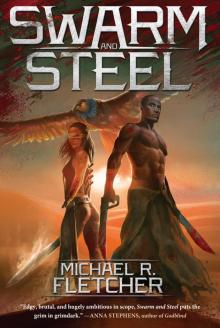
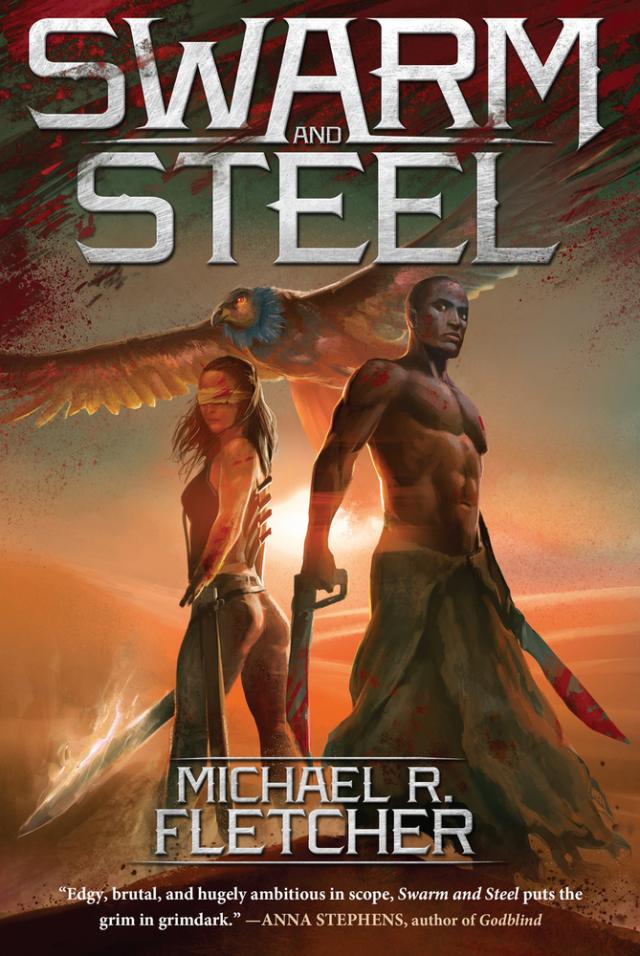
Swarm and Steel, page 12


“You could cook it.”
“I have to eat it raw. They always did in the stories.” He eyed the brain for a moment before shrugging and selecting another piece. He clenched his eyes closed and stuffed the chunk into his mouth, chewing furiously.
Feeling a little better, Jateko pushed himself to his feet. It hurt less than expected. “I bet you used to be pretty,” he blurted. Empty sockets stared at him. “I mean before you were dead and all rotting and had no eyes and weren’t shedding flakes of skin every time you move.” She watched him, unblinking. Well that makes sense. She doesn’t have eyes. Why should she blink? “So … Gogoko said the steel on your horse’s shoes was hiria ero. From the west,” he added when she remained silent. “From the city-states.”
She stared at him.
“I thought all hiria ero women were fat.”
Zerfall nibbled on her lower lip with brown teeth. Her rotten gums had receded making them look over-large and canine. She spat out a shred of decayed flesh. “I go west.”
“Okay,” he said, feeling not at all okay about being left alone. He felt better than he had in days. Maybe ever. Jateko flexed his arms. “Do I look stronger?”
Dark pits studied him for several heart beats. She drew breath to speak. “Your chest might be a little less concave.”
Jateko frowned down at his hairless chest. “Uh … thanks.”
She leaned forward, her face close enough he’d smell her breath if she was breathing. “And maybe your skin looks a little healthier.” A faint whiff of decay followed her words. Even dead and rotting her heart-shaped face held traces of the beauty she had been.
“Gogoko always had good skin,” Jateko said.
The brows over the empty pits furrowed. “What will happen when your tribe finds out you ate Gogoko?”
“They’ll hunt and kill me.” He remembered Jakintsua walking with him, her endless stories filling his thoughts. Somehow she’d forgotten the part of the stories where the tribe would gather its strongest warriors and hunt those who had partaken of the flesh of men. That was an hallucination. He’d been so hungry, so thirsty. I still am. Odd, as he just ate. “You’re going west.”
“Yes.” Her voice left no room for doubt and yet he hesitated. To follow her to the city-states was to leave behind everything he ever knew. You did that the moment you killed and ate Gogoko.
“Why?” he asked, surprising himself. Mother always dissuaded him from questioning, said it was annoying. No one in the tribe liked his questions. He long ago learned to accept whatever he was told. “Why return to the city-states?”
Empty sockets examined him for an uncomfortably long time. “I … There is a church there, a religion called the Täuschung. They preach that our world is a prison and that only through suffering can we be freed.” She looked away, the bony fingers of her right hand clenching into a fist. “They’ve created a hell, populated it with millions of people. These people will suffer in this hell forever unless I end the religion, unless I destroy it completely.”
“That’s—”
“I made the religion.”
“—insane.”
Her attention returned.
I shouldn’t have said that. She’s going to kill me now.
“Belief defines reality,” she said.
Jateko blinked. “Is that some hiria ero philosophy?” Where are all these questions coming from?
Her brows furrowed. “It’s the way things are. If enough people believe in this mad god I invented, he is real.”
“So?”
“The world will truly become our prison and we will suffer for an eternity in hell.” She drew breath. “And it will be my fault.”
Understanding dawned. “You’re going back to the city-states to end this religion.”
Zerfall turned away. Head tilted, she examined the corpse of her half-buried horse. The animal’s hooves protruded forlornly from the sand. Even by moonlight the hiria ero metal on its hooves shone like something ghostly. The Basamortuan tribes talked about how city-states metal was better, but Jateko had never actually seen a tribesman make steel. He had no idea how it was done. All the metal he’d ever seen had been around for generations. Even the newest knife was older than the oldest person in the tribe. New tools were all wood or, more likely, bone.
Hiria ero steel. He remembered seeing his reflection, chin strong, in Nazkagarri’s pitted knife. He stared at Zerfall’s back. She was going west, to the city-states to fight some evil god. Alone.
I want to help her.
But why? Why leave the desert and everything he knew for this strange dead woman?
I don’t know. She needed him. He had to help her.
“I can’t let you travel alone,” he said, joking. “It’s too dangerous.”
“Yeah?” she asked over her shoulder. “You think maybe someone will try and kill me?”
“There’s worse things than death,” he said, remembering Jakintsua uttering the words in dark threat while telling a scary story of demons and lost souls.
She nudged the horse’s distended belly with a toe. “Yeah?”
The beast looked like it might pop, and Jateko backed away. “Uh … rape?” She glanced over her shoulder, an eyebrow arched over a dark and empty pit. “Maybe not,” he admitted.
“A guide wouldn’t be a terrible idea. At least until we’re out of the desert.”
“I’m with you to the end.” He hadn’t meant to say that, it slipped out.
Again she stared at him before shaking her head. “I’m going to kill some very dangerous and powerful people. I’m going to end a centuries old religion and burn it all to the ground. If there is a god, if Wahrergott is real, I’m going to kill him too.”
She’d die without him. She’d never make it out of the desert. She needs me. Nothing else mattered. “I know.”
Zerfall laughed, a dry wheeze as she’d forgot to fill her lungs, but looked doubtful. “You can come.”
“I’ll help you, and in return you can help me …” Help him what? Help him kill and eat people to make him stronger and smarter?
Her hand strayed down to caress the empty scabbard hanging at her left hip, thin fingers little more than flesh stretched tight across pale bone. “You can ride west with me,” she said, attention once again on her horse.
Jateko glanced about the moonlit sands. “Ride?”
“Tod, get up,” said Zerfall, kicking the dead beast. “I’m not walking all the way to Geld.”
With a great stinking fart of rotting intestines, the horse rose from the sand. It stood on shaky legs, belly stretched and looking ready to burst. Its head hung low as if too heavy to lift. With a gaping yawn it vomited sand and Harea knew what else down its front legs. If a corpse could look miserable, this horse managed it admirably. Zerfall scowled at the arrow jutting from between the horse’s empty sockets. Reaching up she snapped the shaft, leaving a finger’s width of wood sticking out like a pathetic horn.
With quick, practised movements she removed the saddle, tossing it aside. The desert sun hadn’t been kind and the leather was faded a pale yellow, dry and cracked. The bit, bridle, and reins she left in place.
“You might want to stand back,” suggested Zerfall, hefting her knife and eyeing the horse like she was trying to decide where to stab it.
Jateko backed away. “I think he’s already dead.”
“Going to relieve Tod of the excess weight he’s gained. Lying in the sand has made him fat and lazy.” She rubbed the horse between the ears. “Sorry Tod,” she said fondly.
Zerfall slashed along the horse’s belly, spilling ropey intestines, huge organs, and all manner of black gore.
The stench clubbed Jateko to his knees. It became his world, suffused the air, clawed at his nostrils, infused his tongue. He retched and spat what little his stomach hadn’t yet digested. Nothing would ever not smell like putrescent horse innards again.
“Does it smell bad?” Zerfall asked, standing ankle-deep in coiled horse guts, blue and green and black with decay, wriggling with white worms.
Jateko fled, crawling through his own puke in an attempt to escape the miasma.
“Really?” asked Zerfall. “I can’t smell a thing.”
From a safe distance he watched as she slashed away the horse’s belly, emptying it until little remained of the beast but patchy skin stretched tight across wiry muscle and protruding bone. The horse looked wretched but made no complaint and stood motionless through the process. Zerfall moved with easy efficiency. She made those sand cats who raided the tribe’s refuse look clumsy in comparison.
Jateko watched her work. Zerfall felt some connection with her dead horse, maybe even liked it, and yet had not hesitated to gut the beast.
What am I to her?
EIGHT
In outward appearance Doppelgangists (and their Doppels) can easily be mistaken for Mehrere (and their Fragments) as both manifest as multiple people. They are not, however, the same. Doppels are aspects of the Doppelgangist’s personality, a part of themselves they hate, or a manifestation of who they wish they were. Mehrere are true schizophrenics. Fragments—the manifestation of their delusions—exist as completely different personalities.
There is one trait all Doppels and Fragments share: They want to be the original and they will stop at nothing to achieve that status.
—Vorstellung, Natural Philosopher
PHARISÄER GAZED UPON THE church, commonly referred to as ‘the Hospice,’ that acted as the public face of the Täuschung religion. Täuschung Hospices were littered throughout most of the city-states. Within this church sane priests preached of Swarm, the heaven where the most deserving souls awaited rebirth as gods. It was a successful lie. Everyone thought they were deserving. Everyone feared death. Everyone wanted to return as something more.
We are a species of wishful fools.
Towering spires decorated with carvings, mystical icons, gargoyles, and intricate stained glass stood at every corner and flanked every entrance. At just shy of three hundred years old, the building showed a variety of architectural styles from the solid stone slabs of its earliest days to the ornate mosaics currently in fashion.
Squinting she examined the carvings. While impressive, they had nothing to do with the Täuschung or Swarm. The church had one purpose: Appeal to the masses.
It’s all a lie.
But then wasn’t that true of all churches? Anywhere people preached of an Afterdeath they’d never seen and gods they’d never met, falsehood must abound. Really, from that metric, the Täuschung was one of the more honest churches. While everything the priests leading the public sermons said was a lie, purposefully planned to make the sane masses feel comfortable and safe, at least the religion’s creators had actually met their god. And while she might not personally care, might not have a vested interest in the Täuschung as a religion, she had no doubt Swarm was real.
Such a waste. All this power, all the money brought in by proselytizing priests begging for donations, and Hölle and Zerfall did nothing but send stupid souls to their ridiculous hallucinated hell.
They could have done something interesting. Enough sane worshipped at Täuschung churches that they’d define local reality with their beliefs. Instead of using that, Zerfall and Hölle only told the worshippers they’d go somewhere special after they died and later return as gods. They could have changed Geld, shaped the city.
The Geborene Damonen, Pharisäer decided, had the right idea: Use the masses to make yourself a god. Or something like that. She wasn’t really sure what they believed. Glancing at the Geborene pyramid sitting like a glistening white turd on the far side of the city, she wondered at the kind of gods created by fastidious arseholes.
I suppose I owe Zerfall, in some small way. The woman spent centuries creating her mad religion, building two virtually unrelated churches—the public face to draw in the fools and their money, and the core of reality-twisting Geisteskranken to collect their souls—only to disappear when it finally was about to become successful. Not that it ever would; Pharisäer would see to that. Toppling the Täuschung would grievously wound Hölle and that was a thousand times more valuable than a mad religion.
When Hölle falls, I shall be real.
Until then, Pharisäer would remain a manifestation of the woman’s delusions, a fragment of a damaged mind, unable to exist on her own. Until she became real, Pharisäer was a prisoner. She couldn’t leave Geld, couldn’t stray too far from Hölle lest she cease to exist altogether. Luckily this church was located near the Täuschung compound where Hölle convalesced. Hopefully when more people believed Pharisäer was Zerfall, she’d be able to travel further afield.
Where was Aas now? Twisting would heal the worst of the wound she’d given him. She saw two likely possibilities and a third less likely. Chances were Aas had either fled Geld or was now hunting the two priests she wanted dead. It was possible he’d gone to Hölle, but Pharisäer felt sure his fear, and the woman’s unconcealed loathing, would keep him away. Either way she won. If he fled the city he was gone and she need not concern herself. If he pursued the two Geisteskranken she wanted dead, he was likely trapped in the sphere of Nimmer’s influence. All that mattered was that Aas stayed away from Hölle so he couldn’t—accidentally or otherwise—reveal the truth about Pharisäer.
I gave him a puzzle. No way he left. Hölle thought Aas dangerously clever, but Pharisäer saw him for what he was: A coward hiding behind stacks of books. He respected Zerfall because she was intelligent and dangerous. He’s submissive, he needs a strong woman. He needs a woman he can fear. Pharisäer had tricked him and trapped him and it had been easy. Even if he managed to figure his way out of her trap he’d be impressed. He’d return and he’d be hers. She didn’t need him, but how could having an assassin in your pocket not be handy?
She returned her attention to the church.
A few stragglers, late for today’s sermon and the Departing of Giernach Reichtum, a highly ranked banker in the Verzweiflung Banking Conglomerate and one of Geld’s wealthiest citizens, hustled to enter before the massive doors were closed. Today marked the next chapter in the Täuschung story. With Giernach publicly declaring herself a believer, more bankers would soon follow. They were an unimaginative lot. Where the Täuschung had lurked in obscurity for hundreds of years, really only finding some small success in the last few decades, the religion was poised for massive expansion. Where Geld lead, the other city-states followed. Handled correctly, the Täuschung could vie against the Wahnvor Stellung within the next decade.
Shame it all has to go.
For now, however, she needed to be seen and to do her part. Once she dealt with Hölle, replaced her as the heart of the Täuschung, perhaps she would start her own religion, something with more profitable ideals.
Pharisäer entered the building through the entrance at the rear. Ranks of priests, true believers in the lie that was the façade, stood in ranks, awaiting her arrival. Centuries ago Zerfall and Hölle hired Geld’s best designers to create these robes with an eye to being impressive. Layers upon layers of the most expensive materials wrapped each man and woman, the number of layers and colours denoting the priest’s rank.
All these supposedly sane men and women so ready to believe in a lie. Not that the deranged were any less gullible. Still, sanity really ought to be worth something.
Unterwürfig, Bishop of Geld, bowed as she entered. The man was as tedious as he was impressive. Dark hair, silvered at the temples, matched perfectly to a well-trimmed beard shot through with grey. Groomed eyebrows and a face lined with compassion and concern completed the image. With the right speach writers the man was a master orator.
Unterwürfig straightened, smoothing the many layers of silk and gold-threaded robes. “Giernach Reichtum … is ready.” He spoke in slow, even tones, his voice deep and ringing.
Pharisäer watched him listen to the dying reverberations of his voice, head tilted to one side as if he contemplated the world-shattering wisdom of his words. No one loved Unterwürfig’s voice more than Unterwürfig.
“The hall?” asked Pharisäer.
“Just shy … of capacity.”
“Close the doors.” She wanted to be done with this, get it over with. There were other, more interesting things to do with her time.
“I have prepared … a special sermon … for Giernach’s Departing,” announced Bishop Unterwürfig, spreading his arms and closing his eyes as if in prayer.
Of course you have. He droned on and she ignored him. If the windbag’s speeches were long it wasn’t because he said a lot; he spent more time listening to his voice bounce about the arched cathedral ceiling than he did actually talking. The thought of standing behind Unterwürfig while he prattled on gnawed at Pharisäer. Zerfall and Hölle preferred to take a background role in the public face of the Täuschung, allowing the sane priests to run the Hospices littered across the city-states.
What a waste.
“I will lead today’s sermon,” she said, interrupting the priest. She needed to be seen, to be real. Might as well get something out of this stupid church before I burn it to the ground.
The Bishop’s eyebrow crept up in askance. “I think … ”
“This is too important,” she said.
He nodded agreement. “Of course.”
Much as he loves talking, he loves getting paid even more.
Pharisäer pointed at one of the lower-ranked priests. “Fetch me the proper robes.” The priest dipped a quick bow and left without a word. She nodded at Unterwürfig. “Begin the ceremony, Bishop.” She didn’t want to have to go through all the boring preamble shite the man loved so much. “You’ll introduce me.”
WEIGHTED DOWN WITH COUNTLESS layers of bright silk and wrapped in gold brocade, Pharisäer stood behind Bishop Unterwürfig, waiting. Somehow he managed to drag her introduction on for a full half hour and he still wasn’t finished. She gazed out over the cathedral hall. Far above, the arched ceiling, sweeping lines like gold sails catching a brisk wind, caught the Bishop’s voice and amplified it.