A Flame in the North, page 45


This book is a work of fiction. Names, characters, places, and incidents are the product of the author’s imagination or are used fictitiously. Any resemblance to actual events, locales, or persons, living or dead, is coincidental.
Copyright © 2024 by Lilith Saintcrow
Excerpt from The Fall of Waterstone copyright © 2024 by Lilith Saintcrow
Excerpt from Shield Maiden copyright © 2023 by Sharon Emmerichs
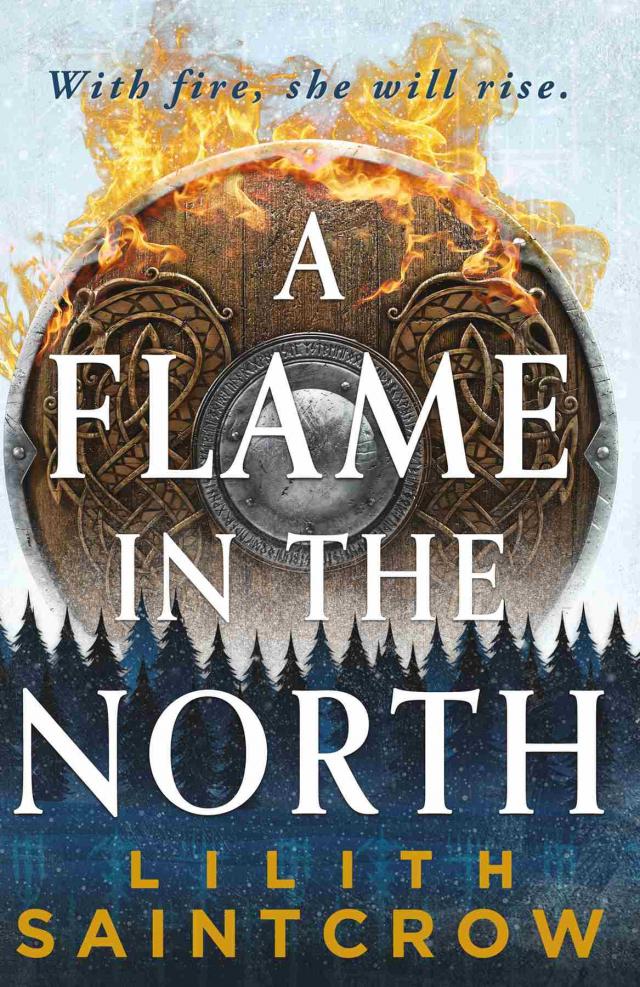
Cover design by Lisa Marie Pompilio
Cover art by Michael Heath | Magnus Creative and Shutterstock
Cover copyright © 2024 by Hachette Book Group, Inc.
Map by Tim Paul
Hachette Book Group supports the right to free expression and the value of copyright. The purpose of copyright is to encourage writers and artists to produce the creative works that enrich our culture.
The scanning, uploading, and distribution of this book without permission is a theft of the author’s intellectual property. If you would like permission to use material from the book (other than for review purposes), please contact permissions@hbgusa.com. Thank you for your support of the author’s rights.
Orbit
Hachette Book Group
1290 Avenue of the Americas
New York, NY 10104
orbitbooks.net
First Edition: February 2024
Orbit is an imprint of Hachette Book Group.
The Orbit name and logo are registered trademarks of Little, Brown Book Group Limited.
The publisher is not responsible for websites (or their content) that are not owned by the publisher.
The Hachette Speakers Bureau provides a wide range of authors for speaking events. To find out more, go to hachettespeakersbureau.com or email HachetteSpeakers@hbgusa.com.
Orbit books may be purchased in bulk for business, educational, or promotional use. For information, please contact your local bookseller or the Hachette Book Group Special Markets Department at special.markets@hbgusa.com.
Library of Congress Cataloging-in-Publication Data
Names: Saintcrow, Lilith, author.
Title: A flame in the North / Lilith Saintcrow.
Description: First edition. | New York : Orbit, 2024. | Series: Black Land’s Bane ; book 1
Identifiers: LCCN 2023025338 | ISBN 9780316440332 (trade paperback) | ISBN 9780316440431 (ebook)
Subjects: LCGFT: Fantasy fiction. | Epic fiction. | Novels.
Classification: LCC PS3619.A3984 F53 2024 | DDC 892.8—dc23/eng/202306012
LC record available at https://lccn.loc.gov/2023025338
ISBNs: 9780316440332 (trade paperback), 9780316440431 (ebook)
E3-20231215-JV-NF-ORI
Contents
Cover
Title Page
Copyright
Dedication
Map
Epigraph
Part One: Journey North Hastily Done
Simple, Easy
Ill News
Arguments
A Warm Hall
Blessing Morn
Never Fear
Stripping the Roof
A Fate in This
Truth
Day Travel
At Any Age
Notice Enough
Quite So Flimsy
Night Falls
Content with Simple
Lady Question
Treesong, Welcome Cup
Precious and Rare
How Men Think
Fare-Thee-Wells
Singularly Incapable
Different Sparring
Quick and Delicate
Edge of Foolhardy
Across the Ford
Part Two: Nithraen Morn in Nithraen
A Promise So Often
Sons of Faevril
Not Hospitality
The Tale Bleaker
Offering Apology
Remove All Doubt
A Riddle in Light
Half Done, Worse than Not
Dread News
Death of Nithraen
Neither Foolish nor Hardy
Swearing Alliance
Individual, Complete
Tasks and Remembrance
Battle, Persuasion
Allies So Few
Not by Foe
Part Three: Redhill to the Wild Laden with Discoveries
The True Difference
Atop the Listening Hill
The Chair of Honor
Truth in Our Dealings
Shieldmaid Dancing
Venture into Winter
Whistle, Bone
A Watchful Ride
Anything Unreasonable
Mistwood’s Shroud
Every Fire Loses
Hold, and Be Ready
Lich and Snow-Hag
Love Latecomers So
Lodestone and Splinter
The Ice Door
The Passage Guards
Waterstone
Acknowledgments
Discover More
Extras Meet the Author
A Preview of The Fall of Waterstone
A Preview of Shield Maiden
Also by Lilith Saintcrow
Praise for Lilith Saintcrow
For those who must leave home.
Explore book giveaways, sneak peeks, deals, and more.
Tap here to learn more.
When there passed us a woman with the West in her eyes,
And a man with his back to the East.
—Mary Elizabeth Coleridge
Several problems have tormented the translator of this tale; many a term in the Old Tongue or southron dialects holds nuance not easily explained in other languages. The reader’s patience is humbly solicited. Any error is unintentional, any inaccuracy likewise.
May the Blessed smile upon both reader and scholar alike, knowing neither insult nor injury are meant.
PART ONE
JOURNEY NORTH
Hastily Done
For seidhr is a tree, and some branches wider than others. Those gifted with its touch may bend one of the great forces of nature to their will, and those with any of the weirding may call a spark. The most blessed among them we call elementalist, and they perform not mere kindling but hold actual flame…
—Navros, First Scholar of Naras in the days of King Edresil
By solstice day the great Althing at Dun Rithell was almost over. Our father took Astrid and Bjorn to the last day of the riverside fair but I did not accompany them; I was already thinking upon the fire.
Mother was abed with winter ague and Bjorn her firstborn useless when it came to organizing, both by temperament and upon account of maleness. If you wished something heavy lifted, something bulky heaved a great distance, something stabbed, slashed, or thumped into submission, he was not only willing to oblige but also an expert of such endeavors, but should you wish for aught else disappointment was the result. Astrid had already done her part with the great feast upon the penultimate day; many a toast was drunk to her health and Ithrik the Stout had already gifted our hall with a great gem-crusted plate as a sign of earnest.
My sister liked the sheep-lord’s middle son Edrik well enough; he was a fine fighter and careful with his father’s great flocks. Astrid’s marriage, while not final by any means, at least was assured in some direction. Come spring Bjorn might be married as well, if any of the visiting girls and their kin liked the look of him. Both prospects pleased me like they should any good sister, but did not mean I wished to go a-fairing that day.
Besides, crowds are always… difficult. Though the quality of my cloth and the marks upon my wrists grant me space and there is always Arneior, I did not cherish the thought of being called to render a summary judgment between drunken warriors or perform some small trick to please a wide-eyed child among a press of visitors and jostling neighbors. Arn might have wished to go upon her own account, but I did not think of that until Father had already left with my siblings and my shieldmaid gazed longingly down the road, her ruddy hair a beacon in the strengthening dawn. Twin hornbraids crested on either side of her head, their tails dangling behind her shoulders wrapped into clubs with leather thongs, and the stripe of blue woad down the left side of her face shouted One of the Black-Wingéd’s own, do not touch.
If she had not the woad, her very carriage and steady glare would serve as warning enough. It is known the battlefield maidens of Odynn’s elect choose those of quick tempers, not to mention swift spears.
“Oh, fishguts,” I said, spreading my hands; the last band upon my left wrist—ink forced under skin with a sharp point—twitched. The scab was almost off, but I had to refrain from scratching or drawing the pain aside to heal it more quickly. One does not use seidhr upon such marks. “I did not think, small one.”
One coppery eyebrow shot up, and Arn scowled at me. Which is usually a cheerful sign; I have called her small one since she was sworn to me at Fryja’s great festival during my sixth springtime—and my shieldmaid’s ninth, for she is older, though I am supposed to be the wiser of our partnership.
“I do not wish to go,” my shieldmaid said, her generous mouth pulled tight. The scales and rings sewn onto her daily hauberk glittered fiercely as the sun’s first limb reached above the horizon, frost and thin metal both gilding the roof of our home. When the sun rises, Eril’s hall echoes it, our men said, and one or two might even lift a drinking horn to the eldest daughter when they did.
One born with seidhr is considered lucky, even if ’tis best to be cautious of a volva’s t
I did not think it wise to dispel such caution wholesale, though. Nor had my teacher Idra.
“You do not wish to attend the fair?” I mimicked astonishment, letting my eyes widen and the words lilt. There was a snapping, growling, baying explosion in the direction of the kennels; the houndmaster Yvin would be taking his shaggy, nose-drunk charges upon their traditional run through the South Moor soon. When they returned there would be scraps for both dogs and pigs, and both groups might be exhausted into reasonable behavior for the rest of the day. “Not even after the bonfire is laid?”
“It will take all day to stack,” Arneior replied stiffly, and I laughed, taking her left arm. The other, of course, was not to be touched even by her charge. Her longhead spear—well upon its way to earning a name in its own way—occupied her right hand, its butt resting easily upon swept cobbles.
Soon the tables would be brought out for the Fools’ Feast before the great evening celebration to mark the Althing’s ending—though not the end of legal cases and other matters to be decided—and I would be very busy indeed.
For the moment, though, I could tease my Arn. “Not if I hurry things along. A volva is hard to please.” The proverb used to pain me; I watched as Father’s golden head sank into the crowd passing down the road, just outside our courtyard’s great timbered gates—ajar to show hospitality during the Althing, as was the custom. Astrid, as she only reached Bjorn’s shoulder, was already lost to view; my brother, though he had his final growth upon him, would not quite match our father’s height. Still, both of them were well-named, a big good-natured bear and a shimmering star.
I oft considered my own naming a great jest, for I am dark-haired as my mother and my father’s mother. For all that, I have my mother’s eyes; they said there was some of the Elder in Gwendelint of Dun Rithell’s line, but I know not the truth of such a tale.
Despite a dark head my temper is much like Eril the Battle-Mad’s, and those who see us together are unable to think me anything but his get. I have his nose, and my chin, while rather more pointed, is also shaped just as his, though my mouth and cheekbones belong to Gwendelint. More than that, Father and I share the same quality of gaze—the word is piercing, as an awl will go through thick leather, and when applied to a pair of eyes it means we see much more than we wish to, though Father’s are dark and mine clear pale blue.
A steady stream of freedmen, bondsmen, servants, and thralls carted wood from every household and camp to the great green across the ancient stone-paved trade-road; the large flat outcropping of greyish rock in the midst of vast grassy space was black-topped from other burnings and bore a stubby crown of stacked logs already. Hopfoot my mother’s steward, his reedy tenor aquiver with age, had been fussily directing the laying of the base since the grey mist before a winter dawn. The wicker cages along one side of the Stone would be quiet at this hour, though—they were small and relatively few, holding only promised sacrifices of fowl and rabbits.
There had been no war or raiding to bring excess livestock lately. Perhaps that accounted for my unease. I could even say I sensed somewhat amiss, but it would be a lie. That morning neither the blessèd gods—Aesyr, Vanyr, foreign—nor any other passing spirit gave no indication of the future, not even to me.
I was merely nervous in anticipation of what I had to do that evening.
My skirts touched Arn’s knee as we slipped back through the gate; the green-and-white winter festival dress was last year’s, true, but I had grown no more and would not reach even Astrid’s height. Small am I, little Solveig like a paring knife, Father had crowed more than once, lifting child-me in his brawny arms.
As I grew older he became uneasy with my strangeness, but that was only to be expected.
“Hastily done is ill done.” Arneior rolled her shoulders precisely once, a sign she was ready for the day’s labors, whatever they might be. “And where is your mantle, my weirdling? Your mother will scold.”
I shrugged in return. Mother would not glimpse me from her bedroom window; I had mixed her morning medicine with a sedative so she could not fret overmuch at being unable to oversee the feasts. My great fur-hooded green mantle was warm, yes, but I had merely stepped into the courtyard to bid Astrid good hunting in the market and also bring Bjorn the blundering his new beard-pin, forgotten at table. The night’s frost was already turning to steam, lifting from our greathall’s gilded roof just as the weary sun hauled itself above the black-timbered breast of white-hooded Tarnarya for the last time that year.
Our great mother-mountain would be renewed with dawn, like the entire world.
Tonight was the Long Dark; the bonfire would burn throughout, holding vigil. I would not sleep much either, making certain the flame kept steady, but at least it was dry weather. I did not taste much snow or ice upon the wind. Our river kept much of winter’s worst excesses away, and we thanked her each spring for the blessing.
Even if it did include cold mud to the knee, and more than one shoe lost in quagmire.
“My lady! My lady Solveig!” Albeig, holding her cheerful blue festival skirt high so the embroidered hem did not touch the ground, waved from the top of the great stairs. She did not like to leave the inner fastness; our housekeeper hated disorder and there would be naught else in every corner, begging to be set aright. “The tables? Shall we?”
And thus it begins. There was no use in sighing; Albeig knew I wished to order the household myself, if only to show Mother she need not worry. “Make it so, then,” I called up the stairs. “But do not set out the meat just yet.”
She knew that as well, but Albeig’s fair round face eased at proof that I was thinking with more than one finger, as the saying goes. She bobbed gently, a tiny wooden boat upon a disturbed puddle, and hurried back inside through the big black carven doors.
“They have not brought the pillars yet.” Arn did not move. No doubt she would prefer chivvying those building the bonfire to the thankless work of setting out board for fortunate beggars and any of my father’s men who wished a mouthful before going to the fair’s colorful, hurrying sprawl.
Each oiled wooden pillar upon the Stone in the green bore a great rune-carving and would sink into prepared holes, ready to keep the lower mass of the bonfire from tipping. Come morning, having done their duty, whatever survived of their guard-watch would be given to the flames as well.
The old must be sacrificed before the new is brought in. So my people believed, and I have not found them wrong. “Then make certain they are placed properly for my first lighting, and return for the nooning.” I rose upon my slippered tiptoes, pressing my lips to her cheek as if we were sisters; she gave an aggrieved sigh. “What? I promise not to stir a step past the gate without my Arn. Go.”
Even a year before she would have refused, but the bands upon my left wrist were seven in number just as the ones upon my right were five, thin dark double-lines of ink and ash forced under the skin, angular runes dancing within their confines. Not only that, but my hair was braided in the complex fashion of a full volva by Astrid just that morn, red coral beads at special junctures, and Father himself had gifted me his mother’s silver torc, the bees of her house and lineage resting heavy and comforting below my collarbone.
In short, none would dare offer violence, jostling, or even a light word to a woman so attired inside a riverlord’s walls. Why risk exile, or a curse taking the flavor from your mead as the old saying warns? There are stories of weirdlings running hot lead into a warrior’s marrow to answer an insult, too.
Every child knows those tales, and is taught to keep a civil tongue when speaking to those with even the weakest seidhr.
Arn gave in after a few moments of token resistance, and glared at me afresh from her relatively imposing height. Even her freckles glowed in thin golden winterlight, and her breath was a fine silver plume. “Not a single step past the gate, Sol.”
“Then don’t be late. Or I might find myself walking alone, riverside-bound to find Astrid.” It was an empty threat delivered only to make her bristle, since I would not willingly stir from the hall’s safety until sunset. “And mind you don’t make Hopfoot stammer; he is very afraid of you.”