A Flame in the North, page 43
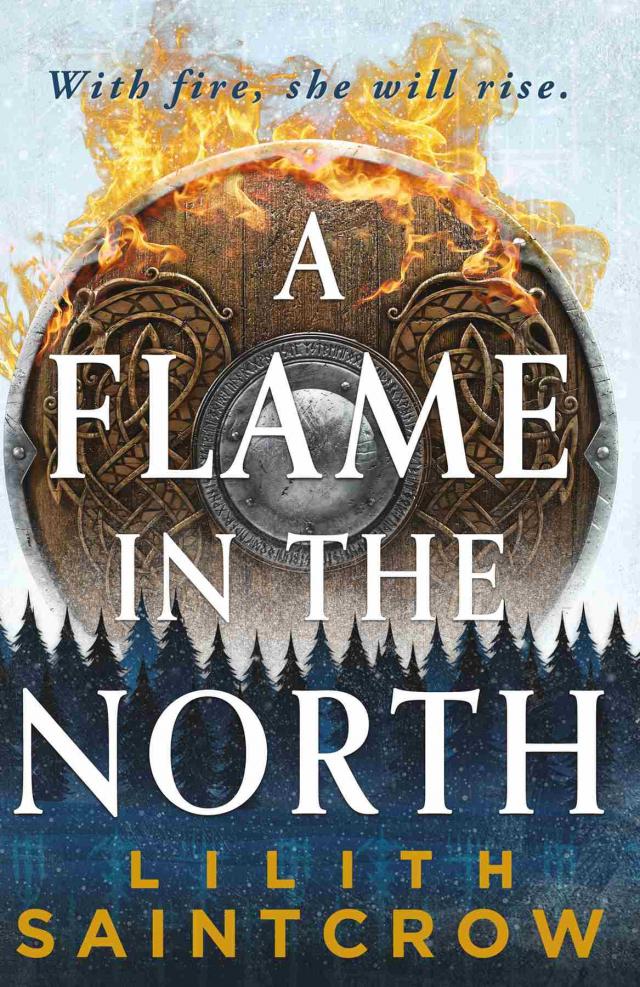


BLACK LAND’S BANE: BOOK 2
by
Lilith Saintcrow
Solveig and her shieldmaiden have finally made it to Waterstone, a fabled city hidden in a world of frost by ancient magic. Shrouded from the Enemy’s gaze, they are safe to rest and regroup—or so they think.
Sol suspects their hosts are not as benevolent as they seem. Whispers race through the halls, hinting at self-serving agendas and secret plots. So, as Sol attempts to harness her awakened magic, she must fight for her voice to be heard or risk being used like a pawn in the greater game.
But the Enemy is always watching and nowhere is truly safe. Before the darkness finds a way in, Sol must decide if she will take up the mantle of power to save not just the home she’s left behind, but the future of the world.
A Brazen Voice
Arneior set me upon my feet with more care than usual, studying my expression. Her freckles glowed, and a healthy flush mounted in her cheeks. The stripe of blue woad upon the left side of her face nearly leapt into thin air, so vivid was it in the noontide. “What a place, Sol. Such gardens. But they live so close—’tis a warren.”
Better than Nithraen. The cave-city had been beautiful indeed, but I preferred open sky, no matter the weather’s fury, to so much rock overhead. “At least we are not underground.” A dry cough clawed at the last word; I denied it.
At the center of Waterstone a great shining palace the color of fresh cream basked in wintry sunshine. Perhaps my anxiety was simply the jarring difference between that light and the temperature, for when the great lamp of day looks pale in a drained sky it should be cold. Yet I did not need my great green mantle, its hood and back lined with fur from a shieldmaid-hunted wolf, nor did I need my sturdy felted overboots.
It was utterly, simply wrong. At least the hideous discordance was somewhat muted here.
The palace was of much grander form than Nithraen’s, and its great silver-chased doors stood open at the head of marble stairs veined with gold. I held fast to Arneior’s arm as we climbed, securely contained in a knot of black-clad Northerners, velvet-wrapped Elder, and the armored guards.
Did they fear us—two lone women, levered from their home and brought here all but unwilling? Eol and Aeredh exchanged meaningful glances as another group of armored Elder appeared, taking charge of visitors with precise movements. Floringaeld did not leave, however—the captain simply slowed, and when he drew level he examined us with much interest, as if he had not seen me and my shieldmaid enough the past few days.
I did not return his gaze, being wholly occupied with placing one foot before the other. Halls folded away upon either side, pillared or lined with bright tapestries and murals I might have been interested in had my head not throbbed so awfully. Arneior glanced down at me several times, especially when we passed gardens and courtyards open to the sky, each with its own plashing, jangling fountain.
“Sol?” Her mouth barely moved; it was the whisper we used in our closet at home, away from prying ears. “You’re pale.”
“So many people.” I had thought the folk of Nithraen beautiful with their shining eyes and bright hair, but every Elder I now saw looked furtive or outright haughty, viewing us with secret disdain and more than a hint of malice. “I can barely breathe.”
“Do you require rest?” Floringaeld stepped nearer; I almost blundered into Arn’s side, flinching from his presence. “Our king gave orders that you be brought, yet at your own pace.”
“I am well enough.” My throat was almost too parched to grant passage to the words; I pushed my shoulders back and set my chin. “This is only the second Elder city I have seen, my lord. Our settlement is small by comparison.” Though fine enough, for it is full of honest folk.
I kept that thought trapped behind gritted teeth, and wished my stomach would cease its rolling.
“Our journey was long, and few our companions.” Blue-eyed Gelad moved forward, almost as if to step between the Elder and me. The Old Tongue, familiar though of archaic Northern accent, pierced my head like an awl forced through heavy leather. “No doubt this is a great change.”
I could have been grateful for his intercession, but there were yet more stairs to climb. I almost wished to be on horseback again; my knees were soft as Albeig’s sops for ill children or the toothless elderly.
At last another set of glittering doors fit for giants swung open, quiet as a whisper, and we were ushered into a vast space full of trees.
Spreading branches met overhead, bearing broad yellow leaves veined with green. I recognized the foliage—the Northerners’ dense sweetish waybread had been wrapped in them, and the forest above Nithraen populated by these smooth greyish trunks as well. In this hall the trees were far more ancient, for even if Arn and I clasped hands their boles would be too large for us to encircle. They grew from a mirrorlike stone floor which imperceptibly turned to soft grass-clad earth where their roots delved, and small pale-blue flowers peeked over their gnarled feet.
I had seen those blossoms before, too—after leaving Redhill and traveling far upon the backs of winter-deep, we had reached a stone-ringed clearing full of them. I strained to remember their name in the Old Tongue, and could not.
That was another wrongness; a volva’s memory does not misplace such small details. My unease turned sharp as a good blade. So did the nausea. Something dire approached, yet I could neither halt nor evade it. A whisper of seidhr trickled into my bones, easing some of the discomfort—but not nearly enough.
“Sol?” Arn, whispering again. I had no attention to spare for her concern.
The center of the space held a slight, natural rise, and upon it stood a simple bench of white stone. Such was the throne of Laeliquaende, and Taeron Goldspear chose no further decoration for his seat. The music here was muted, which was a distinct relief.
Or it might have been, were I not sweating and trembling like a frightened horse.
He was tall and dark-haired, the king of this place, with piercing sky-blue eyes very much like my mother’s. He sat with one leg drawn up, resting an elbow upon it as casually as my brother Bjorn when taking his ease upon a fallen log between practice-ring bouts, and rested his chin upon his hand as he regarded our group. A silver fillet like Aeredh’s clasped his brow, and nearby a bright-haired Elder girl—Naciel his daughter, the treasure of Laeliquaende—with skirts of pale new green like soft early fir-tips set aside a graceful harp. She rested in a nest of pillows, all covered with muted jewel-color velvet. Next to her was a Northerner in the garb of the Elder inhabitants though black as Eol’s cloth, dark of hair and proud of nose, his gaze bearing the same weight as Tarit of Redhill’s.
Not quite seidhr, but very close.
At the king’s left hand stood an Elder man appearing of Aeredh’s age, though that is little indication among their folk. He was another black blot, as if he wished to dress as the wolves of Naras—armor of matte finish, engraved with flowing, near-invisible lines. His eyes showed little difference between pupil and iris, and he wore an air of pronounced vigilance; Maedroth was he, called the Watchful after a star well-beloved by the Elder, and he was Taeron’s nephew.
Their names I learned later. At that moment, I saw only their physical forms as if through a sheet of clear rippling water, distorted as the so-called music. I swayed, pulling upon Arneior’s arm, and the whisper of seidhr became a thunder.
No, please. I cannot.
But fighting this flood was a doomed battle; Idra my teacher would have tweaked one of my braids with ruthless precision. Ride the power, child. Don’t fight it.
But I was so tired, and everything hurt.
“My friend.” Aeredh’s voice should have been comforting—after all, he had carried me upon the last leg of our journey, as if I were a youngling sleepy after a great feast—but it near tore at my cringing nerves. “I bring you Solveig daughter of Gwendelint, alkuine of Dun Rithell, and her shieldmaid Arneior, taken by the Black-Wingéd Ones.”
It was a great honor to be announced thus, presented to an Elder king by the equally royal Crownless himself. I might even have enjoyed it, had my stomach not suddenly plunged and a red-hot wire of pain run through me from scalp to heels.
The black-eyed Elder at the king’s side cocked his dark head, and a shadow lay over him. No, I pleaded silently. I don’t want to see. Stop. My wrists flamed too, as if every bit of ink forced under the skin pinprick-by-pinprick was suddenly full of molten lead.
It was no use. In the great thronehall of Nithraen I had spoken in couplets helpfully provided by a passing spirit, but this was different. Perhaps something about an Elder throne was inimical to me, or provoked seidhr in those who carry the weirding? I could not guess, I knew only the pain.
“Welcome are your friends in my demesnes, son of Aerith.” Taeron’s tone was pleasant, and he used the southron tongue instead of the Old—another signal mark of honor, especially for mortal guests. “So, this is another alkuine? Great indeed is the—”
Agony roared through me, not merely a wire but a heavy swordblade. The seidhr drew me from Arneior’s side, my hand sliding nerveless from her arm, and I took three staggering steps as if mead-drunk upon a festival day.
My head tipped back, my mouth opened. Even submitting to the prophecy-speech granted no relief, for I was ill indeed and had hidden it much as a dog or caged bird will, unwilling to show any vulnerability.
A great brazen voice rose from my lungs, scorched my swell-aching throat, rattled my teeth, and tore past my lips. I was vaguely surprised no blood sprayed forth with it, for it felt as if I bled, a great gout of force rammed through a channel far too narrow.
“Taeron,” it boomed, and the entire hall rattled, darkening. A salt-smelling wind loomed over the trees; their ancient pillars groaned, branch and twig thrash-dancing. A great soughing as of a summer storm in the forest swept the name high, tossing it back into the hall’s cup like dice into a leather container before the gambling begins. “Taeron, my child, I told thee once, and sent one fated to tell thee twice. Now arriveth my final warning.”
The Old Tongue it spoke in, that terrible tone, and the sky over Waterstone turned the color of a fresh bruise. Salt and fish the wind smelled of as it whistled through the white city; I sought to collapse, but the seidhr would not let me. My spine arched, my head thrown back, and Arneior sprang for me, attempting to reach her charge.
She was pushed back, not ungently but clumsily, as if the invisible force inhabiting me for that brief moment did not wish her ill but would brook no interference. Again the voice was drawn forth, this time from my heels as they touched the earth.
“Love not the work of thy hands too much,” it intoned. “Be not so proud of thy House that thou scruple’st to join it to another. Thou know’st my voice, and know’st the truth in thy inmost heart.”
The king had risen, and for a moment I glimpsed a cold blue brilliance about him—for the Elder have seidhr too, though not of our mortal kind, and their subtle selves burn bright-hot. My eyes squeezed shut, tears slicking my cheeks, and for the last time, the voice wrung me like a rag in our housekeeper Albeig’s capable, callused fingers.
“Hope has been offered thee, Taeron. The hour is late; let it not grow later.”
The thing speaking through me—certainly some divinity instead of a mere passing spirit, though at the moment I could not even wonder which—perhaps also tried to be gentle as it lifted up and away like a white bird upon chill salt-freighted breeze. I had only seen the sea with my inner eye, subtle selves freed from my physical body by drugging fumes from Idra’s brass brazier, but its smell was everywhere in that city. For that brief tearing instant I was free of all pain, gliding over the deep cold spear-harbors of the westron shore so far from Dun Rithell.
“Sol! Solveig!” Arn was calling, but I could not answer. Does a pipe feel exhausted when the breath forced through it ceases? I had been used as an instrument, and collapsed at last. A vast soft darkness enfolded me, welcome because it was painless, and the last thing I heard was Aeredh’s voice, the Old Tongue ragged and breathless.
“We passed too close by the Marukhennor; she is in the despair. Fool that I was to not see it.”
For a brief interval I knew nothing, not even to be grateful at the cessation of discomfort. Such was my greeting to Taeron, and little did I guess he knew that voice, having heard it before the Sun rose and a few times thereafter as well.
But I? I landed upon stone floor with bruising force, saved only from skullsplit by Arneior reaching me at last, her spear clattering free as she thrust her hand between my cheek and cool, hard, mirror-glossy stone to cushion the blow.
if you enjoyed
A FLAME IN THE NORTH
look out for
SHIELD MAIDEN
by
Sharon Emmerichs
Fryda has grown up hearing tales of her uncle, King Beowulf, and his spectacular defeat of the monstrous Grendel. Her one desire is to become a shield maiden in her own right, but a terrible accident during her childhood has thwarted this dream. Yet still, somehow, she feels an uncontrollable power begin to rise within herself.
The last thing Fryda wants is to be forced into a political marriage, especially as her heart belongs to her lifelong friend, Theow. However, as foreign kings and chieftains descend upon her home to celebrate Beowulf’s fifty years as the king of Geatland, the partnership begins to seem inevitable.
That is, until, amid the lavish gifts and drunken revelry, a discovery is made that threatens the safety of Fryda’s entire clan—and her own life. Incensed by this betrayal, Fryda resolves to fight for her people no matter the cost. As a queen should. As a shield maiden would.
And as the perilous situation worsens, Fryda’s powers seem to grow only stronger. But she is not the only one to feel the effects of her newfound battle-magic. For, buried deep in her gilded lair, a dragon is drawn to Fryda’s untamed power and is slowly awakening from a long, cursed sleep.…
Prologue
Geatland, in the year 987 CE
On the morning of her thirteenth birthday, Fryda of Clan Waegmunding—daughter of Weohstan and jewel of King Beowulf’s eye—wanted only one good kill. She wished for a sturdy arrow shot straight and true, the rending of flesh under her knife, and the tang of hot blood sending curls of steam into the chill air.
In the pre-dawn darkness, she wriggled her way into trousers pilfered from the laundry the day before. The icy glimmer of stars peeped through the smoke-hole cut into the roof as she pulled on a roughspun tunic and fastened a leather belt around her childishly slim waist. Good, she thought. No one else in the household would stir for another hour at least.
She gathered her wild, butter-coloured curls into thick braids and wound them around her head, hoping the pins would hold, and slid a short seax—a sharp, tapered hunting dagger—under her belt. For a moment she considered fetching Theow from his pallet in the kitchens and asking if he wanted to come with her.
As Theow’s name hovered in her mind, she felt a small frisson shimmer up her spine. Her breath quickened, the hairs on her arms stood up, and her young body woke in ways she did not entirely understand. She nearly surrendered to the rush of temptation that tugged her towards the kitchens, but did not want to risk Theow receiving credit for her hunt. A warrior gets credit for his kills.
Her kills, she thought. Or at least, one kill to prove her prowess at the hunt. One wolf pelt to hang in the mead-hall and call her own.
She grabbed her bow and a quiver of arrows from her wooden chest and crept from the building, trying to be as silent as possible. In the early morning hush, every step, every breath sounded unnaturally loud, and she startled at each rustle and distant birdcall. Her breath misted in the late autumn air, but the nights were not yet cold enough to freeze the dew that pearled on the grass, making everything smell fresh and green.
Fryda made her way towards the western wall, stealing through the burh as quietly as she could. In the hovering darkness of the far-northern autumn, the structures resembled a sprawling village rather than a walled estate. Warm, reddish earthen walls rose in square and rectangular blocks, adorned by thatched, timbered roofs and arched windows set with real glass, sparkling like gemstones. Wooden structures hunkered in rows around an ancient standing stone. The air smelled like salt and brine, and she could hear the distant thunder of waves crashing against the rocky shore.
She nodded to the guards stationed at the gate and they let her pass without question. She had no doubt they would report her early morning exit from the burh to her father, but by that time—she hoped—she would have a fine wolf pelt to placate him.
Fryda padded through a wooded grove outside the stronghold wall, avoiding rustling leaves and noisy twigs. Soon her boots were soaked through and a chill pebbled her skin, but she did not think about turning back. Shield maidens did not stop fighting because of damp feet.
She scanned the ground as she moved, alert for any sign of the beast that had plagued the burh’s hunters since summer’s end. After several cold, breathless moments she spotted the paw prints of an enormous wolf in some soft mud and steadily tracked them westward. They led her out of the woods to the bare, wind-ravaged meadows along the edge of the cliff. Elation filled her, making her feel as if she floated above the ground. She was going to find the wolf. She would find it and kill it and her father would finally see her as a worthy shield maiden. He would finally let her…
Her thoughts rattled out of her head as the earth beneath her shuddered and jerked. Fryda gasped as she staggered, trying to keep her feet. A terrifying roar filled her ears—a sound so monumental she thought Woden himself must have made it. Certainly no wolf could produce such a clamour.
The ground shifted sideways and violently flung her into the grass. A sharp report echoed across the sky, as if the very fabric of the air cracked and tore. The meadow undulated beneath her as though suddenly turned to water, and Fryda clutched the long grass in her fists. The coarse blades tore in her grip as the earth tried to shake her off, like a flea in a dog’s fur.