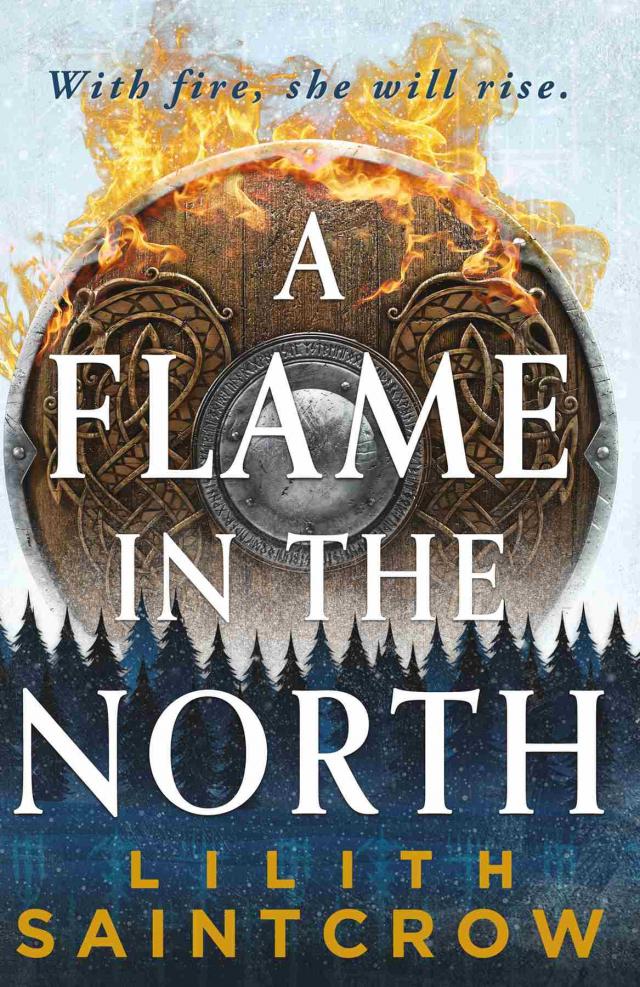
A Flame in the North, page 3


Just like Idra, I nodded. I wish you were here, I thought, and had I heard my teacher’s familiar, pained cackle-laugh riding the wind, I would not have been surprised.
Though I might have flinched at the sound. I do not deny it; my courage has only ever been barely equal to circumstances.
Kolle glided forward too, and the two lifted their lanterns high. The stragglers coming up the long slope to the green would notice the twin lights like eyes upon the Stone, one wavering candle-gold and the other a hard bluish glitter because the flame was held in an Elder-crafted cage.
A mismatched gaze, but it served its purpose. Those it fell upon hurried to snuff or at least muffle their lights. The wind gained fresh strength, tugging at my hood and attempting to lift my skirts. The mantle did its work, though, and I was chilled only by the enormity of what I was about to attempt.
Corag lifted his lantern. His face was turned into an ill spirit’s by the shadows; his cheeks puffed as he blew, and the light went out.
A small child began to cry, deep in the crowd. More restless mutters raced through the assembly; Kolle lifted the Elder lantern. There was a trick to handling it, and I hoped she would teach Isolca before much longer.
The blue light guttered, dying slowly. Starshine limned flying clouds; a bright festival day means a cold night. Yet many would be the children born ten moons from now, lucky infants blessed with the return of sunlight.
Find warmth where you can, Odynn says; even the Allmother knows what a misery cold is.
I had to face the dark wooden pile, my hands aching because they were fists inside fur-edged sleeves. Spending an entire day too busy to dread this meant I did not have even a moment to brace my shield, as the saying goes.
My gaze unfocused. I tried to imagine Idra’s voice. You know what to do, Solveig.
From the dark breast of Tarnarya, a single voice lifted. It was a wolf-cry, and my mantle-hood turned heavier. Perhaps beast or spirit was singing the tale of how a brightspear shieldmaid had hunted a beast to end depredations upon a river people’s livestock, and brought the pelt home to adorn a young volva’s mantle.
Idra would be singing over one last remaining torch before she swung it skyward to purge the old year. I merely had to call the flame from where it lived when unsummoned, that was all.
Sounds simple, does it not, daughter of Gwendelint?
Simple, yes. Not easy, and how Idra used to laugh while teaching me the distinction.
I stared into the darkness, the fear nipping at my fingers, my toes. It brushed the tip of my nose as the wind moaned amid bracken on the green’s edges, kindled a great soughing in the forest cradling the greathall of Dun Rithell, the settlement and outlying steadings sharing its name.
What, in all that blackness, would raise its misshapen head and come for us, should the bonfire not light?
My left hand rose, naked fingers thrust into the wind’s jaws. My breath halted, a familiar pressure mounting behind eyes and breastbone.
Of course nobody truly thought the sun would refuse to rise if the fire remained unlit, and many suspect much of seidhr is misdirection or chicanery, a cunning of hand and eye still worthy of respect even should it not approach true weirding. At the same time, all know the gods both Aesyr and Vanyr, Black-Wingéd valkyra, the hosts of the dead, and passing spirits only occasionally meddle with mortals. Divinities and spirits are usually more than busy with their own affairs; still, a practical, prudent person does their best not to offend even distant neighbors.
For a moment, I was blackly, bleakly convinced that all my practice had been unavailing, all my training a vast prank, and all my marks were going to vanish because I would fail this final test.
A vast hiss filled my skull. A small, still orange point lit in the heart of the big black tower raising before me—or not quite the heart, somewhere around the ankles instead. My concentration almost wavered, but Idra was a thorough teacher, and the fear of a stinging slap to the back of my head before a weary Again, my lady, and do it correctly meant my focus returned, and the bright orange dot widened.
There was a wump as tinder exploded into flame, and a gasp went through those closest to the Stone. I finished exhaling, sharply, and willed the fire to spread. It did not quite hurt, yet it was an effort and my nape was damp by the time the blooming light was no longer in danger of wind-snuffing.
The bonfire was now a yellow-orange star, visible even in the camps across the river. I did not sway, but I did draw my hood further, shadowing my face. Corag and Kolle relit their lanterns with tapers from the blaze and the women began to climb the steps to file past, lighting torch or twist to take home. The new light would go from house to house; a runner was no doubt standing by to bring ceremonial heat and life to my father’s hall.
When the wicker cages burst into flame nothing inside made a sound, though another wolf-howl across the river sounded under a babble of singing, excited chatter, warriors swearing oaths either permanent or yearlong, men and women announcing a god-debt as they climbed down the other side of the Stone upon the wider stairs worked along the rock’s lee.
My pulse returned to its usual pace. I kept my hood high, though many who passed bowed or kissed their fingers in my direction. The wind tore at the flames, but could not kidnap them. After some while Arn reappeared from the head of the stairs, stepping to her usual spot behind my shoulder, for now there were travelers from both downriver and up among the neighbors passing by to gain the new, cleansed light; no few of them studied me critically in the bonfire’s glow.
Yet still, my father did not show himself, nor Bjorn, nor even Astrid.
Ill News
Nothing good comes from the North, especially in winter.
—Southron proverb
Even the laggards had come to collect their new-year light and all others were at table, so there were few indeed treading to the bonfire atop the Stone. Once the drinking was truly underway and the riddles began moving from one bench to the next there would be more visitors, and in the very deepest reaches of night there would be constant traffic bearing fuel for the burning and gifts for the gods, not to mention food and drink brought to those who must hold sworn vigil upon the solstice.
It is a cold duty though an honorable one, and I was glad of the mantle. Arn’s dun overcloak was thick and furred as well; she paced to keep warm, never very far from me. The bonfire’s heat was shredded by rising wind, though I did not have to steady the flame overmuch.
Normally Idra and I would watch together; had Dun Rithell not possessed a wisewoman and apprentice, those with any small seidhr would have taken turns at the bonfire’s side. Though the flame had returned watch must still be kept, and one with weirding on hand to make certain nothing misshapen from the night’s depths—or elsewhere—crept forth to extinguish hope. Once the sun rose the wisewoman could take her ease, not before.
Except Idra was with the Blessed, feasting in a great god-hall or enjoying some amusement she would like better, being of a decidedly solitary bent during her lifetime. Either way, she would pay little attention to mortal problems. Or so I hoped; she had spent her life serving her people, and mine was to be a similar lot.
It was well past feast-time though not yet midnight when a familiar shape slipped up the stairs and made directly for me, weaving between the chance-brought guards like a minnow. Ulfrica daughter of Harrick from over the river was with her, of course, and looked miserably cold in her very fine though not heavy yellow cloak; my sister wore a very sensible hooded and buttoned mantle with her furred boots, and carried my gloves and a hand-pouch as well as a heavy green woolen scarf.
“I brought you bread,” Astrid said, breathlessly. “And news. Oh, I’m so sorry to miss it. Was it terribly difficult?” She peered from her hood, a bright pretty star-maiden with a luminous face, and as usual, I felt a faint weary surprise that I could be related to such a sprite.
“Just difficult enough.” It was the manner of answer Idra might have made; I wrapped the muffler about my neck and pulled my hood up again. It was a distinct improvement, and I could not wait to bury my hands in both gloves and sleeves. Your sister is indeed wondrous fair, Idra had said when I complained of how everyone was ’mazed by Astrid, but she cannot do what you can, and well it behooves you to remember as much. “How many dresses shall we be making with your spoils today?”
But for once, mention of sewing enough to keep us occupied until midsummer failed to brighten her. Astrid’s dark-golden eyebrows had drawn toward each other and Ulfrica pressed close, slipping an arm over my sister’s shoulders, giving me a reproachful look.
“I… I don’t know.” Astrid rubbed at one of her braids, red ribbon threaded through golden hair. “Solveig, listen. Something awful has happened.”
Of course. “I cannot be everywhere at once,” I muttered. “What now?”
“Well, if you had been there, I don’t know how it could have helped.” Astrid shook her head, and her large dark eyes shimmered with incipient tears. She was made of water, Gwendelint’s youngest child. “It was Bjorn. Some man hailed Father, another laughed in my direction, there were words, Bjorn hit one of them, and then—”
Oh, by Hel, I am so sick of this. “And Father owes someone a cup?” Bjorn was always causing some damage, and Father paying restitution. Still, what did everyone expect? Our sire was battle-mad; it was now bred into the line. Astrid’s sons might even gain a double share of the gift.
Dun Rithell was glad enough of Eril’s madness when brigands came, or when petty warlords cast envious looks upon our small prosperity. It could even be said his violent rage upon the field was a gift from Odynn, brought by ravens to an infant’s cradle, or from Uellar the Hunter, who roamed the world before the first sunrise.
“Worse.” Astrid was pale, and her lower lip quivered. I took a closer look at her in the flickering light before glancing at the thin straggling line of latecomers. None of those jostling to relight their hearths whispered, elbowed each other, or cast meaningful glances in our direction. It was almost too chilly for gossip, and that is cold indeed. “Solveig…”
My heart, wiser than me, plunged into my empty belly. “He killed someone.” It wasn’t a far-fetched guess at all, but the instant I said it Astrid blanched afresh.
“Oh, aye.” And there it was, the shadow of fear in her dark gaze as if I had some sooth-knowledge and not simply a working head upon my shoulders. Even those who love a weirdling hold them in caution, as the proverb goes. “A son of a great House in the north. Bjorn hit him, he fell and struck his head upon a stone. There was nothing to be done.”
The bonfire staggered, or maybe I had simply closed my eyes because the disaster was, while not exactly what I had surmised, absolutely within the bounds of possibility and I should have expected it. “Which house?” Owing weregild is not a comfortable thing, and did I know who now required it I could make some guess as to what would be asked for.
“Father knows them, or so I think.” Astrid’s hands were busy at her belt; she drew forth a small package. “Bread and cheese; I toasted it myself. Ulfrica has a skin of ale and Albeig will send much more in some short while. There are guards coming as well; I told Father I would hasten here beforehand. I think Bjorn regrets his rashness, but what else could he do?”
It was the same song I had heard since birth: What else could Bjorn do?
I had a list of things which might have served him better, but it was useless. I gave Astrid the kindest smile I could manage, beckoning Arn close. My shieldmaid, of course, was very interested in the aleskin, and Ulfrica quaked as Arn snatched that coveted object.
“My lady Astrid.” My shieldmaid greeted my sister with a single chin-tip. “I was beginning to think we’d been forgotten.”
I did not quite wince. “A few swallows only, small one, then you must have some bread. Which design do the Northerners bear, Astrid? Not the ones with the rune-mark upon their armor, I hope.” That captain—Uldfang—had a hungry look. Father did not like him either, despite the courteous words exchanged when the black-clad men arrived at the greathall to lay themselves under pax-law for the festival.
A pax Bjorn had broken.
“The… the wolf-ones.” Astrid, her delivery of news and food complete, shivered and drew her cloak closer. “They are very grim, and the one Bjorn… well, he was the younger son of their great lord.”
That is not a pleasant tale. I had seen all the high-ranking travelers both North and South last night at the great welcoming feast, of course—who could not? The wolf-marked ones were dark, though a few bore gazes as clear as my mother’s, and all three groups were tall in plain but high-quality armor. They were upon some pressing business; rumor had not quite provided any believable information about what it entailed.
Father would have given me at least some intimation upon his return from the last of the Althing’s formalities, had not this disaster intervened.
“What of the Northerners? The wolf-ones?” Arn capped the aleskin with a quick motion, then accepted half the cold bread with cheese toasted onto its side. “I did not hear their House’s name, but they are from far away indeed. Almost to the Black Land.”
I suppressed a flare of irritation; the Black Land was either ancient history or a myth. Still, mentioning that blasted, cursèd place was ill done, especially so close to the newborn fire.
Astrid swayed, her eyelids half-dropping as she shivered, and I shook my head. “Take her home, Ulfrica.” Bjorn and I had scared our youngest sibling ruthlessly with tales of the far North’s monsters and the long-dead Great Enemy; she was still young enough to shudder at such amusements. “Don’t let Father send her out again tonight, though we’ll take our dinners as soon as Albeig has time and hands to send them, thank you.”
“They’re sending guards too,” Ulfrica squeaked, and hurried my sister away past the bonfire, stopping only to bob in front of its glow as if she suspected she’d need all the luck she could gain for the rest of the evening, not to mention the year.
“Guards,” Arn muttered, tearing into her bread. I watched my sister reel away in Ulfrica’s care. Astrid, for all her fineness, was not the type to swoon or pretend some ill; she must have been overwhelmed indeed. “Finally. After you had to walk here alone.”
“I am not alone.” At least Father hadn’t sent Bjorn. I might have tipped him into the fire for adding yet another tangle to the festival, one I would no doubt be called upon to sort in some unpleasant fashion. We would have to strip all the roof’s gilding for this. “I have my Arneior. Try to chew instead of just swallowing it.”
“Look to your own dinner, weirdling.” She laughed, turning her head slightly to gaze at the thickening line. Many had now satisfied the first bite of hunger and were coming to make god-offerings; Frestis, Kolle, and their apprentices were at their own feasting, and would not return until just before dawn. “And do not drink all the ale.”
“You were not listening.” I shivered, took a giant mouthful of bread and cheese. It tasted as fine as Fryja’s own baking, for my hunger was sharp.
“What need have I to listen, especially to their babble? You’ll tell me what it means.” She licked at her fingertips, motioning for the aleskin again. “What of the Northerners?”
“Bjorn killed one of them.” I surrendered the ale, knowing she’d leave me at least a swallow, and set myself to the rest of my bread and cheese.
My shieldmaid halted, staring at me as if she suspected some manner of jest. But though I am fond of sharp words and she had been known to make a riddle or two, neither of us prize lightsome speech. “Well,” she said, finally. “What does that mean?”
“Some manner of weregild.” I bent to my own work, for I was hungry. The flame always needs fuel.
I was not wrong. Yet I did not guess how steep the price would be.
Arguments
The gods gave us light and the Enemy gave us war. But we mortals invented the pax, and well we did or we might be crushed between gods and the Allmother’s firstborn. Weregild is a smaller price than death, after all, and many is the marriage made in that fashion.
—Arjeson the Riddler
A good double-hand of my father’s men arrived not long after my sister’s visit, all fully armed and armored despite the festival’s pax. All ten were all old veterans, too, none of the boys I’d grown up with. Perhaps Father meant it as some manner of signal, but I was too cold to care and the bonfire needed more supper, too. Every household had contributed to the blaze, and there were stocks enough to keep it fed until morn.
Or so we hoped. I stared at a heap of sullen coals near the fire’s foot, the scent of roasting and burnt feathers whisked away downwind. Young boys chest-puffed with the importance of their mission brought more wood, arguing good-naturedly about where to place each load.
“My lady.” Flokin was the eldest warrior of my father’s hall, slump-shouldered like a bear and possessed of a great grey beard braided with beads of carven horn. The men took up formation about us, breaking the force of the wind’s winter wailing; Arn stiffened, though none came closer than they should. Thus released, those who had guarded a volva by chance filed past the fire, and would present themselves to Eril for lordly thanks. “Your father would have come to celebrate, but… there is summat unforeseen.”
There might have been an implied insult in the observation; what good was a volva who couldn’t foretell dire woe? Yet the songs, chants, tales, and sagas were brimming-full of idiots like my brother doing things no reasonable seidhr would speak of even if they did foresee, or so it seemed to me that night. “My brother killed a man from the North.” Unease spilled down my back; the mantle’s thickness was little proof against that manner of chill.
It is not uncommon to hear wolves in the hills. To hear them twice upon a winter evening is to be expected. And yet, a wolf-sigil house demanding weregild of my father while their cousins howled?
It did not bode well.