

Jack Vance, page 41
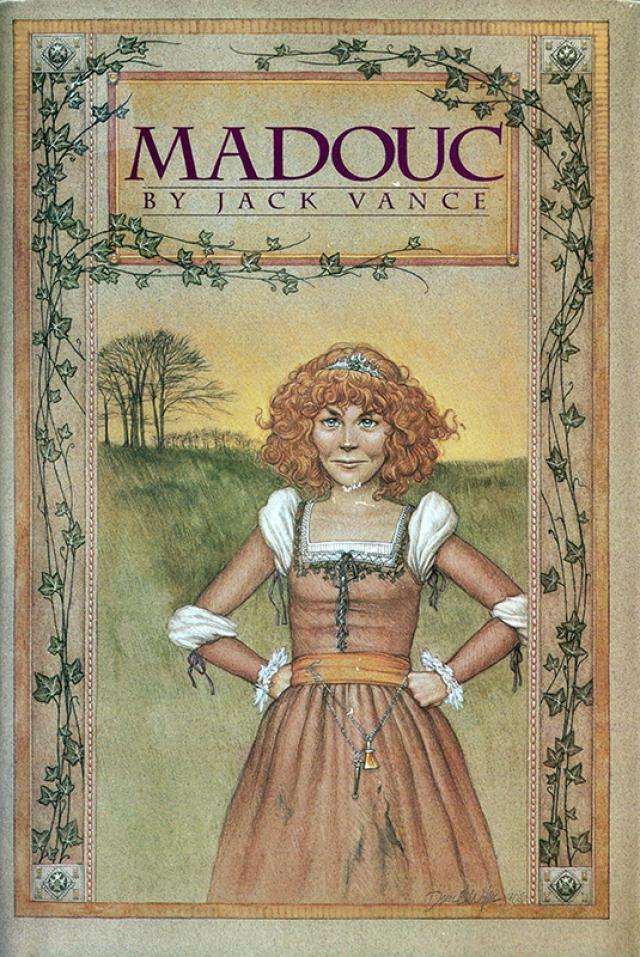


Madouc indicated a bolt of cornflower blue and another of nubbled white linen. “Use this and this. And here: what is this?” She pulled from the case a somewhat scant bolt of dark red velvet, soft of texture, of color so deep as to verge upon black.
“That is a hue known as ‘Black Rose’,” said Hulda in a dispirited voice. “It is quite unsuitable for a person of your age, and also, it is little more than a scrap.”
Madouc paid no heed. “This is a most beautiful stuff. Also, there seems to be just enough to wrap around my skin.”
Hulda said hurriedly: “There is not enough cloth for a proper girl’s gown, with such pleats, flounces, swags, and fullness, as style and modesty dictate.”
“Then I will have a gown without these decorations, because I am ravished by the color.”
Hulda attempted expostulation, but Madouc would not listen. She pointed out that time was limited and that the gown of Black Rose velvet must be cut and sewed before all else, and so it was, despite Hulda’s misgivings. “Truly, the material is scanty! The gown will fit you more explicitly than your age would seem to necessitate.”
“That is as may be,” said Madouc. “I believe the costume will have great charm, and for some strange reason the color is in accord with my hair.”
“I must admit that the gown will probably become you,” said Hulda grudgingly. “If in a manner somewhat premature.”
CHAPTER
TEN
1
The sun rose into a dreary sky, with clouds driving in from the Lir portending storms and rain for the journey to Avallon. Ignoring the dismal prospect, King Casmir and Prince Cassander had ridden from Haidion before dawn, that they might visit Fort Mael along the way. At the castle Ronart Cinquelon, near Tatwillow, where Old Street met Icnield Way, they would rejoin the main party and continue the journey north.
In due course, Queen Sollace, languid and yawning, rose from her bed. She made her breakfast upon porridge and cream, a dozen dates stuffed with soft cheese, and a heartening dish of sweetbreads seethed in milk and cinnamon. During her meal Sir Mungo, the High Seneschal, came to inform her that the royal carriages, escort, equipage, and all else awaited her convenience in the King’s Parade.
Queen Sollace responded with a sad grimace. “Do not remind me, good Sir Mungo! I anticipate only discomfort, bad smells and monotony; why could not the colloquy be called here at Haidion, if only for my sake?”
“As to that, Your Majesty, I cannot say.”
“Ah! What is, is! This I have learned with brutal emphasis over the years! So it is now and I must endure the nuisance with all good grace!”
Sir Mungo bowed. “I will await Your Majesty in the Octagon.”
Sollace was dressed; her hair was coiled and coiffed; her face and hands were refreshed with balm of almonds, and finally she was ready for the journey.
The carriages waited below the terrace, along the King’s Parade. Queen Sollace came from the castle and crossed the terrace, pausing occasionally to address last-minute instructions to Sir Mungo, who responded to each of her requirements with the same urbane equanimity.
Queen Sollace descended to the Parade and was assisted into the royal carriage. She settled herself into the cushions and a robe of baby-fox fur was tucked across her lap.
Madouc then entered the carriage, followed by Lady Tryffyn and Lady Sipple, and last by a certain Damsel Kylas, who had lately been appointed to attend Madouc.
All was in readiness. Queen Sollace nodded to Sir Mungo, who stood back and signalled the heralds. They blew three ‘Royal Retreat’ fanfares, and the cortège moved off across the King’s Parade.
The procession turned up the Sfer Arct, and the company settled itself for the journey. Madouc sat beside Queen Sollace. Facing her was Damsel Kylas, a maiden sixteen years old, of high principles and dedicated rectitude, though Madouc found her tiresome, lacking both charm and wit. Prompted either by vanity or by exaggerated sensitivity, Kylas suspected that all men, young and old, who passed nearby had come to ogle her and perhaps make improper advances. The conviction caused her to bridle and toss her head, whether the man looked in her direction or not. The habit puzzled Madouc, since her thin shoulders and large hips, saturnine face with its long nose, black protuberant eyes and bundles of wiry black curls hanging to each side, like panniers on a donkey, created no image of memorable beauty. It was Kylas’ habit to stare with fixed and unblinking attention at an object of interest. Madouc, sitting opposite, was unable to evade the scrutiny. She thought to fight fire with fire, and for five minutes focused her gaze on the tip of Kylas’ nose, without effect. Madouc became bored, and turned away in defeat.
The procession entered the Arqueers; at the same time the weather which earlier had presaged so poorly, changed; clouds and mist dissolved; the sun shone bright upon the landscape. Queen Sollace said, somewhat complacently: “This morning I prayed that the weather be kind to us, and make our journey safe and pleasant, and so it is.”
Lady Tryffyn, Lady Sipple and Kylas uttered appropriate sounds of wonder and gratification. Queen Sollace arranged a basket of honeyed figs conveniently to hand and spoke to Madouc. “Now, my dear, you may recount all concerning the recovery of the Blessed Grail!”
Madouc looked around the carriage. Kylas stared with owlish intensity; the two court ladies, ostensibly sympathetic, could not mask their hunger for sensation, ultimately to become the precious stuff of gossip.
Madouc turned to Queen Sollace: “Such information, Your Highness, is suited for your royal ears alone! There are secrets which should not be heard by the common folk.”
“Bah!” grunted Sollace. “Lady Tryffyn and Lady Sipple are trusted intimates; they can hardly be described as ‘common folk’! Kylas is a baptized Christian; she has interest in naught but the Blessed Grail itself.”
“So it may be,” said Madouc. “Still, I am constrained.”
“Nonsense! Proceed with your narrative!”
“I dare not, Your Highness! If you wish fully to understand my prudence, come with me, you and I together, deep into the Forest of Tantrevalles.”
“Alone? Without an escort? That is insanity.” Sollace pulled on the bell cord; the carriage halted and a liveried groom jumped down to look through the window. “What are Your Majesty’s needs?”
“These ladies will ride for a space in one of the other carriages. Narcissa, Dansy, Kylas: be good enough to oblige me in this regard. As Madouc indicates, there may be matter here unsuited for general dissemination.”
With poor grace the two ladies and Damsel Kylas moved to another carriage. Madouc quickly took the place vacated by Lady Sipple, across from Queen Sollace, and the procession once more set off up the Sfer Arct. “Now then,” said Sollace, munching a fig and paying no heed to Madouc’s move. “You may proceed. In all candour, I prefer to hear your tale in privacy. Ignore no detail!”
Madouc saw no reason to conceal any aspect of her adventures. She told the tale to the best of her recollection, and succeeded in arousing the wonderment of Queen Sollace. At the end she eyed Madouc with something like awe. “Amazing! When half of your blood derives from Faerie, do you not feel a longing to rejoin the shee?”
Madouc shook her head. “Never. If I had remained at the shee, to eat fairy bread and drink fairy wine, then I would grow into something close to a fairy, except that mortality would come upon me more quickly. At this time, almost all fairies have taints of human blood in their veins; so they are known as halflings. In time, so it is said, the race will mingle into the ruck and the fairies will be gone. Among the human men and women, no one will realize that their quirks and oddities come from the fairy trace. As for me, I am largely mortal, and I cannot change. So I will live and die, as will my children, and soon the flow of Faerie will be forgotten.”
“Just so, and to the greater glory of the Faith!” stated Sollace. “Father Umphred tells us that the folk of Forest Tantrevalles are devils and satanic imps, of lesser or greater venality. Along with heretics, pagans, atheists, impenitents and idolaters, all such folk are destined for the lowest pits of Hell!”
“I suspect that he is wrong,” said Madouc.
“Impossible! He is learned in all phases of theology!”
“Other doctrines exist, and other learned men.”
“They are all heretical, and all false!” declared Queen Sollace. “Logic compels this conviction! Listen now! Where would be the benefits for True Believers if everyone were to share alike in the glories of the hereafter? That is carrying generosity too far!”
Madouc was forced to admit the logic of the remark. “Still, I have not studied the subject, and my opinions count for little.”
When at last Queen Sollace had discussed the affair to her satisfaction, she halted the cortège once again, and allowed Kylas and the Ladies Tryffyn and Sipple, all somewhat disgruntled, back into the carriage. Madouc slid over to the side of the seat. Lady Tryffyn and Kylas took their old places and Lady Sipple perforce occupied Madouc’s original seat, opposite Kylas, to Madouc’s great satisfaction.
Queen Sollace said: “Princess Madouc was correct in her assumptions. She spoke of certain matters which clearly are best not made public.”
“It must be as Your Majesty asserts,” said Lady Tryffyn with a pursed mouth. “It should be noted, however, that I, at least, am notorious for my discretion.”
Lady Sipple said with dignity: “At Deep Daun Keep, where I maintain my household, we are haunted by three ghosts. They come by the dark of the moon to tell their woes. They have entrusted me with highly intimate details, without restraint.”
“So goes the world!” said Queen Sollace heavily. “None of us is wise beyond all others. Even Madouc admits to this.”
Kylas spoke in her quiet, somewhat throaty voice: “I am pleased to discover that the trait of modesty is included among Princess Madouc’s many virtues.”
“Wrong, and wrong again,” said Madouc in a bored monotone. “I have few virtues, and modesty is not one of them.”
“Ha hah!” said Queen Sollace. “So it must be, since among all others Madouc knows herself best!”
2
While King Casmir and Prince Cassander visited the stronghold Fort Mael, Queen Sollace, with her party, rested at Ronart Cinquelon, seat of Thauberet, Duke of Moncrif.
King Casmir and Cassander inspected the facilities at Fort Mael, reviewed troops, and in general were satisfied with what they saw. They departed the fortress during the early afternoon, and by dint of hard riding reached Ronart Cinquelon at dusk.
In the morning King Casmir discovered that Madouc was included among the company, coming upon her as she was about to climb into the carriage. Casmir stopped short in surprise and displeasure. Madouc performed a polite curtsey. “Good morning, Your Majesty.”
For a moment Casmir seemed on the verge of uttering a harsh command, but he turned on his heel and strode away.
Madouc smiled thoughtfully and climbed into the carriage.
The party set off up Icnield Way. The cortège now included King Casmir, Prince Cassander, the carriage, a pair of royal equerries, an escort of six knights, and a group of four men-at-arms who rode at the rear of the column and kept themselves apart from the others. Madouc thought these four a singular group, quite deficient in military discipline, casual and almost disrespectful in their attitudes. Odd, thought Madouc. After a few miles King Casmir became annoyed with their conduct and sent Cassander back to have a word with them, after which they rode in better order.
On the third day after leaving Ronart Cinquelon the company arrived at Cogstone Head on the Cambermouth. A ferry propelled first in one direction then the other, by the ebb and flood of the tide, conveyed the company across the water to the northern shore. An hour later the party arrived at Avallon, the City of Tall Towers.
At the city gates the party was met by a detachment of King Audry’s Elite Guards, splendid in uniforms of gray and green, with helmets of glistening silver. To the music of fifes, pipes and drums, the party from Lyonesse was escorted along a wide boulevard, through the formal gardens at the front of Falu Ffail, to the main portal. King Audry came forward to pronounce a stately welcome.
The royal party was then conducted to a set of chambers surrounding a garden courtyard in the east wing of the palace, with orange trees at the corners and a fountain at the center. Madouc’s quarters were luxurious beyond any she had yet known. A heavy carpet of green plush covered the floor of her parlour; the furniture had been constructed to a light and graceful style, enamelled white and upholstered with blue and green cushions. On two of the walls hung painted representations of nymphs at play in an Arcadian landscape; on a side table a blue majolica vase displayed a bouquet of mixed flowers. Madouc found the total effect both unusual and pleasing. In addition to the parlour the suite included a bedchamber, a bathroom with fixtures carved from pink porphyry and a dressing room with a large Byzantine mirror affixed to the wall. Shelves displayed a variety of perfumes, oils and essences.
Madouc discovered only a single disadvantage to the chambers: the fact that Kylas had been assigned quarters adjacent to her own, with a door opening into her parlour. For whatever reason, Kylas pursued her duties with full dedication, as if keeping a vigil. Wherever Madouc moved, the brilliant black gaze followed her.
Madouc finally sent Kylas on an errand. Waiting only until Kylas had disappeared from view, Madouc ran from the chambers and with all speed consonant with dignity departed the east wing.
She found herself in Falu Ffail’s main gallery, which, like that of Haidion, ran the length of the palace. Arriving in the reception hall, she approached a portly young under-chamberlain, proud in his gray and green livery and loose flat cap of scarlet velvet, which he wore stylishly canted to the right so that it draped over his right ear. He took favorable note of the slender maiden with the copper-gold curls and sky-blue eyes and was pleased to inform her that neither King Aillas nor Prince Dhrun had arrived. “Prince Dhrun will be here shortly; King Aillas has been delayed and may not arrive until tomorrow.”
“How so?” asked Madouc in puzzlement. “Why do they not come together?”
“It is a complicated business. Prince Dhrun arrives aboard his ship the Nementhe on which he serves as first officer. King Aillas, so it appears, has been delayed at Domreis. His young queen is eight months heavy with child, and there was some question as to whether King Aillas would come at all. But we have had late report that he is on his way. Prince Dhrun, however, should be on hand at any moment; his vessel entered the Cambermouth this morning on the tide.”
Madouc turned to look about the hall. At the far end, an archway opened into an atrium illuminated by high glass skylights. To either side stood monumental statues, ranked in a pair of opposing rows.
The under-chamberlain observed the direction of Madouc’s gaze. “You are looking into the Court of Dead Gods. The statues are very old.”
“How is it known that these gods are dead? Or truly dead, for that matter?”
The under-chamberlain gave a whimsical shrug. “I have never gone deeply into the subject. Perhaps when gods are no longer venerated, they fade, or dissipate. The statues yonder were worshipped by the ancient Evadnioi, who preceded the Pelasgians. In Troicinet Gaea is still reckoned the Great Goddess, and in the sea near Ys is a temple dedicated to Atlante. Perhaps these gods are not dead after all. Would you like to see them more closely? I can spare a few moments, until the next party of dignitaries arrives.”
“Why not! Kylas will surely not come to seek me among the ‘Dead Gods’.”
The under-chamberlain took Madouc into the Court of Dead Gods. “See yonder! There stands Cron the Unknowable, across from his terrible spouse Hec, the Goddess of Fate. For a game they created the difference between ‘yes’ and ‘no’, then, once again becoming bored, they ordained the distinction between ‘something’ and ‘nothing’. When these diversions palled, they opened their hands and through their fingers let trickle matter, time, space and light, and at last they had created enough to hold their interest.”
“All very well,” said Madouc. “But where did they learn this intricate lore?”
“Aha!” said the under-chamberlain wisely. “That is where the mystery begins! When theologians are asked as to the source of Cron and Hec, they pull at their beards and change the subject. It is certainly beyond my understanding. We know for a fact that only Cron and Hec are father and mother to all the rest. There you see Atlante, there Gaea; there is Fantares, there Aeris. These are the divinities of water, earth, fire and air. Apollo the Glorious is God of the Sun; Drethre the Beautiful is Goddess of the Moon. There you see Fluns, Lord of Battles; facing him is Palas, Goddess of the Harvest. Finally: Adace and Aronice stand in opposition, as well they might! For six months of each year Adace is the God of Pain, Cruelty and Evil, while Aronice is the Goddess of Love and Kindness. At the time of the equinoxes they change roles and for the next six months, Adace is the God of Bravery, Virtue and Clemency, while Aronice is the Goddess of Spite, Hatred and Treachery. For this reason they are known as ‘The Fickle Pair’.”
“Ordinary folk change by the hour, or even by the minute,” said Madouc. “By comparison, Adace and Aronice would seem to be steadfast. Still, I would not care to be a member of their household.”
“That is an astute observation,” said the under-chamberlain. He inspected her once again. “Am I mistaken, or might you be the distinguished Princess Madouc of Lyonesse?”
“So I am known, at least for the moment.”
The under-chamberlain bowed. “You may know me as Tibalt, with the rank of esquire. I am happy to assist Your Highness! Please advise me if I may continue to be of service!”
Madouc asked: “From sheer curiosity, where is the table Cairbra an Meadhan?”
Tibalt, with a brave flourish, pointed his finger. “The portal yonder leads into the Hall of Heroes.”
Madouc said: “You may conduct me to this hall, if you will.”


