

Jack Vance, page 12
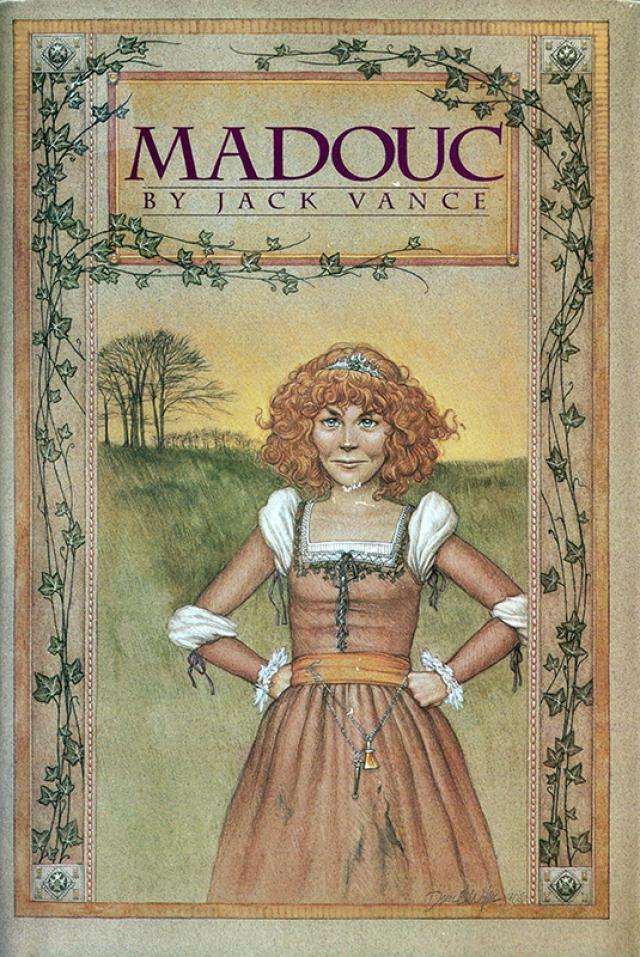


“No matter! You will be pressing your bottom against it, not your eyes! Be seated, if you will!”
“This is the most uncomfortable throne in the world!”
“So it may be. Still, do not squirm around so, as if already you wished to visit the privy.”
“For a fact, I do.”
“Why did you not think of the matter before? There is no time for that now. The king and queen are entering the chamber!”
“You may be sure that both have emptied themselves to their heart’s content,” said Madouc. “I want to do the same. Is that not my privileged right, as a royal princess?”
“I suppose so. Hurry, then.”
Madouc went off without haste, and was in no hurry to return. Meanwhile the king and queen moved slowly across the hall, pausing to exchange a word or two with especially favored personages.
In due course Madouc returned. With an opaque glance toward Lady Desdea she sat upon the gilt and ivory throne, and after a long-suffering look up toward the ceiling, she settled herself.
The king and queen took their places; Prince Cassander entered from the side, wearing a fine buff jacket, breeches of black twill embroidered with gold thread, a shirt of white lawn. He marched briskly across the hall, acknowledging the salutes of friends and acquaintances with debonair gestures, and took his place to the left of King Casmir.
Sir Mungo of Hatch, the Lord High Seneschal, came forward. A pair of heralds blew an abbreviated fanfare, the ‘Apparens Regis’, on the clarions and the hall became silent.
In sonorous tones Sir Mungo addressed the assemblage: “I speak with the voice of the royal family! We bid you welcome to Sarris! We are joyful that you may share with us this most felicitous occasion—to wit: the eighteenth birthday of our beloved Prince Cassander!”
Madouc scowled and dropped her chin so that it rested on her clavicle. On sudden thought, she glanced sidewise and met the ophidian stare of Lady Desdea. Madouc sighed and gave a small despairing shrug. As if with great effort, she straightened in the chair and sat erect.
Sir Mungo concluded his remarks; the heralds blew another brief fanfare, and so commenced the reception. As the guests stepped forward, Sir Mungo called out their names and degrees of nobility; the persons so identified paid their respects first to Prince Cassander, then to King Casmir, then to Queen Sollace and finally, in more or less perfunctory style, to Princess Madouc, who responded, generally with leaden disinterest, in a manner only barely acceptable to Queen Sollace and Lady Desdea.
The reception continued for what seemed to Madouc an eternity. Sir Mungo’s voice droned on at length; the gentlemen and their ladies passing before her began to look much alike. At last, for entertainment, Madouc began matching each newcomer with a beast or bird, so that this gentleman was Sir Bullock and that one Sir Weasel, while here was Lady Puffin and there was Lady Titmouse. On sudden thought Madouc looked to her right, where Lady Crow watched her with minatory eyes, then left, where sat Queen Milkcow.
The game palled. Madouc’s haunches began to ache; she squirmed first to one side, then the other, then slouched back into the depths of the throne. By chance she met Lady Desdea’s stare, and for a moment watched the angry signals with bland wonder. At last, with a painful sigh, Madouc squirmed herself once again erect.
With nothing better to do, Madouc looked around the hall, mildly curious as to which of the gentlemen present might be Prince Bittern of Pomperol, whose good opinion Lady Desdea considered so necessary. Perhaps he had already presented himself without her taking notice. Possible, thought Madouc. If so, she had surely failed to charm Prince Bittern, or win his admiration.
By the wall stood three youths, all evidently of high estate, in conversation with a gentleman of intriguing appearance though, if subtle indications were to be trusted, of no exalted rank. He was tall, spare, with short dust-colored locks clustered close around a long droll face. His bright gray eyes were alive with vitality; his mouth was wide and seemed to be compressed always against a quirk of inner amusement. His garments, in the context of the occasion, seemed almost plain; despite his apparent lack of formal rank, he carried himself with no trace of deference for the noble company in which he found himself. Madouc watched him with approval. He and the three youths, so it seemed, had only just arrived; they still wore the garments in which they had traveled. The three were of an age to be the princes Lady Desdea had mentioned. One was gaunt, narrow-shouldered and ungainly, with lank yellow hair, a long pale chin and a drooping woebegone nose. Could this be Prince Bittern? At this moment he turned to dart a somewhat furtive glance toward Madouc, who scowled, annoyed to be caught looking in his direction.
The press in front of the royal dais diminished; the three youths bestirred themselves and came forward to be presented. Sir Mungo announced the first of the three and Madouc’s pessimism was validated. In orotund accents Sir Mungo declared: “We are honoured by the presence of the gallant Prince Bittern of Pomperol!”
Prince Bittern, attempting an easy camaraderie, saluted Prince Cassander with a feeble smile and a jocular signal. Prince Cassander, raising his eyebrows, nodded politely, and inquired as to Prince Bittern’s journey from Pomperol. “Most pleasant!” declared Prince Bittern. “Most pleasant indeed! Chalmes and I had some unexpected companionship along the way: excellent fellows both!”
“I noticed that you had come in company.”
“Yes, quite so! We had a merry time of it!”
“I trust that you will continue to enjoy yourself.”
“Indeed I shall! The hospitality of your house is famous!”
“It is pleasant to hear this.”
Bittern moved on to King Casmir, while Cassander turned his attention to Prince Chalmes of Montferrone.
Prince Bittern was greeted graciously by both King Casmir and Queen Sollace. He then turned to face Madouc with barely concealed curiosity. For a moment he stood stock-still, at a loss as to what tone to take with her.
Madouc watched him expressionlessly. At last Prince Bittern performed a bow, combining half-hearted gallantry with a trace of airy condescension. Since Madouc was only half his age and barely at the edge of adolescence, bluff facetiousness seemed in order.
Madouc was neither pleased nor impressed by Prince Bittern’s mannerisms, and remained pointedly unresponsive to his lame jocularities. He bowed once more and moved quickly away.
His place was taken by Prince Chalmes of Montferrone: a stocky youth, short of stature, with coarse straight soot-black hair and a complexion marred by pocks and moles. By Madouc’s calculation, Prince Chalmes could be reckoned only marginally more ingratiating than Prince Bittern.
Madouc looked at the third of the group, now paying his respects to Queen Sollace. In her preoccupation with Prince Bittern and Prince Chalmes, she had not attended Sir Mungo’s announcement; still she seemed to recognize this youth; somewhere, so she was assured, she had known him before. His stature was about average; he seemed easy and quick, sinewy rather than heavy of muscle, with square shoulders and narrow flanks. His hair was golden-brown, cut short across the forehead and ears; his eyes were gray-blue and his features were crisp and regular. Madouc decided that he was not only handsome but undoubtedly of a pleasant disposition. She found him instantly likeable. Now if this had been Prince Bittern, the prospect of betrothal would not seem so utterly tragic. Not welcome, of course, but at least thinkable.
The youth spoke reproachfully: “You do not remember me?”
“I do,” said Madouc. “But I can’t remember when or where. Tell me.”
“We met at Domreis. I am Dhrun.”
3
Tranquillity had come to the Elder Isles. From east to west, from north to south, throughout the numerous islands—after turbulent centuries of invasion, raid, siege, treachery, feud, rapine, arson and murder—town, coast and countryside alike were at peace.
Two isolated localities were special cases. The first of these was Wysrod, where King Audry’s diffident troops marched up and down the dank glens and patrolled the stony fells in their efforts to defeat the coarse and insolent Celts, who jeered from the heights and moved through the winter mists like wraiths. The second node of trouble affected the highlands of North and South Ulfland, where the Ska outcast Torqual and his band of cutthroats committed atrocious crimes as the mood came upon them.
Otherwise the eight realms enjoyed what was at least a nominal amity. Few folk, however, considered the peace other than temporary and highly fragile. The general pessimism was based upon King Casmir’s known intent to restore the throne Evandig and the Round Table, Cairbra an Meadhan—otherwise known as the Board of Notables—to its rightful place in the Old Hall at Haidion. King Casmir’s ambitions went farther: he intended to bring all the Elder Isles under his rule.
Casmir’s plans were clear and almost explicit. He would strike hard into Dahaut, and hope to win a quick, easy and decisive victory over King Audry’s enfeebled forces. Casmir would then merge the resources of Dahaut with his own and deal with King Aillas at his leisure.
Casmir was given pause only by the policy of King Aillas, whose competence Casmir had come to respect. Aillas had asserted that the safety of his own realm, which now embraced Troicinet, the Isle of Scola, Dascinet, North and South Ulfland, depended upon the separate existence of both Dahaut and Lyonesse. Further, he had let it be known that in the event of war, he would instantly range himself on the side of the party under attack, so that the aggressor must infallibly be defeated and his realm destroyed.
Casmir, assuming an attitude of benign indifference, merely intensified his preparations: reinforcing his armies, strengthening his fortresses and establishing supply depots at strategic points. Even more ominous, he gradually began to concentrate his power in the northeast provinces of Lyonesse, though the process was sufficiently deliberate that it could not be considered a provocation.
Aillas noted these events with foreboding. He had no illusions in regard to King Casmir and his objectives; first, he would bring Pomperol and Blaloc into his camp either through alliance, facilitated by a royal marriage, or perhaps through intimidation alone. By such a process he had absorbed the old kingdom of Caduz, now a province of Lyonesse.
Aillas decided that Casmir’s ominous pressure must be counteracted. To this end he dispatched Prince Dhrun with a suitable escort of dignitaries first to Falu Ffail at Avallon, thence to confer with bibulous King Milo at Twissamy in Blaloc, then to King Kestrel’s court at Gargano in Pomperol. In each instance, Dhrun delivered the same message, asserting the hope of King Aillas for continued peace, and promising full assistance in the event of attack from any quarter. In order that the declaration should not be considered provocative, Dhrun had been instructed to make the same pledge to King Casmir of Lyonesse.
Dhrun had long been invited to Prince Cassander’s birthday celebration and had returned a conditional acceptance. As it happened, his mission went expeditiously and so, with time to spare, Dhrun set off at best speed toward Sarris.
The journey took him down Icnield Way to Tatwillow Town on Old Street; here he took leave of his escort, who would continue south to Slute Skeme and there take ship to Domreis across the Lir. Accompanied only by his squire Amery, Dhrun rode westward along Old Street to the village Tawn Twillet. Leaving Amery at the inn, he turned aside and rode north up Twamble Lane, into the Forest of Tantrevalles. After two miles he came out on Lally Meadow, where Trilda, the manse of Shimrod the Magician, was situated at the back of a flower garden.
Dhrun dismounted at the gate which gave upon the garden. Trilda was silent; a wisp of smoke from the chimney, however, indicated that Shimrod was in residency. Dhrun pulled on a dangling chain, to prompt a reverberating chime to sound from deep inside the manse.
A minute passed. As Dhrun waited, he admired the garden, which he knew to be tended during the night by a pair of goblin gardeners.
The door opened; Shimrod appeared. He welcomed Dhrun with affection and took him into the manse. Shimrod, so Dhrun learned, had been making ready to depart Trilda on business of his own. He agreed to accompany Dhrun first to Sarris, and then on to Lyonesse Town. Here they would go their separate ways: Dhrun across the Lir to Domreis, Shimrod to Swer Smod, Murgen’s castle on the stony flanks of the Teach tac Teach.
Three days passed by, and the time came to depart Trilda. Shimrod set out guardian creatures to protect the manse and its contents from marauders, then he and Dhrun rode away through the forest.
At Tawn Twillet they encountered another party on the route to Sarris, consisting of Prince Bittern of Pomperol and Prince Chalmes of Montferrone, with their respective escorts. Dhrun, his squire Amery, and Shimrod joined the company and all travelled onward together.
Immediately upon their arrival at Sarris they were conducted to the Great Hall, that they might participate in the reception. They went to stand at the side of the hall, waiting for an opportunity to approach the dais. Dhrun took occasion to study the royal family, whom he had not seen for several years. King Casmir had changed little; he was as Dhrun remembered him: burly, florid; his round blue eyes as cold and secret as if formed of glass. Queen Sollace sat like a great opulent statue, and somewhat more massive than the image in Dhrun’s recollection. Her skin, as before, was as white as lard; her hair, rolled and piled on top of her head, was a billow of pale gold. Prince Cassander had become a swashbuckling young gallant: vain, self-important, perhaps a trifle arrogant. His appearance had changed little; his curls were as brassily yellow as ever; his eyes, like those of King Casmir, were round, an iota too close together, and somewhat minatory, or so it seemed.
And there, at the end of the dais, sat Princess Madouc, bored, aloof, half-sulking and clearly longing to be elsewhere. Dhrun studied her a moment or two, wondering how much she knew in regard to the facts of her birth. Probably nothing, he surmised; who would inform her? Certainly not Casmir. So there sat Madouc, oblivious to the fairy blood which ran in her veins and which so noticeably set her apart from all the others on the dais. Indeed, thought Dhrun, she was a fascinating little creature, and by no means ill-favored.
The press at the royal dais diminished; the three princes went to present themselves to their hosts. Cassander’s greeting to Dhrun was crisp but not unfriendly: “Ah, Dhrun, my good fellow! I am pleased to see you here! We must have a good chat before the day is out; certainly before you leave!”
“I will look forward to the occasion,” said Dhrun.
King Casmir’s manner was more restrained, and even somewhat sardonic. “I have received reports in regard to your travels. It appears that you have become a diplomat at a very early age.”
“Hardly that, Your Majesty! I am no more than the messenger of King Aillas, whose sentiments to you are the same as he has extended to the other sovereigns of the Elder Isles. He wishes you a long reign and continued enjoyment of the peace and prosperity which now comforts us all. He further pledges that if you are wantonly attacked or invaded, and stand in danger, he will come to your aid with the full might of his united realms.”
Casmir gave back a curt nod. “The undertaking is generous! Still, has he considered every contingency? Does he not have the slightest qualm that a pledge of such scope might in the end prove too far-reaching, or even dangerous?”
“I believe he feels that when peace-loving rulers stand firmly united against an aggressive threat, they ensure their mutual safety, and that danger lies in any other course. How could it be otherwise?”
“Is it not obvious? There is no predicting the future. King Aillas might someday find himself committed to excursions far more perilous than any he now envisions.”
“No doubt that is possible, Your Majesty! I shall report your concern to King Aillas. At the moment we can only hope that the reverse is a more probable event, and that our undertaking will help to keep the peace everywhere across the Elder Isles.”
King Casmir said tonelessly: “What is peace? Balance three iron skewers tip to tip, one upon the other; at the summit, emplace an egg, so that it too poises static in mid-air, and there you have the condition of peace in this world of men.”
Dhrun bowed once more and moved on to Queen Sollace. She favored him with a vague smile and a languid wave. “In view of your important affairs, we had given up hope of seeing you.”
“I did my best to arrive on time, Your Highness. I would not like to miss so happy an occasion.”
“You should visit us more often! After all, you and Cassander have much in common.”
“That is true, Your Highness. I will try to do as you suggest.”
Dhrun bowed and moved aside, and found himself facing Madouc. Her expression, as she looked at him, was blank.
Dhrun spoke reproachfully: “You do not remember me?”
“I do—but I can’t remember when or where. Tell me.”
“We met at Domreis. I am Dhrun.”
Madouc’s face came alive with excitement. “Of course! You were younger!”
“And so were you. Noticeably younger.”
Madouc turned a quick glance toward Queen Sollace. Leaning back in her throne, she was speaking over her shoulder to Father Umphred.
Madouc said: “We met even before, long ago, in the Forest of Tantrevalles. At that time we were the same age! What do you think of that?”
Dhrun stared dumbfounded. At last, trying to keep his voice light, he said: “That meeting I do not recall.”
“I expect not,” said Madouc. “It was of very short duration. Probably we no more than looked at each other.”
Dhrun grimaced. This was not a topic to be bruited about within the hearing of King Casmir. At last he found his voice. “How did you chance upon this extraordinary notion?”
Madouc grinned, clearly amused by Dhrun’s perturbation. “My mother told me. You may rest easy; she also explained that I must keep the secret secure.”
Dhrun heaved a sigh. Madouc knew the truth—but how much of the truth? He said: “Whatever the case, we can’t discuss it here.”


