

Jack Vance, page 4
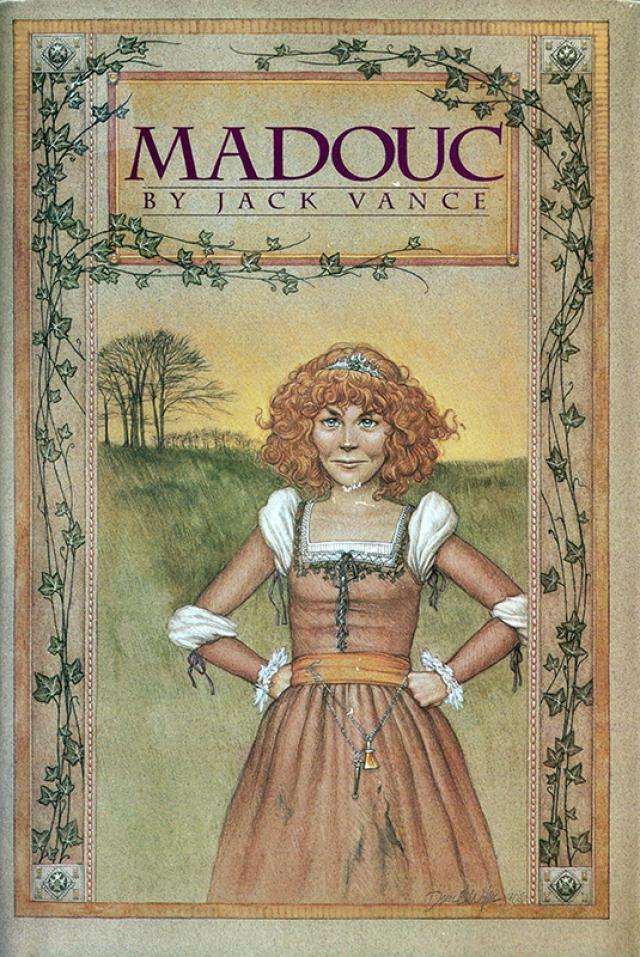


As always, the questions brought no answers, and his bafflement remained. As for Madouc, she had long been accepted as the daughter of the Princess Suldrun, and could not now be disavowed. To legitimize her presence, a romantic tale had been concocted, of a noble knight, secret trysts in the old garden, marriage pledges exchanged in the moonlight, and at last the baby who had become the delightful little princess, darling of the court. The tale was as good as any, and for a fact corresponded closely with the truth—save, of course, for the identity of the baby. As to the identity of Suldrun’s lover, no one knew or cared any longer, except King Casmir, who in his rage had dropped the unfortunate young man into an oubliette without so much as learning his name.
For Casmir, Princess Madouc represented only an exasperation. According to accepted lore, fairy children, when nurtured upon human food and living in human surroundings, gradually lost their halfling cast and were assimilated into the realm of mortals. But sometimes other tales were heard, of changelings who never crossed over, and remained odd wild beings: fickle, sly and cantankerous. Casmir occasionally wondered which sort might be the Princess Madouc. Indeed she differed from other maidens of the court, and at times displayed traits which caused him perplexity and uneasiness.
At this time Madouc still knew nothing of her true parentage. She believed herself the daughter of Suldrun: so she had been assured; why should it be otherwise? Even so, there were discordant elements in the accounts presented by Queen Sollace and the ladies appointed to train her in court etiquette. These were Lady Desdea and Lady Marmone. Madouc disliked and distrusted both; each thought to change her in one way or another, despite Madouc’s resolve to remain as she was.
Madouc was now about nine years old, restless and active, long of leg, with a boy’s thin body and a girl’s clever pretty face. Sometimes she confined her mop of copper-gold curls with a black ribbon; as often as she allowed it to tumble helter-skelter across her forehead and over her ears. Her eyes were a melting sky-blue, her mouth was wide, and jerked, twisted or drooped to the flux of her feelings. Madouc was considered unruly and willful; the words ‘fantastical’, ‘perverse’, ‘incorrigible’, were sometimes used to describe her temperament.
When Casmir first discovered the facts of Madouc’s birth, his immediate reaction was shock, then incredulity, then fury so extreme that it might have gone badly for Madouc had her neck been within reach of Casmir’s hands. When he became calm, he saw that he had no choice but to put a good face on the situation; in not too many years Madouc no doubt could be married advantageously.
Casmir departed the Room of Sighs and returned toward his private chambers. The route led him across the back elevation of the King’s Tower, where the corridor became a cloistered way overlooking the service yard from a height of twelve feet or so.
Arriving at the portal which gave on the cloisters, Casmir stopped short at the sight of Madouc. She stood in one of the arched openings, poised on tiptoe so that she could peer over the balustrade down into the service yard.
Casmir paused to watch, frowning in that mixture of suspicion and displeasure which Madouc and her activities often aroused in him. He now took note that on the balustrade beside Madouc’s elbow rested a bowl of rotten quinces, one of which she held delicately in her hand.
As Casmir watched she drew back her arm and threw the quince at a target in the yard below. She watched for an instant, then drew back, choking with laughter.
Casmir marched forward. He loomed above her. “What mischief do you now contrive?”
Madouc jerked around in startlement, and stood wordlessly, head tilted back, mouth half open. Casmir peered down through the arch into the service yard. Below stood Lady Desdea, staring up in a fury, while she wiped fragments of quince from her neck and bodice, her stylish tricorn hat askew. At the sight of King Casmir looking down from above, her face sagged in astonishment. For a moment she stood frozen into immobility. Then, dropping a perfunctory curtsey, she settled her hat and hurried across the yard into the castle.
Casmir slowly drew back. He looked down at Madouc. “Why did you throw fruit at Lady Desdea?”
Madouc said artlessly: “It was because Lady Desdea came past first, before Lady Marmone.”
“That is not relevant to the issue!” snapped King Casmir. “At this moment Lady Desdea believes that I pelted her with bad fruit.”
Madouc nodded soberly. “It may be all for the best. She will take the reprimand more seriously than if it came mysteriously, as if from nowhere.”
“Indeed? And what are her faults, that she deserves such a bitter reproach?”
Madouc looked up in wonder, her eyes wide and blue. “In the main, Sire, she is tiresome beyond endurance and drones on forever. At the same time, she is sharp as a fox, and sees around corners. Also, if you can believe it, she insists that I learn to sew a fine seam!”
“Bah!” muttered Casmir, already bored with the subject. “Your conduct is in clear need of correction. You must throw no more fruit!”
Madouc scowled and shrugged. “Fruit is nicer than other stuffs. I well believe that Lady Desdea would prefer fruit.”
“Throw no other stuffs either. A royal princess expresses displeasure more graciously.”
Madouc considered a moment. “What if these stuffs should fall of their own weight?”
“You must allow no substances, either vile, or hurtful, or noxious, or of any sort whatever, to fall, or depart from your control, toward Lady Desdea. In short, desist from these activities!”
Madouc pursed her mouth in dissatisfaction; it seemed as if King Casmir would yield neither to logic nor persuasion. Madouc wasted no more words. “Just so, Your Majesty.”
King Casmir surveyed the service yard once again, then continued on his way. Madouc lingered a moment, then followed the king along the passage.
1 In primaeval times a land bridge briefly connected the Elder Isles to Old Europe. According to myth, the first nomad hunters to arrive on Hybras, when they crossed the Teach tac Teach and looked down along the Atlantic foreshore, discovered the city Ys already in existence.
2 Somewhat later, King Phristan of Lyonesse allowed a Christian bishopric at Bulmer Skeme, on the east coast of Lyonesse, insisting only that no wealth be exported to Rome. Perhaps for this reason, the Church received little support from abroad, and the bishop exercised no great influence, either at Bulmer Skeme or at Rome.
3 In years to come Cairbra an Meadhan would serve as model for the Round Table which graced King Arthur’s court at Camelot.
4 Also known as the Hall of Heroes, where Evandig the throne and Cairbra an Meadhan the round table are situated.
5 Also known as the Old Tower.
6 Known as the Eyrie.
CHAPTER
TWO
1
Madouc’s assumptions were incorrect. The event in the service yard had strongly affected Lady Desdea, but not instantly was she prompted to alter her philosophical bent, nor, by extension, her methods for teaching Madouc. As Lady Desdea hurried along the dim corridors of Castle Haidion, she felt only a great bewilderment. She asked herself: “How have I erred? What was my fault, that I have so incited His Majesty? Above all, why should he signal his disfavor in such an extraordinary manner? Is there some symbolism here which evades me? Surely he has recognized the diligent and selfless work I have done with the princess! It is truly most odd!”
Lady Desdea came into the Great Hall, and a new suspicion entered her mind. She stopped short. “Does the matter conceivably go deeper? Am I perhaps the victim of intrigue? What other explanation is possible. Or—to think the unthinkable—does His Majesty find me personally repugnant? True enough, my semblance is one of stateliness and refinement, rather than a simpering teasing coquetry, as might be practiced by some paltry little frippet, all paste and perfume and amorous contortion. But surely any gentleman of discernment must notice my inner beauty, which derives from maturity and nobility of spirit!”
For a fact, Lady Desdea’s semblance, as she herself suspected, was not instantly compelling. She was large of bone, long of shank, flat of chest and elsewhere somewhat gaunt, with a long equine face and pad of straw-colored ringlets hanging down the sides of her face. Despite all else, Lady Desdea was expert in every phase of propriety, and understood the most delicate nuances of court etiquette. (“When a lady receives the duty of a gentleman, she neither stands staring like a heron which has just swallowed a fish, nor yet will she wreathe her face in a fatuous simper. Rather, she murmurs a pleasantry and shows a smile of perceptible but not immoderate warmth. Her posture is erect; she neither sidles nor hops; she wriggles neither shoulders nor hips. Her elbows remain in contact with her body. As she inclines her head, her hands may go behind her back, should she deem the gesture graceful. At no time should she look vacantly elsewhere, call or signal to friends, spit upon the floor, nor embarrass the gentleman with impertinent comments.”)
In all Lady Desdea’s experience, nothing had occurred to parallel the event in the service yard. As she marched along the corridor her perplexity remained as carking as ever. She arrived at the private chambers of Queen Sollace, and was admitted into the queen’s parlour, to find Sollace reclining among green velvet cushions on a large sofa. Behind stood her maid Ermelgart, grooming Sollace’s great masses of fine pale hair. Ermelgart had already combed out the heavy strands, using a nutritive dust of ground almonds, calomel and powdered calcine of peacock bone. She brushed the hair until it shone like pale yellow silk; then rolled it into a pair of bundles, which would at last be secured under nets studded with sapphire cabochons.
To the annoyance of Lady Desdea, there were three other persons in the chamber. At the window the Ladies Bortrude and Parthenope worked at embroidery; at Sollace’s elbow, perched modestly on a stool, sat Father Umphred, his buttocks overflowing the seat. Today he wore a cassock of brown fustian, the hood thrown back. His tonsure revealed a pale flat scalp fringed with mouse-brown hair; below were soft white cheeks, a snub nose, protuberant dark eyes, a small pink mouth. Father Umphred’s post was spiritual adviser to the queen; today in one plump hand he held a sheaf of drawings depicting aspects of the new basilica, now in construction near the north end of the harbour.
Lady Desdea came forward and started to speak, only to be cut short by a flutter of Queen Sollace’s fingers. “One moment, Ottile! As you see, I am occupied with important matters.”
Lady Desdea stood back, chewing her lip, while Father Umphred displayed the drawings, one after the other, eliciting small cries of enthusiasm from Sollace. She voiced only a single reproach: “If only we could build an edifice of truly magnificent proportions, to put all others, the world over, to shame!”
Father Umphred smilingly shook his head. “My dear queen, be reassured! The Basilica of Sanctissima Sollace, Beloved of the Angels, will lack for naught in the holy afflatus which it wafts on high!”
“Oh truly, will it be so?”
“Beyond all doubt! Devotion is never measured in terms of gross magnitude! Were it so, a brute beast of the wild would exert more notice in the halls of Heaven than some tiny babe being blessed with the sacrament of baptism!”
“As always, you place all our little problems in proper perspective!”
Lady Desdea could no longer contain herself. She crossed the chamber and bent to murmur into Queen Sollace’s ear: “I must have private words with Your Majesty, at once.”
Sollace, absorbed in the drawings, made an absent-minded gesture. “Patience, if you please! These are discussions of serious moment!” She touched her finger to a place on the drawing. “Despite all, if we could add an atrium here, with the toil rooms to either side, rather than across the transept, then the space would serve for a pair of lesser apses, each with its shrine.”
“My dear queen, we could follow this plan were we to shorten the nave by the requisite amount.”
Queen Sollace made a petulant sound. “But I do not care to do this! In fact, I would wish to add another five yards to its length, and also augment the curve here, at the back of the apse! We would gain scope for a truly splendid reredos!”
“The concept is undeniably excellent,” declared Father Umphred. “Still, it must be remembered that the foundations are already laid and in place. They control the present dimensions.”
“Cannot they be extended by just a bit?”
Father Umphred gave his head a sad shake. “We are limited, sadly enough, by a paucity of funds! Were there an unstinting amplitude, anything might be possible.”
“Always, always the same dreary tale!” gloomed Queen Sollace. “Are these masons and laborers and stonecutters so greedy for gold that they will not work for the glory of the Church?”
“It has always been thus, dear lady! Nevertheless I pray each day that His Majesty, in the fullness of his generosity, will grant us our sufficiency.”
Queen Sollace made a glum sound. “The splendour of the basilica is not His Majesty’s highest priority.”
Father Umphred spoke in thoughtful tones. “The king should remember an important fact. Once the basilica is whole, the financial tide reverses. Folk will come from near and far to worship and sing songs of praise and bestow gifts, of gold and silver! By this means they hope to gain the gratitude of a joyful Heaven.”
“Such gifts will bring joy to me as well, if we may thereby adorn our Church with proper richness.”
“To this end we must provide goodly relics,” said Father Umphred wisely. “Nothing loosens the purse strings like a fine relic! The king should know this! Pilgrims will enhance the general prosperity, and, by inevitable flux, the royal exchequer as well! All considered, relics are very good things.”
“Oh yes, we must have relics!” cried Queen Sollace. “Where will they be obtained?”
Father Umphred shrugged. “It is not so easy, since many of the best have been preëmpted. However, if one is assiduous, relics may still be had: by gift, by purchase, by capture from the infidels or sometimes by discovery in unexpected places. Certainly it is not too early to start our search.”
“We must discuss this matter in full detail,” said Queen Sollace, and then, somewhat sharply: “Ottile, you are in a state of obvious discomfiture! What is the matter?”
“I am confused and baffled,” said Lady Desdea. “That is quite true.”
“Tell us, then, what has occurred, and we will puzzle it out together.”
“I can only impart this matter to you in private.”
Queen Sollace made a pettish face. “Just so, if you truly feel that such precautions are necessary.” She turned to the Ladies Bortrude and Parthenope. “It seems that for once we must indulge Lady Desdea in her whim. You may attend me later. Ermelgart, I will ring the bell when I am ready for you.”
Lady Bortrude and Lady Parthenope, each with nose haughtily high, departed the parlour, along with the maid Ermelgart. Father Umphred paused, but was not urged to remain and so also departed.
Without further delay Lady Desdea told of the events which had caused her so much distress. “It was time for the Princess Madouc’s diction exercises, which are most necessary; she slurs and lilts like a hoyden of the docks. As I walked across the service yard on my way to the lesson, I was struck on the neck by a piece of rotten fruit, hurled from above with both accuracy and force. I am sorry to say that I instantly suspected the princess, who is sometimes prone to mischief. However, when I looked up, I found His Majesty watching me with a most curious expression. If I were an imaginative woman and the person were other than His Majesty, who of course has the best of reasons for all his deeds, I would describe the expression as a leer of triumph, or, perhaps more accurately, vindictive glee!”
“Amazing!” said Queen Sollace. “How can it be? I am as astonished as you; His Majesty is not one to perform silly pranks.”
“Naturally not! Still—” Lady Desdea looked over her shoulder in annoyance, as into the parlour came Lady Marmone, her face suffused with anger.
Lady Desdea spoke crisply: “Narcissa, if you please, I am consulting with Her Majesty upon a most serious affair. If you will be kind enough to—”
Lady Marmone, as stern and doughty as Lady Desdea herself, made a furious gesture. “Your business can wait! What I have to say must be said at this very instant! Not five minutes ago, as I crossed the kitchen yard, I was hit on the forehead by an overripe quince, thrown down from the arcade above.”
Queen Sollace gave a throaty cry. “Yet again?”
“‘Yet’ or ‘again’: whatever you like! It happened as I have described it! Outrage gave me vigor; I ran at speed up the stairs hoping to waylay the perpetrator, and who should come trotting from the corridor, smiling and gay, but the Princess Madouc!”
“Madouc?” “Madouc?” cried out Queen Sollace and Lady Desdea together, as if in one voice.
“Who else? She confronted me without a qualm and even asked me to move aside so that she might continue on her way. Nevertheless, I detained her and asked: ‘Why did you hurl a quince at me?’ She said, quite soberly: ‘With nothing more suitable at hand, I used quince; this was on the strong advice of His Majesty the King.’ I cried out: ‘Am I to understand that His Majesty advised you to such a deed? Why should he do so?’ And she responded: ‘Perhaps he feels that you and Lady Desdea are inexcusably tiresome and tedious in your instruction.’”
“Astonishing!” said Lady Desdea. “I am dumbfounded!”
Lady Marmone went on: “I told her: ‘Out of respect for your rank, I may not properly chastise you as you deserve, but I will immediately report this outrage to Her Majesty the Queen!’ The princess responded with an airy shrug and continued on her way. Is it not remarkable?”
“Remarkable but not unique!” said Lady Desdea. “I suffered in the same degree, but it was King Casmir himself who hurled the fruit.”
Lady Marmone stood silent for a moment, then said: “In that case, I am confused indeed!”


