Evil Psychopaths, page 20
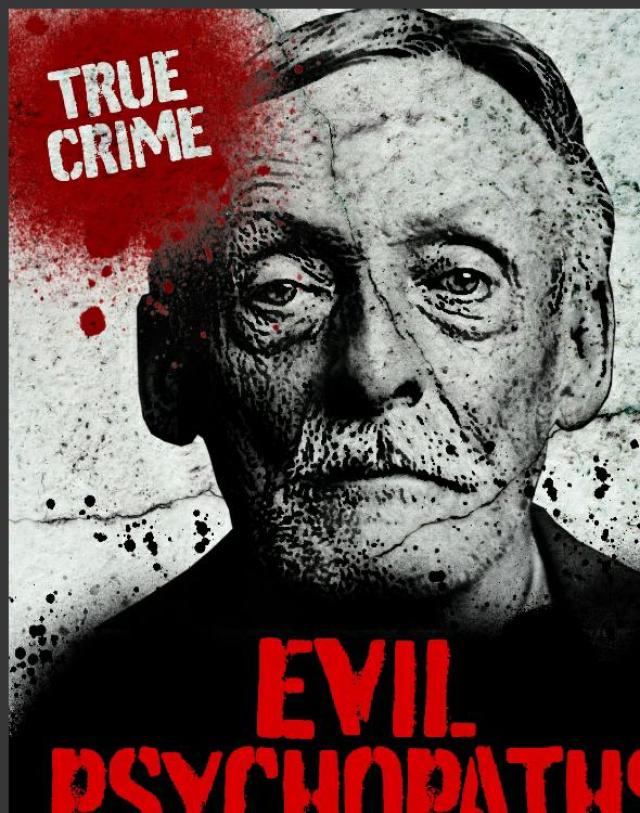


Around this time, Kürten claimed, he committed his first murder when he drowned a school-friend with whom he was playing on a raft on the River Rhine. When another friend dived in to try to rescue the drowning boy, Kürten pushed him under the raft until he drowned. Their deaths were treated as accidents.
His killings were inextricably linked to his sexual urges and his perversions knew no bounds. He committed acts of bestiality on sheep and goats in stables close to where he lived, learning that the experience was made all the more intense if he stabbed the creature during the act.
The first of the twenty-seven prison sentences he received in his life was for stealing. Over the next few years, he would receive short sentences for the theft of clothing or food. Released from prison in 1899, at the age of sixteen, he moved in with a masochistic prostitute twice his age. He was able to practise his base urges on her and had finally graduated to human beings from animals.
Kürten’s incarcerations infuriated him. He believed it wrong that someone as young as him should be locked up but it had its benefits. He arrived at a position in prison where he could achieve orgasm by imagining brutal sex acts. Intentionally breaking prison rules got him sent to solitary confinement where he could be alone with such thoughts and refine them in his sick head.
Not long after his release from one of his periods of confinement, he tried to kill for the first time. He attacked a girl in the Grafenberger Woods while he was having sexual intercourse with her. He left her for dead, but her body was never found and she was never reported missing which means that she probably survived and was too ashamed to report the incident to the authorities.
The more he was sent to prison, the greater became his sense of injustice. He began to consider his increasingly sadistic attacks to be acts of revenge on society.
His first murder took place on 25 May 1913, when he was twenty years old. He had been breaking into bars and inns where the owner lived in a flat above the premises. He knew they would be busy downstairs, leaving him free to pillage whatever he could from their accommodation. This particular night, he targeted an inn in Cologne owned by Peter Klein.
He broke in and made his way to the first floor of the building but was frustrated to discover nothing of any particular value in any of the rooms he entered. Opening one door, to a bedroom, he discovered a little girl, Christine Klein, aged about ten, in bed asleep. Something clicked in Kürten and instead of quietly closing the door and creeping away, he went over to the bed, grabbed the child by the neck and quickly strangled her as she struggled in his arms. He then inserted a finger into her genitals before taking out the pocket knife he always carried and slitting her throat. In his later confession, he described enthusiastically how the blood spurted from the gaping wound ‘in an arch, right over my hand. The whole thing lasted about three minutes.’
Suspicion for the murder fell on Peter Klein’s brother, Otto, who had unsuccessfully tried to persuade his brother to loan him some money the previous evening. In a violent rage at being denied the money, he had threatened to do something that Peter ‘would remember all his life’, as he had put it. The police could come up with no other reason for the murder to have been carried out and Otto was charged with the murder although he was later acquitted due to lack of evidence.
Meanwhile, the people of Dusseldorf were subjected to a series of axe and strangulation attacks.
They came to an abrupt stop during the war years, however, as Kürten was sent to prison after deserting the army. Released in 1921, he resolved to start a new life. He moved to Altenburg, found a job in a factory and married a prostitute. He became active
in trade unionism, actually settling down to a
normal life.
In 1925, however, he moved back to a city centre apartment in Dusseldorf where for the next four years he carried out arson attacks and petty crime as well as a rising tide of horrific attacks. People were dispatched with knives or scissors and on one occasion he intensified his experience by sucking blood out of a young girl’s head.
The year 1929, however, was when his bloodlust really came to the surface, taking on a ferocity even he had never known. Between February and November of that year, there was an unparalleled spate of sex crimes, hammer and knife attacks and strangulation. The victims were indiscriminate – men, women and children. The authorities now knew that there was a maniac on the loose and the city was terrified. Elderly people and children stayed home and some even moved out of town until the perpetrator was caught. The newspaper headlines screamed that a vampire was stalking the streets of the city.
It began in early February 1929, when he attacked a woman, grabbing her by the lapels and stabbing her repeatedly. She had received twenty-four stab-wounds by the time he ran off. Kürten later told how he liked to return to the scenes of his crimes. He revisited the scene of this particular crime later that evening as well as several other times. ‘In doing so,’ he said, ‘I sometimes had an orgasm.’
The body of Rosa Ohliger was discovered under a hedge on 9 February, stabbed thirteen times. He had stabbed her in the vagina and semen stains were found on her underwear. He had attempted to burn the body by pouring petrol over it and setting it on fire. He would later describe how he achieved orgasm as the flames caught hold.
He killed a middle-aged mechanic five days later, stabbing him twenty times in a frenzied knife attack. Again, he returned to the scene, entering into conversation with a detective working there.
The police thought they had their killer when they arrested a man named Strausberg who suffered from learning difficulties. He had assaulted two women using a noose and detectives involved in the Vampire case were convinced he must have committed the February crimes. They were, therefore, overjoyed when he confessed to everything they threw at him, almost bringing the investigation to a halt.
They were shocked back into action on 21 August, however, when, with their supposed killer in custody, their maniac went on a knifing binge, stabbing three people in separate attacks. As they walked on a country lane, a man passed and bid them ‘Good evening’. The man, of course, was Kürten, and, as he passed, he lunged at them, stabbing them in the ribs and in the back.
On 23 August, like hundreds of others, Kürten attended the annual fair at Flehe. Two girls, sisters aged five and fourteen, had left the fair to walk home through some allotments. As they walked, a man emerged from some trees, following closely behind them. He stopped them to ask if one of them would go back to the fair to buy some cigarettes for him. One of the girls, Louise, obliged, skipping back the way they had come. As soon as she had disappeared, Kürten picked up the other sister, Gertrude, and strangled her before slowly cutting her throat. When the other girl came back with his cigarettes, he strangled and decapitated her.
The following day, when he encountered a woman and asked if he could have sex with her, she replied, ‘I’d rather die.’ He responded, ‘Die then!’ before plunging his knife into her. She survived, however, and managed to provide a good description of him.
Kürten was now out of control. September saw him committing a rape and murder and he also savagely beat a girl with a hammer. In October the hammer came in handy again when he used it to attack two women. On 7 November, he strangled a five-year-old girl and stabbed her thirty-six times with a pair of scissors. Following this murder, he sent a map to a local newspaper showing them where he had buried her body.
Meanwhile, the police received tip-offs from the public that pointed the finger at thousands of different people. An enormous manhunt was under way and the city was in a frenzy of terror and suspicion.
In 1930, he made numerous hammer attacks in February and March, none of which proved fatal.
His eventual arrest was the result of an accident. An unemployed and homeless domestic servant by the name of Budlick was picked up at Dusseldorf station by a man promising to take her to a hostel. As they walked into a dimly lit park, she remembered the stories of the killer who was on the loose and became reluctant to go any further. They argued, and another man approached asking if she was having problems. The first man took off, leaving her alone with the second man. He was Peter Kürten. She went with him to his room on Mettmanner Strasse but she said she did not want to have sex with him, asking instead if he could take her somewhere that she could find a bed for the night. They took a tram and walked into the Grafenberger Woods where he grabbed her by the neck and asked her to have sex with him. ‘I thought that under the circumstances she would agree and my opinion was right,’ he said later. He took her back to the tram, saying later that he did not kill her because she had offered no resistance to him. He let her go, believing that she would never be able find his flat or him again
On 21 May, he was surprised, therefore, to return to his room to find her there. She had written a letter describing the incident to a friend who had immediately passed the letter to the police. Fraulein Budick did, indeed, remember the location of Kürten’s flat and had led the police to it.
Seeing her, Kürten went into the flat and then swiftly re-emerged, walking out onto the street, but followed by plain clothes detectives. He knew that capture was now inevitable, but reasoned that for the moment, the only charge against him would be one of rape which would mean a sentence of about fifteen years. He was concerned about how this would leave his wife and resolved to tell her everything so that she could take the information to the police and claim the substantial reward that was being offered for information leading to the capture of the Vampire of Dusseldorf.
On 24 May, Frau Kürten went to the police with her story, informing them also that she had arranged to meet her husband outside St. Rochus Church at three that afternoon.
That afternoon, the area around the church was completely surrounded and as Peter Kürten appeared, four officers rushed towards him. He put his hands up, smiled and said, ‘There is no need to be afraid.’
Adolf Hitler
Adolf Hitler was born in an inn, the Gasthof zum Pommer, in Braunau am Inn, in the Austro-Hungarian Empire on 20 April 1889, the fourth of a family of six. His father Alois, a customs official, had to obtain papal permission to marry his third wife, Klara, who was also his half-niece. Only Adolf and his younger sister, Paula, survived to adulthood. Hitler’s childhood was unhappy. His father was frequently violent towards him as well as to his mother to whom Hitler was deeply attached.
The family moved frequently but in spite of the disruption the young Hitler performed well at school until, aged around eleven, he had to repeat a year. He claimed he was rebelling against his father who wanted his son to follow in his footsteps as a customs official, but Hitler wanted to be a painter. His father died in 1903 and Hitler dropped out of school a couple of years later, aged sixteen.
He claimed his passion for German nationalism emerged around this time, when he read a book about the Franco-Prussian War and wondered why German Austrians did not join with Prussia against the French.
In 1905, Hitler went to live in Vienna but was rejected twice by the Academy of Fine Arts and was told he was more suited to being an architect but he did not have the requisite qualifications to attend the architectural school. He struggled to make a living as a painter, copying postcards and selling to tourists. By 1910, he was living in a house for poor working men.
In 1913, he received money from his father’s estate and was able to move to Munich which allowed him to escape military service in Austria. He was arrested eventually by the Austrian army but was deemed unfit for service and allowed to return to Munich. On the outbreak of World War I, however, he enlisted in the Bavarian army, serving in Belgium and France. At the end of the war, he held the rank of lance-corporal but his role in the war had been dangerous. He had been engaged as a runner, a position that exposed him regularly to enemy fire. He fought at Ypres, the Somme, the battle of Arras and at Passchendale and was twice decorated for bravery. His award of the Iron Cross, First Class, in 1918 was one rarely given to a soldier of his rank. It seems, however, that his superiors did not believe that he possessed sufficient leadership skills to be made full corporal. He was wounded in the leg in 1916, but returned to the front in March 1917.
Germany’s surrender in 1918 was a great shock to him. He had become a fervent German patriot and believed in the Dolchstoßlegende (dagger-stab legend), that the army and the country had been stabbed in the back by the poiliticians and Marxists at home. The Treaty of Versailles did nothing to allay this feeling. It punished Germany severely for the war – depriving it of territories, almost totally demilitarising the German armed forces, demilitarising the Rhineland and imposing massive reparation payments. It would help Hitler later when he persuaded Germans that this must not be allowed to happen again.
Hitler remained in the army at the war’s end, based in Munich. He became a police spy working for the Aufklärungskommando (Intelligence Commando) with responsibility for influencing his fellow soldiers and for infiltrating the German Workers’ Party, founded by Anton Drexler. The party was anti-semitic, anti-Communist and nationalist and it immediately appealed to Hitler. Drexler, for his part, was impressed with Hitler and he was invited to become the party’s fifty-fifth member.
He met a formative influence at this point – Dietrich Eckhart, one of the party’s founders. He and Hitler exchanged ideas and Eckhart advised him on everything, even how to dress. He also provided him with introductions to many important people. Soon, the party changed its name to the Nationalsozialistische Deutsche Arbeiterpartei (the national Socialist German Workers Party).
Discharged from the army in March 1920, Hitler became fully involved with the party and they made full use of his greatest skill – his oratory. His audiences began to grow, on one occasion 6,000 turned up in Munich to listen to him rail against the Treaty of Versailles, Marxists and Jews.
In July 1921, Hitler staged a coup within the party, replacing Drexler as chairmen. At his first meeting as leader, he was introduced as ‘der Führer’, a name that would continue to be used until his death.
The party began to grow, attracting followers fired by Hitler’s inflammatory speeches. Rudolf Hess, Hermann Göring and Julius Streicher were all early members. Hitler became accepted in Munich society and formed relationships with business leaders.
Hitler was very impressed by Mussolini’s fascists and wanted to emulate the drama of their ‘March on Rome’, the coup d’etat that brought them to power. He had the support of a number of important people, including Gustav von Kahr, de facto ruler of Bavaria and General Erich Ludendorff, as well as leading figures in the army and the police.
On 8 November 1923, Hitler and his Sturmabteilung (storm troopers) launched what has become known as the ‘Beer Hall Putsch’ when they stormed a public meeting in a large beer hall outside Munich. He proclaimed the establishment of a new government and demanded support of von Kahr and the local military leaders. The following day as Hitler and his group marched from the beer hall to the Bavarian War ministry to overthrow the Bavarian government, they were attacked and dispersed by the police who killed sixteen members of the National Socialist Party.
Hitler was arrested for high treason and became a national figure at his trial when he expressed his nationalist sentiments. Sentenced to five years in Landsberg Prison, he was released after serving just nine months as part of an amnesty for political prisoners.
In prison, Hitler had used his time to dictate his book Mein Kampf, an autobiography and a political manifesto to his deputy, Rudolf Hess. Published in two volumes, by the end of World War II, it would have sold around ten million copies.
Following his release, there was an attempt to unseat him as leader of the party and he reacted to this challenge to his authority with the introduction of the Führerprinzip (leadership Principle). By this, leaders were appointed by their superiors and were responsible to them while being accorded unquestioning obedience by those below them.
The Depression was a godsend to Hitler who, by the time it struck Germany in 1930, was keeping within the law as he tried to gain power, while still appealing in his oratory to German nationalist sympathies. Meanwhile, the government of the Weimar Republic which had ruled the country since the war was deeply loathed by all, from the extremists on the right to the communists on the far left. In 1930, Chancellor Heinrich Brüning led a minority government and was forced to use emergency decrees to implement his measures. This was a form of government that endured for several parliaments and certainly prepared the ground for Hitler’s authoritarian style of government.
In 1932, Hitler finally obtained German citizenship which rendered him eligible to run for the German presidency against the incumbent, Paul von Hindenberg. He lost.
Elections were called in July 1932 and the Nazis won 230 seats, their best result so far, making them the largest party in the Reichstag, the German parliament. The new Chancellor, Fritz von Papen, tried to get Hitler to become his Vice-Chancellor, but Hitler would accept nothing less than the top job. Soon, the von Papen government had collapsed and fresh elections were called. The Nazis remained the largest party with thirty-three per cent of the vote.
After several more attempts to form a minority government had failed, President von Hindenberg had no option but to appoint Hitler Chancellor of a coalition government, but with politicians from other parties taking the key roles in the cabinet. On 30 January 1933, Adolf Hitler took the oath of office in von Hindenberg’s office.
Again, as no party had a majority, the Reichstag was dissolved in readiness for new elections in March 1933, but on 27 February, the Reichstag building was the victim of an arson attack which was blamed on the communists. The government reacted by suspending basic civil liberties and by banning the German Communist Party. Communists were rounded up, fled or, in some cases, murdered.