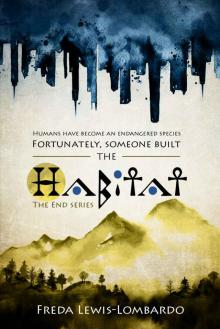
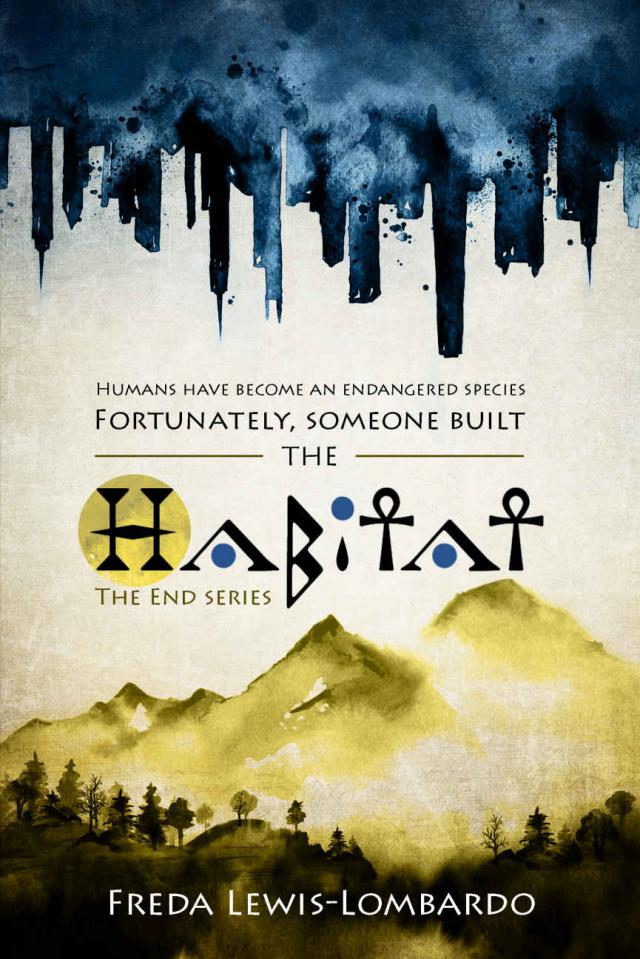
Habitat, page 1
part #1 of The End Series


Copyright © 2019 by Freda Lewis-Lombardo
fredalewislombardo.com
All rights reserved. This book or any portion thereof may not be reproduced or used in any manner whatsoever without the express written permission of the publisher except for the use of brief quotations in a book review.
This book is a work of fiction. Names, characters, places, and incidents either are the product of the author’s imagination or are used fictitiously. Any resemblance to actual persons, living or dead, events, or locales is entirely coincidental.
Printed in the United States of America
First Printing, 2019
ISBN 978-1-7332479-0-0
Editing by Sam Wright
Cover Design by Ranka Stevic
Interior Book Design by Roseanna White Designs
Poem
The End
CHAPTER 1
CHAPTER 2
CHAPTER 3
CHAPTER 4
CHAPTER 5
CHAPTER 6
CHAPTER 7
CHAPTER 8
CHAPTER 9
CHAPTER 10
CHAPTER 11
CHAPTER 12
CHAPTER 13
CHAPTER 14
CHAPTER 15
CHAPTER 16
CHAPTER 17
CHAPTER 18
CHAPTER 19
CHAPTER 20
CHAPTER 21
CHAPTER 22
CHAPTER 23
CHAPTER 24
EPILOGUE
Reading Group Discussion Guide
ACKNOWLEDGMENTS
To the reader
For my brilliant daughter, Liz.
You are such a marvelous example of perseverance and achievement.
I am so proud of you.
Without your love, support, and absence
(source of my empty-nest syndrome),
this book could not have been
finished.
You are my heart.
POEM
HABITAT
Oh, sweet ignorance,
My one true guardian,
Do not abandon me
In this world of deceit.
THE END
I was named Savannah, Georgia/March 2, 2032/Female/4-21 days old/Survivor 3 by the military team who rescued me twenty years ago. I’ll never learn my birth name because my biological parents didn’t survive the nuclear war that destroyed our world. I was one of the lucky ones, having no memories of family or life as it once was. Neither do I remember the horror of war nor the joy of rescue. I can only imagine the relief of being brought to the town of Horizon with the other 4,999 survivors.
Many adults married days after meeting—a prerequisite for adopting an orphaned child. The town’s leaders thought our best chance of success lay in creating new family bonds. We were a group of devastated strangers thrown together in the darkest time of man’s existence and given the monumental task of rebuilding civilization.
Years before The End, the government designed and built a network of secret refuges across America to shelter politicians if Armageddon occurred. Doomsday came, but they weren’t rescued, nor were our families. Everything and everyone we loved was gone. No other government bunkers have contacted us and now, two decades later, finding survivors is unlikely. I hope that someone saved other groups, just like the Horizon 5000 and they, like us, were now somewhere safe and happy.
Because the bunkers beneath our town were fully stockpiled with necessities for any emergency, we didn’t struggle initially. However, those supplies couldn’t last forever. We learned to make some essentials, but conservation was crucial. Who could have imagined creating ways to make clothes last for twenty years? In Horizon, we needed each other’s skill and knowledge to survive.
Two decades after The End, our new goal is about more than mere survival. Now, we look for ways to thrive in what remains of our restructured society. We acknowledge sadness comes from missing life from before the war. Those crippling memories held on to from the last world stand between success and us. The constant reminders of all we lost drain our spirits; therefore, we practice releasing old memories to avoid emotional instability. Naturally, the older you are, the more memories you have. The more memories you have, the more you have to release. Our regulated therapy program helps manage everything considered harmful. I’m thankful I don’t have memories of the other world. How can we move forward if we are chained to the past?
Although we are protected inside Horizon, I am still frightened when I hear the machines clean radiation from the air—just one additional reminder of lingering danger beyond our walls. My father says that war will never happen again—those inclinations vanished with The End. We hope he is right.
I believe we live in a better world, and it’s called The Beginning.
—Ellis Bauer, graduation essay excerpt
Horizon: A Look Back, A Look Forward
July 2052
CHAPTER 1
It was July 4, 1986, at one of those low-country mansions in Charleston, South Carolina. That place was square in the middle of nowhere I cared about, and yet it was the only place I wanted to be. She was, without a nickel’s worth of doubt, the most beautiful woman I’d ever laid my eyes on, and she was way outta my league. My daddy worked his whole life on a horse farm, and I’d probably end up doing the same. Her daddy was a millionaire banker.
It was Friday night, and she wore this flowery, mini skirt with a pale pink sweater slung over her shoulders. Lillian Rose Stallworth—Lilly Rose, for short. Giant chandeliers hung from the ceiling of an old, southern ballroom that had no purpose any more than just to show off. Charleston’s cream of the crop mingled about pretending to have more money than everybody else.
Lilly Rose gave me my invitation while I shoveled manure out of her Arabian’s stall. Mutan was a big, fierce, black stallion who didn’t think I was good enough for her either, and he let me know it by giving me a kick to the thigh when she walked away. That horse bout near broke my leg, but I would have shown up to that party in a body cast if I had to.
I wasn’t ever shy before. Heck, that wasn’t my first rodeo, but my knees wobbled as I shuffled over to where she stood talking with her girlfriends. After a tap on her shoulder and a bunch of stammering, I somehow found the courage to ask for a dance. Without saying a word, she smiled and gave me her hand. Out of all those Citadel College boys with their turned-up-collar polo shirts and silver-spoon trust funds, she chose me.
It felt like heaven to hold her in my arms. She smelled like wild honeysuckle on a breezy, summer night. That was it. She was mine for the next forty-five years.
When you’re still a pup, you think you’ll live forever. The End War took my Lilly Rose. Now, the only thing left is the memory of her I keep secret. Memories are dangerous things. They’re forbidden here in Horizon, and they’re trying to take ‘em from us.
—Henry A. Parsons
Release Sleep Therapy Recording
July 4, 2052
RELEASE
THE SIRENS BLASTED during the night for the second time this month. As usual, I got out of bed to shelter with Mom and Dad in the safe room. Who knew we would still have these threats twenty years after the war? I wouldn’t have minded so much, but this time I couldn’t get back to sleep. The windowless room had soft, thick sleeping bags, always comfortable, but the stupid, red nightlight had me in a trance. I tried to will it to change color with an attempt at mind control. Finally, at 5:00 am, we got the green—no more red. Either the radiation dispersed, or my superhero powers finally kicked in. I suspect it was not the latter.
I stumbled back to my bedroom in the dark, tripped over my dataport, and banged into the nightstand. From then on, I laid in bed, trying to will my toe to stop throbbing. Yeah, it’s official; I have no mind-control over anything. Since the radiation alarm activated during the night, school would be canceled. I was grateful because getting back to sleep was difficult.
“Wake up, Ellis.” I tried to block out the voice.
For a millisecond, I was walking through a dazzling city of high-rises and streets bustling with cars. I was so happy, and then it vanished into some vague memory, melting like ice cream on a hot, summer day. Sadness washed over me. Now, a persistent knock at my door stole the final shreds of the magnificent dream. I sighed. Time to get up and leave behind places I’d never seen and never would. After all, that world died long ago.
“Ellis, you will be late again. Hurry, so the doctor won’t need to rearrange her schedule. Tardiness is inconsiderate.” My mother opened the bedroom door. “I agreed to let you nap because of sirens in the night, but I won’t allow you to miss your appointment—no matter how tired you claim to be.”
Had other people heard her, they might have assumed I was a child instead of a twenty-year-old future graduate.
“I’m awake,” I said. I sat up in bed, and she turned to leave.
My dataport alarm chimed, “The time is 3:30 pm, July 15, 2052.”
“Dataport, alarm off,” I said. A small beep acknowledged my voice command.
I sat on the edge of the bed shaking off sleepiness and dreams of cities that no longer existed, except in pictures. I looked for my clothes. At the foot of the bed, a suspicious mound lay under the covers. “Gotcha,” I said aloud. Sure enough, the missing shirt. Now if I could find my shorts, I could be on my way. I still had thirty minutes.
“Ellis,” my mother yelled from the kitchen.
Where are my sneakers? I didn’t hate my weekly release sessions; I’d spent hundre ds of hours with Dr. Adler. Our visits were helpful. She supported my goal to become a release therapist. Helping people find relief from negative emotions appealed to me. If I scored high enough on my placement test, I would begin training in the fall.
With graduation and career placement consuming my thoughts, I’d been somewhat irritable. On the most hectic days, I never completed school, homework, my daily activities list, and release therapy without exhausting myself mentally and physically.
Now dressed, I stuck my tongue out while standing in front of the full-length mirror. I tried to make peace with the image staring back, but she wasn’t cooperative. Five feet-four inches was the most I could hope for, and if I didn’t stop sneaking to the Fountain for real food, I’d never lose the extra ten pounds. I didn’t have a problem with my weight. I had a problem with the problem my mom had with my weight. She lived life as an organic, naturalist, vegetarian, neat freak, exercising, yoga-doing type of person.
I stepped back and made my final analysis. My clothes weren’t backward or inside out (wished I could say the same for other days). I had no blemishes this week, and my auburn ponytail was straight with curls surprisingly well behaved. Congratulations, you’re not a total mess today.
Aromas drifted from the kitchen reminding me today was baking day. Please let it be edible. I rushed in at the exact moment Mom removed cookies from the oven—rutabaga-wheat germ. Crap. When she turned her back, I grabbed two and juggled them from hand to hand. Heat was nearly a successful deterrent for food theft. The front door was on the verge of closing when I remembered to say goodbye. I jammed one cookie into my mouth and held it between my teeth as I jumped on my bike. Steam burn. Mom’s rant about stealing the cookies without asking reached my ears as I hurried to get away. I gobbled the first cookie while steering and came close to choking because it was the worst goodie I’d ever eaten. To be honest, the name baddie would have been a compliment considering the flavor. An accurate taste description was a cross between tree bark, dried leaves, and dirt. This might set the diet revolution on fire. If I kept eating this garbage, I’d lose those ten pounds in no time.
Then again, I could end up hospitalized.
From our enormous mountains, exhilarating air swooped in gentle gusts. Fresh and scented with the last gardenias of the season, I gulped in great lungfuls. Sweet freedom. Why hadn’t I spent more of my day outside enjoying this beauty?
Mother Nature was remarkable and just as resolute as the Horizon 5000 to survive. Years ago, the town celebrated the return of the first white-tailed deer. Professor Zhào explained, after the war, nature needed rest to plan its comeback. Now, every time an animal reappeared, it renewed hope for the future.
The End War claimed responsibility for many living organisms becoming extinct but not humans. Five thousand wasn’t an enormous number, but we survived and continued to grow since the war. Many people thought radiation might cause infertility. However, our determination and the luck of having survivors with medical knowledge saved us. We hoped other groups of people might be outside Horizon fighting to make their comeback as well.
Arriving on time for my therapy appointments had never been an issue, despite Mom’s incessant warnings. I quickened my pace and rocketed through our quiet street when I noticed my neighbor, Henry Parsons. Dad and Mom expected me to address older adults by mister or missus, but Mr. Parsons and I worked out a deal a long time ago to call him Mr. Hap.
“This way it makes us seem more friendly-like,” he told me once, “and makes me not feel like such an old fart blossom.”
Today, my friend focused on picking up an oak leaf with the audacity to fall onto his well-controlled lawn. Mr. Hap must have spent hours taking care of his home, although he was in his eighties. All houses in our neighborhood were one story with two bedrooms, their exteriors varied. Mr. Hap’s white New England cottage with blue shutters and blue roof represented one of fifty designs. My home was a craftsman design with a natural stone exterior. The government thought of everything when planning this community.
Despite living in a post-apocalyptic world, the town administration expected our homes to be kept in rule-abiding, pristine condition. Nothing ever looked neglected. I complimented Mr. Hap on his colorful garden one day, and he told me his wife always loved a well-kept yard.
“It was her favorite hobby,” he explained. “That little gal of mine loved flowers better than a poor hog loves slop. Back before everything went to hell in a handbasket, she’d sit on the porch and watch me cut grass. She’d meet me on every third turn around the yard and bring me a sip of homemade lemonade with fresh mint and crushed ice served in a mason jar. My little gal declared there wasn’t nothing more soul-satisfying than a freshly mowed yard and a good-looking devil with an honest sweat. So now, I keep on doing this for her, cause she’s looking down on me every moment.”
I wondered if someone would love me enough to keep my memory alive twenty years after I’d gone. I doubted if I’d have a marriage last fifty years. My parents’ union wasn’t the best example of supreme felicity.
As a child, I once asked Mr. Hap if he might marry again. I remembered he said, “Once you’ve found your soul mate, no one else can come close. You smile just thinking about them, and your heart lights up when you see them. Remember that, and you’ll find a love that lasts forever.”
I couldn’t go past him today without stopping—even if time was running close. He was one of my favorite people to talk with because he told me stories of life before The End.
“Hi, Mr. Hap,” I called out. I slowed and glided onto the sidewalk. “How are you today?”
He walked toward me with a small garden tool I didn’t know the name for. “Well, I’m a tad-bit down in my back, to tell the truth.” He rubbed the area and smiled through weary eyes. “The curse of being a darn fossil,” he said with a hint of a sly grin, “but hard work ain’t never killed nobody.”
“Cookie?” I held up the remaining one.
He shook his head. “Thanks, but I’ll pass. No offense, Ellis, but your Ma ain’t no cook.”
“You’ve got a point, Mr. Hap.” He belted out a hearty laugh as sweat dripped from his face. “Maybe you should rest today. I bet your wife wouldn’t mind you taking a day off from her garden,” I said. I finished the remaining cookie, including the crumbs on my faded, tie-dyed T-shirt.
“My wife? Shoot, she woulda wanted me to dig up this whole place. Lilly Rose told everyone I spent too much time in the yard. To be honest with ya, little Miss, I stayed outside to get a break from her,” he explained.
I grinned and waited for one of his famous punch lines. He didn’t even cut a smile.
“But Lilly Rose loved tending the yard with you,” I said, “and your story of the roses and how she always wore floral printed clothes…”
Mr. Hap chuckled. I relaxed and smiled; I hadn’t misunderstood the wonderful love story he told me so many times in my life.
He raised the tool in his hand and aimed it toward the ground. He flung it straight into its intended mark. His laugh faded, “Make no mistake, Ellis, if my wife had a tender side, she musta kept it locked in a box somewhere.” He took a stained handkerchief from his back pocket and wiped the sweat from his brow. “Gardening was the only time she wasn’t in my ear with hellacious—pardon my French—naggin’ about something or other. No, ma’am, there wasn’t ever a moment’s worth of peace with that woman. I suppose some folks just aren’t meant for each other, and I wish it hadn’t taken me so long to find out.” He replaced the handkerchief in his pocket, “We divorced twenty years too late if you ask me.”
I leaned half on and half off my bike, fixated on an altered version of this man’s marriage. Mr. Hap and Lilly Rose never divorced.
“You okay there, Ellis? You look like you done seen a ghost. Why don’t you park yourself in the shade for a spell? Come on and sit here by this butterfly bush and I’ll bring you something cool to drink.” He pointed back toward the house to a chair sitting by an enormous plant.