

Jackal, page 1


Jackal is a work of fiction. Names, characters, places, and incidents either are the products of the author’s imagination or are used fictitiously. Any resemblance to actual persons, living or dead, events, or locales is entirely coincidental.
Copyright © 2022 by Erin E. Adams
All rights reserved
Published in the United States by Bantam Books, an imprint of Random House, a division of Penguin Random House LLC, New York.
Bantam Books is a registered trademark and the B colophon is a trademark of Penguin Random House LLC.
Hardback ISBN 9780593499306
Ebook ISBN 9780593499313
randomhousebooks.com
Title-page and part-title images: edb_16 / stock.adobe.com (forest)
Chapter-opening images: MysticLink / stock.adobe.com (heart); setory / stock.adobe.com (feather); Sete / stock.adobe.com (scales)
Cover design: Julianna Lee
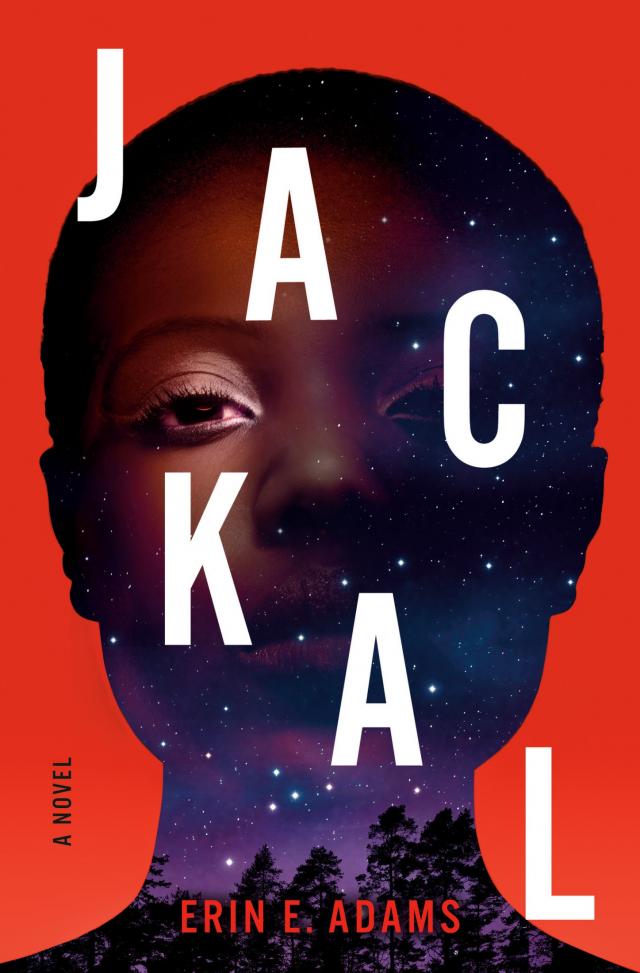
Cover images: iStock/Getty Images (woman), Shutterstock Images (landscape)
ep_prh_6.0_141032870_c0_r0
Contents
Cover
Title Page
Copyright
Alice
The Heart
Chapter One
Chapter Two
Chapter Three
Chapter Four
Chapter Five
Chapter Six
Keisha
Chapter Seven
Chapter Eight
Chapter Nine
Chapter Ten
Chapter Eleven
The Feather
Morgan
Chapter One
Chapter Two
Chapter Three
Chapter Four
Chapter Five
Chapter Six
Kayla
Chapter Seven
Chapter Eight
Chapter Nine
Chapter Ten
Chapter Eleven
Chapter Twelve
Brittany
Chapter Thirteen
Chapter Fourteen
Chapter Fifteen
Chapter Sixteen
Chapter Seventeen
Chapter Eighteen
Chapter Nineteen
Diana
Chapter Twenty
Chapter Twenty-one
Chapter Twenty-two
Chapter Twenty-three
Chapter Twenty-four
The Scales
Caroline
Chapter One
Chapter Two
Chapter Three
Chapter Four
Chapter Five
Chapter Six
Lucy
Chapter Seven
Jack
Chapter Eight
Dedication
Author’s Note
Acknowledgments
About the Author
ALICE
June 1985
Tanisha Walker loved the stars. She didn’t memorize the paths of the cosmos or their patterns. She just loved the look of them. The fact that she could see them so clearly was the only part she liked about moving to a town as small as Johnstown. Her husband told her their daughter would be safe. After all, the only place safer than the suburbs was the middle of nowhere. They’d moved because he’d gotten a job at the steel mill. With the finite resource running low, he was brought in to help put the place to rest. A full transition would take years, but the town knew men like him coming meant the beginning of the end. The industry had dried up.
Upon arriving, Tanisha didn’t trust the place. If pressed, she couldn’t say why. The best answer she could give was: It felt too safe. Tanisha had grown up in the city and was numb to loud noises and erratic personalities; her calm demeanor belied her understanding that danger always lurked right around the corner. But they had moved to a town without corners. Danger didn’t need a place to hide, it preferred to fester. First it would smile and bring you German chocolate cake. Then it would wait out in the open on your front porch until it felt good and ready.
Tanisha’s daughter, Alice, was named for the writer of a book Tanisha had read in high school. The book was banned. Tanisha read it anyway because she liked the cover. Alice was Tanisha’s only child. Born a full two months early, at thirty-two weeks, she was three pounds, four ounces, and fit in the palm of her father’s hand.
I think Alice came early because she couldn’t wait to see the world.
However, her premature arrival meant they’d kept her in the hospital for those two months while her lungs grew to their full capacity. There the nurses talked to her on their lunch breaks, the residents checked on her between rotations, and every night at 11:00, her parents came to bathe her and rock her to sleep. They were both dead tired but elated to spend time with their daughter.
From the beginning, Alice was loved.
She was always loved.
She will always be loved.
Small-town living agreed with Alice. She loved to explore the forest and play “Let’s Get Lost.” Her favorite meal was sauerkraut and sausage. She had no tolerance for anything remotely spicy. And she had never met a potato she didn’t like. Like her mother, she loved the night sky. But unlike her mother, she was not dazzled by the stars. She loved how the darkness between them went on forever. If she stared long enough, she felt like she could fall up into the vast blackness above.
Alice wasn’t a picky child, but she did have a favorite jacket. No matter the weather, she’d wear it. Tanisha hated it. Unable to say no to his daughter, her husband got it for Alice anyway. It had unfinished denim edges and its fluffy white shearling reminded Tanisha of the rich white girls who had stuck gum in her hair on her train rides to school in the city. Even so, Tanisha would have lived as that jacket, wrapped around her daughter, for the rest of her life.
When she turned ten, Alice finally felt the differences between herself and her peers. Ever the optimist, Tanisha let her daughter live in blissful ignorance for as long as she could. Of course Alice was aware of the color of her skin, but she hadn’t yet mastered what it meant. At first, the differences were slight and revolved around her hair. To get it done, she went to a lady’s house, not a salon. She got braids before she went on vacation. And in swim class, she had to wrap her hair in a tight swim cap or else her mother would “kill” her. She forgot the cap once and cried. She told her instructor about her mother’s stance on getting her hair wet, and her mom had to have a meeting with a lady from the state that day. Alice wasn’t allowed to say “Mom would kill me” ever again, unless she really, really meant it. Alice was beginning to understand how she was different. She just didn’t have all the words yet.
Early summer is fickle. On Friday, June 21, 1985, the temperature dipped just enough to be chilly. Still, Alice begged to go exploring outside with her friends, a request Tanisha almost always denied if there wasn’t an adult. Mostly because of the stories about the woods. Always some nonsense about shadows. Tanisha hadn’t lived in Johnstown long enough to have mastered the adage “if you think you saw something…no, you didn’t,” but she was wise enough to glean the truth behind the lore. Shadows hid danger. Danger for Black girls was different. It didn’t obey the boundaries of stories. For them, it was always real.
But so much time in this small town had made Tanisha easy. She didn’t always lock her doors anymore. She had stopped interlacing her keys between her fingers when she walked alone at night. After a few years, her guard had finally come down. For the first time, she agreed and offered Alice her favorite jacket.
“Mom,” Alice whined, “I don’t need it. It’s fine.”
“If you get sick, you’ll be upset,” Tanisha warned. “And don’t forget to wear your bandana if you happen to ‘find’ yourself in the woods.” Tanisha looked down at her daughter knowingly. “I put it in the pocket. Please, Munchkin.”
Alice looked at the jacket and the bandana and for the first time she understood that these two totems were more than Day-Glo and denim, they were her mother’s care. Alice took the jacket and did her best to conceal her smile as she ran out the front door and off to play.
With her jacket around her waist, Alice and her friends streaked past houses and haphazard gardens until they reached the last house on the block before the woods began. The dirt driveway extended past the garage and dissolved into an array of Eastern hemlock trees. At the end of the driveway, there was a boy she’d never seen before.
One of Alice’s friends whispered, “He said he found a deer skull last night! There’re still brains inside.”
Another rolled their eyes to the back of their head and let out a zombie groan, “Braaaainnns…”
Without a second thought, all her friends took off toward the tree line. Alice faltered. This new boy looked odd. Too young to be out there alone or very small for his age. He looked angry. For the first time, she felt a hint of her mother’s worry. She fished around in her jacket for the bandana. In the afternoon sun, its orange hue made her eyes ache. She wo uld look like a total loser and she knew it. Alice shoved it back into her pocket and then remembered the swimming cap incident. She had never seen her mother cry until that lady from the state talked to her. Alice didn’t like seeing her mother cry. Her mother asked her to wear the bandana like a necklace, but Alice had a better idea. She flipped the stiff fabric up and wrapped it around her head, like a crown.
“Alice,” someone called. The voice was soft, she couldn’t be sure who it was, but it was coming from the trees. She took a step toward the woods. A chill passed through her. Her mom was right. It wasn’t as warm as she thought. Freshly crowned, Alice put on her favorite jacket, turned up its fluffy collar, and ran into the woods after her friends.
The streetlights came on.
Night fell.
Her friends made their way home.
Alice didn’t.
Before Tanisha could call them, the police knocked on her door. They sent a female officer because the department thought this needed a woman’s touch. In reality, none of the men on the force was up for the task. When Tanisha answered, the officer spoke with a heavy sense of duty.
“Ma’am, do you recognize this?” she asked. The officer held up a plastic bag.
Tanisha shook her head. “No. Wait.” She leaned in to get a closer look. The officer tried to pull the bag back, but it was too late. Tanisha could smell it. The plastic couldn’t contain the sharp metallic tang of blood. The evidence bag slid over the fabric—whatever it was, was soaked. The bag moved in the officer’s hand and a shearling collar shifted into view. Tanisha reached out and grabbed it to get a closer look. The cold slickness of the bag did not match the warmth that the liquid inside once contained. While the officer stepped back, she could not stop the realization building in Tanisha. Though the denim jacket was stained with blood and mud, the collar shone through.
Tanisha’s life stopped. Time continued, but she was forever divided: There would always be before this moment and after it. With each passing second, the pain of the present robbed the past of its luster. Tanisha, like any mother would, tried to do the impossible. She saw time marching forward, and she wanted to turn it back. But like the heavy bag in her hands, time slid out of her grip. The weight of the jacket brought her to her knees.
Tanisha had wanted Alice to be seen so she wouldn’t become a hunter’s prey. She’d had that title long before she reached my eyes.
You can’t stop a mother from seeing the good in her child, even in their most abject state. After hours of questions and paperwork. After her husband broke down and put himself back together. After they walked down the long hallway to the morgue. When they showed her Alice, all Tanisha saw was her daughter’s serene face. She didn’t look at the hole in her chest. She didn’t ask about the innocence taken. She didn’t seek out Alice’s missing organ, her heart. Instead, Tanisha chose to see what little serenity Alice had left.
Walker Tragedy Ruled an Accident
March 13, 1986
JOHNSTOWN, PA—Alice Walker’s tragic death has been ruled accidental after months of investigation. The medical examiner’s office released this statement: “After a thorough investigation, we have concluded that Walker got lost and succumbed to the elements. Injuries previously considered to be foul play have been deemed animal activity. We take this time to remind parents to ensure their children’s safety when hiking and playing in the woods. Children should be under adult supervision at all times. Our thoughts and prayers are with the Walker family tonight. We hope this answer offers them some solace.” Walker’s parents could not be reached for comment.
ONE
June 17, 2017
Welcome to Johnstown: Home of the World’s Steepest Vehicular Inclined Plane.
All of that, every single word, is emblazoned on a massive billboard visible about a mile outside of town. Because of the angle of the train’s approach, the Inclined Plane is the first and only landmark I see. It means I’ve reached my final destination. The journey here has been rife with spotty cell service, dotted with tiny towns and abandoned industries consumed by thick forests. Yes. After fourteen years away, I, Liz Rocher, am returning to Johnstown, Pennsylvania. The rust belt.
Home.
I take another gulp of my train wine. The cheap varietal burns my palate. Varietal. Palate. Who do you think you are? There it is. Judgment. One of the many things I ran from when I left.
The train slows. I catch a glimpse of my reflection in the window. With my thick natural hair and dark skin, my Appalachian origins are unexpected. I buzzed all my hair off a little over three months ago. It’s finally settled into its new length. Returning home with no hair means no protection. That’s why this trek required a trip to Harlem to get a decent wig. Her name is Valerie. On the box, she looked like a pop star. On me, she looks like a PTA mom. Between the wig and my rumpled business casual, I look like a mockery of what I’ve become: a “city girl.” You’ll never be rid of that backwoods, small-town stink. There it is again. My therapist, a tall white woman who gives me names for my feelings, would call that voice my anxiety. The tightness in my chest is my imposter syndrome. The occasional inability to catch my breath is a perfectionist tendency. Neat little notes in her records. My next sip of wine becomes a full gulp, finishing off the split.
“This stop is Johnstown, Pennsylvania.”
I gather my things. My phone lights up with a notification from the office. Sales never sleeps. I’ve taken the weekend off, but I have work to do. I always have work to do. If I don’t, I ask for more. The first time I did, my then-boss laughed and asked, “Trouble at home?” Implying that I didn’t have ambition, I had misplaced avoidance. I smiled back at him with all my teeth. In two years, I had his job and an engagement ring on my finger. I don’t have the ring anymore, but the work is a constant. Sometimes I wonder how he knew. I try to open the document but it refuses to load. A single bar of service flickers in and out. Great. I cling to my technology, like the rind of this place won’t get on me if I’m shiny enough.
Moving into the aisle, I have to peel my dress pants off the backs of my thighs. I chose slacks over sweats because I feel powerful in a suit. In control. Every sweaty wrinkle threatens to break that illusion.
The train comes to a stop. What should have been an eight-hour journey became ten because of delays, and my body is sore and stiff. I turn my head to stretch my neck. A ligament pulls tight all the way down the center of my back, pinching right behind my heart. My eyes land on a red sign at the top of the open train door.
Exit.
My suitcase is above my head. One good pull and I can roll off this train. Or I could stay? Ride on to Pittsburgh. Take a flight back to New York.
My phone rings.
Melissa Parker.
How does she always know exactly when to call? I answer it.
“You’re here!” she says.
I glance across the car, half expecting her to pop out from one of the empty seats. “How do you— I’ve been delayed for— Are you tracking my trip?”
“Someone won’t stop asking when you’re going to get here.” Mel is more than enough reason to come home. Her daughter, my goddaughter, Caroline, is another.
I lift my bag into the aisle, but I don’t leave the train just yet. A few passengers slide by me.
“Last call for Johnstown!”
I look back at my seat. Seats. Plural. I paid for both of them back in January when Mel called me and said, “I’m getting married.” No hello. No how are you. No delighted scream. No girlish cheering. Mel started the call with a statement. She ended it with a date. That’s how I knew she was serious. I bought tickets. The details would come later. She’d made a New Year’s resolution to live in the “present.” After more than ten years of living with her boyfriend, Garrett Washington, Melissa Parker was going to take his last name. Then, I had been all too eager to attend because I was finally who I imagined myself to be: Successful. Great job. Great fiancé. I’d become a New Yorker who had plans to move to Connecticut in three years.


