

Jackal, page 30
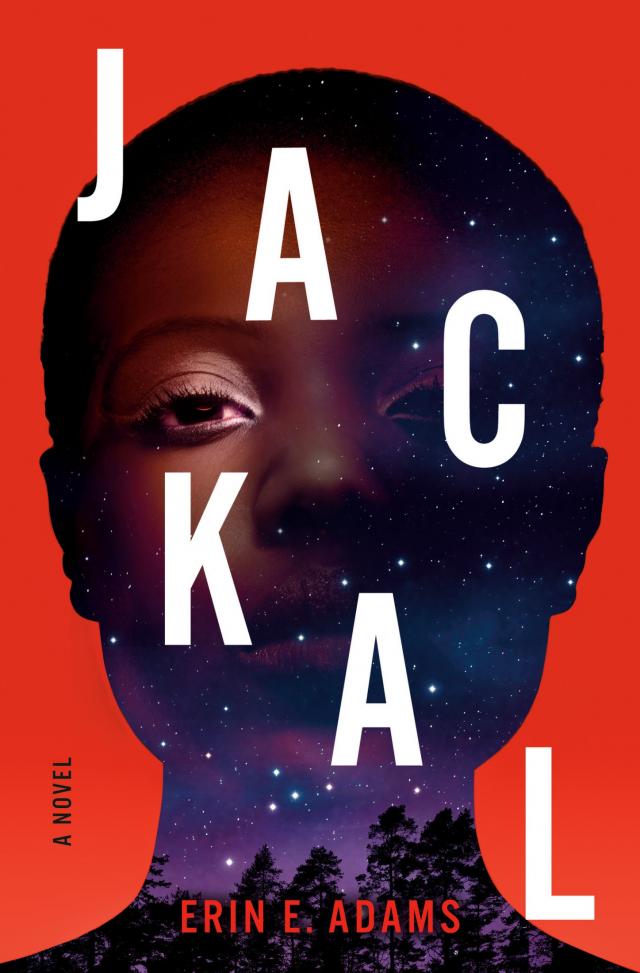


“Here,” she says. She hands me her drawing. I look at it. In the time we’ve painted, she’s filled every inch of the paper. There are white and yellow orbs representing the winter constellations. The true feat is the night sky itself. The blacks, blues, and purples she’s used to make the sky cast the dark in many fine textures. It makes my eyes search for shapes in it. The crayon strokes look like little tendrils emanating from a source. I find it. There, in the lower right-hand corner, if I squint just right, I see the profile of a canine with two upright ears.
I search Caroline’s eyes. They aren’t light or dark, but red with tears. I know I gathered all the pieces Jack left in people. I wonder about Caroline. I search her eyes from time to time to see if he left a bit of himself in her too. If a shred of him is in this child, I’ll take the monster in again. In a heartbeat.
“Auntie Liz?”
I give Caroline a smile the way I like to smile. The way I did before Jack. One-sided and close-lipped.
“Thank you, Care-bear.”
She runs back inside.
The boys have finished putting up the paint. I’m alone outside in the setting sun. I look at the drawing again. I find what I’ve been looking for all along: the truth.
I don’t know if Jack is really dead. I don’t know if something like him can die. I’ll never forget what it was to become the beast. The truth I have told no one is, what Jack did to me worked. All that anger he craved? It didn’t go away when he did. A lifetime ago, Denise first laid eyes on me outside the train station, and she told me nothing good came from being hateful and hollow, but my anger could be useful. So many have used my anger to silence me, to hurt me, to manipulate me, to try to kill me. I know it’s because they are terrified of what I could accomplish if I used my anger for myself. Everyone in this town—this country—is so afraid of the other, whoever the “other” is today. If there’s one thing fear can do, it’s make a beast out of a shadow. It turns us all into monsters.
The enemy of the shadow isn’t light. It’s sight.
The sun sets. It’s dark. Quiet. Out of habit, I name things.
A drop of blue paint.
My mother’s car.
A pink crayon.
I bend to pick it up. Something flickers at the edge of my vision. I still myself and get a glimpse of what’s on the other side of my grief. It’s not an emotion or place. It’s action. I will pick myself up. I will fight.
Another moment and the shadow enters my sight.
I turn.
I face it.
For my first cheerleaders and biggest supporters.
I love you, Mom and Dad.
AUTHOR’S NOTE
One of my favorite things about going home is the train ride. The nearly eight-hour journey, replete with incredible views and long stretches of quiet, is perfect for reflecting and writing. The only interruptions are occasional announcements for small-town stations and landmarks like the Horseshoe Curve and the Rockville Bridge. I can’t go home without traversing history. While this book has always been a work of fiction, writing it has required a personal journey through my hometown’s past.
In fiction, the events are made up but the emotions are real. As I delved into this story, I started to demand touches of reality around its location. No matter how many towns I imagined and mapped, they all ended up looking a little too familiar. With each draft I rebuilt my hometown: Johnstown, Pennsylvania. After we’d moved every three years of my life until middle school, Johnstown was where my mother and I set down roots. Ever since arriving I’ve had an uneasy relationship with the town. So, like Liz, to get to the other side of this novel I had to face what homecoming meant to me.
I still remember the first weekend my mother and I visited. Sitting in the back of a job recruiter’s car while they toured my mother around downtown, I stared out the window and noted clues: water lines on buildings, brass bars, strange concrete locks in the riverbed, the presence of a vehicular inclined plane. All across town I encountered scars of a tragedy. By the time I studied the unit of history in school, I was ready to put all the pieces together.
The Johnstown Flood of 1889 occurred on a Friday afternoon at the end of May. About fourteen miles upstream of the town was the South Fork Dam. It changed ownership over the years, which meant its upkeep varied greatly. As it aged it frequently sprang leaks and there were concerns over its integrity, but no action was taken. After days of heavy rain, on the morning of May 31, 1889, the South Fork Dam was on the brink of failure. Workers tried to relieve the structure, but it was too late. The dam was there one moment and gone the next. In a little over an hour, the South Fork Dam emptied, sending 20 million tons of water hurtling toward the town below. Laden with debris from its path down the mountain, a wave of floodwater thirty-five to forty feet high hit Johnstown at forty miles per hour.
Harrowing firsthand accounts describe indiscriminate destruction. Some houses were completely swept away, while others suffered minimal damage. Some families were spared while others were decimated in seconds. Entire trains were swept off tracks. Four square miles of downtown Johnstown were destroyed. The debris piled up against Stone Bridge, which spanned the Conemaugh River, and caught fire. It burned for three days straight. The previous days of rain and the flood itself knocked out the telegraph wires. With night falling, survivors had to wait until news of the tragedy trickled out to be rescued.
Once notified, help came swiftly. In my research, I found donations from groups all across the country and internationally. Not just monetary help—people offered their labor and expertise in supporting and rebuilding the town. The American Red Cross, led by Clara Barton, arrived on June 5. This was the organization’s first major peacetime effort. When the waters receded, the death toll came in. More than 2,209 souls perished. Bodies were found for years after, some hundreds of miles away.
Once the town started to heal, one question came to the forefront: Why did the dam fail? Of all the hands the South Fork Dam passed through, its most recent owner was the South Fork Fishing and Hunting Club—an affluent retreat for Pittsburgh’s elite; a who’s who of America’s ruling class. Among its members were Andrew Carnegie, Andrew Mellon, and Henry Clay Frick. These men made their fortunes in the same industries Johnstown and many other towns in the rust belt were known for: iron, coal, and steel. The club was a getaway from the worries of work and the city. Thus, when the dam was modified or cared for, it was done so to suit their interests before anyone else’s. For example, one alteration included lowering the dam to allow for carriage travel, thereby reducing its ability to discharge stormwater. After the flood, litigation followed. But after years of lawsuits and investigations, the flood was determined to be an Act of God. Though these men donated to the relief effort, they took none of the blame. This is where being a local changed my view of history.
According to articles and textbooks, the fault for the flood was vague and hazy. The blame was passed from person to person and organization to organization with aplomb. Finally, in 2013, the truth came out. The South Fork Fishing and Hunting Club misrepresented their modifications of the dam. Their changes jeopardized the structure’s integrity and directly led to its collapse in 1889. If you asked anyone in Johnstown, they could have told you that truth years ago without batting an eye: This happened because of the negligence of the wealthy.
Sometimes excavating history means confirming a truth people have collectively known for years. Other times, it means digging up a past that has been left in a shameful shadow.
Growing up in Johnstown, I collected clues around a different historical event. These hints were more evasive than brass bars. Johnstown is very segregated, in both race and class. Traveling from downtown to uptown and beyond, there are distinct differences at every latitude. I lived in the haven of small-town America; kids could walk to school unchaperoned and people seldom locked their doors. None of these assurances could explain or soothe my near-constant anxiety. I was one of three Black kids in my entire school, in both middle and high school. I accepted this as a fact of living where I did. Who’d ever heard of Black folks in the middle of nowhere? But when I picked at that rhetorical question and tried to pull it apart, I got pushback. There was something there. For a town that valued hard work, rebuilding, and rebirth, there was no reason for it to be so divided. Of all things, with the industries in town, it should have been blended across all areas. In pursuing the source of my anxiety, another historical event in Johnstown’s history found its way into my novel. Here I must thank Cody McDevitt and his work in Banished from Johnstown for helping me solve another mystery about the place I call home.
In the summer of 1923, much of the United States greatly feared the possibility of a race riot. In Johnstown, only two years after the Tulsa massacre, a drunken brawl in the predominantly Black neighborhood of Rosedale resulted in the deaths of Robert Young, a Black man, and white police officers Otto Nukem, Otto Fink, Joseph Louis Abrahams, and John James. To save the town from full social upheaval, Mayor Joseph Cauffiel handed down a decree: “I want every Negro who has lived here less than seven years to pack up his belongings and get out.” He banned Black and Mexican laborers from coming to the city. He banned gatherings of Black citizens for any reason except worship. To find the outcome and glean the fallout, we must collect the clues. The decree was never enforced. But two thousand Black and brown people left Johnstown the following week. Cauffiel was quickly admonished and lost his office. However, on the evening of the edict, ten crosses burned in the hills of Johnstown.
To me, this banishment and the Johnstown Flood are inextricably linked. They carry hard truths hidden in their details: The carelessness of the wealthy destroyed a rising working-class town, and white fear and anxiety drove off a substantial part of the town’s Black population. I was never under the impression that everything in my hometown was without conflict. I know what it means to live in America. There are other towns with histories like Johnstown’s. But because it’s my town, I must face it. Out in the woods, if you see or hear something that makes your hair stand on end—no, you didn’t. But learning, naming, and confronting what makes us afraid and uncomfortable, no matter how ugly, is key to understanding and ensuring it never happens again. Sometimes anger comes with truths like this. I don’t think that’s a bad thing. Anger fueled some of the writing of this book. My discomfort drove me to weave together all the clues I needed to craft my complex idea of “home.” Often, anger is only there to mask fear. Once fear passes, all that’s left to do is take a look at the truth. Sometimes it’s the only thing that can inspire change and allow the space needed to heal.
ACKNOWLEDGMENTS
From an early age, my parents instilled in me a love of the library. My childhood is filled with memories of checking out stacks of books and falling in love with each and every one of them. Both my mother and my father fostered my love of language throughout my life: They read me stories until I memorized them. They gave me cash to tear up the book fair. They gave me space and time to read every summer. They never banned books from me. If I could comprehend the world, then I could learn about life on the pages. For that trust, I’m forever thankful for Anne-Marie Sterlin and Derick Adams.
In its infancy, this book was lovingly witnessed and critiqued by my writer’s group, Re: Group. Thank you, Charlotte Lang-Bush, Jordan Tierney, Jack MacCarthy, and Kacey Stamats. You all gave me the care and confidence I needed to complete this novel.
I will never be able to thank Sonia Hartl and Annette Christie enough. They changed my life. They sent me an edit letter that taught me how to revise by teaching me to listen to my writer’s gut. For years I was too afraid to dream my dream of being a writer. Sonia and Annette helped me make that dream a reality. Thank you to my Pitch Wars class for being there for me every step of the way. Special shout-out to CJ Dotson, Angela Montoya, Diba Bijari, and Zahra Zelle for reading drafts of this book and for your continued support. Thank you, Brenda Drake, and thanks to all the volunteers who helped run Pitch Wars.
Thank you to NYU’s Department of Dramatic Writing. Thanks to the faculty and the class of 2022. Thank you, Komal Surani, Anuhea Brown, and Gareth Mattey, for listening to all my crazy plot pitches during revisions. Thank you to Robin Epstein for giving me grace, space, and guidance while I did these edits.
Kerry D’Agostino is a gift of an agent, who met me where I was and saw where I wanted to be as a writer. Thank you to the entire team at Curtis Brown: Holly Frederick, Madeline R. Tavis, Sarah Perillo, and Mahalaleel Muhammed-Clinton, among others. I’m such a lucky, lucky writer.
Thank you a thousand times to Jenny Chen. I still remember the vibration of excitement we had in our first Zoom call. My gut said, “She wants this just as much as you do.” Jenny read Jackal and saw how to make it even more brave and stunning. She and her assistant, Mae Martinez, guided me through this incredible revision. By the end, the book smelled even more like me than the initial draft did. I love it. I’m obsessed with it. I’m so proud of the work we did and that I get to call this book my debut.
The entire team at Bantam has been a dream. Thank you, Allison Schuster, Allyson Lord, Jordan Forney, Yewon Son, Quinne Rogers, Loren Noveck…and everyone else who has helped bring this story to life.
Thank you to my incredible gremlin, Thisbe, aka the goodest dog in existence.
It took a village of people to make Jackal. I’m forever grateful for all who got this book here and who will carry it into the future.
ABOUT THE AUTHOR
Erin E. Adams is a first-generation Haitian American writer and theater artist. She received her BA with honors in literary arts from Brown University, her MFA in acting from The Old Globe and University of San Diego Shiley Graduate Theatre Program, and her MFA in dramatic writing from NYU Tisch School of the Arts. An award-winning playwright and actor, Adams has called New York City home for the last decade. Jackal is her first novel.
erineadams.com
Twitter: @IAmEEAdams
Instagram: @IamEEAdams
What’s next on
your reading list?
Discover your next
great read!
Get personalized book picks and up-to-date news about this author.
Sign up now.
_141032870_
Erin E. Adams, Jackal


