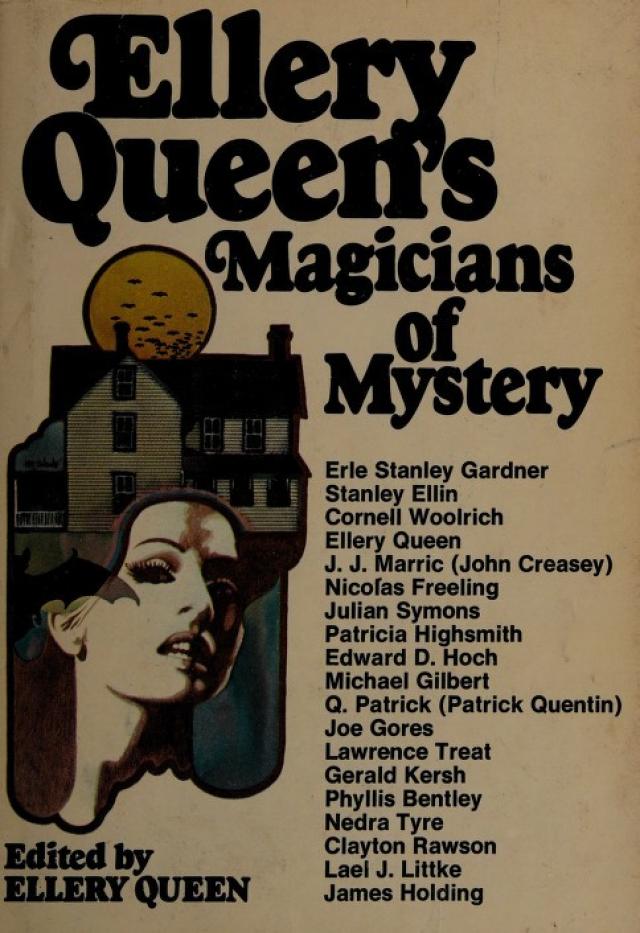
Ellery Queen's Magicians of Mystery, page 5


They confirmed that they had never seen Jimmy before, but that they knew his sister well.
“Now, Jimmy, I want you to understand this,” Gideon was saying the next morning, just before the court hearing. “Tell the magistrate the truth and he will believe you. You’re young enough to be put on probation. Your sister will go to prison for her part in the crime, but you won’t. The probation officer will find you a job, and a hostel where you can live, and if you don’t get into any more trouble you’ll be all right. Do you understand me?”
“Yes, sir.”
“Do you believe me?”
“Oh, yes, sir!”
“That’s fine,” said Gideon. “So stop worrying.”
He put a reassuring hand on Jimmy’s shoulder; and something of Gideon’s compassion, of his warm-heartedness and confidence, passed itself on to the boy.
Nicolas Freeling
Van der Valk and the Two Pigeons
Another in Nicolas Freeling’s series about Van der Valk, Chief Inspector of Amsterdam’s Juvenile Brigade. . .the story of two pigeons, one soft and downy, the other venturesome and vivacious, and how Van der Valk, like his London counterpart Gideon, proves himself anything but a cold-blooded, hard-hearted policeman; and like Gideon, Van der Valk knows the true meaning of his job. . .
Detective: VAN der VALK
Chief Inspector Van der Valk had been in England on business, and he first saw them on the night-ferry train which trundles its slightly dirty way from the dismal hubbub of Liverpool Street to Lethe’s muddy shore at Harwich. Neither is what you would call a place to make you fall in love with England’s green and pleasant land, and he wondered why they were crying so desolately.
It was high summer. The train was crowded with purposeful Germans gathered round their cheerleaders, and smaller, grimmer groups of sturdy Britons; but all were staggering under fearful burdens—huge lumps of shapeless textiles, great clattering bundles of ironmongery. One could barely move. Smells of beer and sweaty jollity rose above the English-railway scent of dust.
Van der Valk was pinned down under a table in the swaying, gibbering car, watching the two girls fill in their immigration forms. They were Dutch, looking isolated in the hearty mill of holidaymakers, the more bizarrely since they went on gulping and weeping into grimy handkerchiefs.
One was the prototype of the country girl—a big pink shapeless thing all soft and downy, with that wispy hair that is neither blonde nor brown. The other was smaller, thinner, with a close cap of brown hair and gamine good looks; her vivacious features would be pretty when not smeared with crying.
He watched them limping with pathetic suitcases along the icy, drafty platform at Harwich, their backsides sticking out in dirty blue jeans. He saw them again in Hoek van Holland, under the horrid blue notice saying Welcome Home where starched, bedizened military police examine everyone for signs of subversion. They did not cry at being welcomed home, but looked utterly forlorn.
He saw them again, shuffling toward the exit of the Central Station in Amsterdam, the dumpy one stumbling along more uncoordinated than ever from sleeping in the train. But the slim girl had a remnant of tautness in her bearing, and she was shouldering a discolored canvas bag as though she would not easily loosen her grip on youth, on enjoyment, on life itself. The two pigeons, thought Van der Valk. But in the story, surely, only one pigeon went away. The nervous one had stayed at home. Yes, but in his mind there they were—the two pigeons. . .
It was a month later and he had forgotten them, but despite the change he knew the pigeon at once when she came forward to serve him in a dairy, over in the dingy quarter between central Amsterdam and the docks. Now she was fresh and rosy, almost pretty in a clean white apron, wholesome as the smells of cheese and yoghurt. She had a country accent, an earthy thickness in her speech; he had known she would.
“Where’s your friend?” asked Van der Valk cheerfully.
She looked startled, but she had the round-eyed, perpetually bewildered look of her type.
“What friend?”
“I saw you last dragging your bags along in England, the two of you.”
“Oh. . .I don’t know. She went away, I think. I—I had just met her, that’s all.”
Why was he so sure she was lying? And why should she lie?
Sure enough it was in August, barely ten days later, that he saw the other one, the venturesome pigeon, in the street, not a hundred meters from the dairy in the Oude Schans. Shiny slim legs twinkled under her pale-lilac miniskirt; the smooth cap of hair was now bright blonde, and she swung a jaunty little handbag.
Van der Valk should have been delighted with this pleasant sight; instead he frowned. He made a half-hearted step as though to follow her, but it was eight in the evening and he was tired. He put a cigarette in his mouth and compressed his lips so that it jumped up and down and touched his nose. Then he shrugged and went home. The Oude Schans, a lifeless and dingy canal, was some distance from the tourists’ red-light quarter, but not as far as that; and when a day later he was in the Warmoestraat, which is the district bureau for the old quarter, he asked the desk sergeant if anything was known about the two pigeons.
“Short blonde hair and a lilac mini? Doesn’t ring any bell but I’ll keep an eye out. I can think of several—but all nearer forty than twenty.”
“This one,” said Van der Valk dryly, “is the wrong side of twenty—my side.”
It was odd—he was worried about his two pigeons. Naturally, hundreds of teen-age girls go through the hands of the Juvenile Bureau every year, but he knew nothing to justify a professional interest. It was somehow personal. Had he not seen them crying in the train leaving England, dirty and bedraggled from a night on the North Sea Ferry, but with that odd spark of verve? He had his files of missing girls searched, a thankless task in August. Nothing.
But when toward mid-September he got a call from the Criminal Bureau, and an address near the Oude Schans, a thundercloud of foreboding rolled over the streets of Amsterdam so clean and bright at the dawn of a lovely late-summer’s day.
“Teen-age girl, Van der Valk—I think you’d better look at this one.”
The only surprise was that the dead girl was not the gay one in the lilac miniskirt. It was the milkmaid, and she was no longer rosy; her face showed the vile bluish color of strangulation. Lightning had struck the stay-at-home pigeon.
He climbed a narrow dark staircase to a third floor and found a youngish Inspector, not very experienced, who had plainly called in the older man for fear of making a mistake. Van der Valk looked round the room, with its tumble of clothes and possessions, the primitive washing arrangements, the dingy curtain down the middle that could be drawn to give privacy of a sort. He knew these down-at-the-heels houses in the older quarters, warrens of one-room flats rented cheap with a few sticks of junk furniture to students, married couples with no money, girls who work and men who do not. Nobody knows anyone else; questions are considered in poor taste; people come and go. The Inspector was looking at handbags, papers, letters, and making notes.
Van der Valk pointed to the other bed.
“Find her yet?”
“Holy cow, I just got here.”
“Better find her quick—or you might find her in the river. Who reported it?” It was barely six, and few people were about as yet.
“A fellow who goes to work early. He saw the door open, thought it funny, and looked inside. Street door shut, of course.”
“But is left open half the day.”
“I guess so.”
“I know these girls by sight. I think this will prove to be an open-and-shut case. We must find the other girl, and quickly. I’ll get a description broadcast. She’ll be easy to find—a waitress, some temporary job of that sort. She’s certainly in trouble—and she may be in danger.”
A noise in the open doorway made both men glance over their shoulders, for though it was a small noise, like a breath suddenly drawn in, it startled them. Van der Valk laid a hand on the other’s arm, but the clown was already bawling, “Stop. Come here. Hey, you.”
Van der Valk looked at him and uttered a short bitter monosyllable. “You frightened her off.”
Both men made for the door. Van der Valk tripped on a ragged piece of carpet, bumped into the other, and lost several valuable seconds. He had to go gently on the dark worn stairway if he were not to break his neck. Nobody was at the street door; he cursed the policeman who should have been there, looked up and down, saw nobody, and said furiously, “Take that way, and hurry!” A street with canals on all four sides!
He forced himself to look carefully at doorways, alleys, and shadowed patches. Amsterdam hereabouts goes to bed late and nobody was about. He was very afraid. He stopped at the corner, listening above the silence and the distant grumble of the stirring city, and then he heard the sullen noise of a heavy object striking water, and ran, but he had taken the wrong turn. When he saw the movement on the scummy water he was breathless and in a sweat, but still able to curse: disgusting foul water, fool of a girl.
He took his jacket and shoes off, trying to slow his clumsy movements, and went in with a bellyflop. He blew a foul taste out of his nose and mouth, swam like a wounded hippo, tried to judge distance, dived, wondering if he would ever come up and muttering, “Please, not both.”
Five minutes later he was sitting giddily on greasy pavingstones, throwing up. Two Amsterdammers whose windows had been open—they are never greatly surprised at persons or things falling in the canal—were holding another figure carefully, helping it to throw up too.
“Police car,” gasped Van der Valk, lurching to rubber legs.
“When did you have your last typhoid shots?” a bored intern asked at the hospital.
“Is the girl all right?” He got up, hitched a brown ambulance blanket to stop it from falling off, and looked to see if everything was still in his jacket.
“She’ll be all right. We’ll keep her, naturally, a day or two. She’s in shock—large dose of sedative.”
“Keep her carefully.” He looked over at the Inspector, who was standing there staring as though Van der Valk were the monster from ten thousand fathoms, all gray ooze, (look like it, and sure smell like it, he decided).
“As soon as she can talk get a description of all the men she’s been with—one of them killed her little friend.”
“A psychopath?”
“How the hell should I know? Is there a cup of hot coffee around?”
“Two pigeons,” he said slowly. It was the next day; he was sitting in his office; two sets of distraught parents, arrived from the backwoods, were gibbering at him. “They were always together, and one was the natural leader, always. It was her idea to go to England—am I right?”
“But we thought they were still there. We’ve had letters—”
“Slowly please. Two girls went to England, to the usual ‘au pair’ jobs. Where was it, by the way?”
“A place called Scarborough.”
“We’ll have to get in touch with the police there. One left her job. But she didn’t want to go back to Holland, which is dull. She liked England. I saw them, crying, on the boat train. We don’t know yet—perhaps she got into mischief. Perhaps her permit was canceled. It was something they did not care or dare to admit in their letters. Forced to leave, they came back as far as Amsterdam, and decided to stay there. It was exciting. They wrote to acquaintances in England, enclosing occasional letters to be given an English stamp and postmark. To keep you from inquiring.
“Now, I’m afraid, we have a sadder tale. They had to find jobs here. In the summer that is not difficult. The quiet girl found a job in a dairy—simple, pleasant work. A docile girl, easily led. The other wanted life—thrills. Work is not thrilling. We learned she took a job as a hotel chambermaid. Poorly paid, but the evenings were free. You must not blame her if she slipped into bad company. Many of these girls slide onto the fringe, surreptitious pickups in the bars and cafés. In the summer, with the town full of tourists, this becomes very difficult to control. One cannot upset and frighten visitors with unending identity checks.
“The other, we may guess, wanted no part of that life, but she had no resource but in her active friend. One day, perhaps, the other brought a man back to the room in the side street. She had to learn to pay no attention, draw the curtain, and go to sleep. One man—we have him, by the way—remembered the address and returned one night. The street door was still open—they often are, up to midnight. The people who live in these houses are honest, but casual, irresponsible, and feel they have little to lose and much convenience to gain.
“The man was quite drunk. He had no vicious purpose—he had no idea except to find a girl who had pleased him. He found the wrong girl. Probably she lost her head and began to scream and it is quite likely, as he claims, that he wished only to silence her. She was not assaulted. He was frightened and ran away, leaving the door open. Nobody saw him. I am sorry—it is not a pretty story.
“The other had stayed out all night. In the early morning she came back to change and go to work as usual. She found the dead body of her friend and overheard a scrap of conversation between two policemen. Incoherent with terror and remorse, her one idea was to seek death herself. She has suffered, and will suffer, much more than her friend.”
“You yourself, Chief Inspector, saved her from death.” The girl’s father was a prosperous shopkeeper from a small provincial town, not at all a bad or even a stupid man.
Van der Valk looked at him. “But I did not save the other. I saw her in the shop, looking quite happy. I thought nothing of it. I caught a glimpse of her friend, with her hair dyed, in the street. And I thought little enough of that. She had not been noticed in bad company. After this month she would have been. But the police are overworked in summer. A regrettable fatality.”
“You cannot be blamed. We blame ourselves.”
“Try not to blame her.”
Van der Valk accompanied the two worthy couples to the door and went to see Commissaire Boersma.
“Such things happen every day,” Van der Valk said after the business had been covered. “Why should I be so upset?”
The Commissaire looked at him, shifting the pipe in his teeth.
“The lightning struck the wrong pigeon,” he said, “and there’s something about those night ferryboats that brings out the romantic in you. Next time I’ll go myself to England.”
Erle Stanley Gardner
The Clue of the Runaway Blonde
There were forces in Rockville—the political bigwig and one of the newspaper publishers and other leading citizens—who wanted to oust 70-year-old Sheriff Bill Eldon. Despite Eldon’s popularity, they considered the sheriff an old fogy in his crime-fighting methods—an old fossil who didn’t know “modern scientific stuff.” But Sheriff Eldon, with his slow drawl and whimsical, sense of humor, with his warmth and kindness, and especially with his understanding of the townspeople in particular and of people in general, had his own detective method—a method that has never grown old or old-fashioned, that is always as new as the latest electronic gadget. He knew that the solutions to the deepest mysteries of life lay not in physical clues (notwithstanding the title of this story!) but in the hearts and minds of people, in human nature and human character. . .
BONUS: Something you don’t usually expect in an Erle Stanley Gardner detective story—an “impossible crime.” The victim was found stabbed to death in a freshly plowed field with no footprints going in any direction—not even the victim’s! How can a person walk over moist, loamy soil and not leave any footprints?
A fast-moving, shrewdly plotted short novel complete in this anthology. . .
Detective: SHERIFF BILL ELDON
Cold afternoon sunlight made a carpet of long shadows back of the eucalyptus trees along the road as Sam Beckett opened the gate of the old Higbee place and drove his tractor into the eighty-acre field.
Things had been moving swiftly. Only the night before, the Higbee heirs had finally quit squabbling long enough to agree on a selling price. John Farnham, the realtor, had made a hurried trip to see Beckett the next morning. Within a few hours Beckett had gone over the property again, and the heirs had signed on the dotted line, the money went into title escrow, and Sam turned his horses into the Higbee place to pasture. Now he was starting plowing. He’d work until midnight, or longer if he didn’t get too sleepy.
Out in the center of the field the old homestead was hemmed in by big shade trees. The dirt road ran to it in a diagonal line from the gate. But Beckett had no use for the big rambling house. It would cost more to renovate it than it was worth.
He lowered the plow and started up the tractor. As he plowed up roads and green sod with utter impartiality, the rich black soil rolled out in smooth billowing streams. The welcome smell of moist, fertile earth filled his nostrils.
Low sullen clouds drifted by overhead and to the east. Only in the west, where a wind from the ocean was temporarily pushing back the heavy clouds, was there a strip of blue sky. And the setting sun, glinting through under the clouds, turned the lower dragging wisps of moisture to a reddish purple which held a trace of orange, a color peculiar to wintry sunsets in Southern California.
The monotony of the tractor’s motor, the steady strain of watching the furrow, lulled Sam Beckett into a state of half hypnotism where minutes marched by unnoticed.
The long shadows dissolved in dusk. Sam Beckett switched on the headlights and kept going. His eyes were fixed on the strip between grass and plowed earth, keeping it lined up just to the left of the right front wheel.
The chill night air flowed past his legs and stung his cheeks. His hands grasped the wheel until the knuckles felt numb, but his eyes remained automatically fixed on that slowly moving strip of ground, green on one side, black on the other.