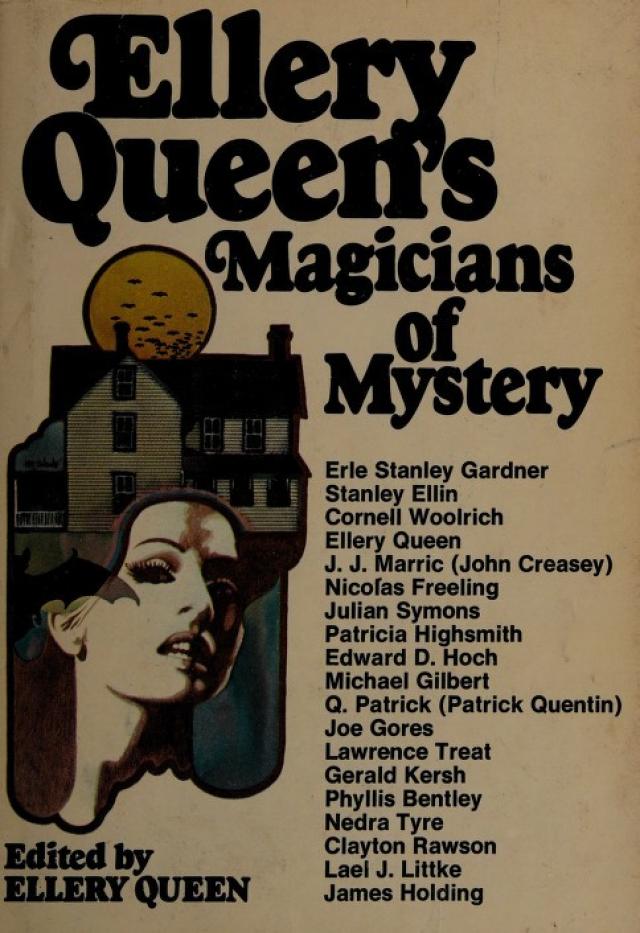
Ellery Queen's Magicians of Mystery, page 35


I jumped in at them, caught the wrist holding it, turned the skin cruelly round. She dropped it and I caught it in my open palm. The maid stepped back and began to snivel.
I said, “Why didn’t you call me, you little fool!”
“I did call you,” the maid snuffled.
I pocketed the revolver and said to the girl, “We don’t need you any more.” And to Iveria’s wife, “Come on downstairs.” She followed me, white as a ghost.
“Do we go now?” she asked at the foot of the stairs.
“You don’t suppose I’m going to leave you behind me out here, after what you just tried to do.”
“That was a momentary impulse. It won’t happen again. It wouldn’t be fair to Streak. It would be giving Arnold his victory too cheaply.”
We’d gone back to the room in which I’d first spoken to her.
“Sit down,” I said curtly. “Give yourself time to quiet down first.”
She looked at me hopelessly. “Is there anything I can do or say that will make you believe me? I had nothing to do with Arnold’s death.”
I didn’t answer—which was answer enough.
“I don’t suppose you believe that, do you?” I didn’t answer. “You’re positive I meant to kill Arnold, aren’t you?” I didn’t answer. “He saw to it that you would be. He went to you and told you the story, didn’t he? Told it his way.”
I didn’t see any point in denying that; it was self-evident by the mere fact of my being there. “Yes, he did.”
She let her head slowly droop forward, as if in admission of defeat. But then she raised it again a moment afterward, refusing the admission. “May I have the same privilege? May I tell the story my way?”
“You’re going to have that privilege anyway, when the time comes.”
“But don’t you see it’ll be too late by then? Don’t you see this is a special case? The mere accusation in itself is tantamount to a conviction. One wisp of smoke, and the damage has been done. Streak and I can never live it down again—not if every court in the land finds insufficient evidence to convict us. That’s what he wanted, to ruin the two of us—”
“But I’m just a detective. I’m not a judge—”
“But he only told it to you, no one else at the time—”
This did get a rise out of me. “How do you know that?”
“Dr. Drake showed me the dying message he had taken down; it had your name on it—‘Burke.’ It was addressed to you personally, no one else. It was easy to see he’d made you the sole repository of his confidence—until the time came to shout the charges from the rooftops. The evidence was too nebulous, there was no other way in which to do it.”
“Tell it, then,” I agreed.
She didn’t thank me or brighten up; she seemed to know it would be hopeless ahead of time. She smiled wanly. “I’m sure the external details are going to be the same. He was far too clever to have changed them. He selected and presented each and every one of them so that I cannot deny them—on a witness stand, for instance—unless I perjure myself. It’s their inner meaning—or rather the slant of the story—that he distorted.”
I just sat and waited, noncommittal.
“I met Arnold in St. Moritz and I felt vaguely sorry for him. Pity is a dangerous thing, so often mistaken for love. No one told me what was the matter with him.”
Here was the first discrepancy. He’d said she knew ahead of time. And he’d said he had documents to prove it.
“He proposed to me by letter, although we were both at the same resort. He used the word ‘hemophilia’ in one of them, said he knew he had no right to ask me to be his wife. I’m not a medical student—I’d never heard the word before. I thought it was some minor thing, like low blood pressure or anemia. I felt the matter was too confidential to ask anyone; after all, the letter was a declaration of love. I wrote back, using the strange word myself; I said it didn’t matter, I thought enough of him to marry him whether he was in good health or poor health.
“By the time I actually found out, it was too late. We’d already been married eight months. I stick to my bargains; I didn’t welsh. I was married to a ghost. That was all right. But then I met Streak, and—I found out my heart was still single. I went to Arnold and I said, ‘Now let me go.’ He just smiled. And then I saw I hadn’t married any ghost. I’d married a devil.
“You don’t know what torture really is, the mental kind. You may have beaten up suspects at times. You don’t know what it is to have someone say to you three times a day, ‘You wish I was dead, don’t you?’ Until finally you do wish he was dead.
“We didn’t want a cheap undercover affair. If that was all we’d wanted it could have been arranged. Streak was born decent, and so was I. He wanted to be my husband, I wanted to be his wife. We were meant for each other, and this ghost was in the way.
“Finally I couldn’t stand it any more. I said, ‘It would be so easy; why should we go on letting him do this to us?’ Streak said, ‘Don’t talk that way. We don’t want to get together by building a bridge over someone’s dead body.’ Streak’s not a murderer. Streak’s out of this entirely.”
Which didn’t prove a thing, except that she loved him.
“They say the female of the species is more deadly than the male. I toyed with the idea. I let it grow on me. Finally it took hold, became decision. Arnold wouldn’t give me a chance to change my mind, he kept it at the boiling point.
“Streak came around in his car, to see if he couldn’t win Arnold over by having a man-to-man talk with him alone. I knew he didn’t have a chance. I knew what a venomous, diseased mind he was up against. I was the one loosened the clamps on that windshield, with a little screwdriver, while both were in the house. But it missed fire.
“I tried in one or two other ways. And then suddenly I came back to my senses. I saw what it was I’d been trying to do all those weeks and months. Take away someone’s life. Murder. No matter what a fiend he was, no matter how he’d made us suffer, I saw that was no solution. I’d only have it on my conscience forever after. Dead, he would keep me and Streak apart far more effectively than he had when alive.
“It’s ironic, isn’t it? When I wanted to kill him, nothing I tried would work. Then suddenly, after I’d stopped trying, he goes off—like that!”
I said. “D’you realize what you’ve just been saying? What you’ve just admitted? That you actually did try to murder him several times without succeeding. And now you want me to believe that this last time which finally did succeed, it wasn’t you, but an accident!”
“Yes, you’ve got to—because it’s true! I could have denied that I ever had such an idea altogether. But I don’t want to mix part truth and part falsehood. What I’ve told you is all truth from beginning to end, and I want you to believe it. I did intend killing him, I did try; then I changed my mind, gave up the idea, and an accident took his life.
“All right, now you’ve heard my side of it. If you want me to go with you, I’m ready to go. Only think well what you’re doing, because once the damage is done, there’s no undoing it.”
“Suppose I go back to town now without doing anything—for the present. Say just overnight. What will you do?”
“Wait here—hoping, praying a little, maybe.”
“How do I know that?”
“Where can I go? Running away won’t help; it’ll just fasten guilt on me. It’ll just bring on the ignominy he wanted Streak and me to suffer. If we were going to run away now, we could have run away while he was still alive.”
She was right about that, of course. “Then wait in this house until you hear from me. Consider yourself in the custody of your own conscience. I’m going back to town now, alone. I want to think this whole thing out—by myself, away from here. I can’t think clearly when I’m this close to you. You’re very beautiful, you know. I’m a human being, I’m capable of making a mistake, and I don’t want to make a mistake. As undeniably as you are beautiful, Iveria is just as undeniably dead.”
“It’s going to be awful,” she said, “to have it hang suspended over my head like that. Will it be very long before I know?”
“As soon as I know myself; sometime tomorrow, maybe. Don’t leave the house. If the doorbell rings, and you see me standing out there—you’ll know I’ve come to take you back to face a charge of murder. If the telephone rings—that means you’re in the clear.”
Crawley looked in on me at midnight. “What’s the matter, haven’t you any home?”
I motioned him on his way. “I’m trying to think something out,” I said. “I’m going to sit here if it takes all night.”
I had the deposition on the table in front of me, and the cigarette case, and the deathbed note. It all balanced so damnably even, his side and hers. Check and doublecheck. Which was the true story, which the false?
The crux of the matter was that final incident. That was where my dilemma lay. If it was murder, Iveria’s death demanded reparation. If it was an accident, then it proved him the devil she claimed him to be, for he himself must certainly have known it to be an accident; yet before he died he deliberately phoned me from the hospital and dictated that deathbed message emphasizing that it was murder.
I reviewed the whole case from start to finish. He had walked in to us at Headquarters and left an affidavit in my hands telling me he expected his wife to kill him, in the guise of a trivial accident; telling me he would say “This is it” when it happened. He’d had a trivial accident, and he’d said “This is it” before he died.
I went out to question her and I found her dancing for joy in the presence of the man she loved. She admitted she had tried to kill Iveria several times in the past. She denied she had tried to kill him this last time. But—she had tried to bribe me not to pursue the investigation any further. What was the evidence? A bedside bulb loosened a little in its socket so it wouldn’t light, a hassock placed where it didn’t belong.
She had left me, as if overwhelmed by this gossamer evidence that was really no evidence at all. She didn’t come back. I sent the maid after her. I went in there and found the two of them grappling in desperate silence over a gun she had tried to use on herself. As a guilty person who felt that she had been found out? Or an innocent person who despaired of ever satisfactorily clearing herself? I calmed her down, listened to her side of the story, and finally left to think it over alone, telling her I would let her know my decision by coming back for her (guilty) or telephoning (exonerated).
And here I was.
And I’d finally reached one. Even though the scales remained evenly balanced and counterbalanced, to the last hair’s-breadth milligram. Only one grain more had fallen on one side.
In the cold early daylight peering into the office I picked up the phone and asked the sleepy Headquarters operator to get me the number of the Iveria house up there in the country, where she was waiting to know.
I hadn’t heard the maid call out from that adjoining room, and I had been fully awake. But he claimed he had heard his wife cry out in there, and he was supposedly asleep.
No; he had actually been on his way in there at the time, gun in hand, to take her life, when a combination of unexpected little mischances turned the tables on him.
Julian Symons
The Sensitive Ears of Mr. Small
“When I become excited, you see, my hearing becomes very—very acute.” Mr. Small had a curious hearing condition—extraordinary magnification of certain sounds. That was the curious part of it—not all sounds, only certain sounds. Like those his wife Lucy made: they grated, bombarded his ears, jarred his nerves. And like those Marilyn made: they were delicious, delightful—they soothed, caressed, excited. . .
Julian Symons’ story is a probing and perceptive “study in crime”—a study in the power of life and death. . .
The kitchen door closed with a slight, yet decisive and delicious promising click. Mr. Small moved smoothly into his daydream. He got up, went smiling out to the kitchen, discovered Marilyn there in the act of pulling up her stockings. She gave a small protesting but delighted gasp as his arms clasped her from behind. Beneath his hand he heard the soothing sound of fingers on silk. . .
Crunch. His wife’s teeth as they bit into toast destroyed the dream. Crunch and crunch again, like a series of mortars exploding. It was a relief when she dipped a spoon into the pot for more marmalade, although the resultant squelch was still unpleasant. But then inevitably came another crunch, against which he rustled the morning paper in vain.
The attack quite drowned any sound that Marilyn was making in the kitchen. He felt himself unable to bear it. This was a very bad morning. He rose and said he must go. The touch of his lips on Lucy’s cheek was the briefest possible contact. In the car on the way to the station he said aloud, “It can’t go on.”
The curious condition of his hearing had existed now for some four months. It had begun, if he liked to put a time to it, just after Marilyn came to work for them three mornings a week. It was as though he felt things through his sense of hearing rather than through his sense of touch; the result was that almost every movement Marilyn made gave him a thrill of pleasure while everything Lucy did, whether it was moving a chair or turning the pages of a magazine, jarred his nerves.
Apart from things done by Marilyn and Lucy his hearing was perfectly normal, which somehow did not make things any better. He tried to explain it to old Dr. Bentham.
“When I become excited, you see, my hearing becomes very—very acute.” It did not seem wise to mention Lucy and Marilyn.
Dr. Bentham was old and red-faced. His hand shook a little and his breath smelled of whiskey. He made a cursory examination and said, “Nervous strain. Overworking in the office. The pace we all live at nowadays. Need to slow down a bit. Give you some pills.”
The pills had no effect, and within another few days it became clear to Mr. Small that pleasure was associated with Marilyn, pain with Lucy. One was as intense as the other. He began to indulge in daydreams in which the pleasure was accentuated and the pain did not exist. . .
Mr. Small was rather small, although not diminutive. He was 40 years old. Everybody liked him because he was almost always cheerful and placid. His name was Geoffrey, but most people called him Geoff. Friends and acquaintances felt rather sorry for him because Lucy, although a splendid manager and good cook, was inclined to lay down the law about everything and wait for him to agree.
As people said, it was a pity they had no children, although of course they got on terribly well. And at Truwell Hanslit, the firm of manufacturing chemists where Mr. Small was the assistant accountant, he got on terribly well, too, enduring better than anyone else the schoolboy sarcasm of the general manager, Mr. Best. Yes, everybody liked Geoff Small.
On the morning that he had said, “It can’t go on,” Mr. Small had lunch in the executives’ restaurant with Grady, the company’s chief analytical chemist. Grady, an ebullient Irishman, liked to talk, and there was no better listener than Geoff Small. As a matter of fact, they’d had lunch together quite often in the past month. While Grady talked, Mr. Small noticed that the ordinary restaurant noises did not bother him at all.
Truwell Hanslit manufactured dozens of different branded preparations, from a new cortisone ointment for rashes to a contraceptive pill that was said to have no side effects of any kind. Grady liked talking about these, but he talked rather more about the power held by analytical chemists in general and the importance of his own work in particular.
“Some of the things we work on and then give up, Geoff, you’d never believe. Talk about the power of life and death! You know what the Home Office analysts say.”
“What do they say?” Mr. Small inquired timidly.
“Well, they only whisper it, mind you, but everyone knows there are a hundred different laboratory ways of committing undetected murder.”
“Poisons, you mean?”
“Not poisons, Geoff, compounds.” Grady jabbed with his fork. “There are half a dozen compounds in the lab at this moment that would send somebody off to sleep for good. Experiments, you know, we shan’t manufacture them.” He gave a great belly laugh. “Next time you’re in the lab—”
It happened that Mr. Small had to go across to the laboratory that very afternoon, on a query which proved to be a mistake in the Accounting Department. Grady was delighted to see him and continue their conversation. At the end they made what was almost a conducted tour of the laboratory in which Grady cast a little light on his companion’s ignorance. It had been said that Mr. Small was a good listener, and he did not mention to Grady that long ago he had passed a physics examination which naturally included chemistry. His knowledge was haphazard but genuine.
On the way home that evening Mr. Small made a few purchases at three different drug stores. It would be pointless to say what they were, for each of the substances was harmless in itself. On the way back from the station in the car he repeated, “It can’t go on.”
Mr. Small had always liked puttering about in the kitchen. He did nothing elaborate, but he baked bread, made teacakes, and always took up a bedtime drink to Lucy. On the evening after his conversation with Grady he pottered about, then took up not only a sleep-inducing drink but one of the little buns he had just made.
Lucy ate it, and burped. A sound like a shot went through Mr. Small’s body. “Too much baking powder,” she said.
That night she felt ill. Not very ill, but Mr. Small insisted on calling Dr. Bentham. He came, bad-tempered and sleepy, diagnosed injudicious eating, and gave Lucy a sedative.
On the following morning Marilyn arrived to find Mr. Small making breakfast for Lucy, who was still in bed. He explained that she had had a nasty turn.
“Oh ah.” She was a blonde girl, whose parents had died a few years back. She had a slightly crooked smile and a way of looking sideways that was conspiratorial and attractively sly. As she took off her coat, standing close to him, there was a rustle like music.