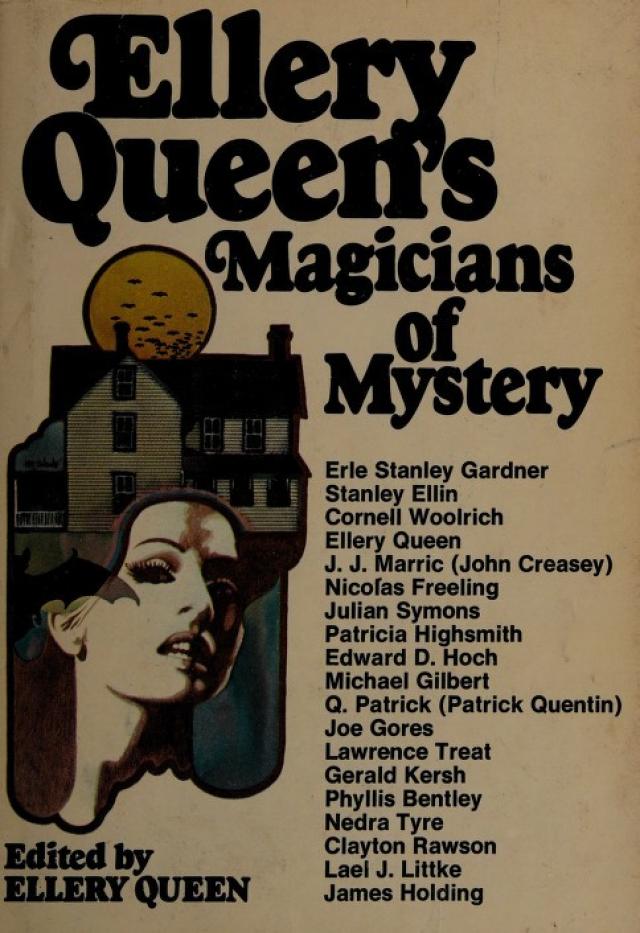
Ellery Queen's Magicians of Mystery, page 32


Eleanor heard herself chatting as she always did, though in an odd way she felt she was not present with Mary, not even in the Rolands’ house. It wasn’t a “miles away” feeling, but a feeling it was not taking place. It was not even as real as a dream.
Eleanor went home at midnight, after Tom returned. Somehow she knew she was going to die that night. It was a calm and destined sensation. She might have died, she thought, if she had merely gone to bed and fallen asleep. But she wished to make sure of it, so she took a single-edge razor blade from her shelf of paints in the kitchen closet—the blade was rusty and dull, but no matter—and cut her two wrists at the basin in the bathroom.
The blood ran and ran, and she washed it down with running cold water, still mindful, she thought with slight amusement, of conserving the hot water in the tank. Finally, she could see that the streams were lessening. She took her bathtowel and wrapped it around both her wrists, winding her hands as if she were coiling wool. She was feeling weak, and she wanted to lie down and not soil the mattress, if possible.
The blood did not come through the towel before she lay down on her bed. Then she closed her eyes and did not know if the blood came through or not. It really did not matter, she supposed. Nor did the finished and unfinished skirts and dresses downstairs. People would come and claim them.
Eleanor thought of him, small and strong, strange and yet so plain and simple. He had never told her his name. She realized that she loved him.
Cornell Woolrich
Only One Grain More
Another highly charged, emotionally packed, suspense-filled detective novelet by Cornell Woolrich. . .
At one point Inspector Burke thought: “Why, there was no difficulty about this case, it was a pushover.” But Inspector Burke was never more wrong. The beautiful Princess—was she guilty or innocent? “The scales remained evenly balanced and counterbalanced, to the last hair’s-breadth milligram. Only one grain more had fallen on one side. . .”
Detective: INSPECTOR BURKE
He sent his card in to me. We don’t get much of that down at Headquarters. Any, you might say. They’re either dragged in, or, if they come of their own accord, they just say who they are by word of mouth. What was on it made me raise my brows.
Arnoldo, Prince of Iveria
With a crown over it. We don’t get much of that either, down at Headquarters. I was so impressed I even talked it over with Crawley, who happened to be in the room at the time, before I did anything about having him shown in. Sort of trying to get my bearings.
“What the hell do you suppose a blueblood like this could want? And he comes to us instead of sending for us to come to him!”
“I suppose the family rubies have been stolen,” Crawley snickered.
“In the first place, is he a real prince or a phony?”
“There is a party by that name,” Crawley told me. “I’ve seen it in the papers once or twice. Wait a minute, I can check, so we’ll be that much ahead.”
He seemed to know how to go about it; I wouldn’t have myself.
He called Who’s Who, and also some very swank club, and managed to find out what we wanted, without letting on we were the police. “Get a description while you’re at it,” I said over his shoulder.
When he got through he said, “The genuine article is about twenty-nine, nearly six feet tall, lean, and light-haired; looks more English than Latin.”
The cop who had brought in the card nodded vigorously and said, “That’s who’s waiting out there right now.”
“All right, then we don’t have to worry about phonies,” I said, relieved.
“Here’s a thumbnail sketch of the rest of it,” Crawley said. “His own country don’t exist any more, it was annexed by another country. He’s married to an American girl, the former Marilyn Reid. Scads of dough. Her grandfather first invented chocolate bars with peanuts in ’em. They live out at Eastport.”
“That ought to do. I hate to have to ask a lot of fool questions with a guy like this. Better not keep him waiting any more, O’Dare.”
I was almost stage-frightened by this time. I straightened the knot of my tie, polished the toe of my shoe against the opposite trouser leg, sat down and arranged a lot of papers in front of me, like I was up to my ears in work. “How does this look?” I asked Crawley nervously.
“Phony as hell—to me,” he grinned. “But he won’t know the difference.”
The cop held the door open and there was one of those breathless waits, like in a play on the stage. He came in on a cane. For a minute I thought it was just swank, but then I could see he seemed to need it. A little shaky on his legs.
I didn’t know how to address him, so I didn’t. Just nodded.
Maybe he didn’t know how to address me either, because he nodded back. He said, “Do you mind if I sit down? I’m not—very strong.”
Crawley slid a chair up, and I said, “Sorry we kept you waiting—”
“I don’t mind. You see, I had to come to you myself. If I’d sent for you it would have defeated the purpose—for which I’ve come to you.”
I said, “What can we do for you, your highness?”
He shook his head. “There are no highnesses here. I am taking out my first papers next month. But of course I won’t live to become a full-fledged citizen—”
I looked at Crawley and he looked at me.
Iveria had taken out a hammered-gold cigarette case with a sapphire clasp. I thought, to smoke, but he didn’t open it, just passed it to me. “I may not be able to prevent it coming out that I stopped in here. In which case I shall say that I came in to report the loss of this case. So suppose you keep it in the meantime, as an excuse. Let us say some honest person found it and turned it in. You are holding it for me. That will explain my visit here. Is that all right with you?”
I could have told him that I was a Homicide man, not the Lost and Found Department, but I didn’t. “If you want it that way, yes,” I said uncertainly. Again Crawley and I exchanged a look.
“Now, as to what I have actually come here about”—he looked from one to the other of us—“I am sorry, but I don’t intend to speak about it before more than one person. I want this held confidential between myself and just one detective or police official. Until the time comes for this one official to act upon what I have told him today. Then let the whole world know. I will be gone by then, anyway. Now—can that be arranged?”
I didn’t answer him right away.
He went on, “It is very painful; it is very personal; it is so subtle it will require a man of acute perception and great tact.”
I said, “Well, would you care to tell Crawley here? He’s very perceptive and tactful.”
He took just one look at him, then he turned back to me. “You have just shown yourself to be the more tactful of the two, by the very fact that you recommended him. You are the man I would like to tell this to, if I may.”
“I’m at your disposal,” I said.
Crawley took it in good part. He said, “See you later,” and eased out.
“And now—”
“Inspector Burke.”
“And now, Inspector Burke. . .” He opened his fluffy llama wool coat, took a thick manila envelope soldered with sealing wax out of its inner pocket. “This is an affidavit, duly notarized, which merely restates what I am about to tell you. It will bear more weight later than a verbal accusation, particularly after I am no longer alive. You will put it away, please, until the time comes for you to use it. Write your own name on it; show it to no one.”
I scrawled Burke, in re Iveria across it, went over and put it in the safe, along with the cigarette case. Then I came back and waited for him to begin.
He made a steeple of his hands. “Now it is a very simple matter. Stated in its simplest form—which, however, does not do it justice—it is merely this: I am about to be killed by my wife. But without me you will not be able to prove that she did such a thing.”
“I won’t have to prove it, I’ll prevent it—” I started to say.
He flexed his hand at me almost indifferently. “No, neither you nor I will be able to prevent it. It will surely happen. Nothing will be able to prevent it. For it is coming in such a small way. So, for all practical purposes, let us say I am already dead.”
“We don’t go along in things like that here—” I started to say, but again he overrode me.
“But it is not right that she should do such a thing and remain unpunished, isn’t it so? Or at least enjoy the fruits of her crime, enjoy peace of mind afterwards—with him. That is why I have come to you ahead of time. Even so, you will have a difficult time proving it. Without me, you would never even be able to establish it was a murder.”
I just sat there eying him unblinkingly. Whatever else I was, I wasn’t bored. He had the gift of holding you spellbound. Once the desk phone rang and I switched the call into another room without even trying to find out what it was.
“Here is the background, so you will understand the thing fully,” he went on. “You must realize that it is difficult for me to speak of these things to another man. But for present purposes you are not a man, you are a police official—”
I considered that a dubious compliment at best, but I let it go.
“—so, I will hold nothing back. I am descended from a branch of the ruling house of what was formerly Iveria. I therefore bear in my veins both the assets and the liabilities of royalty.” He smiled ruefully when he said that, I noticed.
“I met my wife, the former Marilyn Reid, three years ago in St. Moritz and we were married there. She was supposedly enormously wealthy; both parents dead, sole heiress to the Reid peanut-bar fortune. I have seen American papers which thought it was one of those usual fortune-hunting matches, and didn’t hesitate to say so. I gave her the title, for what it was worth, she gave me the use of her money. As a matter of fact, it was quite the other way around. I was the wealthier by far, even at the time of our marriage.
“On the other hand, through bad management and her own extravagance, the enormous estate that had come down to Marilyn from her grandfather was already badly depleted at the time I first met her, and since then has dwindled away to nothing. Naturally, that isn’t commonly known. Even if it were, it wouldn’t be believed.
“The point is, I did not marry Marilyn for her money. When you see her face you won’t have to be told why I did: she was the most beautiful girl in Europe, and she still is the most beautiful in America today. Try to keep in mind—when the time comes—that she murdered me. It won’t be easy to do so.
“The rest is rather shabby. I will hurry over it as quickly as I can. I am ill; she married only a shadow of a man. But when a thing is once mine, I keep it. If she wanted freedom only for herself, I would give it to her. But she wants it for this—this automobile speed-racer.
“In Cannes we met this ‘Streak’ Harrison. She’d always had a mania for breakneck driving herself, so that gave him a good head start. What is there about boxers, airplane pilots, racers, that makes women lose their heads? After we’d been back six months and he had ‘casually’ turned up over here himself, she asked me for her freedom. I said no.
“She was tied hand and foot, the decision rested with me, and it has brought murder into her heart. She could not buy me off—I had the fortune, and she no longer had a dime of her own by that time. She could not get a divorce, because divorce is not recognized in Iveria, and my entire estate is there. Nor could she have it annulled on the grounds of my hereditary disability. I took pains to warn her of that before our marriage, and there are documents in existence to prove that. She went into the marriage with her eyes open.
“I am the last of my line. As my widow—but only as my widow—she would be sole inheritor under Iverian law.
“Now we come to my imminent murder. My affliction is hemophilia, the disease of kings. You know what that is.” I did, but he went on to illustrate, anyway. “Once the blood begins to flow, there is no checking it. There is imminent death about me all day long. Things which to you are simply an ‘Ouch!’ and a suck at the finger, to me can mean death. For instance, I am sitting here in this office with you. There is a nail on the underpart of this chair. I touch it—so—and accidentally make a little puncture on the pad of my finger. Within a few hours, if they can’t find a way of stopping it, I am done for.”
“Don’t do that again, will you?” I said, white-faced. I knew that chair, and there was a nail under it; Crawley had torn his pants on it once.
He smiled; he saw that he’d got his point across.
“But are you sure she contemplates actual murder, Iveria?”
“If I weren’t, do you think I would be here?”
“Let me ask you something. Is she a stupid woman, your wife?”
“She is one of the most keen-witted, diabolically clever women who ever lived.”
“Then why should she risk murder? Granting that she wants to be rid of you, wants to marry this Harrison and at the same time enjoy your ancestral fortune, all she needs is a little patience. As you yourself said a few minutes ago, you bear imminent death with you all day long. All she has to do is sit back and wait—”
“You forget something. I have lived with this blood curse all my life. I know how to guard against it, take care of myself. If you or anyone else were suddenly afflicted with it, you would probably do something that would cause your death within the first twenty-four hours; you wouldn’t be used to taking precautions against it. That is the difference between us. I avoid angles and sharp-edged or pointed things. I have my hair singed instead of clipped, my nails sandpapered instead of filed. I don’t dance on waxed floors or walk about my bedroom barefoot, and so on.
“My father lived to fifty, my grandfather to sixty-four, and both had it. I have lived twenty-nine years with it. What is to prevent my living another twenty-nine? Another thing: she knows that so far, until now, she stands to inherit automatically, under Iverian law, in case of my death. She cannot be sure that tomorrow I will not give away my entire estate to charity or deed it to the state, a privilege which is mine while I am still alive.”
That did put a different slant on it; he was winning me over. But I still had to be sure. “In this setup you have outlined,” I said, speaking slowly, “there is invitation enough to murder. But what actual proof have you that she intends doing it?”
“I thought you would ask that, as a police official,” he smiled wryly. “I cannot give you phonograph records on which she says at the top of her voice ‘I will kill him!’ I can only give you little things which show the way the wind blows. Tiny, trifling things. Each one in itself meaning nothing. But added to one another over a period of time, meaning—murder. That is why I said I wanted to tell this to someone who was acutely perceptive, who does not need a brick wall to fall on his head before he senses something.
“Well, at random, here are some of these trifling things—and I am leaving out as many as I am recalling. When this Streak first came back here from Europe he seemed very anxious to enjoy my company. He kept asking me to go out driving in his car with them. Since they loved each other, I couldn’t understand why he should be concerned with my being present. I unexpectedly agreed one day, simply to find out what it was about. At once a sort of tension came over the two of them. She gave some lame excuse at the last moment, to get out of going with us; apparently it was not part of their plan for her to endanger herself.
“I figured the route he would take, stepped back in the house a moment just as we were ready to leave, and phoned ahead to a gas-station attendant Marilyn and I both knew. When we reached there he was to tell Streak there’d been a call for him—from a lady—and he was to wait there until she called back. He’d think it was Marilyn of course.
“The mechanic flagged us and Streak fell for it. While he was in the office waiting, I said to the attendant, ‘Check this car and find out what’s the matter with it.’ And I got out and stood clear while he was doing it.
“He went over it quickly but expertly, and when he got through he said, ‘It’s in fine condition, I can’t find anything wrong with it.’ Then he took his cloth and, from long habit, began polishing the windshield. It fell through the frame and shattered all over the front seat where I’d been until then. The little clamps that held it to the frame had all been unnoticeably loosened, so that any unusual pressure or impact—he would have braked abruptly somewhere along the way, or grazed a tree or a wall or another car—just enough to give it that little shaking out.
“He would have been with me, of course. Maybe he would have even been more hurt than I was. But he could afford a few bloody nicks and gashes. I couldn’t. I went back to our place on foot and left him there in the office still waiting for that nonexistent call. I didn’t say a word to her, simply said I was not used to being kept waiting at the roadside by anyone. They couldn’t tell if I knew or didn’t know.
“But that ended his participation, gave him cold feet. He never came around again. I’ve never seen him since. I know he’s lurking there unseen in the background, waiting for her to do the job and give him the all-clear signal. He may be reckless on the speedway, but he has no stomach for murder.
“All the remaining attempts have come from her. More trivial even than that, as befits the feminine genius. So subtle that—how shall I repeat them to you and make them sound like anything?”
“Let me be the judge,” I murmured.
“The other night she attempted to embrace me, wound both arms about my neck. A caress, surely? But the gesture was false, had no meaning any more between us, so I quickly warded it off in the nick of time—for that reason alone. What death lurked in that innocent sign of affection?