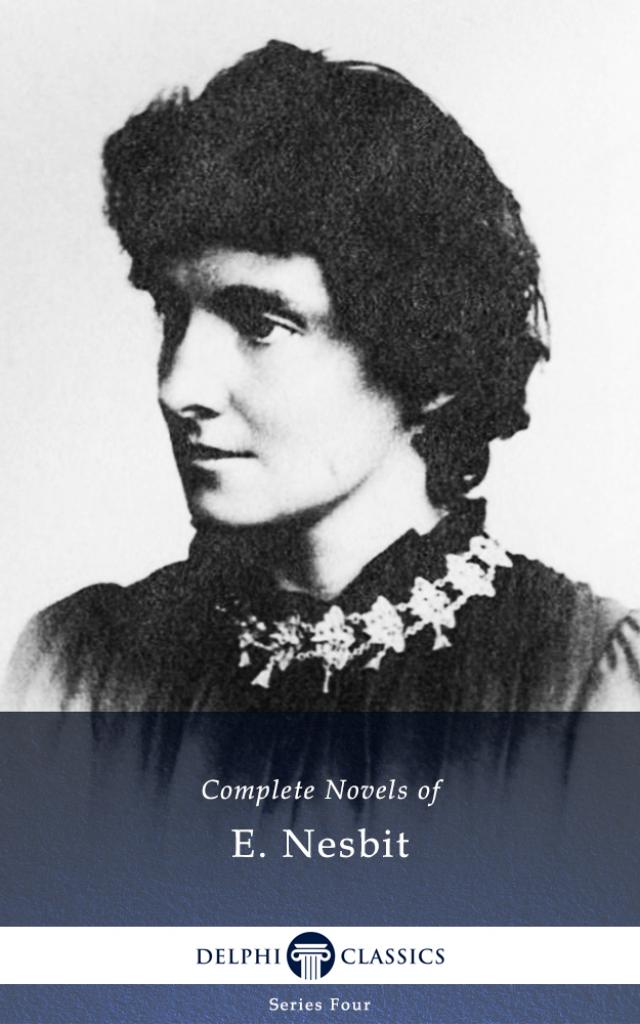
Complete Novels of E Nesbit, page 583


So he went by many passages and stairways, and could find no way out; and after a long time of searching he crept by another way back to come unawares on the door which shut him off from the room where the many lights were, and the wine and the treasure. Then terror leaped out upon him from the dark hush of the place, and he beat on the door with his hands and cried aloud, till the echo of his cry in the groined roof cowed him back into silence.
Again he crept stealthily by strange passages, and again could find no way except, after much wandering, back to the door where he had begun.
And now the fear of death beat in his brain with blows like a hammer. To die here like a rat in a trap, never to see the sun alight again, never to climb in at a window, or see brave jewels shine under his lantern, but to wander, and wander, and wander between these inexorable walls till he died, and the rats, admitting him to their brotherhood, swarmed round the dead body of him.
“I had better have been born a fool,” said the thief.
Then once more he went through the damp and the blackness of the vaulted passages, tremulously searching for some outlet, but in vain.
Only at last, in a corner behind a pillar, he found a very little door and a stair that led down. So he followed it, to wander among other corridors and cellars, with the silence heavy about him, and despair growing thick and cold like a fungus about his heart, and in his brain the fear of death beating like a hammer.
It was quite suddenly in his wanderings, which had grown into an aimless frenzy, having now less of search in it than of flight from the insistent silence, that he saw at last a light — and it was the light of day coming through an open door. He stood at the door and breathed the air of the morning. The sun had risen and touched the tops of the towers of the house with white radiance; the birds were singing loudly. It was morning, then, and he was a free man.
He looked about him for a way to come at the park, and thence to the broken wall and the white road, which he had come by a very long time before. For this door opened on an inner enclosed courtyard, still in damp shadow, though the sun above struck level across it — a courtyard where tall weeds grew thick and dank. The dew of the night was heavy on them.
As he stood and looked, he was aware of a low, buzzing sound that came from the other side of the courtyard. He pushed through the weeds towards it; and the sense of a presence in the silence came upon him more than ever it had done in the darkened house, though now it was day, and the birds sang all gaily, and the good sun shone so bravely overhead.
As he thrust aside the weeds which grew waist-high, he trod on something that seemed to writhe under his feet like a snake. He started back and looked down. It was the long, firm, heavy plait of a woman’s hair. And just beyond lay the green gown of a woman, and a woman’s hands, and her golden head, and her eyes; all about the place where she lay was the thick buzzing of flies, and the black swarming of them.
The thief saw, and he turned and he fled back to his doorway, and down the steps and through the maze of vaulted passages — fled in the dark, and empty-handed, because when he had come into the presence that informed that house with silence, he had dropped lantern and treasure, and fled wildly, the horror in his soul driving him before it. Now fear is more wise than cunning, so, whereas he had sought for hours with his lantern and with all his thief’s craft to find the way out, and had sought in vain, he now, in the dark and blindly, without thought or will, without pause or let, found the one way that led to a door, shot back the bolts, and fled through the awakened rose garden and across the dewy park.
He dropped from the wall into the road, and stood there looking eagerly to right and left. To the right the road wound white and sinuous, like a twisted ribbon over the great, grey shoulder of the hill; to the left the road curved down towards the river. No least black fly of a figure stirred on it. There are no travellers on such a road at such an hour.
THE GIRL AT THE TOBACCONIST’S
John Selwyn Selborne cursed for the hundredth time the fool that had bound him captive at the chariot wheels of beauty. That is to say, he cursed the fool he had been to trust himself in the automobile of that Brydges woman. The Brydges woman was pretty, rich, and charming; omniscience was her pose. She knew everything: consequently she knew how to drive a motor-car. She learned the lesson of her own incompetence at the price of a broken ankle and a complete suit of bruises. Selborne paid for his trusting folly with a broken collar-bone and a deep cut on his arm. That was why he could not go to Portsmouth to see the last of his young brother when he left home for the wars.
This was why he cursed. The curse was mild — it was indeed less a curse than an invocation.
“Defend us from women,” he said; “above all from the women who think they know.”
The grey gloom that stood for dawn that day crept through the curtains and made ghosts of the shadows that lingered still in his room. He stretched himself wearily, and groaned as the stretched nerves vibrated to the chord of agony.
“There’s no fool like an old fool,” said John Selwyn Selborne. He had thirty-seven years, and they weighed on him as the forty-seven when their time came would not do.
He had said good-bye to the young brother the night before; here in this country inn, the nearest to the scene of the enlightenment of the Brydges woman. And to-day the boy sailed. John Selborne sighed. Twenty-two, and off to the wars, heart-whole. Whereas he had been invalided at the very beginning of things and now, when he was well and just on the point of rejoining — the motor-car and the Brydges woman! And as for heart-whole ... the Brydges woman again.
He fell asleep. When he awoke there was full sunshine and an orchestra of awakened birds in the garden outside. There was tea — there were letters. One was from Sidney — Sidney, who had left him not twelve hours before.
He tore it open, and hurt his shoulder in the movement.
“Dear John,” said the letter, “I wanted to tell you last night, but you seemed so cheap, I thought I’d better not bother you. But it’s just come into my head that perhaps I may get a bullet in my innards, and I want you to know. So here goes. There’s a girl I mean to marry. I know she’ll say Yes, but I can’t ask her till I come back, of course. I don’t want to have any humbug or concealing things from you; you’ve always been so decent to me. I know you hate jaw, so I won’t go on about that. But I must tell you I met her first when she was serving in a tobacconist’s shop. And her mother lets lodgings. You’ll think this means she’s beneath me. Wait till you see her. I want you to see her, and make friends with her while I’m away.”
Here followed some lover’s raptures, and the address of the lady.
John Selborne lay back and groaned.
Susannah Sheepmarsh, tobacconist’s assistant, lodging-house keeper’s daughter, and Sidney Selborne, younger son of a house whose pride was that it had been proud enough to refuse a peerage.
John Selborne thought long and deeply.
“I suppose I must sacrifice myself,” he said. “Little adventuress! ‘How easy to prove to him,’ I said, ‘that an eagle’s the game her pride prefers, though she stoops to a wren instead.’ The boy’ll hate me for a bit, but he’ll thank me later. Yalding? That’s somewhere on the Medway. Fishing? Boating? Convalescence is good enough. Fiction aid us! What would the villain in a book do to come between fond lovers? He would take the lodgings: at least he would try. And one may as well do something.”
So he wrote to Mrs Sheepmarsh — she had rooms to let, he heard. Terms? And Mrs Sheepmarsh wrote back; at least her reply was typewritten, which was a bit of a shock. She had rooms. They were disengaged. And the terms were thus and such.
Behold John Selwyn Selborne then, his baggage neatly labelled with his first and second names, set down on the little platform of Yalding Station. Behold him, waggonette-borne, crossing the old stone bridge and the golden glory of the Leas, flushed with sunset.
Mrs Sheepmarsh’s house was long and low and white. It had a classic porch, and at one end a French window opened through cascades of jasmine to a long lawn. There were many trees. A middle-aged lady in decent black, with a white cap, and white lace about her neck, greeted him with formal courtesy. “This way,” she said, and moved for him to follow her through a green gate and down a shrubbery that led without disguise or pretence straight away from the house. It led also to a little white building embowered in trees. “Here,” said the lady. She opened the door. “I’ll tell the man to bring your luggage. Good evening — —”
And she left him planted there. He had to bend his head to pass under the low door, and he found himself in a tiny kitchen. Beyond were a sitting-room and two bedchambers. All fitted sparsely, but with old furniture, softly-faded curtains, quiet and pleasant to look upon. There were roses in a jug of Grès de Flandre on the gate-table in the sitting-room.
“What a singular little place!” he said. “So these are the lodgings. I feel like a dog in a kennel. I suppose they will throw me a bone by-and-by — or, at any rate, ask me what kind of bones I prefer.”
He unpacked his clothes and laid his belongings in the drawers and cupboards; it was oddly charming that each shelf or drawer should have its own little muslin bag of grey lavender. Then he took up a book and began to read. The sunset had died away, the daylight seemed to be glowing out of the low window like a tide, leaving bare breadths of darkness behind. He lighted candles. He was growing hungry — it was past eight o’clock.
“I believe the old lady has forgotten my existence,” he said, and therewith opened his cottage door and went out into the lighter twilight of the garden. The shrubbery walks were winding. He took the wrong turning, and found himself entering on the narrow lawn. From the French window among the jasmine came lamplight — and voices.
“No servant, no food? My good mother, you’ve entertained a lunatic unawares.”
“He had references.”
“Man cannot live by references alone. The poor brute must be starving — unless he’s drunk.”
“Celia! I do wish you wouldn’t — —”
John Selborne hastening by, put a period to the conversation by boots crunching heavily and conscientiously on the gravel. Both voices ceased. He presented himself at the lamp-lit oblong of the window.
Within that lamplight glowed on the last remnants of a meal — dinner, by the glasses and the fruit. Also on the lady in the cap, and on a girl — the one, doubtless, who had evolved the lunatic idea. Both faces were turned towards him. Both women rose: there was nothing for it but advance. He murmured something about intrusion—”awfully sorry, the walks wind so,” and turned to go.
But the girl spoke: “Oh, wait a moment. Is this Mr Selwyn, mother?”
“My daughter, Miss Sheepmarsh — Mr Selwyn,” said the mother reluctantly.
“We were just talking about you,” said the girl, “and wondering whether you were ill or anything, or whether your servant hasn’t turned up, or something.”
“Miss Sheepmarsh.” He was still speechless. This the little adventuress, the tobacconist’s assistant? This girl with the glorious hair severely braided, the round face, the proud chin, the most honest eyes in the world? She might be sister to the adventuress — cousin, perhaps? But the room, too — shining mahogany, old china, worn silver, and fine napery — all spoke of a luxury as temperate as refined: the luxury of delicate custom, of habit bred in the bone; no mushroom growth of gross self-indulgence, but the unconscious outcome of generations of clear self-respect.
“Can we send anything over for you?” the elder lady asked. “Of course we — —”
“We didn’t mean by ‘entirely private’ that we would let our tenant starve,” the girl interrupted.
“There is some mistake.” Selborne came to himself suddenly. “I thought I was engaging furnished apartments with er — attendance.”
The girl drew a journal from a heap on the sofa.
“This was the advertisement, wasn’t it?” she asked.
And he read:
“Four-roomed cottage, furnished, in beautiful grounds. Part of these are fenced in for use of tenant of cottage. And in the absence of the family the whole of the grounds are open to tenant. When at home the family wish to be entirely private.”
“I never saw this at all,” said Selborne desperately. “My — I mean I was told it was furnished lodgings. I am very sorry I have no servant and no means of getting one. I will go back to London at once. I am sorry.”
“The last train’s gone,” said Miss Sheepmarsh. “Mother, ask Mr Selborne to come in, and I’ll get him something to eat.”
“My dear,” said the mother, “surely Mary — —”
“My dear mother,” said the girl, “you know Mary is having her supper.”
The bewildered Selborne presently found himself seated at the white-spread, silver-sparkling table, served with food and drink by this Hebe with the honest eyes. He exerted himself to talk with the mother — not of the difference between a lodger and a tenant, but of music, art, and the life of the great world.
It was the girl who brought the conversation down from the gossip of Courts and concert-rooms to the tenant’s immediate needs.
“If you mean to stay, you could have a woman in from the village,” said she.
“But wouldn’t you rather I went?” he said.
“Why should we? We want to let the cottage, or we shouldn’t have advertised it. I’ll get you some one to-morrow. Mrs Bates would be the very thing, mother. And you’ll like her, Mr Selwyn. She’s a great dear — —”
Sure enough, the next morning brought a gentle, middle-aged woman to “do for” Mr Selwyn. And she did excellently. And three slow days passed. He got a boat and pulled up and down the green willow-fringed river. He tried to fish; he read somewhat, and he thought more. And he went in and out of his cottage, which had its own private path debouching on the highway. Many times a day he went in and out, but he saw no more the red hair, the round face, and the honest eyes.
On the fourth day he had nursed his interest in the girl to a strong, well-grown sentiment of curiosity and attraction. Coming in at his own gate, he saw the mother leaving hers, with sunshade and cardcase — an afternoon of calls evidently setting in.
Now or never! The swift impulse took him, and before he had time to recall the terms of that advertisement, he had passed the green fence of division, and his feet were on the wandering ways of the shrubbery. He felt, as he went, a glow of gratitude to the fate which was rewarding his care of his brother’s future with an interest like this. The adventuress? — the tobacconist’s assistant? — he could deal with her later.
Through the garden’s green a gleam of white guided — even, it seemed, beckoned.
He found the girl with the red hair and the honest eyes in a hammock swung between two cedars.
“Have pity on me,” he said abruptly.
She raised her eyes from her book.
“Oh, it’s you!” she said. “I am so glad. Get a chair from under the weeping ash, and sit down and talk.”
“This turf is good enough for me,” said he; “but are you sure I’m not trespassing?”
“You mean the advertisement? Oh, that was just because we had some rather awful people last year, and we couldn’t get away from them, and mother wanted to be quite safe; but, of course, you’re different. We like you very much, what we’ve seen of you.” This straightforward compliment somehow pleased him less than it might have done. “The other people were — well, he was a butterman. I believe he called himself an artist.”
“Do you mean that you do not like persons who are in trade,” he asked, thinking of the tobacconist’s assistant.
“Of course I don’t mean that,” she said; “why, I’m a Socialist! Butterman just means a person without manners or ideals. But I do like working people better than shoppy people, though I know it’s wrong.”
“How can an involuntary liking or disliking be wrong?” he asked.
“It’s snobbish, don’t you think? We ought to like people for what they are, not for what they have, or what they work at.”
“If you weren’t so pretty, and hadn’t that delightful air of having just embraced the Social Gospel, you’d be a prig,” he said to himself. To her he said: “Roughly speaking, don’t you think the conventional classifications correspond fairly well with the real ones?”
“No,” she answered roundly.
And when the mother returned, weary from her calls, she found her tenant and her daughter still discussing the problems of good and evil, of heredity and environment, of social inequalities and the injustice of the world. The girl fought for her views, and she fought fairly, if fiercely. It was the first of many such fights. When he had gone the mother protested.
“Dearest,” said the girl, “I can’t help it! I must live my own life, as people say in plays. After all, I’m twenty-six. I’ve always talked to people if I liked them — even strangers in railway carriages. And people aren’t wild beasts, you know: everything is always all right. And this man can talk; he knows about things. And he’s a gentleman. That ought to satisfy you — that and his references. Don’t worry, there’s a darling. Just be nice to him yourself. He’s simply a godsend in a place like this.”
“He’ll fall in love with you, Celia,” said the mother warningly.
“Not he!” said the daughter. But the mother was right.
Living alone in the queer little cottage, the world, his accustomed life, the Brydges woman, all seemed very far away. Miss Sheepmarsh was very near. Her frank enjoyment of his talk, her gay acceptance of their now almost constant companionship, were things new in his experience of women, and might have warned him that she at least was heart-whole. They would have done had he ever faced the fact that his own heart had caught fire. He bicycled with her along the pleasant Kentish lanes; he rowed with her on the little river of dreams; he read to her in the quiet of the August garden; he gave himself up wholly to the pleasure of those hours that flew like moments — those days that passed like hours. They talked of books and of the heart of books — and inevitably they talked of themselves. He talked of himself less than most men, but he learned much of her life. She was an ardent social reformer; had lived in an Art-and-Culture-for-the-People settlement in Whitechapel; had studied at the London School of Economics. Now she had come back to be with her mother, who needed her. She and her mother were almost alone in the world; there was enough to live on, but not too much. The letting of the little house had been Celia’s idea: its rent was merely for “luxuries.” He found out from the mother, when she came to tolerate him, that the “luxuries” were Celia’s — the luxuries of helping the unfortunate, feeding the hungry, and clothing little shivering children in winter time.