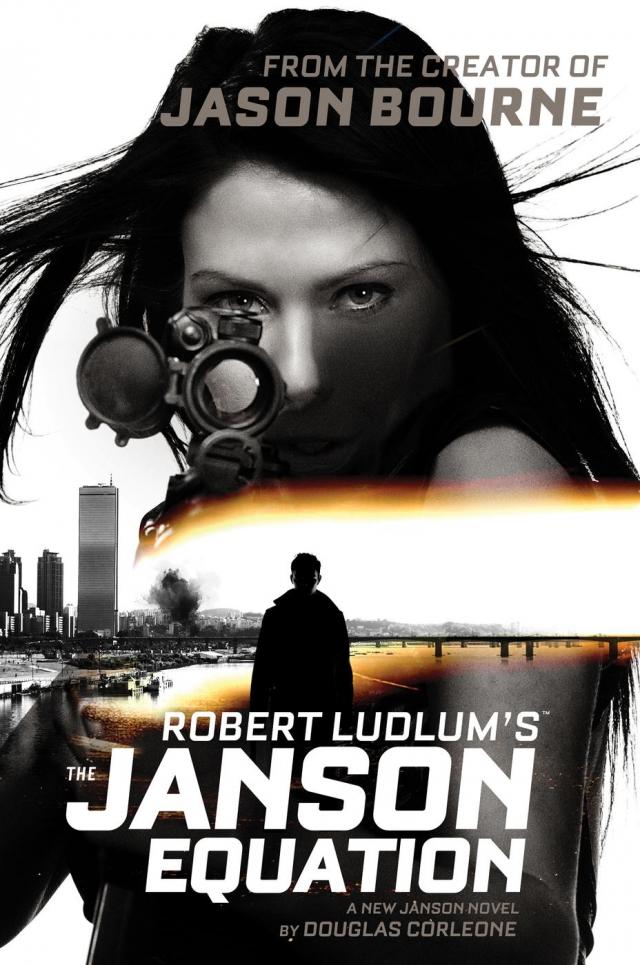
Robert Ludlum's (TM) the Janson Equation, page 30


The moment she did, one of the two soldiers looked back at his group. Then both shouted at Janson and Jina, Jina suddenly screaming in Janson’s ear, “Get down.”
Janson dropped flat on his stomach. One of the soldiers helped him along, pressing him hard into the ground, stepping on the back of his neck. He heard Jina cry out in pain and he immediately burned with a desire to pick himself off the ground and kill the two soldiers with his bare hands.
Once they were thoroughly frisked and found to be clean, the soldiers shouted out new commands. Janson looked hopefully to Jina Jeon.
“Stay down,” she said. “They’re bringing General Han.”
General Han Yong Chol was a large man by North Korean standards. He stood a full six feet tall. With broad shoulders, a wide chest, and a uniform every bit as crisp as the January air, he exuded authority. His booming voice did nothing to dispel the effect.
Although Janson was entirely comfortable with Jina Jeon doing the speaking, she immediately made clear that she intended to translate instead.
“The general wants to know why he shouldn’t shoot us.”
That wasn’t the question Janson had been expecting.
Still lying flat on the ground, Janson said, “Tell him we’re friends of his daughter, Mi-sook.”
Jina translated Janson’s words, then the general’s response. “He says, ‘Where is she? What have you done with her?’”
“Tell him she defected.”
General Han didn’t wait for Jina’s translation. “You lie,” he shouted in English. “She would never betray the Fatherland.”
“She didn’t do it for herself,” Janson shouted back, “she did it for your granddaughter.”
The general pulled a handgun from its holster, knelt, and held the gun to Janson’s head.
“Jina,” Janson shouted, “do you still have your phone?”
“Yes.”
“General Han, you can speak directly to your daughter. We can call her right now.”
Han kept his weapon trained on Janson but held his other hand out for the phone. Jina cautiously pulled it from her pocket and set it in his outstretched palm.
“We’re here to warn you,” Janson said. “The firefight in the Joint Security Area, it was planned. The first shots were fired by US intelligence officers acting on the authority of the director, without the White House’s knowledge or consent. They’re trying to draw you into a war that will ultimately collapse your regime.”
Janson dared to look up. The gun was still leveled at his head. But the general had Jina Jeon’s phone to his left ear.
“Mi-sook?” Han said.
As the general spoke to his daughter in Korean, Janson listened for familiar words. Hearing Yun Jin-ho’s name, Janson felt as though his heart might break into two.
When General Han ended the call a few seconds later, Janson didn’t know what to expect, a bullet or further dialogue. He tried to prepare himself for either event.
Han said, “According to Mi-sook, this war poses an existential danger to both Chosun and South Chosun.”
“It’s true,” Janson said. “If Pyongyang retaliates for this morning’s incursion, it will draw US forces into the conflict. In days North Korea will be leveled.”
“Up,” Han shouted.
Janson slowly rose to his knees, then to his feet.
“What do we do?” the general said.
“We need to get to Pyongyang before this gets too far out of hand. We need to get to the palace.”
The general shook his head. Lowered his voice even though none of his soldiers was in earshot.
“Surely you know that the Supreme Leader is a madman,” Han said. “He will never listen to us.”
“Even madmen respond to psychology,” Janson told him. “If Kim Jong-un knows he’s being tricked into going to war, he’ll respond to that. We can get him on the phone with the US president.”
“You know the US president personally?”
“Let’s just say, I have contacts.” When Han didn’t respond, Janson added, “It’s our only chance, General. It’s our only hope to avoid a second Korean War that will lead to the destruction of both Seoul and Pyongyang and the deaths of millions of Koreans on either side of the thirty-eighth parallel.”
After a moment of silence, Han said, “You may have direct access to your White House, but I do not have access to the palace. The Guard’s Command would never permit us to enter, especially after the incident that occurred at the Ryongsong residence earlier this week.”
“Just get us to Pyongyang,” Janson said. “I’ll get us into the palace.”
“You?”
“Yun Jin-ho showed me the way. You have to trust me, General. I know what we have to do.”
FIFTY-SEVEN
Twenty minutes later Janson was back on the Reunification Highway on his way to Pyongyang. This time, however, he and Jina Jeon rode in the rear of a troop transport with two dozen North Korean soldiers under General Han’s command. The troop transport breezed past the numerous KPA checkpoints without incident.
“We have reached the city,” the general announced in English over a walkie-talkie Jina Jeon held in her hand.
She nodded to Janson, who pulled Han Yong Chol’s smartphone from his pocket. As a general, Han was one of the privileged few in the Korean People’s Army who could make calls outside North Korea with his cellular phone.
Janson dialed Park Kwan, who immediately turned the line over to Kang Jung.
“Eagle has landed,” Janson said. Kang Jung had insisted on the use of the code.
“Acknowledged,” she replied. “T-minus one eighty.”
Janson glanced at his watch. To Jina he said, “In three minutes Kang Jung is going to shut down the grid.”
Because rolling blackouts were a regular occurrence in North Korea, the palace and other elite areas operated on a separate electrical grid. To which, thanks to North Korea Uncovered, a Google Earth project made public by the US-Korea Institute at Johns Hopkins, Kang Jung knew the precise coordinates.
“Amazing kid,” Jina said.
Janson slipped General Han’s phone back into his pocket. “Yes, she is.”
* * *
WITH THE ELECTRIFIED FENCE unelectrified, General Han’s troop transport crashed through the gate, sending unsuspecting soldiers and guards fleeing for their lives.
A hundred yards inside the compound the vehicle screeched to a stop. The tailgate opened and out spilled the two dozen troops under Han’s command.
Leading the way with smoke grenades, Han’s soldiers moved briskly and brazenly toward the palace.
When they reached the palace doors, General Han demanded that the Guard’s Command throw down their weapons and surrender—and they did. Janson had seen nothing like it since the First Gulf War, when the Iraqi army surrendered to American military forces immediately upon their arrival in the deserts of Kuwait during Operation Desert Storm.
Once the Guard’s Command surrendered, Han summoned Janson and Jeon to the front. He ordered several of his soldiers to stand guard outside the palace doors, then commanded his remaining troops to drop their weapons.
“We’re going inside the palace unarmed?” Jeon exclaimed.
“Repeated attempts on the lives of Kim Jong-il and Kim Jong-un by their own bodyguards have resulted in a new palace policy,” Han explained. “No weapons allowed in the same building as the Supreme Leader. No exceptions.” Marching forward, he continued speaking over his shoulder. “Rest assured, we will not meet with any armed resistance inside the palace walls. In fact, if our experience on the grounds outside the residence is any indication, we should not meet with any resistance at all.”
* * *
KINCAID AND SIN BAE lowered their weapons and dropped back even farther once they received word from Park Kwan that Janson and Jina Jeon had made it to Pyongyang.
Kincaid couldn’t help but look on Sin Bae with revulsion. His mere image stirred up the fear and anger she’d experienced sprinting through Dosan Park. The helplessness she felt diving into the rear of the taxi, ducking down into the subway station, disguising herself in the dressing room of that Seoul department store.
She glanced at him over her shoulder and saw him as he was when he entered the T-Lound nightclub. Though the sounds of automatic weapons fire replaced club beats, he appeared as he’d appeared on the upstairs dance floor—ruthless and relentless.
This is the same monster, she thought. The same monster who’d nearly sliced through her windpipe with the garrote he extracted from his cuff link. The same monster who would have ended her life without a scintilla of remorse had Park Kwan not stepped into the coatroom and spotted his gun at the exact moment that he did.
“He’s a lot more like you and me than either of us could have imagined,” Janson had said.
Speak for yourself, she thought. But then, that was exactly what Janson had been doing.
Janson saw himself as a monster, Kincaid realized. Still, after all this time severed from Consular Operations. He’d said as much in the car on the way to Chuncheon this morning.
She suddenly felt for Janson something she’d never dreamed she’d feel for him. Had never dreamed there would ever be a need. Never dreamed there would ever be so much as an excuse, even if she’d wanted to.
Pity.
For the first time in her life Kincaid pitied the man she loved.
The most beautiful, most intelligent, most caring man she’d ever met didn’t believe he was a good man, didn’t believe he was a man at all. He thought he was a monster. Like Sin Bae.
“He’s a lot more like you and me than either of us could have imagined.”
Janson still thought of himself as a Machine.
* * *
IN A MAGNIFICENT ROOM of vaulted ceilings and green marbled walls, Janson stood rigidly with General Han Yong Chol on his left and Jina Jeon on his right.
Following their forced entry into the compound the last thing Janson had thought would become a priority was proper decorum. But the enigmatic hermit kingdom continued to live up to its reputation.
A white-haired official stepped into the room, followed by two members of the Guard’s Command. He issued orders to the three visitors, orders that Janson, of course, couldn’t understand.
“You have to remove your watch,” Jina Jeon whispered.
The official shouted at her. She responded in Korean, apparently informing the official that Janson spoke only English.
This is surreal, Janson thought. If someone told him last week that in a few days he’d be standing in Kim Jong-un’s palace, he’d have tried to smack them out of their derangement.
Janson waited for one of the Guard’s Command to pat them down, but no one else approached. He supposed visitors to the palace never made it this far without getting frisked, maybe not without enduring a full-body cavity search.
Bad security, he thought.
Janson regretted not snatching one of the handguns from the troop transport. He’d known that with the grid down, the entrance metal detectors wouldn’t be functioning. But he presumed the Guard’s Command would fall back on wands. And there was something far more important Janson needed to get past security. Something largely made of plastic that alone probably wouldn’t have set off a metal-detecting wand. So he hadn’t wanted to risk inviting additional scrutiny. After all, foiling Diophantus was far more pressing than his own personal safety, or even Jina Jeon’s.
Ten full minutes later—ten full minutes of standing, ten full minutes of silence—a second official entered the room, followed by six others. Janson couldn’t help but notice that each official who entered was several inches shorter than the last.
Janson thought of Nam Sei-hoon; immediately he felt an overwhelming heat rise up his neck till it colored his cheeks and the tops of his ears.
He took several deep breaths and waited for his pulse to slow.
Once the seven dwarfs were lined up against the wall in size order, the original white-haired official walked to the middle of the grand room and spoke in a voice majestic enough for Yankee Stadium.
“The chairman of the Presidium of the Supreme People’s Assembly of the Democratic People’s Republic of Korea will now enter.”
Janson glanced to his left at Han Yong Chol, who whispered, “Officially, he serves as head of state, the Supreme Leader’s number two.”
“And in reality?”
“In reality, he is Kim Jong-un’s puppet, his mouthpiece. Nothing more than a stooge.”
FIFTY-EIGHT
Lawrence Hammond gazed out the office window and watched the Embraer 650 touch down at Hickam Field. He’d convinced the senator and Mrs. Wyckoff to allow him to board the jet first. For their safety, of course. Hickam had lost communications with the Embraer long ago, and they didn’t know quite what to expect. The senator suggested that a pair of soldiers greet his son on the plane, but Hammond argued that a military presence would only frighten Gregory after all he’d been through. The senator and Mrs. Wyckoff finally agreed—Hammond would take the lead.
Watching the jet taxi along the runway, Lawrence Hammond lightly shook the contents of the bottle of Snapple Green Iced Tea.
The knock at his door meant that it was time to step onto the tarmac.
* * *
THE KNOCK AT Nam Sei-hoon’s door meant that his interviewee had arrived. He straightened his tie. Removed his glasses and cleaned the lenses. Checked his email for updates, but there were none.
Initial reports had come in. There had been an incident at the DMZ. But details were murky at best. Nam had ordered his deputy Jae-suk to keep him informed. If the situation worsened, Nam Sei-hoon would take a motorcade to the Blue House to consult with the president.
“Enter,” Nam said in Korean.
The door opened. In its frame stood two guards, between them one of the most beautiful women Nam Sei-hoon had ever laid eyes on.
Nam remained seated. Not out of impoliteness but because he was ashamed of his height, especially around beautiful women.
He motioned to the leather chair opposite his desk and asked the woman to have a seat. Then he dismissed the guards. One began to protest, but Nam shot him a look that made it clear this was not an issue subject to debate.
When the door closed behind the guards, Nam said, “Let me be among the first to welcome you to the Republic of Korea.” He bowed his head. “Please allow me to introduce myself. My name is Nam Sei-hoon. I am the director of North Korean Affairs here at the National Intelligence Service.”
A lovely smile materialized on the young woman’s face.
“I know who you are,” she said.
* * *
NINE MEMBERS of the Guard’s Command preceded three high-ranking military commanders whom Janson didn’t recognize.
Only once everyone was standing at attention did an old man in a black suit appear in the frame of the double steel doors. He wore a steel-gray tie, small gold-rimmed glasses, and his hair (what little was left of it) was dyed jet-black.
As the chairman stepped forward the line of Guard’s Command members parted to allow him through. He was followed by one of his military commanders, who Janson could now see held the rank of general.
As the pair moved forward the general touched a finger to his right ear.
The old man halted roughly ten feet from Janson, Jeon, and General Han. From this distance, Janson realized the chairman had to be approaching his nineties, if he wasn’t there already.
“I am General Jang Yong-sun,” the uniformed man said in English. “You are standing in the presence of the chairman of the Presidium of the Supreme People’s Assembly, Comrade Tak Dong-gun.”
On either side of him, Han and Jina bowed, so Janson did too.
“State your business,” General Jang ordered.
Janson glanced at Han but immediately realized all eyes were on him.
“My name is Paul Janson,” he said. “I am a former covert agent for the United States government. I presently work as a private security consultant. I was recently hired by United States senator James Wyckoff of North Carolina to locate his teenage son, Gregory Wyckoff, who has been falsely accused by the South Korean government of murdering his girlfriend, Lynell Yi.
“Ms. Yi had been working as an interpreter for the US envoy in connection with the four-party talks currently being held in the Joint Security Area of the Korean Demilitarized Zone. I’m here because my colleagues and I, in the course of our investigation, learned that Lynell Yi was murdered by an agent working on behalf of a rogue faction of a United States intelligence agency.
“Gregory Wyckoff was subsequently put in the frame in order to remove him from the equation. Ms. Yi was murdered because she overheard a conversation between the US and South Korean envoys. The conversation was about a clandestine operation called Diophantus. The objective of Diophantus, we have since learned, is to provoke the North into starting a second Korean War that would ultimately collapse the current regime here in Pyongyang.
“That is why shots were fired across the border in the demilitarized zone this morning. And that, General, is why you must refrain from escalating hostilities. Rogue US factions, in cooperation with rogue factions within South Korea’s National Intelligence Service, want you to respond with an attack on the South, so that the United States military will be drawn into the conflict in accordance with US-ROK security agreements.
“Once the United States is involved, this war—as you know, General—will result in the slaughter of your military and, eventually, your civilian population.”
General Jang remained expressionless as he placed a finger to his right ear. At his side the chairman appeared profoundly bored.
“Comrade Chairman?” Janson said to the old man.
It was General Jang who responded. “We find it difficult to believe that the United States government is unaware of this so-called plot, Mr. Janson. What you describe would cost massive sums of money, particularly if, as you suggest, the ultimate objective is to remove the regime here in the Democratic People’s Republic and reunify Korea. All of us on the peninsula appreciate the fact that reunification, no matter how desperately we want it, will cost billions of your US dollars.”