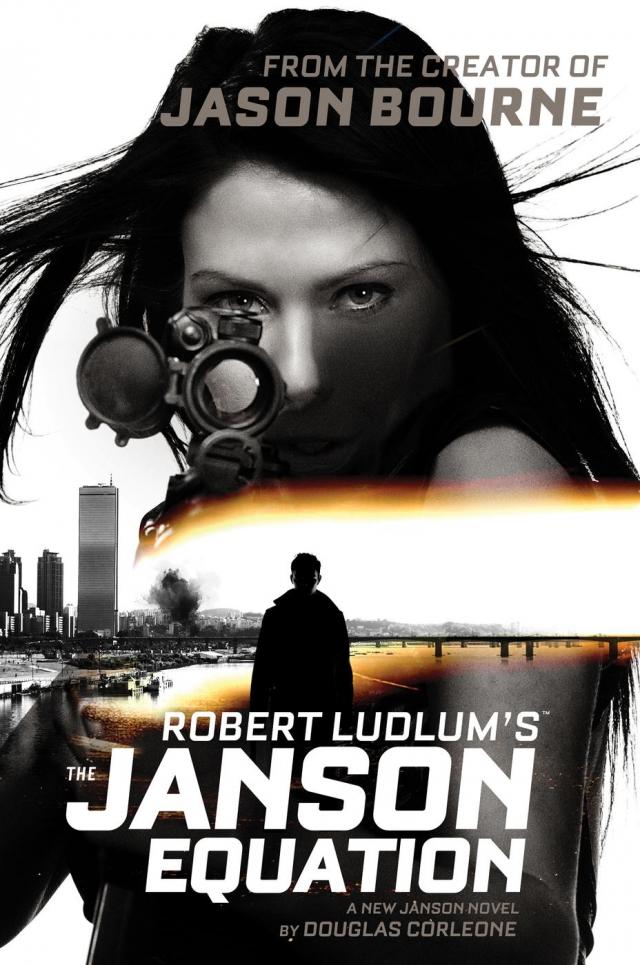
Robert Ludlum's (TM) the Janson Equation, page 26


He dialed the number Ping had given him earlier.
The phone rang four times before a woman answered.
“CatsPaw Associates,” she said.
* * *
QUINTISHA UPCHURCH felt her skin crawl the moment she heard the slurred voice on the other end of the line. Quintisha had been the general operations manager for both CatsPaw and the Phoenix Foundation since their inception. She was known around both organizations as the only person in the world who could find Paul Janson, day or night. In the time she’d worked for Janson, she’d pretty much heard it all. Often with her heart in her throat. But the tone of this call was different somehow. She experienced a level of dread she’d never felt before. As though all calls leading up to this one were merely rehearsals.
“Tell him that I have her,” the voice said. “If he wants for her to leave this place alive, have him call the little man within the next half hour. No later. Because in thirty-one minutes, she dies.”
That was the entire conversation. Roughly three dozen words in all. Not a single name was mentioned during the call. But Quintisha Upchurch understood the message perfectly, and she wasted no time. She touched her finger to the flash button and speed-dialed Paul.
“Mr. Janson,” she said as soon as he answered, “we have a situation.”
FORTY-SEVEN
Nam Sei-hoon reached across his desk and lifted the ringing phone, expecting to hear Ping’s voice when he held the receiver to his ear.
The voice greeted him in clearly spoken Korean, but Nam could detect a definite accent. A Western accent. Maybe even American. Which was odd because Americans, in his experience, sorely lacked an aptitude for foreign languages. Surely a dolt like Edward Clarke had not attempted to learn Korean. Surely not so much as a greeting.
Yet this was Nam’s very personal, very private line.
“To whom am I speaking?” Nam said in English.
“The man who is going to put a bullet into your fucking traitorous skull.”
Nam Sei-hoon suddenly began to sweat. His hands became so wet so fast, the phone nearly slipped from between his fingers.
“Janson?” he managed through quickening breaths.
“I would say you’re a disgrace to your country, Sei-hoon, but that wouldn’t suffice. You are a goddamn stain on all of humanity.”
Nam stood from his chair, found himself weak in the knees. He was suddenly overcome by a certainty that Janson was somewhere inside the building.
Impossible, he thought. But then, if anyone could penetrate NIS it was Janson.
“Is this some kind of a joke, Paul?” he said, his voice thick with fear.
“Where is Kincaid?”
“Your partner? I do not know. I have not heard from her. Has she gone missing? Is there some way that I can help?”
“Right now,” Janson said, “you can only help yourself.”
Nam Sei-hoon carefully lowered himself back into his chair. Janson knew. Playing stupid was not going to save him. Still, he couldn’t bring himself to allow a single concession just yet. So he said nothing.
“The only way you live,” Janson said, “is if I die first. And I’m going to give you that chance, Sei-hoon.”
“Paul, I…” He swallowed the bile rising in his throat.
“Shut up and listen carefully,” Janson said. “Because I am going to make you an offer that will only be good until I hang up this phone. And if I hear one word from you that I don’t like, I’m going to hang up without warning. And then I’m coming for you. Understood?”
“I…” Nam realized there was no use. “Yes, Paul, I understand.”
“Good,” Janson said. “Because I am going to trade you my life—and, thereby, yours—for Jessica Kincaid’s.”
* * *
NAM SEI-HOON BELIEVED Janson when he said that Kincaid didn’t know anything about Nam’s involvement. Of course she didn’t. Had she known, she never would have shown up at the safe house in Gangnam. And surely with Sin Bae hovering over her, she hadn’t spoken to anyone since.
But Kincaid did know about Diophantus. Assuming that Gregory Wyckoff knew, of course. And that was the assumption he demanded everyone make. Which meant that Kincaid would still have to be eliminated.
But that could wait until after Janson was dead.
Nam Sei-hoon knew that Janson wasn’t bluffing when he offered to trade his life for Kincaid’s. Even if he hadn’t loved her, that was a trade Paul Janson would make. That was the kind of man Janson was—or at least the kind of man Janson had become.
When Nam first met Janson, he was a frogman, a US Navy SEAL, a green-faced killing machine who stood out among his teammates during joint US-ROK live-fire training exercises at Rodriguez Range, roughly fifteen miles south of the Korean Demilitarized Zone. Nam had been so impressed with Janson that he insisted on meeting the man. During Janson’s stay, they dined together regularly, discussing the Forgotten War over drinks. Nam quickly realized that Janson was as smart as he was strong, and the two became fast friends. They had been close ever since.
Over the years, Nam followed Janson’s career the way most men follow professional sports. When Janson disappeared in Afghanistan, Nam Sei-hoon mourned. Eighteen months later, when Nam learned of Janson’s daring escape from Kabul, he celebrated. When Janson joined Consular Operations, Nam offered his support anywhere in the world it might be needed. When he learned of Janson’s falling-out with Cons Ops, Nam Sei-hoon offered him sanctuary in South Korea.
Soon after, Nam heard that Janson considered himself “reformed.” He’d gone into business as a private security specialist. But his objective was not the accumulation of wealth; it was to aid former covert government agents like himself. Nam Sei-hoon didn’t know what to make of it. But in recent months it had become clear that Janson was no longer the man he’d been. The Machine had regrettably gone soft. And now that Janson’s interests conflicted with his own, Nam Sei-hoon only did what had to be done.
Still, he knew Janson to be a man of his word, whether that word was posed as a promise or a threat. So Nam would have been a damn fool not to take Janson up on his offer. Had he not jumped at it, Nam would have instantly been reduced to a walking corpse.
Now Nam Sei-hoon had calls to make.
His first call was to Clarke’s man, Ping. He again warned the handler not to allow Sin Bae to kill Kincaid. There was going to be a trade, he told him. Nam would call Ping back in ten minutes with further instructions.
His next call was to Edward Clarke himself. Nam knew better than to divulge any details to Clarke about the goings-on in Seoul. He simply wanted to instruct him on what needed to happen in the United States.
“The jet will be landing in Honolulu to refuel,” Nam said. “And I am told that the senator and his wife are still in the islands.”
“That’s correct,” Clarke replied.
“That boy can never make it to the mainland. He can never even make it into his father’s arms.”
“I assure you,” Clarke said, “Gregory Wyckoff will be taken care of. We’ve already jammed all the Embraer’s communications. And I have a plan in place on the ground at Hickam Field.”
“Good. Keep me informed.”
Nam Sei-hoon hung up the phone and studied the timetable for Diophantus. He needed more time. Not much, but enough to ensure that the operation would move forward without a hitch early tomorrow morning.
He picked up the phone and redialed the number for Ping.
When Ping answered he said, “Do not talk. Just listen. Sin Bae is about to receive a new guest.”
FORTY-EIGHT
Nam Sei-hoon would attempt a double cross, Janson was sure. But it wouldn’t involve killing Kincaid right away. Instead he’d have her followed. He’d make certain Janson was dead before moving on her again. Nam Sei-hoon may have been a two-faced prick. But he wasn’t stupid by any stretch of the imagination.
Janson gazed up at the windows high above the neon city. How many snipers had their scopes trained on him this evening? Were they Nam Sei-hoon’s men? Or Edward Clarke’s agents? Or both?
He supposed it didn’t matter.
Janson’s phone finally buzzed in his hand. He pressed it against his ear. As he listened to the voice, he could feel the presence of two men approaching him from behind.
As instructed, Janson took two steps forward so that he was standing on the edge of the curb.
The men who came up behind Janson began to frisk him. He raised his arms out at his sides and spread his legs just enough so that they could check his inseam. This part didn’t matter; he was clean. Janson was sure Nam Sei-hoon knew that he wouldn’t risk Kincaid’s life by showing up armed. Nam would know this was no ruse.
The voice on the phone said, “There is a black van approaching from your left. Hang up now and await a call from the female. You will have precisely six seconds. As you speak to her, the van will pull up directly in front of you. When the six seconds are up, the phone will be taken from you and you will step inside the van.”
With his thumb, Janson ended the call. The moment he did the phone vibrated in his hand again. He pressed it to his ear.
“Paul?”
Her voice sounded nasal, as though she’d been struck in the face. Anger as sharp as a nail rose in his throat. He drew a deep breath. His heart pounded in his chest. She was alive, at least. Kincaid was alive and her voice still sounded sweeter than the most beautiful music he’d ever heard.
In his peripheral vision, he saw the van pulling over to the curb.
“Are you safe?” he said.
“Paul, don’t do this! It’ll be for nothing. I won’t be able to liv—”
The van rolled to a complete stop directly in front of Janson.
“We have three seconds, Jessie. Are you safe?”
“Yes. I’m in a public pla—”
As the phone was ripped from Janson’s hand, he was struck in the back of the head. His knees buckled beneath him. He became dizzy and had started to fall when multiple sets of hands grabbed hold of him. A hood was draped over his head. Barely conscious, Janson was hefted into the back of the van.
The panel door slid closed as the van merged back into traffic.
Behind the hood, Janson closed his eyes; he dreamed again of Jessie, in her red two-piece, on the soft warm sands of Waikiki Beach.
* * *
WHEN THE HOOD was finally pulled off his head, Janson kept his eyes closed to allow them time to adjust. But instead of the peach hue he expected to see displayed on the backsides of his lids, he saw only a gunmetal gray that reminded him of the sky over Pyongyang. Slowly, he opened his eyes and gazed up at the badly damaged face of Sin Bae.
Good for you, Jessie, he thought.
“Before now,” Sin Bae said softly, “we only knew each other by reputation.”
Janson tested his restraints; his arms were securely fastened behind him, his legs to the legs of the sturdy wooden chair on which he was seated.
“You’re much uglier than I expected,” Janson said, looking into the killer’s eyes. There he saw a flicker of light that he hadn’t found in the eyes of many active Cons Ops agents.
Sin Bae half-smiled. One of his top front teeth was missing; it looked like a recent adjustment to his face.
Jessie really did a number on you, didn’t she? That’s my girl.
“You are much more human than I expected,” Sin Bae said.
For a moment Janson had the eerie feeling that Sin Bae was reading his mind. But no, here Janson had the advantage. Because he had only hours ago read a complete dossier on his captor, courtesy of Grigori Berman.
“I had been told you were the Machine,” Sin Bae continued. He took a step forward and leaned into Janson’s face.
Janson could smell the stench of blood on him.
“But if you are a machine,” Sin Bae said, “then you are an old, broken-down machine at best. You are a printing press. A typewriter, maybe. A pay phone. A fax machine. Whatever you are, Paul Janson, you are obsolete.”
Janson said nothing. He thought briefly of a man named Doug Case. A former Cons Ops agent whom Janson had found in a broken-down secondhand wheelchair at the mouth of a filthy abandoned railroad tunnel in Ogden, Utah.
Doug Case had been Janson’s first.
First recruitment.
First student.
First graduate of the Phoenix Foundation.
Doug Case had been the first covert government agent that Janson saved.
When Janson first dreamed up Phoenix, he knew it wouldn’t be easy. Janson’s skill set was specific. And if he wanted to atone, he had no choice but to make use of those skills. In order to rescue other covert government agents—in order to give them new lives—he’d need money, and plenty of it. In order to earn that money, he’d have to take on dangerous jobs, and dangerous jobs often required the use of force.
Sometimes lethal force.
Janson was never under any illusion. He knew he’d be tested on every mission, that he could fail in his task with a single pull of the trigger. His business, after all, was rife with moral conundrums, not the least of which was the necessity of atoning for violence with violence. Hence, the Janson Rules.
No torture.
No civilian casualties.
No killing anyone who doesn’t try to kill us.
But regardless of the difficulty, Janson had been determined to evolve. The Machine had resolved to become human.
That, Janson was convinced, is what Sin Bae sees now. That is what’s hopefully frightening the living hell out of him.
Janson watched Sin Bae twist his left cuff link between his thumb and his index finger. According to the extensive dossier Janson read on Sin Bae back at Jina Jeon’s suite at the Westin, the gesture was the assassin’s tell. It meant that Janson would be dead within thirty seconds.
“It’s not too late, you know,” Janson said as casually as he could manage.
Sin Bae’s expression was one of mild amusement. “Too late for what?”
“It’s not too late to atone.”
The assassin smirked. “Are you a priest?”
“No,” Janson said, lifting his head and leveling his gaze at him. “There’s no religion for men like us. Let’s not pretend like there is.”
Sin Bae stepped slowly around to the back of Janson’s chair.
Janson said, “I was just there, you know.”
“Just where?”
“Pyongyang. The city where you were born. The city you and your family were snatched from in the dead of night when you were just seven years old. The last place you saw before Yodok.”
Janson held his breath, waited for the garrote to close around his throat. He closed his eyes and summoned an image of Kincaid. But instead of Jessie’s smiling face he saw her shouting at him from a distance.
“Paul, don’t do this! It’ll be for nothing. I won’t be able to liv—”
“Tell me,” Janson said slowly. “When you escaped from Yodok, when you fled the North, when you found the American embassy in Beijing, did you tell them that you had left your baby sister behind?”
Silence.
Janson said, “Did you tell the Americans that Su-ra remained at Yodok? That she was close to dying of malnutrition? Did you tell them that?”
Further silence.
“Did you ask for help? Did you ask the Americans to help you rescue your sister? Did you tell them that you had promised her? That you promised you’d be back for her? That you cut yourself and bled for her so that she’d believe—so that she’d know—you were coming back to save her?”
Janson could feel Sin Bae hovering over him, could hear the assassin’s heavy breathing, like the sound of a sick and dying animal.
“What did they do, Sin Bae? What did they do for your sister? What did they do for you?”
When Sin Bae remained silent, Janson said, “I’ll tell you what they did. They did for you what they did for me. They turned you into a killer.”
Sin Bae leaned in behind him. Janson could smell his breath, could again smell the stench of blood on him.
“Do you even know why you’re about to kill me?” Janson said. “Do you know why you were going to kill Jessica Kincaid?”
“Because you are traitors,” Sin Bae muttered.
“You think so?” Janson said softly. “Really? And what about the thirteen-year-old Korean girl they tried to kill? Is she a traitor too?” Janson’s voice rose several octaves along with his anger. “Tell me, Sin Bae. Who did she betray? What has that little girl done that she deserves to die?”
Sin Bae said nothing.
“We are all machines to them, Sin Bae. We are all just machines to Consular Operations. We are all just machines to Director Clarke. We are all just machines to be turned on and off at will. We are all just machines awaiting instructions to kill. And when we don’t serve their purposes any longer—when we become obsolete—then they terminate us. They’ll do it to you, Sin Bae, just as they’re doing it to me.”
Janson could hear the assassin slowly extracting the garrote from his cuff link, like the reeling in of a fishing line. It was too late, he realized. The Korean was too far gone. Janson had never turned, never saved an agent from a position of such vulnerability. What could he say? What could a dead man have to offer the living?
“We are all just weapons to them,” Janson said quietly. “We’re all just guns and garrotes. How much did you mourn the last time you lost one of those cuff links? How much did you mourn the last gun you had to leave behind in some nameless city? That’s how much they’ll mourn for you, Sin Bae, when you become lost or obsolete. That’s how much they’ll mourn for me.”
The wire began to close around Janson’s throat.
“I was just like you,” Janson breathed. “Then I woke up one morning in a cold sweat thinking about all the people I killed for all the wrong reasons. That was the morning I realized I was nothing more than a sanctioned serial killer. That’s the morning I ceased to be a machine. That’s the morning I became human.”