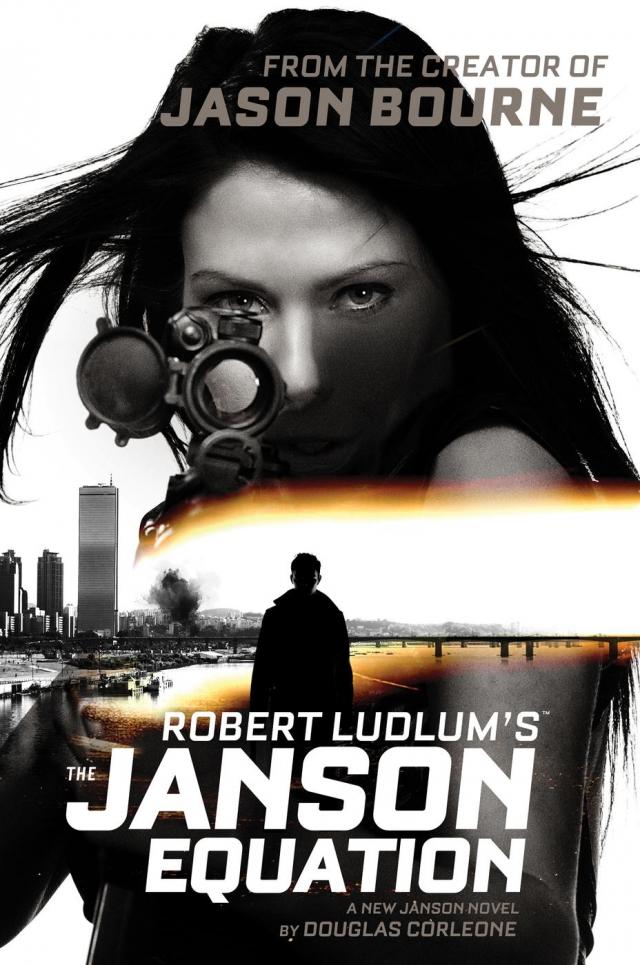
Robert Ludlum's (TM) the Janson Equation, page 27


“It is too late for me,” Sin Bae said as the garrote sliced into the outer layer of flesh around Janson’s throat.
Janson felt his face burn red, felt every part of his head turning to fire from his neck to the top of his scalp.
This was it, he knew. This was the end.
“You should know,” Janson said, struggling for breath, “why you’re about to murder me. You should know why you were asked to kill Kincaid and the thirteen-year-old girl. You should know…”
Janson struggled to get out the final few words of his plea.
“You should know…about Diophantus.”
FORTY-NINE
Director Edward Clarke stepped into the sumptuous banquet hall and turned 360 degrees, gazing up at the two-story ceilings with their dangling crystal chandeliers, the spotless egg-white walls that seemed to be a football field apart from each other, taking in all the empty space.
Christ, he thought. Our voices are going to echo in here as though we’re in the goddamn Himalayas.
In the center of the room stood a great round table, topped with fine china and crystal water glasses. Seven men and one woman sat around the table exchanging silly banter. With a head of steam, Clarke finally approached.
“Whose fucking idea was all of this?” he said, motioning around the hall.
Bruce Javers, the thirty-something blowhard who’d founded Jupicon, Ltd., a multinational software company headquartered in Silicon Valley, jumped out of his seat, exhibiting a smile as wide as his ass.
“What are you talking about, Eddie? This place is fantastic.” He placed his rhino’s leg of an arm around Clarke’s shoulder, and it was all Clarke could do not to twist it into a pretzel and keep twisting it until the loudmouth squealed like a pig.
“First of all, Bruce, don’t call me Eddie.” Clarke spoke loud enough for those at the table to hear. He didn’t want to repeat this conversation. And he didn’t want a repeat of this abomination to secrecy and security when it came time for their post-operation meeting in a few days.
“Has history taught you people nothing?” Clarke squawked.
Milhouse Hastings, CEO of defense contractor Leverton-Wells and another heart attack waiting to happen, looked up in surprise.
“You people?” Milhouse said. “What do you mean by ‘you people’?”
Clarke had fucking had it. This was a long time coming. “I mean you filthy-rich, white-bread dumbfucks who hold clandestine meetings that make the royal-fucking-wedding appear unpretentious.”
“What are trying to say, Ed?” This from Jacob Paltrow of Norvo Incorporated, the biotech giant that would one day make environmentalists consider giving Monsanto the Lady Bird Johnson Award.
“What I’m saying is,” Clarke shot back, “did all of you sleep through the forty-seven percent debacle? Look at this goddamn room. For all we know, Jimmy Carter’s grandson could be sitting behind that wet bar, taping this entire meeting for Mother Jones. Hell, he could be standing there in plain sight, and we wouldn’t be able to see him without binoculars given the size of this fucking place.”
Bruce Javers laid one of his beefy hands on Clarke’s shoulder again. “Relax, Eddie, we had the place swept half an hour ago. It’s cleaner than the Duchess of Cambridge’s va—”
“Shut up, Bruce! We already have one international incident on our hands.” Christ, the guy was drunk; Clarke could smell the bourbon on his breath. “And don’t call me Eddie.”
Clarke moved past him toward the table.
The place was swept, fine. Then let’s get this the hell over with.
* * *
“FIRSTLY,” CLARKE BEGAN ten minutes later, “I want to thank everyone at this table for their patriotism.”
What a crock of shit, he thought as he continued with his preamble. The titans of industry sitting around the table—Bruce Javers, Milhouse Hastings, Jacob Paltrow—had lent their financial support to this operation for one reason and one reason only: to advance their bottom lines. Granted, Clarke agreed with their conviction that the current administration wasn’t doing enough to combat the systematic data theft and cyber-espionage being committed against their corporations by the Chinese government. The three American companies represented at this table alone had been victimized to the tune of hundreds of billions of dollars. Hence, Diophantus. Collapsing once and for all the North Korean regime would create a unified Korea, one governed by an American ally, the democratically elected administration in Seoul. Once Korea became whole, the United States would have a friendly nation right on China’s border. A strategic boon for America, a nightmare for the Chinese. No longer would their cybercrimes against US industry go unchecked. But even then, to call these three patriots, well, that was almost laughable.
“Without your support,” Clarke continued, “this operation would never have been possible.”
Clarke considered himself the only patriot in the room. Sandy Hildreth, the NSA director, was being paid handsomely for his role. Ella Quon was gunning for the position of director at the Central Intelligence Agency, and Douglas Albright, well, he simply wanted war. He’d been the administration’s loudest critic when the president announced budget cuts for the Department of Defense. Albright was banking on becoming defense secretary once the right party took office, and he wanted to inherit a military that could fight at least two wars at a time. For years, Albright had been eyeing North Korea and Iran, quietly advocating military force to remove the regime in each. Word around the DOD was that Albright also had his sights set on Pakistan and half the Middle East.
Clarke cleared his throat and took a swallow of ice water. “Now, as you all know, we are not at this table to celebrate. That would be premature. However, we are here to discuss the next phase of Diophantus, which is just as, if not more, crucial to our success.”
Opposite Clarke, the blowhard Bruce Javers looked to be tuning out. But it didn’t matter. He had a seat at the table because of his money, not his mind. With Congress watching every last penny being spent, an operation like Diophantus would have been impossible to keep secret otherwise. And, of course, it needed to be kept secret. Because even the goddamn neocons, who never met a war they didn’t like, were opposed to military action in North Korea. At least out loud. Their pipe dream was that the regime would fall on its own. But if it didn’t fall during the Great Famine of the nineties, when millions of North Koreans died of starvation and malnutrition, Clarke held out little hope that the leadership would collapse under its own weight anytime soon.
After all, how would it? The people of North Korea certainly weren’t going to stage a revolution. Nothing like the Arab Spring was remotely possible in the DPRK. There was no freedom of assembly. There was no Internet, no social media platforms that could help citizens organize. And protestors wouldn’t face just tear gas, rubber bullets, and fire hoses; they’d be shot dead in the streets. No, the people of North Korea weren’t capable of collapsing the Kim regime.
And the regime needed to collapse, to be sure. Twenty years of failed diplomacy had gotten America and her allies absolutely nowhere. Administration after administration did nothing while the Kim regime advanced its nuclear weapons program right under their fucking noses.
What few seemed to comprehend was that the DPRK wasn’t just a threat to the region; North Korea constituted a threat to the entire globe. As badly as that country needed money, who in the rational world could seriously doubt that Kim Jong-un would sell some of his nukes to al-Qaeda or Hezbollah or ISIS or some other terrorist organization hell-bent on spreading Sharia law to every nation in the world?
“As we’ve discussed before,” Clarke said, “we’re looking at a hard landing in Korea. Once the Kim regime falls, we’re going to face a humanitarian crisis of biblical proportions. We’re going to need to help Seoul deal with the flood of refugees. These people are going to need food, clothes, shelter, and they’re going to need counseling. Integration isn’t going to be easy. These folks have been brainwashed their entire lives. All that brainwashing is going to need to be undone. And once our boys take Pyongyang, the North is going to need a Marshall Plan. This is a war we’re going to win, but war isn’t pretty. We’ll need to rebuild. We don’t have a crystal ball; we can’t see into the future. Nothing’s a guarantee. But while we can’t count on much, the one thing we can be damn certain of is that the American taxpayer isn’t going to want to pay for the aftermath of the second Korean War.”
Edward Clarke folded his hands on the table in front of him and looked at Javers, Hastings, and Paltrow, one at a time. “And that, once again, is where you gentlemen—and your checkbooks—will come into play.”
FIFTY
Janson is dead.”
Nam Sei-hoon took a deep breath and savored Ping’s words. He received no pleasure from having his old friend killed. Only relief. Because Janson had made it clear that if he lived, Nam would die. And Nam Sei-hoon’s country needed him. His life was only now getting started. In a few months, maybe even in a few weeks, Nam could finally emerge from the shadows and take his rightful place in history.
“Thank you,” he said into the phone. “Now we must deal with Kincaid.”
“Sin Bae informs me that Kincaid has returned to the area. She has the building under surveillance. But she has brought the Seoul police officer. In Sin Bae’s condition, he cannot eliminate them both. He will need assistance. In fact, he should immediately be extracted. We believe he suffered broken bones in the accident, maybe even serious internal injuries. Besides, too many South Koreans have seen his face. Now that the cop is involved, I would like to get him out of Seoul as quickly as possible.”
Nam Sei-hoon sighed. “Very well. I will contact Clarke and have him send two of his people to the location.”
“And Sin Bae?”
“He is to remain until they arrive, of course. Then he may return to Shanghai for medical attention.”
* * *
“THE LITTLE MAN will have Clarke send two agents to clean up.”
Sin Bae stretched his neck as he listened to Ping over the phone. The pain from the injuries he received in Beijing was getting worse, and he told Ping so.
“Once the agents arrive,” Ping said, “you may return to China. I will meet you in Shanghai and get you the medical attention you need.” There was a lengthy pause, followed by a barely audible sigh. “Once again, I apologize. The agent who was driving the Audi will be punished accordingly.”
“I would like for him to be in Shanghai when I arrive.”
“It will be arranged,” Ping said. “But I urge you to consider who is to blame. It was the woman with the bicycle who caused you to be in the road. Our man was only attempting to assist you in the capture of the boy by cut—”
“I asked for no assistance,” Sin Bae huffed and hung up.
* * *
NAM SEI-HOON SAID, “Absolutely not. Do not even consider leaving Seoul.”
Ambassador Owen Young remained quiet on the other end of the line. Then he said, “With due respect, we discussed this a long time ago and—”
“That was before you permitted one of your translators to overhear our plans.”
“You just finished telling me that everyone has been dealt with,” the ambassador cried. “I beg you. At least allow me and my chief aide to take leave. Jonathan is the one who caught our eavesdropper in the first place. Without his help, we would not even have known Diophantus was in jeopardy.”
“It is far too risky at this point. If the American ambassador is seen fleeing Seoul less than twenty-four hours before the conflict, it will implicate us all.”
“You speak of risk,” Young hissed. “You are putting our very lives at risk by not allowing us to leave the capital.”
“Do not be absurd, Ambassador. With the aid of American forces, this war will not last a week.”
“But it is war. And I have family, goddamn it. I have children.”
“And they will be safe, Ambassador, because the North will never get anywhere near Seoul.”
“We do not know all their capabilities.”
“You are wrong. You do not know all the North’s capabilities. I do. You are speaking to the National Intelligence Service’s head of North Korean Affairs, or have you forgotten?”
“North Korea is an intelligence black hole.”
Nam Sei-hoon wanted to reach into the phone and grab Young by the throat.
“Do you really believe that, Ambassador? What if I were to tell you that I have been running a deputy director in Pyongyang for the past five years?”
Ambassador Young fell silent once more.
Nam Sei-hoon felt something shift in his gut. This was a secret he had kept close to the vest since the very beginning. Other intelligence agents in North Korean Affairs knew about Nam’s people in the Guard’s Command and the Ministry of State Security. But no one knew he had someone in the leadership at the palace.
Nam hung up the phone.
He stood and walked over to the wall that displayed a map of Korea. The map would soon need to be replaced. The demarcation line would be erased, the demilitarized zone known by a new name. After a century of occupation and division, Korea was once again about to become whole.
And Nam Sei-hoon would be the man responsible for returning the peninsula to its long-forgotten glory.
FIFTY-ONE
Kincaid badly wanted to see Janson. But it would have to wait. Just now she was needed as a lure. Sitting in a plush chair in room 1708 at the Westin hotel, she leaned her head back so that Jina Jeon could get a better look at her nose. In the bedroom of the suite, the baby began bawling.
“Sorry,” Jeon said as she went to check on the child.
Kincaid lifted her head. “Where did the mother say she was going again?”
“She didn’t,” Jeon called back to her. “Not really. She just said she’d be back in thirty minutes. That was three hours ago.”
“Maybe she got lost.”
“Doubtful,” Jeon said as she reentered the room. “I gave her one of my two phones with my other number and the number of the hotel plugged in. She would have called if she were lost.”
“Did you try calling her?”
“Twice. Both calls went straight to voice mail. The phone’s shut off.”
“You think someone took her?”
“No, I don’t. What I think is…” Jina Jeon trailed off.
“What?” Kincaid prodded. Every time she spoke, the left side of her face felt as though it were on fire.
“I think she was under the impression that she couldn’t be a good mother to her daughter here in Seoul. I think she looked around the city and felt like she’d landed on another world. I think she was scared.”
“So what are you going to do?” Kincaid said. She had been certain she wasn’t going to like Jina Jeon, but she’d been wrong. And she was kind of disappointed about it.
“Nothing. Until I know for sure.” Jeon returned to her position behind Kincaid’s chair. “Lean your head back again.”
Before Kincaid could comply, the hotel phone began to ring. Kincaid leapt from her chair to retrieve it.
Hearing Park Kwan’s voice felt like ten milligrams of Valium melting under her tongue. “Kang Jung and I are both safe and sound and back in Seoul,” he said.
“Thanks so much for returning my call so quickly.”
“Would you like us to come to the hotel?”
“No,” Kincaid said. “Just continue taking care of Kang Jung until all this blows over.”
Kincaid gave Park Kwan the number to Jina Jeon’s phone.
She hung up the phone and retook her seat.
“Lean your head back,” Jina Jeon said.
There was a knock on the hotel room door. Kincaid hopped off the chair again. “I’ll see who it is.”
“It’s my mother,” Jina Jeon said as Kincaid put her eye to the peephole.
“It’s your mother,” Kincaid said as she opened the door.
Jina Jeon’s mother gave Kincaid a hug and asked her how she was feeling.
“Fine,” she lied.
“Great. Now where’s my little girl?”
“Right here, Mom.”
“Not you, silly. The baby.”
“She’s sleeping in the next room.”
“Let me go have a look at her.”
Jina Jeon pointed at the chair. “Jessie?”
Kincaid pointed to her watch. “No time. We have to go.”
* * *
KINCAID MOVED ON the signal. She crossed the street toward the apartment complex, her eyes darting left and right. The image of Sin Bae’s body bouncing off the Audi A7 in Beijing remained fresh in her mind.
As she entered the courtyard, her nerves began to rattle. She kept herself from checking Jina Jeon’s position for fear of giving away her cover. But she surveyed the bushes, the trees, expecting someone to jump out at her at any time the way Sin Bae had back at Dosan Park.
Halfway through the courtyard, Kincaid heard a thump.
She hurried to the door of the building and found it propped open with a crushed can of Hite Queen’s Ale.
I sure could use a beer or twelve when all this is over.
She opened the door and heard a second thump from behind her.
Then in her ear, Jina Jeon’s silky voice.
“All clear.”
* * *
UPSTAIRS IN THE master bedroom of the safe house, Kincaid stared at one of the Cons Ops agents, who was out cold, restrained to the chair she’d been restrained to just hours earlier.
He was dark-skinned. Maybe Indian. A pair of pewter eyeglasses lay on the nightstand on the left side of the bed. Round frames, like John Lennon’s. Only this guy didn’t look like he was about to wake up and belt out a couple of verses of “Imagine.”
She stepped out of the room. And came face-to-face with Sin Bae.