H. M. S. Cockerel, page 9


Lewrie’s ardour had at last cooled, though he had relished news of them. By ’86, off for the Bahamas, he’d almost put them out of mind. He did learn, though, that Pilchard had been arrested long before, for forgery, theft and huge debt; and if he hadn’t done a “Newgate hornpipe” on the gallows, then he was a prime candidate for the first convoy to New South Wales, now England had once more a place for those doomed to be “transported for life.”
Belinda . . . their mutual father’d robbed her and Gerald of their dead mother’s inheritance, too; run through every penny, and hadn’t got his hands on Alan’s, so they’d been turned out, penniless. He’d heard she made her living on her back. He’d even seen her listed in the new gentleman’s guide to Covent Garden whores . . . a high-priced courtesan, in the latest edition.
Gerald, well . . . they didn’t publish guides for what he did. He had survived, after a fashion; toadying, fawning, conniving and scheming to ingratiate himself with every member of his peculiar “tribe” in London, to sponge off others’ largesse, so he could still make a grand show about town in the latest fashion, in the best circles. As long as he allowed other men of his stripe to ride him.
Lewrie almost giggled as he took in how low Gerald had fallen in the years since he’d last heard of him. A stupendous comedown, if this establishment was the best he could afford to frequent. Or the meanest strait he’d been reduced to, as a market for his fading wares. Getting buggered for sixpence, instead of guineas.
There was a carefully folded pile of civilian long clothing he took to be Gerald’s. Lewrie knelt to examine them. He still sported silk stockings, yes, but they were raveled above the knees and darned where they’d run. His shirt boasted a puffy lace jabot, but the rest, which the waistcoat would hide, was a faded, much-mended horror from a ragpicker’s barrow. The seat of his pale blue velvet breeches was worn shiny, his once-elegant satin waistcoat had patches of bullion and silver embroidery missing. And his hat! Gerald had been rather keen on fashionable hats. Gerald’s wine-coloured beaver was greasy with too much past sweat, table oils, hair dressing, and stained by overlong exposure to the elements.
Alan poked about until he found Gerald’s carefully hidden purse, a worn-bare, figured-silk poke. It held a mere two shillings eleven pence. Prompted by past remembrance, he dug into a cracked shoe, delving into Gerald’s favourite hidey-hole, and found . . . a single crown. And this was the top-lofty bastard who’d feared going out of an evening unless he could sport at least fifty pounds! He’d thought it ungentlemanly!
Lewrie stood up suddenly as the lank bastard groaned and rolled his head, exposing teeth grayed by the mercury cure for pox. He spun on his heel and fled the room, before Gerald awoke.
“Bosun,” he called, trying to keep his rising malevolent grin in check. “Bosun Tatnall?”
“Sir,” that worthy grunted.
“Seems to me there’s nought we may do to shut this horror down. Nothing official, that is, but . . .” Alan began, biting his cheek.
“Burn h’it t’th’ groun’, sir, that’d suit,” Tatnall scowled.
“Probably a dozen more like it in spitting distance. But, we could do some real good this night, even so,” Lewrie went on. “Can’t stay open without its owner, or its star performer up yonder,” Lewrie joshed, almost elbowing the man in confidential camaraderie. “Do you not think that old tripes-and-trullibubs would make a fine volunteer, Bosun? Once you convince him that joining’s a sight better than being hanged for a bugger?”
“Oh, aye, sir!” Tatnall agreed heartily. “An’ if the’ bugger tries ’is ways ’board ship, they’ll flay ’at maggotty flesh off’n ’is bones! Cut a feller soft’z ’im like fresh cheese, ’ey would, sir!”
“Pity about that shop door below, too, Bosun. When we left it, it was locked, but ’tis a rough location, after all. Pity some criminals from the stew broke in and drank him dry.”
“Oh, aye, sir!” Tatnall concurred again. “A hellish pity!”
“I’ll speak to that crimp of ours. He must have friends who’d savour a bottle or two,” Lewrie snickered. “Take our deserters and the owner to the tender. I’ll deal with our crimp, and catch you up later.”
“I’ll see to ’em, sir, never ya fear.”
And I wonder if that crimp knows where a good tattoo artist may be found this time o’ night, Lewrie wondered to himself, hellish happy with the evening’s outcome, after all.
Bound and gagged, blindfolded, both muffled and disguised by a filthy sheet, Gerald Willoughby could but grunt, squeal and attempt to curse as the tattooist plied his skills at Bridey’s knocking-shop. The old drab had bales of castoff slop clothing to garb Gerald in, and the crimp delighted in his smart, newly exchanged gentleman’s togs.
The tattooist did complain, though, as he laboured over Gerald’s pale, hairless and shallow chest, as the whores hooted encouragement to him, at the poor state of his “canvas,” at the boot-blacking he had to use; at the weak light and the watching crowd as he strove to complete his masterpiece.
It was rather good, though, considering how Gerald behaved, how violently he struggled against every quill prick, the liberal tots they poured down his maw. The rum won out. Toward the end, his thrashings abated, and he rambled gagged snatches of song, before his lights at last went out, and he began to snore.
And once he was thoroughly comatose, Lewrie, the chuckling crimp and their unwitting accomplice Will Cony, delivered Gerald Willoughby, Esq., into the gentle ministrations of the Deptford district ’press tender. There to sleep off his monumental drunk—there to be sweetly wafted down-river to the Nore as an impressed sailor— there to awaken with a shriek of horror to a new life and trade.
Lewrie was mortal certain Gerald no longer had a single influential or fashionable patron who might spring to his aid, so there could be no hope of rescue from without. And from within, Gerald, garbed in slop clothing, and sporting an especially fine (though new) chest tattoo of a rope-fouled anchor, listed as taken by an Impress officer by the name of Bracewaight, could protest until his face turned blue that he wasn’t a sailor, to no avail whatsoever. No, his only hope of escape would be to declare himself for what he was.
But, once ’pressed, he fell under the harsh strictures of the Articles of War, most especially Article the Twenty-Ninth:
If any person in the Fleet shall committ the unnatural
and detestable Sin of Buggery or Sodomy with Man or
Beast, he shall be punished with Death by the sentence
of a Court Martial.
Oh, it would be a fine and manly, though austere, life Gerald would be entering, Lewrie thought smugly. Wind, rain, the perils of the sea, foul food, rancid reeks, stern discipline, days aloft on the yards dependent on fickle footholds, the risks of battle. Flogging.
And the weeks and months spent cheek-to-jowl with hundreds of fit, healthy, lithe young men, cooped up on the gun decks, swaying in a narrow hammock, with not one whit of privacy—living as celibate an existence as so many damned monks!
Or else, of course.
B O O K I I I
Heu miseros nostrum natosque pateresque! Hacine nos
animae faciles rate nubila contra mittimur?
Alas, for those of us with fathers or sons alive! Is
this the ship in which we thoughtless souls are sent
forth in the face of a clouded sky?
Argonautica
Book I, 149–152
Valerius Flaccus
C H A P T E R 1
Post nubila—Phoebus, Cony,” Lewrie informed his man. “My thought for the day. ‘After clouds—sunshine’!”
“Iff’n ya say so, sir,” Cony replied, trying to shelter under a scrap of canvas in the bumboat, as Portsmouth Harbour seethed at the lash of a sullen April rain shower.
Bare days after his antic over his half brother Gerald, there had at last come a packet from the Admiralty. Perhaps Rear Admiral Sir George Sinclair had turned his toes up, or sailed. Perhaps some rumour of Garvey’s past dealings in the Bahamas had come to light at last. Or, more likely perhaps, his and Captain Lilycrop’s almost weekly letters to far and near had become such a nuisance to some overworked clerk—whatever, Lt. Alan Lewrie, RN, was ordered to make his way to Portsmouth instanter and report aboard the Cockerel frigate, a 32-gunned vessel of the 5th Rate currently fitting out, as her first officer.
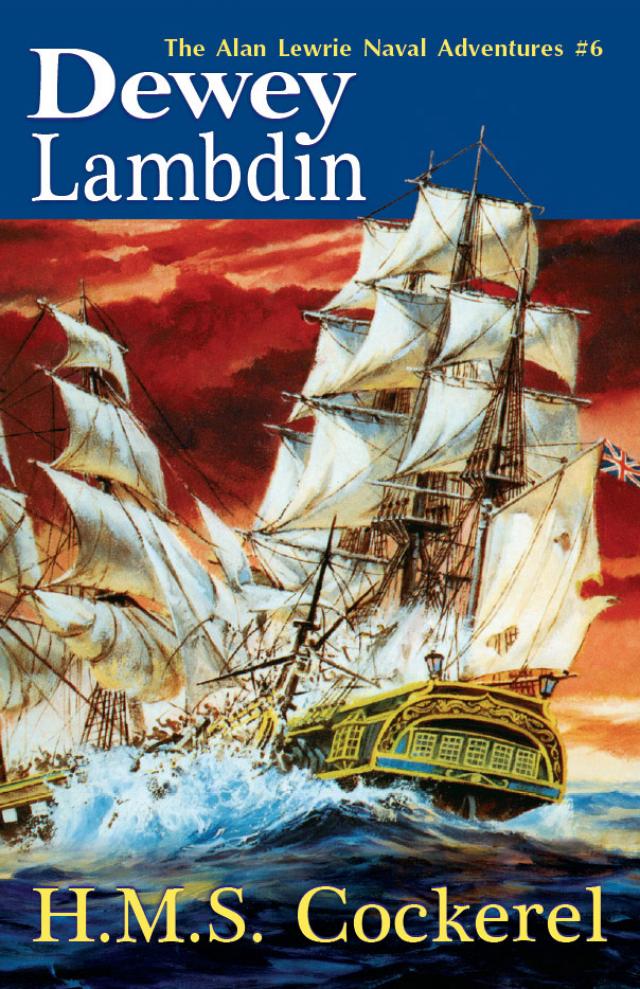
Even the gloom of a drizzly day could not dampen his appreciation of his new ship as they neared her, nor could spume, mist nor rain detract from Cockerel ’s aggressively angular and martial appearance.
Her lower hull above the waterline was a glossy ebony, as were her bulwarks. Her gunwales were, however, buff-coloured, and gleamed with the sheen of prized ivory, slickened by the rain. The yards on her three towering masts were neatly squared away, of a golden buff from linseed oil or fresh paint where the wooden spars were bared to the gloom; courses, tops’ls, royals and t’gallants all in perfect alignment with each other a’span the decks, and lift lines tugged until each spar lay perfectly horizontal. And not a brace, parrel, halliard or jear hung slack, not a clew, brail or lift line varied from purposeful, straight-line perfection.
There were touches of red and gilt about the transom and the taffrails, the quarter-galleries, windows and ports, and the lanterns aft. There was lavish gilt about the entry port. And what Lewrie could espy of the figurehead, an irate, wing-fanning rooster wearing a golden fillet crown, and the beakhead rails, was liberally coated with gilt paint as well.
“Shiny as a new-minted guinea!” Lewrie muttered to himself as he marveled how devilish-handsome she appeared, as if she was fresh from the builder’s yard—or she had a captain who possessed a duke’s purse to bring her from in-ordinary, idle seediness to a state worthy of a royal yacht. Her captain had been named in Lewrie’s orders as one Howard Braxton; but with no “the Honourable,” “Sir Howard,” or aristocratic title attached to his name and naval rank, which indicated inherited wealth. Perhaps Cockerel had been captained by one so rich, and had been turned over to Braxton entire, he speculated.
Cockerel was supposed to be fitting out, yet to Lewrie’s eyes, at last (and grudgingly) experienced with such matters, the frigate’s “Bristol Fashion” orderliness bespoke a warship ready at that instant to set sail.
Thankee God, Lewrie smirked to himself with relief; You surely know what a lazy bastard I am. Less work for me, my first week’r so, ha ha! She’s better fitted out than any ever I did see!
“Boat ahoy, there!” came a shout from the entry port.
“Aye aye!” Cony bellowed back, shucking his sailcloth cover, and Lewrie shrugged his boat cloak over his shoulders to expose his uniform. Cony held up fingers to clue the harbour watch to the requisite number of sideboys needful to the dignity of a first officer’s welcome aboard. Despite the rain, Lewrie undid the chain about his neck and folded the boat cloak for Cony to tend to, so he could go aboard unencumbered by anything that could trip him up, or embarrass his first appearance before his new crew. He tucked his hanger to the back of his left hip, and half-rose off the thwart.
Ariadne, Lewrie thought, vexed by the memory of his very first boarding, of being dunked chest-deep, nigh drowned, by the puzzles of slimy boarding battens, algae-slick man-ropes, and a ship rolling her guts out. Thankfully, there was little breeze and Cockerel lay still as a patient old hacking mare, gentle enough for a lady to ride. Man-ropes threaded through the outer ends of the battens were red-painted two-inch manila, taut as shrouds in the mainmast chains’ deadeyes. And, he noted with relief, someone thoughtful had ordered fresh tar on the battens, reinforced with gritty sand to make a secure foothold.
He scampered up lithely, inclining a bit toward the entry port as the tumblehome of the ship’s side retreated inward to lessen the weight of top-hamper and spar deck above her artillery’s monstrous mass.
His hat drew level with the entry-port lip as the bosun’s pipes began to shrill. Marines slapped muskets and stamped their feet; sideboys lifted their hats, and a Marine sergeant and a Navy officer flourished half-pike or sword, respectively, as he arrived. Lewrie gained the starboard gangway (stepping far enough in-board so a sudden roll wouldn’t sling him back where he’d come from) and doffed his own hat.
“Alan Lewrie, come aboard to join, sir,” he announced, trying to quash his sudden joy.
“Welcome aboard, sir,” the Navy officer said in greeting as he swept his sword down, spun it overhand with a practiced fillip, and resheathed it. “Allow me to name myself, sir . . . Lieutenant Lewrie. I am Barnaby Scott. Third lieutenant.” If he’d said his name was Eric the Red, Lewrie would have considered it more apt; Barnaby Scott looked more like an ancient Viking raider (albeit a cleanshaven one). His body was thick and square, saved from brute commonness by his height, which was about two inches more than Lewrie’s. Wide-shouldered, thick-chested, bluff and hearty as a professional boxer. Scott’s hair was pale blond, almost frizzy, and only loosely drawn back into a seaman’s queue that more resembled a horsetail that badly needed teazeling. His complexion was deeply tanned, though sporting ruddier colour on nose, cheeks and forehead. And his eyes were a disconcertingly penetrating watery blue.
“Mister Scott, good morrow to you, sir,” Lewrie smiled, taking his hand, which more resembled a bear paw, for a hearty shake. There was no choice about that; Scott did the pumping.
“And you come aboard, sir, as . . . ?” Scott inquired, cocking one suddenly wary blond eyebrow.
“First officer, Mister Scott.”
“Thank bloody Christ, sir, and very welcome aboard!” Lieutenant Scott beamed of a sudden, and almost mangled Lewrie’s hand with fresh vigour.
“Our captain is aboard, is he, Mister Scott?” Lewrie asked, glad to get his hand back at last, with all the requisite fingers.
“Aye, sir, Captain Braxton is aft in the great-cabins. Mister Spendlove?” Scott called over his shoulder without looking.
“Aye aye, sir?” a tiny midshipman chirped as he popped up from nowhere.
“Escort Mister Lewrie, our new first officer, aft so he may announce himself to the captain.”
“Aye aye, sir,” the fourteen-year-old piped, almost bobbing in eagerness. Or relief, Lewrie wondered? What made his arrival such a joyous occasion?
“I’ll see to getting your chest aboard, sir,” Lieutenant Scott offered.
“Just steer my man Cony the right direction, Mister Scott.” He turned to follow the boy to the quarterdeck ladders which led below from the sail-tending gangways to the gun deck.
“Another hand, then? Bloody good!” Scott beamed, cracking his palms together with satisfaction.
Cockerel, like all modern frigates, was flush-decked. Her after fourth was a bare and functional quarterdeck, with no accommodations in a poop cabin. It was broken only by the after capstan heads, the base of the mizzenmast, a double wheel, compass binnacle, chart table and traverse board aft of that, and guns. There were signal-flag lockers right-aft by the taffrail, a hatchway near the stern so her captain had a quick, informal access, and a long coach top, a skylight which fed sun and air below to that worthy’s great-cabins, between after hatch and the wheel. On either beam, bowsed up to the low bulwarks, were pieces of artillery; two long six-pounders and two shorter-barreled twenty-four-pounder carronades in both larboard and starboard batteries.
Cockerel ’s gun deck proper stretched 130 feet from bow to stern, with the bulk of it exposed to the sky in the waist between the foc’s’le and the great-cabins. There her main armament nested— twenty-six twelve-pounder guns, with some aft in the captain’s quarters.
Unlike larger two-decked ships of the line, her officers and men did not sleep, idle or sup jammed between the artillery. Frigates had a second, lower deck (confusingly named gun deck) below the gun deck proper, for accommodations, with hands forrud, Marines aft of them and the commission and warrant officers right aft, under the captain, in the wardroom. A frigate’s captain was the only person to reside on the true gun deck, in solitary splendour of the great-cabins, which were as large as the entire wardroom.
Tiny Midshipman Spendlove announced Lewrie to the Marine sentry on guard without the entry door, underneath the overhang of the quarterdeck’s forward edge. The Marine hitched a deep breath, and banged the butt of his Brown Bess musket on the oak planks, then shouted out just what, and whom, dared interrupt their captain’s musings.
“Come.” A laconic voice was heard from within.
Lewrie entered, hat and orders under his left arm, in past the chartroom to starboard, and a roomy and inviting dining coach which lay to larboard, rich with waxed and varnished table, bulkheads and beams. On a gleaming sideboard there were coin-silver lamps and tea-things, ornate, highly polished brass accoutrements, much like what he had seen in Calcutta or Canton. The dish service was Oriental, too.
He took in the usual black-and-white chequered sailcloth which covered the deck of the day cabin in lieu of formal tiles, and several carpets laid atop it. He’d seen their like before, as well. There were intricately figured trellis-patterned Hindoo and Bokhara, all red and gold and black. And a few pale green, beige or pale yellow Chinee carpets, with their enigmatic glyphs in their centers. To starboard was a seating area, made up of fancy-filigreed Chippendale-Chinese chairs and a real sofa, with ecru silk fabric, and side tables and bookcases of gleaming teak, a large square, glossy black construct he took for a wine cabinet, lightly sketched over with pale gilt scenes. For a moment, he thought he was back in a trader’s “hong” in Canton, or his father’s luxurious, Grand Moghul of a palace-bungalow in Calcutta!
“Yes?” his new captain prompted at last with some irritation.
“Sir . . . !” Lewrie harrumphed, drawing his wits back to the matter at hand, ending his perusal (and rapid valuation) of his new lord and master’s private digs. “Lt. Alan Lewrie, sir, reporting aboard.”
“I see,” Captain Braxton sighed, sounding a bit put upon. “And you are to be my new first?”
Belinda . . . their mutual father’d robbed her and Gerald of their dead mother’s inheritance, too; run through every penny, and hadn’t got his hands on Alan’s, so they’d been turned out, penniless. He’d heard she made her living on her back. He’d even seen her listed in the new gentleman’s guide to Covent Garden whores . . . a high-priced courtesan, in the latest edition.
Gerald, well . . . they didn’t publish guides for what he did. He had survived, after a fashion; toadying, fawning, conniving and scheming to ingratiate himself with every member of his peculiar “tribe” in London, to sponge off others’ largesse, so he could still make a grand show about town in the latest fashion, in the best circles. As long as he allowed other men of his stripe to ride him.
Lewrie almost giggled as he took in how low Gerald had fallen in the years since he’d last heard of him. A stupendous comedown, if this establishment was the best he could afford to frequent. Or the meanest strait he’d been reduced to, as a market for his fading wares. Getting buggered for sixpence, instead of guineas.
There was a carefully folded pile of civilian long clothing he took to be Gerald’s. Lewrie knelt to examine them. He still sported silk stockings, yes, but they were raveled above the knees and darned where they’d run. His shirt boasted a puffy lace jabot, but the rest, which the waistcoat would hide, was a faded, much-mended horror from a ragpicker’s barrow. The seat of his pale blue velvet breeches was worn shiny, his once-elegant satin waistcoat had patches of bullion and silver embroidery missing. And his hat! Gerald had been rather keen on fashionable hats. Gerald’s wine-coloured beaver was greasy with too much past sweat, table oils, hair dressing, and stained by overlong exposure to the elements.
Alan poked about until he found Gerald’s carefully hidden purse, a worn-bare, figured-silk poke. It held a mere two shillings eleven pence. Prompted by past remembrance, he dug into a cracked shoe, delving into Gerald’s favourite hidey-hole, and found . . . a single crown. And this was the top-lofty bastard who’d feared going out of an evening unless he could sport at least fifty pounds! He’d thought it ungentlemanly!
Lewrie stood up suddenly as the lank bastard groaned and rolled his head, exposing teeth grayed by the mercury cure for pox. He spun on his heel and fled the room, before Gerald awoke.
“Bosun,” he called, trying to keep his rising malevolent grin in check. “Bosun Tatnall?”
“Sir,” that worthy grunted.
“Seems to me there’s nought we may do to shut this horror down. Nothing official, that is, but . . .” Alan began, biting his cheek.
“Burn h’it t’th’ groun’, sir, that’d suit,” Tatnall scowled.
“Probably a dozen more like it in spitting distance. But, we could do some real good this night, even so,” Lewrie went on. “Can’t stay open without its owner, or its star performer up yonder,” Lewrie joshed, almost elbowing the man in confidential camaraderie. “Do you not think that old tripes-and-trullibubs would make a fine volunteer, Bosun? Once you convince him that joining’s a sight better than being hanged for a bugger?”
“Oh, aye, sir!” Tatnall agreed heartily. “An’ if the’ bugger tries ’is ways ’board ship, they’ll flay ’at maggotty flesh off’n ’is bones! Cut a feller soft’z ’im like fresh cheese, ’ey would, sir!”
“Pity about that shop door below, too, Bosun. When we left it, it was locked, but ’tis a rough location, after all. Pity some criminals from the stew broke in and drank him dry.”
“Oh, aye, sir!” Tatnall concurred again. “A hellish pity!”
“I’ll speak to that crimp of ours. He must have friends who’d savour a bottle or two,” Lewrie snickered. “Take our deserters and the owner to the tender. I’ll deal with our crimp, and catch you up later.”
“I’ll see to ’em, sir, never ya fear.”
And I wonder if that crimp knows where a good tattoo artist may be found this time o’ night, Lewrie wondered to himself, hellish happy with the evening’s outcome, after all.
Bound and gagged, blindfolded, both muffled and disguised by a filthy sheet, Gerald Willoughby could but grunt, squeal and attempt to curse as the tattooist plied his skills at Bridey’s knocking-shop. The old drab had bales of castoff slop clothing to garb Gerald in, and the crimp delighted in his smart, newly exchanged gentleman’s togs.
The tattooist did complain, though, as he laboured over Gerald’s pale, hairless and shallow chest, as the whores hooted encouragement to him, at the poor state of his “canvas,” at the boot-blacking he had to use; at the weak light and the watching crowd as he strove to complete his masterpiece.
It was rather good, though, considering how Gerald behaved, how violently he struggled against every quill prick, the liberal tots they poured down his maw. The rum won out. Toward the end, his thrashings abated, and he rambled gagged snatches of song, before his lights at last went out, and he began to snore.
And once he was thoroughly comatose, Lewrie, the chuckling crimp and their unwitting accomplice Will Cony, delivered Gerald Willoughby, Esq., into the gentle ministrations of the Deptford district ’press tender. There to sleep off his monumental drunk—there to be sweetly wafted down-river to the Nore as an impressed sailor— there to awaken with a shriek of horror to a new life and trade.
Lewrie was mortal certain Gerald no longer had a single influential or fashionable patron who might spring to his aid, so there could be no hope of rescue from without. And from within, Gerald, garbed in slop clothing, and sporting an especially fine (though new) chest tattoo of a rope-fouled anchor, listed as taken by an Impress officer by the name of Bracewaight, could protest until his face turned blue that he wasn’t a sailor, to no avail whatsoever. No, his only hope of escape would be to declare himself for what he was.
But, once ’pressed, he fell under the harsh strictures of the Articles of War, most especially Article the Twenty-Ninth:
If any person in the Fleet shall committ the unnatural
and detestable Sin of Buggery or Sodomy with Man or
Beast, he shall be punished with Death by the sentence
of a Court Martial.
Oh, it would be a fine and manly, though austere, life Gerald would be entering, Lewrie thought smugly. Wind, rain, the perils of the sea, foul food, rancid reeks, stern discipline, days aloft on the yards dependent on fickle footholds, the risks of battle. Flogging.
And the weeks and months spent cheek-to-jowl with hundreds of fit, healthy, lithe young men, cooped up on the gun decks, swaying in a narrow hammock, with not one whit of privacy—living as celibate an existence as so many damned monks!
Or else, of course.
B O O K I I I
Heu miseros nostrum natosque pateresque! Hacine nos
animae faciles rate nubila contra mittimur?
Alas, for those of us with fathers or sons alive! Is
this the ship in which we thoughtless souls are sent
forth in the face of a clouded sky?
Argonautica
Book I, 149–152
Valerius Flaccus
C H A P T E R 1
Post nubila—Phoebus, Cony,” Lewrie informed his man. “My thought for the day. ‘After clouds—sunshine’!”
“Iff’n ya say so, sir,” Cony replied, trying to shelter under a scrap of canvas in the bumboat, as Portsmouth Harbour seethed at the lash of a sullen April rain shower.
Bare days after his antic over his half brother Gerald, there had at last come a packet from the Admiralty. Perhaps Rear Admiral Sir George Sinclair had turned his toes up, or sailed. Perhaps some rumour of Garvey’s past dealings in the Bahamas had come to light at last. Or, more likely perhaps, his and Captain Lilycrop’s almost weekly letters to far and near had become such a nuisance to some overworked clerk—whatever, Lt. Alan Lewrie, RN, was ordered to make his way to Portsmouth instanter and report aboard the Cockerel frigate, a 32-gunned vessel of the 5th Rate currently fitting out, as her first officer.
Even the gloom of a drizzly day could not dampen his appreciation of his new ship as they neared her, nor could spume, mist nor rain detract from Cockerel ’s aggressively angular and martial appearance.
Her lower hull above the waterline was a glossy ebony, as were her bulwarks. Her gunwales were, however, buff-coloured, and gleamed with the sheen of prized ivory, slickened by the rain. The yards on her three towering masts were neatly squared away, of a golden buff from linseed oil or fresh paint where the wooden spars were bared to the gloom; courses, tops’ls, royals and t’gallants all in perfect alignment with each other a’span the decks, and lift lines tugged until each spar lay perfectly horizontal. And not a brace, parrel, halliard or jear hung slack, not a clew, brail or lift line varied from purposeful, straight-line perfection.
There were touches of red and gilt about the transom and the taffrails, the quarter-galleries, windows and ports, and the lanterns aft. There was lavish gilt about the entry port. And what Lewrie could espy of the figurehead, an irate, wing-fanning rooster wearing a golden fillet crown, and the beakhead rails, was liberally coated with gilt paint as well.
“Shiny as a new-minted guinea!” Lewrie muttered to himself as he marveled how devilish-handsome she appeared, as if she was fresh from the builder’s yard—or she had a captain who possessed a duke’s purse to bring her from in-ordinary, idle seediness to a state worthy of a royal yacht. Her captain had been named in Lewrie’s orders as one Howard Braxton; but with no “the Honourable,” “Sir Howard,” or aristocratic title attached to his name and naval rank, which indicated inherited wealth. Perhaps Cockerel had been captained by one so rich, and had been turned over to Braxton entire, he speculated.
Cockerel was supposed to be fitting out, yet to Lewrie’s eyes, at last (and grudgingly) experienced with such matters, the frigate’s “Bristol Fashion” orderliness bespoke a warship ready at that instant to set sail.
Thankee God, Lewrie smirked to himself with relief; You surely know what a lazy bastard I am. Less work for me, my first week’r so, ha ha! She’s better fitted out than any ever I did see!
“Boat ahoy, there!” came a shout from the entry port.
“Aye aye!” Cony bellowed back, shucking his sailcloth cover, and Lewrie shrugged his boat cloak over his shoulders to expose his uniform. Cony held up fingers to clue the harbour watch to the requisite number of sideboys needful to the dignity of a first officer’s welcome aboard. Despite the rain, Lewrie undid the chain about his neck and folded the boat cloak for Cony to tend to, so he could go aboard unencumbered by anything that could trip him up, or embarrass his first appearance before his new crew. He tucked his hanger to the back of his left hip, and half-rose off the thwart.
Ariadne, Lewrie thought, vexed by the memory of his very first boarding, of being dunked chest-deep, nigh drowned, by the puzzles of slimy boarding battens, algae-slick man-ropes, and a ship rolling her guts out. Thankfully, there was little breeze and Cockerel lay still as a patient old hacking mare, gentle enough for a lady to ride. Man-ropes threaded through the outer ends of the battens were red-painted two-inch manila, taut as shrouds in the mainmast chains’ deadeyes. And, he noted with relief, someone thoughtful had ordered fresh tar on the battens, reinforced with gritty sand to make a secure foothold.
He scampered up lithely, inclining a bit toward the entry port as the tumblehome of the ship’s side retreated inward to lessen the weight of top-hamper and spar deck above her artillery’s monstrous mass.
His hat drew level with the entry-port lip as the bosun’s pipes began to shrill. Marines slapped muskets and stamped their feet; sideboys lifted their hats, and a Marine sergeant and a Navy officer flourished half-pike or sword, respectively, as he arrived. Lewrie gained the starboard gangway (stepping far enough in-board so a sudden roll wouldn’t sling him back where he’d come from) and doffed his own hat.
“Alan Lewrie, come aboard to join, sir,” he announced, trying to quash his sudden joy.
“Welcome aboard, sir,” the Navy officer said in greeting as he swept his sword down, spun it overhand with a practiced fillip, and resheathed it. “Allow me to name myself, sir . . . Lieutenant Lewrie. I am Barnaby Scott. Third lieutenant.” If he’d said his name was Eric the Red, Lewrie would have considered it more apt; Barnaby Scott looked more like an ancient Viking raider (albeit a cleanshaven one). His body was thick and square, saved from brute commonness by his height, which was about two inches more than Lewrie’s. Wide-shouldered, thick-chested, bluff and hearty as a professional boxer. Scott’s hair was pale blond, almost frizzy, and only loosely drawn back into a seaman’s queue that more resembled a horsetail that badly needed teazeling. His complexion was deeply tanned, though sporting ruddier colour on nose, cheeks and forehead. And his eyes were a disconcertingly penetrating watery blue.
“Mister Scott, good morrow to you, sir,” Lewrie smiled, taking his hand, which more resembled a bear paw, for a hearty shake. There was no choice about that; Scott did the pumping.
“And you come aboard, sir, as . . . ?” Scott inquired, cocking one suddenly wary blond eyebrow.
“First officer, Mister Scott.”
“Thank bloody Christ, sir, and very welcome aboard!” Lieutenant Scott beamed of a sudden, and almost mangled Lewrie’s hand with fresh vigour.
“Our captain is aboard, is he, Mister Scott?” Lewrie asked, glad to get his hand back at last, with all the requisite fingers.
“Aye, sir, Captain Braxton is aft in the great-cabins. Mister Spendlove?” Scott called over his shoulder without looking.
“Aye aye, sir?” a tiny midshipman chirped as he popped up from nowhere.
“Escort Mister Lewrie, our new first officer, aft so he may announce himself to the captain.”
“Aye aye, sir,” the fourteen-year-old piped, almost bobbing in eagerness. Or relief, Lewrie wondered? What made his arrival such a joyous occasion?
“I’ll see to getting your chest aboard, sir,” Lieutenant Scott offered.
“Just steer my man Cony the right direction, Mister Scott.” He turned to follow the boy to the quarterdeck ladders which led below from the sail-tending gangways to the gun deck.
“Another hand, then? Bloody good!” Scott beamed, cracking his palms together with satisfaction.
Cockerel, like all modern frigates, was flush-decked. Her after fourth was a bare and functional quarterdeck, with no accommodations in a poop cabin. It was broken only by the after capstan heads, the base of the mizzenmast, a double wheel, compass binnacle, chart table and traverse board aft of that, and guns. There were signal-flag lockers right-aft by the taffrail, a hatchway near the stern so her captain had a quick, informal access, and a long coach top, a skylight which fed sun and air below to that worthy’s great-cabins, between after hatch and the wheel. On either beam, bowsed up to the low bulwarks, were pieces of artillery; two long six-pounders and two shorter-barreled twenty-four-pounder carronades in both larboard and starboard batteries.
Cockerel ’s gun deck proper stretched 130 feet from bow to stern, with the bulk of it exposed to the sky in the waist between the foc’s’le and the great-cabins. There her main armament nested— twenty-six twelve-pounder guns, with some aft in the captain’s quarters.
Unlike larger two-decked ships of the line, her officers and men did not sleep, idle or sup jammed between the artillery. Frigates had a second, lower deck (confusingly named gun deck) below the gun deck proper, for accommodations, with hands forrud, Marines aft of them and the commission and warrant officers right aft, under the captain, in the wardroom. A frigate’s captain was the only person to reside on the true gun deck, in solitary splendour of the great-cabins, which were as large as the entire wardroom.
Tiny Midshipman Spendlove announced Lewrie to the Marine sentry on guard without the entry door, underneath the overhang of the quarterdeck’s forward edge. The Marine hitched a deep breath, and banged the butt of his Brown Bess musket on the oak planks, then shouted out just what, and whom, dared interrupt their captain’s musings.
“Come.” A laconic voice was heard from within.
Lewrie entered, hat and orders under his left arm, in past the chartroom to starboard, and a roomy and inviting dining coach which lay to larboard, rich with waxed and varnished table, bulkheads and beams. On a gleaming sideboard there were coin-silver lamps and tea-things, ornate, highly polished brass accoutrements, much like what he had seen in Calcutta or Canton. The dish service was Oriental, too.
He took in the usual black-and-white chequered sailcloth which covered the deck of the day cabin in lieu of formal tiles, and several carpets laid atop it. He’d seen their like before, as well. There were intricately figured trellis-patterned Hindoo and Bokhara, all red and gold and black. And a few pale green, beige or pale yellow Chinee carpets, with their enigmatic glyphs in their centers. To starboard was a seating area, made up of fancy-filigreed Chippendale-Chinese chairs and a real sofa, with ecru silk fabric, and side tables and bookcases of gleaming teak, a large square, glossy black construct he took for a wine cabinet, lightly sketched over with pale gilt scenes. For a moment, he thought he was back in a trader’s “hong” in Canton, or his father’s luxurious, Grand Moghul of a palace-bungalow in Calcutta!
“Yes?” his new captain prompted at last with some irritation.
“Sir . . . !” Lewrie harrumphed, drawing his wits back to the matter at hand, ending his perusal (and rapid valuation) of his new lord and master’s private digs. “Lt. Alan Lewrie, sir, reporting aboard.”
“I see,” Captain Braxton sighed, sounding a bit put upon. “And you are to be my new first?”