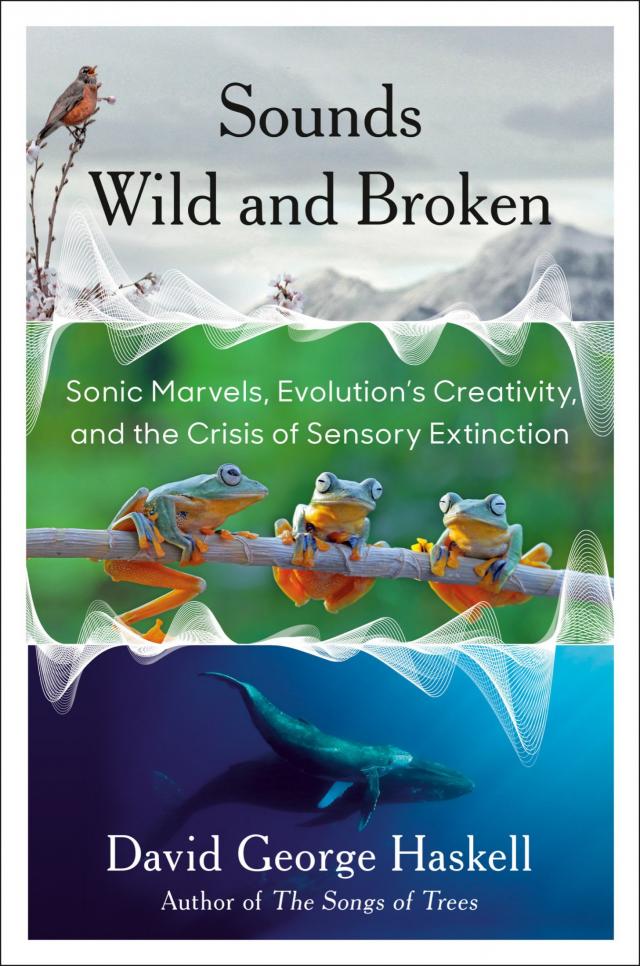
Sounds Wild and Broken, page 40


My mentors during my undergraduate education at the University of Oxford, Andrew Pomiankowski and William Hamilton, showed me the extraordinary power and beauty of evolutionary biology, especially the many ways that aesthetics have shaped and diversified sound and other forms of animal communication. Greg Budney, Russ Charif, and Chris Clark were generous guides as I learned sound recording and analysis techniques as a graduate student at Cornell University, and many colleagues at Cornell in the fields of ecology, evolution, and animal behavior deepened my appreciation of evolution’s creative powers.
In the research for this book I made extensive use of the libraries at the University of the South, Sewanee, and at the University of Colorado, Boulder, and offer my thanks to the staff at both for their help, especially during the challenges of the pandemic. The University of the South provided funding for my visit to Germany and granted me a leave of absence to work on this project.
I wrote this book while living on the unceded territory of the Arapaho. I pay my respects to elders past, present, and emerging.
Thank you, reader, for spending time with the sounds, living beings, ideas, and places imperfectly evoked by these words. I offer the book as an invitation to both wonder and action, guided by your own listening.
BIBLIOGRAPHY
Primal Sound and the Ancient Roots of Hearing
Aggio, Raphael Bastos Mereschi, Victor Obolonkin, and Silas Granato Villas-Bôas. “Sonic vibration affects the metabolism of yeast cells growing in liquid culture: a metabolomic study.” Metabolomics 8 (2012): 670‒78.
Cox, Charles D., Navid Bavi, and Boris Martinac. “Bacterial mechanosensors.” Annual Review of Physiology 80 (2018): 71‒93.
Fee, David, and Robin S. Matoza. “An overview of volcano infrasound: from Hawaiian to Plinian, local to global.” Journal of Volcanology and Geothermal Research 249 (2013): 123‒39.
Gordon, Vernita D., and Liyun Wang. “Bacterial mechanosensing: the force will be with you, always.” Journal of Cell Science 132 (2019): jcs227694.
Johnson, Ward L., Danielle Cook France, Nikki S. Rentz, William T. Cordell, and Fred L. Walls. “Sensing bacterial vibrations and early response to antibiotics with phase noise of a resonant crystal.” Scientific Reports 7 (2017): 1‒12.
Kasas, Sandor, Francesco Simone Ruggeri, Carine Benadiba, Caroline Maillard, Petar Stupar, Hélène Tournu, Giovanni Dietler, and Giovanni Longo. “Detecting nanoscale vibrations as signature of life.” Proceedings of the National Academy of Sciences 112 (2015): 378‒81.
Longo, G., L. Alonso-Sarduy, L. Marques Rio, A. Bizzini, A. Trampuz, J. Notz, G. Dietler, and S. Kasas. “Rapid detection of bacterial resistance to antibiotics using AFM cantilevers as nanomechanical sensors.” Nature Nanotechnology 8 (2013): 522.
Matsuhashi, Michio, Alla N. Pankrushina, Satoshi Takeuchi, Hideyuki Ohshima, Housaku Miyoi, Katsura Endoh, Ken Murayama et al. “Production of sound waves by bacterial cells and the response of bacterial cells to sound.” Journal of General and Applied Microbiology 44 (1998): 49‒55.
Norris, Vic, and Gerard J. Hyland. “Do bacteria sing?” Molecular Microbiology 24 (1997): 879‒80.
Pelling, Andrew E., Sadaf Sehati, Edith B. Gralla, Joan S. Valentine, and James K. Gimzewski. “Local nanomechanical motion of the cell wall of Saccharomyces cerevisiae.” Science 305 (2004): 1147‒50.
Reguera, Gemma. “When microbial conversations get physical.” Trends in Microbiology 19 (2011): 105-13.
Sarvaiya, Niral, and Vijay Kothari. “Effect of audible sound in form of music on microbial growth and production of certain important metabolites.” Microbiology 84 (2015): 227‒35.
Unity and Diversity
Avan, Paul, Béla Büki, and Christine Petit. “Auditory distortions: origins and functions.” Physiological Reviews 93 (2013): 1563‒619.
Bass, Andrew H., and Boris P. Chagnaud. “Shared developmental and evolutionary origins for neural basis of vocal–acoustic and pectoral–gestural signaling.” Proceedings of the National Academy of Sciences 109 (2012): 10677‒84.
Bass, Andrew H., Edwin H. Gilland, and Robert Baker. “Evolutionary origins for social vocalization in a vertebrate hindbrain–spinal compartment.” Science 321 (2008): 417‒21.
Bezares-Calderón, Luis Alberto, Jürgen Berger, and Gáspár Jékely. “Diversity of cilia-based mechanosensory systems and their functions in marine animal behaviour.” Philosophical Transactions of the Royal Society B 375 (2020): 20190376.
Bregman, Micah R., Aniruddh D. Patel, and Timothy Q. Gentner. “Songbirds use spectral shape, not pitch, for sound pattern recognition.” Proceedings of the National Academy of Sciences 113 (2016): 1666‒71.
Brown, Jason M., and George B. Witman. “Cilia and diseases.” Bioscience 64 (2014): 1126‒37.
Bush, Brian M. H., and Michael S. Laverack. “Mechanoreception.” In The Biology of Crustacea, edited by Harold L. Atwood, and David C. Sandeman, 399‒468. New York: Academic Press, 1982.
Ekdale, Eric G. “Form and function of the mammalian inner ear.” Journal of Anatomy 228 (2016): 324‒37.
Fine, Michael L., Karl L. Malloy, Charles King, Steve L. Mitchell, and Timothy M. Cameron. “Movement and sound generation by the toadfish swimbladder.” Journal of Comparative Physiology A 187 (2001): 371‒79.
Fishbein, Adam R., William J. Idsardi, Gregory F. Ball, and Robert J. Dooling. “Sound sequences in birdsong: how much do birds really care?” Philosophical Transactions of the Royal Society B 375 (2020): 20190044.
Fritzsch, Bernd, and Hans Straka. “Evolution of vertebrate mechanosensory hair cells and inner ears: toward identifying stimuli that select mutation driven altered morphologies.” Journal of Comparative Physiology A 200 (2014): 5‒18.
Göpfert, Martin C., and R. Matthias Hennig. “Hearing in insects.” Annual Review of Entomology 61 (2016): 257‒76.
Hughes, A. Randall, David A. Mann, and David L. Kimbro. “Predatory fish sounds can alter crab foraging behaviour and influence bivalve abundance.” Proceedings of the Royal Society B 281 (2014): 20140715.
Jones, Gareth, and Marc W. Holderied. “Bat echolocation calls: adaptation and convergent evolution.” Proceedings of the Royal Society B 274 (2007): 905‒12.
Kastelein, Ronald A., Paulien Bunskoek, Monique Hagedoorn, Whitlow W. L. Au, and Dick de Haan. “Audiogram of a harbor porpoise (Phocoena phocoena) measured with narrow-band frequency-modulated signals.” Journal of the Acoustical Society of America 112 (2002): 334‒44.
Kreithen, Melvin L., and Douglas B. Quine. “Infrasound detection by the homing pigeon: a behavioral audiogram.” Journal of Comparative Physiology 129 (1979): 1‒4.
Ma, Leung-Hang, Edwin Gilland, Andrew H. Bass, and Robert Baker. “Ancestry of motor innervation to pectoral fin and forelimb.” Nature Communications 1 (2010): 1‒8.
Page, Jeremy. “Underwater Drones Join Microphones to Listen for Chinese Nuclear Submarines.” Wall Street Journal, October 24, 2014.
Payne, Katharine B., William R. Langbauer, and Elizabeth M. Thomas. “Infrasonic calls of the Asian elephant (Elephas maximus).” Behavioral Ecology and Sociobiology 18 (1986): 297‒301.
Popper, Arthur N., Michael Salmon, and Kenneth W. Horch. “Acoustic detection and communication by decapod crustaceans.” Journal of Comparative Physiology A 187 (2001): 83‒89.
Ramcharitar, John, Dennis M. Higgs, and Arthur N. Popper. “Sciaenid inner ears: a study in diversity.” Brain, Behavior and Evolution 58 (2001): 152‒62.
Ramcharitar, John Umar, Xiaohong Deng, Darlene Ketten, and Arthur N. Popper. “Form and function in the unique inner ear of a teleost: the silver perch (Bairdiella chrysoura).” Journal of Comparative Neurology 475 (2004): 531‒39.
“ ‘Sonar’ and Shrimps in Anti-Submarine War.” The Age (Melbourne, Australia), April 8, 1946.
Versluis, Michel, Barbara Schmitz, Anna von der Heydt, and Detlef Lohse. “How snapping shrimp snap: through cavitating bubbles.” Science 289 (2000): 2114‒7.
Washausen, Stefan, and Wolfgang Knabe. “Lateral line placodes of aquatic vertebrates are evolutionarily conserved in mammals.” Biology Open 7 (2018): bio031815.
Sensory Bargains and Biases
Dallos, Peter. “The active cochlea.” Journal of Neuroscience 12 (1992): 4575‒85.
Dallos, Peter, and Bernd Fakler. “Prestin, a new type of motor protein.” Nature Reviews Molecular Cell Biology 3 (2002): 104‒11.
Dańko, Maciej J., Jan Kozłowski, and Ralf Schaible. “Unraveling the non-senescence phenomenon in Hydra.” Journal of Theoretical Biology 382 (2015): 137‒49.
Deutsch, Diana. Musical Illusions and Phantom Words: How Music and Speech Unlock Mysteries of the Brain. New York: Oxford University Press, 2019.
Fritzsch, Bernd, and Hans Straka. “Evolution of vertebrate mechanosensory hair cells and inner ears: toward identifying stimuli that select mutation driven altered morphologies.” Journal of Comparative Physiology A 200 (2014): 5‒18.
Graven, Stanley N., and Joy V. Browne. “Auditory development in the fetus and infant.” Newborn and Infant Nursing Reviews 8 (2008): 187‒93.
Hall, James W. “Development of the ear and hearing.” Journal of Perinatology 20 (2000): S11‒S19.
Kemp, David T. “Otoacoustic emissions, their origin in cochlear function, and use.” British Medical Bulletin 63 (2002): 223‒41.
Lasky, Robert E., and Amber L. Williams. “The development of the auditory system from conception to term.” NeoReviews (2005): e141‒e152.
Manley, Geoffrey A. “Cochlear mechanisms from a phylogenetic viewpoint.” Proceedings of the National Academy of Sciences 97 (2000): 11736‒43.
———. “Aural history.” Scientist 29 (2015): 36‒42.
———. “The Cochlea: What It Is, Where It Came from, and What Is Special about It.” In Understanding the Cochlea, edited by Geoffrey A. Manley, Anthony W. Gummer, Arthur N. Popper, and Richard R. Fay, 17‒32. New York: Springer, 2017.
Moon, Christine. “Prenatal Experience with the Maternal Voice.” In Early Vocal Contact and Preterm Infant Brain Development, edited by Manuela Filippa, Pierre Kuhn, and Björn Westrup, 25‒37. New York: Springer, 2017.
Parga, Joanna J., Robert Daland, Kalpashri Kesavan, Paul M. Macey, Lonnie Zeltzer, and Ronald M. Harper. “A description of externally recorded womb sounds in human subjects during gestation.” PLOS One 13 (2018): e0197045.
Pickles, James. An Introduction to the Physiology of Hearing. Leiden: Brill, 2013.
Plack, Christopher J. The Sense of Hearing, 3rd ed. Oxford and New York: Routledge, 2018.
Robles, Luis, and Mario A. Ruggero. “Mechanics of the mammalian cochlea.” Physiological Reviews 81 (2001): 1305‒52.
Smith, Sherri L., Kenneth J. Gerhardt, Scott K. Griffiths, Xinyan Huang, and Robert M. Abrams. “Intelligibility of sentences recorded from the uterus of a pregnant ewe and from the fetal inner ear.” Audiology and Neurotology 8 (2003): 347‒53.
Wan, Kirsty Y., Sylvia K. Hürlimann, Aidan M. Fenix, Rebecca M. McGillivary, Tatyana Makushok, Evan Burns, Janet Y. Sheung, and Wallace F. Marshall. “Reorganization of complex ciliary flows around regenerating Stentor coeruleus.” Philosophical Transactions of the Royal Society B 375 (2020): 20190167.
Predators, Silence, Wings
Bar-On, Yinon M., Rob Phillips, and Ron Milo. “The biomass distribution on Earth.” Proceedings of the National Academy of Sciences 115 (2018): 6506‒11.
Beraldi-Campesi, Hugo. “Early life on land and the first terrestrial ecosystems.” Ecological Processes 2 (2013): 1‒17.
Betancur-R, Ricardo, Edward O. Wiley, Gloria Arratia, Arturo Acero, Nicolas Bailly, Masaki Miya, Guillaume Lecointre, and Guillermo Orti. “Phylogenetic classification of bony fishes.” BMC Evolutionary Biology 17 (2017): 162.
Béthoux, Olivier. “Grylloptera—a unique origin of the stridulatory file in katydids, crickets, and their kin (Archaeorthoptera).” Arthropod Systematics & Phylogeny 70 (2012): 43‒68.
Béthoux, Olivier, and André Nel. “Venation pattern and revision of Orthoptera sensu nov. and sister groups. Phylogeny of Palaeozoic and Mesozoic Orthoptera sensu nov.” Zootaxa 96 (2002): 1‒88.
Béthoux, Olivier, André Nel, Jean Lapeyrie, and Georges Gand. “The Permostridulidae fam. n. (Panorthoptera), a new enigmatic insect family from the Upper Permian of France.” European Journal of Entomology 100 (2003): 581‒86.
Bocast, C., R. M. Bruch, and R. P. Koenigs. “Sound production of spawning lake sturgeon (Acipenser fulvescens Rafinesque, 1817) in the Lake Winnebago watershed, Wisconsin, USA.” Journal of Applied Ichthyology 30 (2014): 1186‒94.
Brazeau, Martin D., and Per E. Ahlberg. “Tetrapod-like middle ear architecture in a Devonian fish.” Nature 439 (2006): 318‒21.
Brazeau, Martin D., and Matt Friedman. “The origin and early phylogenetic history of jawed vertebrates.” Nature 520 (2015): 490‒97.
Breure, Abraham S. H. “The sound of a snail: two cases of acoustic defence in gastropods.” Journal of Molluscan Studies 81 (2015): 290‒93.
Clack, J. A. “The neurocranium of Acanthostega gunnari Jarvik and the evolution of the otic region in tetrapods.” Zoological Journal of the Linnean Society 122 (1998): 61‒97.
Clack, Jennifer A. “Discovery of the earliest-known tetrapod stapes.” Nature 342 (1989): 425‒27.
Clack, Jennifer A., Per E. Ahlberg, S. M. Finney, P. Dominguez Alonso, Jamie Robinson, and Richard A. Ketcham. “A uniquely specialized ear in a very early tetrapod.” Nature 425 (2003): 65‒69.
Clack, Jennifer A., Richard R. Fay, and Arthur N. Popper, eds. Evolution of the Vertebrate Ear: Evidence from the Fossil Record. New York: Springer, 2016.
Coombs, Sheryl, Horst Bleckmann, Richard R. Fay, and Arthur N. Popper, eds. The Lateral Line System. New York: Springer, 2014.
Daley, Allison C., Jonathan B. Antcliffe, Harriet B. Drage, and Stephen Pates. “Early fossil record of Euarthropoda and the Cambrian Explosion.” Proceedings of the National Academy of Sciences 115 (2018): 5323‒31.
Davranoglou, Leonidas-Romanos, Alice Cicirello, Graham K. Taylor, and Beth Mortimer. “Planthopper bugs use a fast, cyclic elastic recoil mechanism for effective vibrational communication at small body size.” PLOS Biology 17 (2019): e3000155.
———. Response to “On the evolution of the tymbalian tymbal organ: comment on “Planthopper bugs use a fast, cyclic elastic recoil mechanism for effective vibrational communication at small body size” by Davranoglou et al. 2019.” Cicadina 18 (2019): 17‒26.
Desutter-Grandcolas, Laure, Lauriane Jacquelin, Sylvain Hugel, Renaud Boistel, Romain Garrouste, Michel Henrotay, Ben H. Warren et al. “3-D imaging reveals four extraordinary cases of convergent evolution of acoustic communication in crickets and allies (Insecta).” Scientific Reports 7 (2017): 1‒8.
Downs, Jason P., Edward B. Daeschler, Farish A. Jenkins, and Neil H. Shubin. “The cranial endoskeleton of Tiktaalik roseae.” Nature 455 (2008): 925‒29.
Dubus, I. G., J. M. Hollis, and C. D. Brown. “Pesticides in rainfall in Europe.” Environmental Pollution 110 (2000): 331‒44.
Dunlop, Jason A., Gerhard Scholtz, and Paul A. Selden. “Water-to-land Transitions.” In Arthropod Biology and Evolution, edited by Alessandro Minelli, Geoffrey Boxshall, and Giuseppe Fusco, 417‒39. Berlin: Springer, 2013.
French, Katherine L., Christian Hallmann, Janet M. Hope, Petra L. Schoon, J. Alex Zumberge, Yosuke Hoshino, Carl A. Peters et al. “Reappraisal of hydrocarbon biomarkers in Archean rocks.” Proceedings of the National Academy of Sciences 112 (2015): 5915‒20.
Galtier, Jean, and Jean Broutin. “Floras from red beds of the Permian Basin of Lodève (Southern France).” Journal of Iberian Geology 34 (2008): 57‒72.
Goerlitz, Holger R., Stefan Greif, and Björn M. Siemers. “Cues for acoustic detection of prey: insect rustling sounds and the influence of walking substrate.” Journal of Experimental Biology 211 (2008): 2799‒2806.
Goto, Ryutaro, Isao Hirabayashi, and A. Richard Palmer. “Remarkably loud snaps during mouth-fighting by a sponge-dwelling worm.” Current Biology 29 (2019): R617‒R618.
Grimaldi, David, and Michael S. Engel. Evolution of the Insects. Cambridge, UK: Cambridge University Press, 2005.
Gu, Jun-Jie, Fernando Montealegre-Z, Daniel Robert, Michael S. Engel, Ge-Xia Qiao, and Dong Ren. “Wing stridulation in a Jurassic katydid (Insecta, Orthoptera) produced low-pitched musical calls to attract females.” Proceedings of the National Academy of Sciences 109 (2012): 3868‒73.
Hochkirch, Axel, Ana Nieto, M. García Criado, Marta Cálix, Yoan Braud, Filippo M. Buzzetti, D. Chobanov et al. European Red List of Grasshoppers, Crickets and Bush Crickets. Luxembourg: Publications Office of the European Union, 2016.
Kawahara, Akito Y., and Jesse R. Barber. “Tempo and mode of antibat ultrasound production and sonar jamming in the diverse hawkmoth radiation.” Proceedings of the National Academy of Sciences 112 (2015): 6407‒12.
Ladich, Friedrich, and Andreas Tadler. “Sound production in Polypterus (Osteichthyes: Polypteridae).” Copeia 4 (1988): 1076‒77.
Linz, David M., and Yoshinori Tomoyasu. “Dual evolutionary origin of insect wings supported by an investigation of the abdominal wing serial homologs in Tribolium.” Proceedings of the National Academy of Sciences 115 (2018): E658‒E667.
Lopez, Michel, Georges Gand, Jacques Garric, F. Körner, and Jodi Schneider. “The playa environments of the Lodève Permian basin (Languedoc-France).” Journal of Iberian Geology 34 (2008): 29‒56.
Lozano-Fernandez, Jesus, Robert Carton, Alastair R. Tanner, Mark N. Puttick, Mark Blaxter, Jakob Vinther, Jørgen Olesen, Gonzalo Giribet, Gregory D. Edgecombe, and Davide Pisani. “A molecular palaeobiological exploration of arthropod terrestrialization.” Philosophical Transactions of the Royal Society B 371 (2016): 20150133.
Masters, W. Mitchell. “Insect disturbance stridulation: its defensive role.” Behavioral Ecology and Sociobiology 5 (1979): 187‒200.