The Boys in the Boat (Young Readers Adaptation), page 7
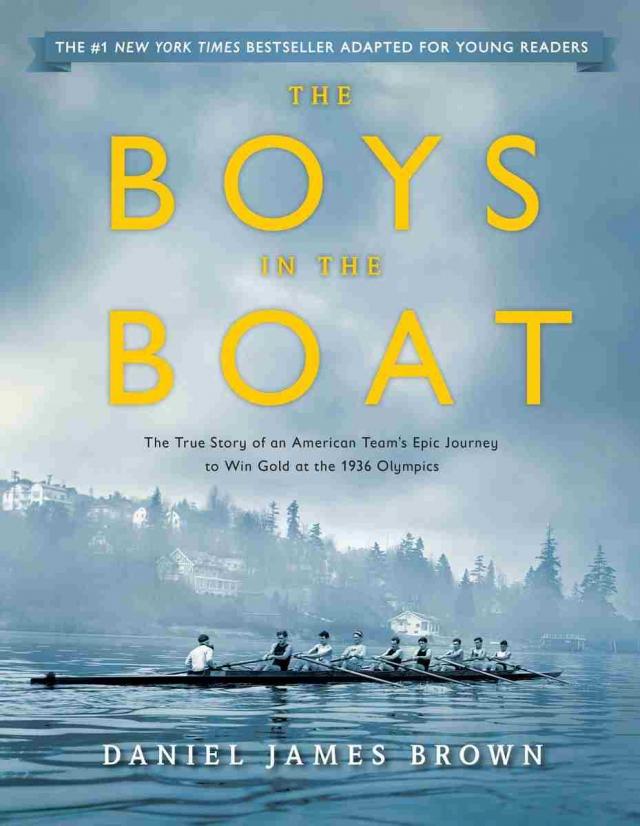


The heat had barely faded. A hint of a north wind lightly ruffled the water. The Washington boys backed their shell into position. Morry, the coxswain, lowered his hand to signal the starter that his boat was ready to row. Joe Rantz took a deep breath, settling his mind. Roger Morris adjusted his grip on his oar.
At the crack of the starting pistol, Syracuse immediately jumped in front, rowing at thirty-four strokes per minute, followed closely by Washington, rowing at thirty-one. Everyone else—Columbia, Rutgers, Pennsylvania, Cornell—began to fall behind. At a quarter of a mile down the river, it looked as if Syracuse would, as predicted, settle into the lead. But by the half-mile mark, the boys from Washington had crept up and nosed ahead without raising their stroke rate. They’d begun to get a feel for rowing in the current. They were too focused on their task to notice the heat. As the leaders swept under the railroad bridge at the halfway mark, officials on the bridge signaled that Washington was in the lead.
Slowly the bow of the Syracuse boat came into Joe’s field of view, just beginning to fall away behind him. He ignored it, focused instead on the oar in his hands, pulling hard and pulling smoothly, rowing comfortably, almost without pain. At the mile-and-a-half mark, someone in the middle of the Syracuse boat caught a crab. The Orange faltered for a moment, then recovered their rhythm.
But it no longer mattered. Washington was two and a half lengths ahead. Cornell, in third, had all but disappeared, eight lengths farther back. George Morry whipped his head around, took a quick look, and was startled at the length of their lead. Nevertheless, as he had against California in April on Lake Washington, he called up the rate in the last few hundred feet, just for the show of it. The boys from Washington passed the finish line an astonishing five lengths ahead of Syracuse.
In Seattle and in Sequim, people who had been huddled around radios in their kitchens and parlors stood and cheered. Just like that, the farm boys and fishermen and shipyard workers from Washington State, boys who just nine months before had never rowed a lick, had whipped the best boats in the East and become national freshman champions.
And it wasn’t just folks back home who stood up and paid attention to what had just happened. The win startled race fans across the country. It wasn’t just the margin of victory or their time. It was how the boys had rowed the race. From the starting gun to the finish, they had rowed as if they could keep going at the same pace for another two miles or ten. At the finish, rather than slumping in their seats and gasping for breath, they had been sitting bolt upright, looking calmly around. They looked as if they were simply out for an afternoon paddle, wide-eyed western boys wondering what all the fuss was about.
Sequim as it appeared when Joe lived there.
13
Stay Out of Our Life
The regatta did not end as well as it started for Washington. After the freshman crew’s stunning victory, Coach Ulbrickson’s varsity lost to California. The Olympic Games were still two years away, but Ulbrickson was left staring at a cold, hard fact. His rival at Cal, Ky Ebright, just seemed to have an uncanny knack for winning the ones that mattered most. That very evening, the national newspapers began to carry stories saying that certainly the boys from Cal would be going to the Olympics in 1936.
Joe took a roundabout journey home from Poughkeepsie. He visited his aunt and uncle in Pennsylvania, then traveled down to New Orleans, marveling at the sight of the huge ships making their way up the Mississippi, eating huge platters full of cheap shrimp and crab, digging into steaming bowls of gumbo and jambalaya, soaking up the jazz and the blues. On his way home, he traveled across an America that had begun to dry up and blow away.
It was the beginning of what would come to be called the “Dust Bowl.” Intense heat was scorching crops across the country. A colossal dust storm had swung out of eastern Montana, rolled east, dumped twelve million tons of dirt on Chicago, and then moved on to tower over Boston and New York. People in New York’s Central Park stood and looked up in astonishment at a blackened sky. Somewhere in the neighborhood of 350 million tons of American topsoil had become airborne in that single storm. As Joe traveled north and west, staring out train windows, it seemed as if the whole country had withered and browned under the searing sun. Deep piles of powdery dust lay along fence lines. Windmills stood motionless. Gaunt cattle, their ribs protruding and their heads hanging low, stood listless at the bottoms of dried-up ponds. Under the fierce sun, people raised their hands to their brows and stared at Joe’s train as it passed, giving it cold, hard looks, wishing they could get aboard and go somewhere else. Anywhere else.
That summer, Joe moved back to the half-finished house in Sequim, desperate to conjure up enough money to get through another school year. He cut more hay, dug more ditches, and spread more hot, black asphalt on the highway. He tried snagging salmon again too, but the game warden sneaked up on him from behind one day, slamming a piece of driftwood against the back of Joe’s head and knocking him cold. He came to a few moments later, just in time to see his friend Harry Secor chasing the warden down the river with a pole. The boys got away, but they knew the warden would be back, so they never snagged a salmon again.
Mostly, Joe worked in the woods with Charlie McDonald. One afternoon Charlie took Joe upriver, hunting for cedar for a new roof on his farmhouse. The upper reaches of his property had been logged for the first time just a dozen years before. The loggers had taken only the prime middle section of each tree, leaving long sections from the tops, where the branches were, and the bottoms, where the trunks began to flare out and the grain of the wood no longer ran perfectly straight and true. Some of the cedars had been more than two thousand years old, and the stumps that remained were seven or eight feet in diameter and just as tall. They rose from the ground like ancient monuments.
Charlie led Joe among the stumps and downed trees, teaching him how to understand what lay beneath the bark of the fallen logs. Much of the wood could still be used, but only if one knew how to read the wood, to decipher its inner structure. Charlie rolled them over, felt for hidden knots and irregularities. He crouched down at the cut ends and peered at the annual growth rings. Joe was fascinated, intrigued by the idea that he could learn to see what others could not see in the wood. He was thrilled at the notion that something valuable could be found in what others had passed over and left behind.
Within a few days, Joe had mastered the tools used to cut and split the massive logs. A year of rowing had made his arms and shoulders strong, and he worked his way through the cedar like a machine. Proud of his new skill, he found that shaping cedar satisfied him down to his core and gave him peace. He liked the way that the splitting wood murmured to him before it parted, almost as if it was alive. As the wood opened up, it always perfumed the air, and the spicy-sweet aroma that rose from freshly split cedar was a familiar one from the shell house in Seattle.
A few years earlier, Pocock had made the revolutionary decision to begin crafting the skins of his rowing shells out of native Washington cedar. Pocock found the wood to be light, springy, and strong. He believed that his cedar shells had a kind of liveliness, a tendency to spring forward with each stroke in a way that no other design or material could duplicate. To Pocock, there was magic in cedar, an unseen force that imparted life to the shells he built.
Now, out in the woods, the scent of the freshly split logs brought Pocock to Joe’s mind. Joe had been thinking a lot about Pocock lately. The man was mysterious, but it seemed to Joe that there was a connection between what the boatbuilder did in his shop and what he was trying to do himself, here among a pile of freshly split cedar, striving to master a skill, striving to become truly excellent at something difficult.
When Joe arrived back at the shell house on October 5, 1934, it was another radiant afternoon, much like the day when he had first shown up as a freshman. But there was a different attitude among the bunch of boys Joe had rowed with last year. As they moved in and out of the shell house, in shorts and jerseys, helping Coach Bolles register the new freshmen, there was an unmistakable hint of swagger in their step. After all, they were the national freshman champions. Now, as sophomores, it was their turn to grin at the nervous freshmen climbing awkwardly aboard Old Nero.
There were other reasons to be confident. Over the summer, there had been suggestions that Ulbrickson should elevate them to varsity status immediately, even though juniors and seniors usually made up that first crew. It seemed profoundly unlikely, but the idea was out there, in public, and the sophomore boys already had begun to talk quietly about it among themselves. Ulbrickson had been thinking about it as well, but the last thing he needed was for a bunch of upstart sophomores to start thinking they were God’s gift to rowing. They were good, but they were still green, not yet great. A great oarsman needed a rare balance of ego and humility. For now, what he saw strutting around the shell house and lounging in the doorway was plenty of ego and not much humility.
Coach Bolles had told Ulbrickson to look particularly hard at a couple of the boys. One was the baby of the boat, a seventeen-year-old boy in the number two seat, six-foot-three George “Shorty” Hunt. He was an ox for work and absolutely indispensable. But he was high-strung, nervous, someone you often had to treat with kid gloves to settle down, like a racehorse. The other was the blond kid with the crew cut in the number three seat, Joe Rantz. Ulbrickson remembered him as the boy he had spotted in the gym at Roosevelt High two years before. He was as poor as a church mouse. Anybody could tell that just by looking at him. When he wanted to, though, Bolles had reported, Joe Rantz would row longer and harder than any man in the boat. The problem was that he didn’t always seem to want to. All last spring he had been on one day, off the next. He had learned to square up, but he marched to his own drummer. The others boys had taken to calling him “Mr. Individuality.” He was physically tough, independent, confident, friendly, and yet at the same time strangely sensitive. He seemed to have tender spots that you had to watch out for if you wanted him to come through for you, though nobody, not even the other sophomores, could figure out quite what they were.
But Al Ulbrickson wasn’t one to waste a lot of time trying to figure out a touchy kid’s tender spots. He picked up the megaphone and barked at the sophomores to assemble down on the ramp. The boys shuffled toward the water. Ulbrickson stood higher on the ramp, so he’d be looking down at even the tallest boys. He gazed out at them for a moment, saying nothing. And then he began to tell them how it was going to be.
“You will eat no fried meats,” he began abruptly. “You will eat no pastries, but you will eat plenty of vegetables. You will eat good, substantial, wholesome food—the kind of food your mother makes. You will go to bed at ten o’clock and arise punctually at seven o’clock. You will not smoke or drink. . . . And you will follow this regimen all year round, for as long as you row for me. . . . You will not use profane language in the shell house, nor anywhere within my hearing. You will keep at your studies and retain a high grade point average. You will not disappoint your parents, nor your crewmates. Now let’s row.”
Two weeks later, Ulbrickson listed the first tentative “boatings,” or crew rosters, for the new year. There were five potential varsity boats in all. Most were made up of a mix of sophomores, juniors, and seniors. Only one boat from the previous season remained intact: Joe’s boat, with Shorty Hunt at the two seat, and Roger Morris at seven. But lest anyone—and particularly the sophomores themselves—read too much into it, Ulbrickson put the boat far down the list. The sophomore boys were not in the first boat or the second. Ulbrickson placed them fifth.
As the fall training season got under way, the boys’ swagger promptly disappeared from their steps. Ulbrickson was a harder man than Bolles, and this season would clearly be harder than the last. Joe in particular struggled to keep up his spirits. It wasn’t just the status of his boat that worried him. It wasn’t just the brutality of the long workouts or the days of rowing in the rain and bitter cold. Despite the long summer of work, Joe found himself even poorer than he had been the previous year. He could hardly afford to take Joyce out on dates of any kind now.
There were family matters eating at Joe as well. He had found out that Harry and Thula, and his half siblings, were living in Seattle. They had been there all along, in fact, since the night in 1929 when they had driven away and left Joe behind in Sequim. Over the years they had moved from home to home. First they lived in a dilapidated shed by the waterfront, with rats scurrying around the two rooms. Harry could not find work, and when they moved to a different house, it was hardly an improvement, as they could not even afford firewood to fuel the one stove that heated the house. Thula had to frequent local soup kitchens, looking for free food. Most of the meals she managed to put before her children consisted of thin stews made from parsnips, rutabagas, potatoes, and chipped beef.
When Harry finally landed a decent job as a mechanic, he moved the family to a small but respectable house, not far from where Joe rowed nearly every afternoon. That’s where Joe found them in the fall of 1934. His brother Fred had given him the address, and Joe and Joyce drove over one afternoon. They parked, took deep breaths, and climbed a flight of concrete steps to the front porch, holding hands. They could hear someone playing violin inside. Joe knocked on a yellow Dutch door, and the violin fell silent. A shadow moved behind lace curtains on the upper half of the door. There was a moment’s hesitation, and then Thula opened the door halfway.
She did not seem particularly surprised to see them. Joe had the sense that she’d been expecting this for a long time. She glanced at Joyce and nodded at her pleasantly enough, but she made no move to invite them in. There was a long moment of silence. Joe thought Thula looked careworn and exhausted, much older than her thirty-six years. Her face was pale and drawn, her eyes a bit sunken. Joe focused for a moment on her fingers and saw that they were red and chafed.
Finally Joe broke the silence. “Hello, Thula. We just came by to see how you are doing.”
Thula peered at him silently for a moment, her expression veiled, then dropped her eyes as she began to speak.
“We’re fine, Joe. We’re doing fine now. How is school going?”
Joe said it was going well, that he was on the crew now.
Thula responded that she had heard that, and that his father was proud of him. She asked Joyce how her parents were doing, and expressed her regret when Joyce replied that her father was quite ill.
Thula continued to hold the door just half open, her body blocking the entrance. Even as she addressed them, Joe noticed, she continued to look down at the porch, as if studying something at her feet, trying to find the answer to something there.
Finally Joe asked if they could come in and say hello to his father and the kids. Thula said that Harry was at work and the kids were visiting friends.
Joe asked if he and Joyce could come back and visit them another time.
Thula seemed suddenly to find what she had been looking for. She raised her eyes abruptly and leveled them at Joe. “No,” she said, her voice colder now. “Make your own life, Joe. Stay out of ours.” And with that she closed the door gently and slid the deadbolt into position with a soft, metallic click.
As they drove away, Joyce fumed. Over the years she had been slowly learning more about Joe’s life, about what had happened at the Gold and Ruby mine, and in Sequim. She could not understand how Thula had been so cold, how his father had been so weak, and why Joe himself seemed to show so little anger about it all. Finally, as Joe pulled over to the curb to drop her off at the judge’s home, Joyce erupted. Why did he go on pretending they hadn’t done him any harm? What kind of woman would leave a boy alone in the world? What kind of father would let her do that? She was nearly sobbing by the time she finished.
She glanced across the seat at Joe, and saw at once, through a blur of tears, that his eyes were full of hurt too. But his jaw was set, and he stared ahead over the steering wheel rather than turning to look at her.
“You don’t understand,” he murmured. “They didn’t have any choice. There were just too many mouths to feed.”
Joyce thought about that for a moment, then said, “I just don’t understand why you don’t get angry.”
Joe continued to stare ahead through the windshield.
“It takes energy to get angry. It eats you up inside. I can’t waste my energy like that and expect to get ahead. When they left, it took everything I had in me just to survive. Now I have to stay focused. I’ve just gotta take care of things myself.”
George Pocock’s shop.
14
Driven Nearly to Madness
The boys sat on hard benches, shivering in their mismatched shorts and cotton jerseys. The sun had already set, and the shell house was drafty and uncomfortable. Outside, it was a bitterly cold night. The panes of glass on the great sliding doors were frosted at the corners. It was the evening of January 14, 1935, the first crew turnout of the new year. Tensions in the shell house had run high during the fall season, as the continuing rumors that the sophomores might be pegged for the first varsity boat had everyone on edge. There was little of the usual banter and joshing. Icy stares began to replace good-natured grins. Now the boys were waiting for Al Ulbrickson to lay out his plan for the upcoming racing season. After a long, uncomfortable wait, Ulbrickson emerged from his office and began to talk. By the time he finished, nobody in the room was cold any longer.
He had started off simply, announcing a change of basic strategy. They were not going to take it slow for the first few weeks of winter quarter, as they generally did, working on details of form and technique while waiting for the weather to improve. Instead, they were going to row all out every day, right from the start. They were going to work themselves into top physical condition. And their races would be for the highest of stakes. This was not going to be an ordinary season. “At one time or another,” he declared, “Washington crews have won the highest honors in America. They have not, however, participated in the Olympic Games. That’s our objective.” The push to go to Berlin in 1936, and to win gold there, was to begin that night.