The Boys in the Boat (Young Readers Adaptation), page 15
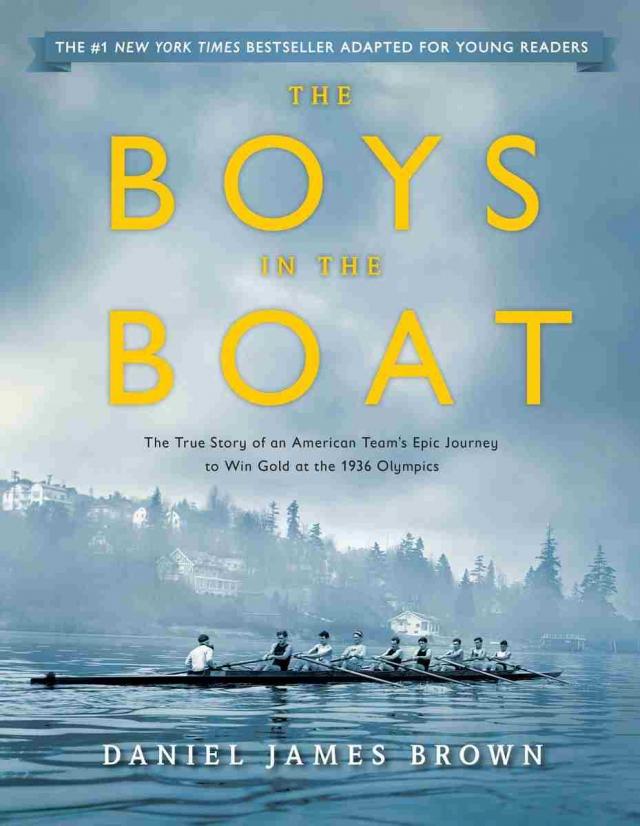


Waiting to go for gold.
26
In the Race of Their Lives
By early afternoon, the rain had still not let up in Grünau. The Langer See was rough, the wind brisk out on the water, the scene dark and gloomy. But in those days, rowing was one of the most popular Olympic events, and tens of thousands of spectators, most of them German, began to flood into the regatta grounds. They huddled under black umbrellas. They wore black slickers and hats. They filled the massive wooden bleachers on one side of the course, stood shoulder to shoulder at the water’s edge, and took refuge under the cover of the huge permanent grandstand at the finish line. As the start of the first race approached, more than seventy-five thousand fans had packed the regatta grounds, the largest crowd ever to witness an Olympic rowing event.
The eight-oared competition was the main event, but not the only rowing race that day. At 2:30 p.m., the four-man race began. The Swiss jumped out to an early lead but were soon overtaken by the German boat. Inside the shell house, the American boys were waiting. They’d laid Don Hume out on a massage table like a corpse, bundling him in overcoats to keep him warm and dry. As the boats in the first race approached the finish, they could hear the roar of the crowd. The fans chanted Germany’s name, “Deutschland! Deutschland! Deutschland!” And Germany sliced across the finish line a full eight seconds ahead of the Swiss. Then the boys heard another, deeper, more guttural roar rising from the crowd, and a different chant: “Sieg Heil! Sieg Heil! Sieg Heil!”
Adolf Hitler had entered the regatta grounds, followed by a large entourage of Nazi officials. Wearing a dark uniform and a full-length rain cape, he made his way up a staircase and took his place of honor on the wide balcony looking down on the crowd and the Langer See. He held up his right hand. The crowd continued to thunder “Sieg Heil!” until Hitler lowered his hand. Only then did the racing resume.
The crowd soon had plenty of opportunity to make more noise. In event after event that afternoon, German oarsmen charged down the course ahead of their competition, winning gold medals in the first five races. Each time, the Nazi flag was raised at the end of the race, and the crowd sang the national anthem, “Deutschland über alles,” or “Germany above all,” a little more loudly. Hitler’s chief lieutenants, including Joseph Goebbels and Hermann Göring, his main military adviser, celebrated with each victory. Hitler himself, peering through his binoculars, simply nodded enthusiastically each time a German boat crossed the line in first place. He believed his people were superior. These triumphs were expected.
German fans waiting in the rain.
The rain began to taper off. The skies lightened. And the crowd was in a frenzy. It looked as if Germany would sweep the day. Then, in the sixth race, the British pair of Jack Beresford and Dick Southwood rallied terrifically in the final 250 meters and won by almost six seconds. For the first time all day, a queer hush fell over the regatta course at Grünau. In the shell house, George Pocock was looking over the Husky Clipper when he paused for a moment and realized suddenly that he was listening to the British anthem, “God Save the King.” Out of habit, he stood bolt upright, filled with pride.
As the final event grew near, the crowd began to grow noisy once more. The eight-oared race was the rowing event that nations boasted about. This was the ultimate test of young men’s ability to pull together. It was the greatest display of power, grace, and guts on water.
A little before six, Don Hume got up from the massage table. He joined the rest of the boys as they hoisted the Husky Clipper to their shoulders and walked down to the water. The Germans and Italians were already in their boats. The Italians were wearing silky light blue uniforms, and they had tied white scarves around their heads, pirate-style. The Germans wore white shorts and white jerseys, each emblazoned with a black eagle and swastika on the front. The American boys were wearing mismatched track shorts and tattered old sweatshirts. They didn’t want to get their new uniforms dirty.
Bobby Moch tucked Tom Bolles’s lucky fedora beneath his seat in the stern of his shell. The boys huddled briefly with Ulbrickson, reviewing the race plan, then stepped into their boat and paddled up the lake toward the starting line. Ulbrickson and Pocock climbed up to a balcony of a shell house near the finish line. They were worried. Their boys were good. But with Don Hume looking like a dead man and the crew stuck out in lane six, they figured their chances of taking gold were slim to none.
In Seattle it was early morning. Harry Rantz had risen before dawn and made coffee and turned the radio on, just to make sure it was working. Joyce had come over a bit later and gotten the kids up. Now they were all in the kitchen, eating oatmeal, trying to steady their nerves. All over America millions of people were tuning their radios to listen in. If they were lucky enough to have a job, they were going in to work a little late. If they were lucky enough to still have a farm, they were putting off their chores until later.
The story of the track star Jesse Owens had already excited much of the country. Owens, an African-American man, won four gold medals in Berlin, dominating the track-and-field competition and defying Hitler’s theory of the Aryan race’s supremacy. Owens’s victories infuriated the Nazis. Back home, his accomplishments—and Hitler’s angry reaction—reminded America what the Nazis stood for. Americans realized that there was more at stake in these Olympic Games than a few medals. A way of life was at stake. Basic fairness was at stake. Some Americans had never even heard of Seattle before the Poughkeepsie Regatta, but now millions waited anxiously to see what the rough-and-tumble western boys from Washington would do as Hitler looked on.
At 9:15 a.m. in Seattle, as the radio commentary began, Joyce rummaged through her purse and pulled out a small book. She flipped through its pages and carefully extracted a delicate green four-leaf clover. Joe had given it to her years before, and she had pressed it between the book’s pages. Now she laid it atop the radio, pulled up a chair, and started to listen.
On the Langer See, the boys rowed toward the starting line. Rain showers had begun to slant down out of the sky again. But the rain wasn’t the problem. They were from Seattle. They’d rowed through much worse rain. The wind, however, was gusting on and off, pushing in bursts and fits at the starboard side of the shell. Up front, Roger Morris and Chuck Day were having a hard time keeping the boat on an even keel. Bobby Moch was manipulating the rudder, desperately trying to keep the shell on a straight course. He didn’t like the wind, and he didn’t like the looks of Don Hume. He was just paddling, not putting much into his strokes.
Joe Rantz felt pretty good, though. As the noise of the crowd fell away behind them, the world in the shell had grown quiet and calm. It seemed to be past time for words. Joe and the boys in the middle of the boat were just rocking gently back and forth, rowing slow and low, breathing in and out comfortably. The boat felt easy under them, sleek and lithe. For Joe, anxiety gave way to a sense of calm. He was more determined than nervous. If Don Hume had the guts to row this race, Joe and the boys were not going to let him down.
They pulled the shell into position, backing against a gangway. They were out in the middle of the Langer See. Ahead of them the lake was wide open. The wind was worse than it had been down in front of the grandstands. It pushed at their bow, slapping small, choppy waves against the port side. Roger Morris and Gordy Adam were struggling, stroking in place on the starboard side, trying to lever the boat back against the wind and keep the bow pointed more or less down the middle of the lane. In the next lane over, the British boat backed into position.
They waited for the start. Bobby Moch hollered instructions up front to Roger and Gordy, who were still focused on straightening the bow. Behind them, and out of sight, the official starter suddenly emerged, holding a flag aloft. Almost immediately, he turned slightly in the direction of lanes one and two, the Germans and the Italians. Then he shouted into the wind, in French—“Partez!”—and dropped the flag.
Bobby Moch never heard him. Never saw the flag. Neither, apparently, did British coxswain Noel Duckworth. Four boats surged forward. The British and the Americans, for a horrific moment, sat motionless at the line, dead in the water.
Out of the corner of his eye, Joe saw the Hungarian boat leap forward. A split second later, he saw the British boat do the same. He bellowed, “Let’s get out of here!” Bobby Moch barked, “Row!” All eight American oars dug into the water. For another fraction of a second, the Husky Clipper sagged slightly under the boys as nearly a ton of dead weight resisted being put in motion. Then the boat sprang forward, and the boys were away. They were already a stroke and a half behind in the race of their lives.
Bobby Moch had planned to come from behind, as always. But the spectacularly bad start meant that the two-length handicap of being in lane six was even greater now. Moch needed to build up some momentum, and he needed to do it quickly. He shouted at Hume to hit it hard. Hume set a high pace and the boys dug hard and fast.
The Germans and Italians moved briskly to the front of the field. The British boat charged furiously back. At the rear of the field, the American boat began to claw its way forward. As the first boats crossed the hundred-meter mark, an announcer called out the standings, and the crowd roared when they heard the Germans were in the lead. The Americans were still in last place, but only a length and a half behind the Germans. Bobby Moch told Hume to ease off on the rate a bit. They were still nearly sprinting, but Moch figured that with the wind they had to row at a high rate just to stay in contention. He could only hope they’d still have something left for the real sprint at the end. The boys began to settle in.
As they moved out into the widest part of the Langer See, the wind grew even stronger. Waves splashed over the small American flag toward the bow of the Husky Clipper. Moch struggled to steer the boat in the wind. Switzerland claimed the lead. At two hundred meters, the British surged past Germany and into second place. Bobby Moch watched them but he didn’t take the bait. It was fine with him if the Brits wanted to burn themselves out in the first half of the race.
The German eight.
Then, three hundred meters out, Moch saw something that chilled him to his core. Don Hume suddenly went white in the face and all but closed his eyes. His mouth fell open. Moch yelled at him, “Don! Are you okay?” Hume didn’t respond. Moch couldn’t tell if he was about to pass out or just in some kind of zone. Either way, it didn’t look right. The way he looked, Moch wasn’t sure if Hume could even finish the race, let alone sprint when the time for sprinting came.
The boats were approaching the five-hundred-meter mark now, a quarter of the way down the racecourse. Switzerland, Britain, and Germany were tied for the lead. The Americans and Italians were a boat length behind them. Hungary was last. The boats in the inside lanes were moving into the protected part of the lake now, where the water was nearly flat. But the American boys were still being slammed by the winds, spray flying from their oars every time they popped out of the water. The pain started to build. Very slowly they began to fall farther back. By eight hundred meters, they were dead last again.
Over in the sheltered water of lane two, Italy came up from the rear and took a narrow lead over Germany. The bow of the Italian boat sliced across the halfway point. A bell began to toll, signaling the spectators at the finish that the crews were approaching. Seventy-five thousand people rose to their feet. On the balcony of the main shell house, Haus West, Hitler, Goebbels, and Göring pressed their binoculars to their eyes. Next door, Al Ulbrickson saw the Husky Clipper struggling down the outside lane. The announcer called out the thousand-meter-split times. The crowd roared. Italy was in first, but Germany was close behind. Ulbrickson’s boys were behind by nearly five full seconds.
Three of the Italian eight.
In the stern of the Husky Clipper, Bobby Moch knew he couldn’t afford to wait any longer. He hunched forward and bellowed for Hume to take the stroke rate up. “Higher!” he shouted into Hume’s face. “Higher!” Nothing happened. “Higher, Don! Higher!” he screamed, pleading now. Hume’s head rocked back and forth with the rhythm of the boat, as if he were about to nod off. He seemed to be staring at something on the floor of the boat. Moch couldn’t even make eye contact with him.
Germany retook the lead. Another enormous roar went up from the crowd. Then the roaring turned into chanting. The crowd was cheering in time with the stroke rate of the German boat. “Deutsch-land! Deutsch-land! Deutsch-land!” On his balcony Hitler rocked back and forth with the chant.
In Seattle a hush fell over Harry Rantz’s living room when Joe’s family heard the times.
In the boat, Joe had no idea how things stood, except that he was vaguely aware that he hadn’t seen any boats falling away behind him. He knew that meant they were trailing the field, but he also knew it wasn’t because they’d been rowing easy. He had been rowing hard against the wind all the way. His arms and legs were starting to feel as if they were encased in cement. It was too early for the sprint, but he was starting to wonder what would happen when Moch called for it. How much would he have left? How much would any of them have left?
Moch was growing desperate. Hume still wasn’t responding. The only option Moch had left was to hand the stroke’s responsibility off to Joe. It would be a dangerous move that could throw everyone off, but if he could just get Joe to set a higher rate, maybe Hume would sense the change and pick it up. Moch had to do something, and with the finish line approaching, he had to do it now.
As Moch leaned forward to tell Joe to raise the rate, Don Hume’s head snapped up, his eyes popped open, he clamped his mouth shut, and he looked Bobby Moch straight in the eyes. A startled Moch yelled, “Pick’er up! Pick’er up!” This time Hume responded. Moch yelled again, “One length to make up—six hundred meters to go!” The boys leaned into their oars. The stroke rate jumped, and then jumped again, climbing higher and higher. At the 1500-meter mark, the Husky Clipper eased from fifth to third place. But they were still nearly a full length behind Germany and Italy.
The Langer See narrowed. The Husky Clipper finally sliced into water that was protected from the wind by tall trees and buildings. Conditions were even now. The game was on. But there were only 350 meters to go. The boat began to move, reeling the leaders in seat by seat. With 300 meters to go, the American boys pulled even with Italy and Germany. Approaching the final 200 meters, the boys pulled ahead by a third of a length.
Bobby Moch glanced up ahead at the huge black-and-white “Ziel” sign—the German word for “Finish.” He began to calculate just what he needed out of the boys. He decided it was time to start lying.
Moch barked, “Twenty more strokes!” He started counting them down, “Nineteen, eighteen, seventeen, sixteen, fifteen . . . Twenty, nineteen . . .” Each time he hit fifteen he reset back to twenty, hoping the boys wouldn’t notice. In a daze, the boys threw their long bodies into each stroke, rowing furiously, flawlessly, and with uncanny elegance. Their oars were bending like bows, the blades entering and leaving the water cleanly, smoothly, efficiently. The shell ghosted forward between pulls, its sharp cedar prow slicing through the dark water. Boat and boys were forged together, bounding fiercely forward like a living thing now.
They were in full-sprint mode, pulling forty strokes per minute, when they hit a wall of sound. The boat had reached the bleachers on the north side of the course. In lane six, the boys were not more than ten feet away from the edge of the stands. Thousands of spectators stood over them, screaming, “Deutsch-land! Deutsch-land! Deutsch-land!” The sound utterly drowned out Bobby Moch’s orders. Not even Don Hume, sitting just eighteen inches in front of Moch, could understand the coxswain.
The Italians surged. So did the Germans. All three leaders were rowing at a full sprint. The race was even again. Moch yelled and screamed, but nobody heard him. Joe didn’t know what was happening, except that he hurt like he’d never hurt in a boat before. He felt like hot knives were stabbing the muscles in his arms, legs, and back. Every desperate breath burned his lungs.
On the balcony of Haus West, Hitler dropped his binoculars to his side. He rocked back and forth with the chanting of the crowd. His henchmen, Goebbels and Göring, were cheering wildly. On the balcony next door, Al Ulbrickson stood motionless. His face was blank. He fully expected to see Don Hume collapse over his oar at any moment. Back home in Seattle, the radio announcer was screaming. Harry and Joyce and all the kids couldn’t make out what was happening, but they were all on their feet.
Out of the corner of his eye, Moch saw the Germans and Italians surging again and knew that the boys had to go still higher, to give even more than they were giving, even as he knew they were already giving everything they had. With the wooden handles at the ends of his steering lines, he started banging on ironwood knocker boards on the outside of the boat. Even if the boys couldn’t hear his commands, maybe they could feel the vibrations, and know he needed more. They did. They understood that it was a signal to do what was impossible, to go even higher. Somewhere deep down inside, each of them grasped at shreds of will and strength they did not even know they possessed.
The gold medal finish, USA in the far lane.
The three boats stormed toward the finish line, the lead going back and forth. Hume took the beat higher and higher until the boys hit forty-four. They had never rowed at this rate before. They’d never even thought it was possible. They edged narrowly ahead. The Italians began to close again. The Germans were right beside them. “Deutsch-land! Deutsch-land! Deutsch-land!” thundered in the boys’ ears. Bobby Moch was pounding the wood, screaming words no one could hear. The boys took one last mighty stroke and hurled the boat across the line.