The Boys in the Boat (Young Readers Adaptation), page 12
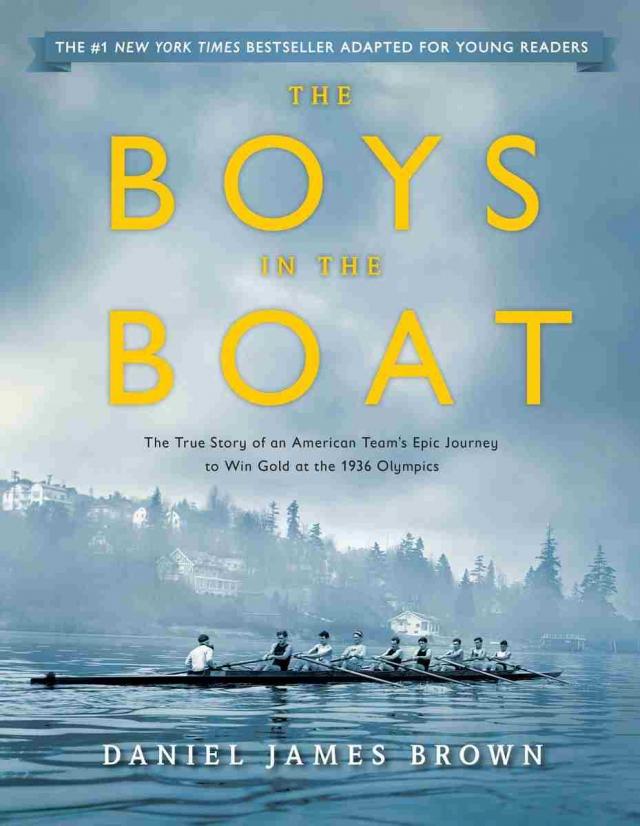


But Ulbrickson remained unruffled. He was not going to schedule another trial. He wanted well-rested boys in the race. He told his boys to relax. There would be only light workouts until race day, and that was fine with the boys. They already knew something that nobody else knew, not even their coach.
Late on the night of their final time trial, after the wind had died down and the waters had calmed, they had begun to row back up the river, in the dark, side by side with the freshman and JV boats. It was a moonless night. The water was ink black. Bobby Moch set the boys to rowing at a leisurely twenty-two or twenty-three. Joe and his crewmates chatted softly with the boys in the other two boats. But they soon found that they had pulled ahead without meaning to, just rowing soft and steady. Soon, in fact, they had pulled so far ahead that they could not even hear the boys talking in the other boats. And then, one by one, they realized they couldn’t hear anything at all except for the gentle murmur of their blades dipping into and out of the water. They were rowing in utter darkness now. They were alone together in a realm of silence and darkness. They were rowing perfectly, fluidly, mindlessly. They were rowing in perfect unity, as if on another plane, among the stars, just as Pocock had said. And it was beautiful.
By the morning of the championship regatta, the consensus in the eastern newspapers was that California and Cornell were the boats to beat in the varsity race. People crowded onto ferries, boats, and the observation train. As many as ninety thousand fans lined both sides of the Hudson River. As the starting time approached, the breeze died. The water was placid, smooth and glassy, tinged with bronze in the late afternoon light.
The freshmen came through again for Tom Bolles. He was wearing his lucky fedora, but he didn’t need it, as his boys gradually overpowered Navy, then beat Cal by a boat length. An hour later, Washington’s JV crossed the line three lengths ahead of Navy, still pulling away at the head of a long, strung-out parade of boats far to their rear. Even as the last boats crossed the line and the cheering began to die down, a murmur began to ripple through the crowd along the shore. Washington, for the second time in two years, now stood again on the brink of sweeping the regatta. California, on the other hand, could become only the second school ever to win the varsity race four years in a row. But anything was possible. Cornell looked as if they could finally win this year. Or maybe Navy.
As the observation train drew back upriver again for the start, the atmosphere grew electric. The crowd began to buzz. Boat whistles shrilled. Fans draped arms over one another’s shoulders and sang college fight songs. On the train, in a car packed full of Washington coaches, alumni, and sportswriters, George Pocock and Tom Bolles paced up and down the aisle. Al Ulbrickson sat alone in silence, looking out from under the brim of his white cloth cap toward the spot where Joe and the boys sat in their shell, waiting. Washington had drawn the worst lane, number seven, far out in the middle of the river, where any hint of wind or current would be strongest. California had drawn the most protected lane, number one.
At 8:00 p.m., the starter called out, “Are you ready?”
The starting gun popped, and for five full strokes, all seven boats stayed even. Then Washington suddenly eased up. The other boats surged out in front of them. That was okay with Bobby Moch. That was just what he wanted. Prior to the race, Ulbrickson had explained that he had a new plan for his coxswain to follow. He wanted the boys to stay at a low, easy stroke rate, no matter what the other boats were doing. If they fell more than two boat lengths behind, he told Moch he should pick up the pace, but otherwise, he wanted them to hold off until the halfway point, then start to raise the rate and pass the leaders at the end. Now, as Moch settled his crew in, rowing at a steady twenty-eight, he began to chant their newest rowing mantra in time with the stroke—“Save, save, save”—reminding them to conserve their power.
After half a mile, Washington was in last place, almost five lengths behind the leaders. A mile into the race, Navy and Penn were in the lead, with California and Columbia close behind. Washington passed Syracuse, but remained four lengths back. On the train, Al Ulbrickson was still silent and calm, slowly chewing a stick of gum. Soon, he figured, Bobby Moch would make his move, just as they’d planned.
At two miles Penn had begun to fade, falling behind Columbia. Cal and Navy were battling for the lead. Washington was in fifth place, but Bobby Moch still hadn’t altered the beat at all. Ulbrickson began to grow uneasy. He had told Moch not to let the leaders get more than two lengths ahead. Now the boys were twice that far behind. And Moch was supposed to have started moving by now. But out on the water, Bobby Moch told Don Hume, “Take your time. We can catch those boys anytime we want.”
As they passed the two-and-a-half-mile mark, Ulbrickson had begun to slump in his seat. He stopped chewing his gum. What on earth was Moch doing? Why in God’s name didn’t he turn them loose? Tom Bolles and George Pocock sat down, looking morose. It was starting to look like a case of suicide.
In the boat Bobby Moch took a long look at the four lengths between his bow and California’s stern, and hollered to the boys facing him, “Okay, you lugs! We’re one length behind.”
A roar went up as the crowds near the finish line began to see the leaders. Navy was neck and neck with Cal, and the two of them seemed to be running away with it. With a mile to go, Washington was still nearly three lengths back. The boys were rowing as if in a kind of trance now. There was little sound out in the middle of the river, except for Moch’s chanting, the rattle of oars in oarlocks, their own deep rhythmic breathing, and their pulses pounding in their ears. There was almost no pain. In the number five seat, Stub McMillin realized with astonishment that he was still breathing easy, through his nose. On the train, Ulbrickson muttered, “They’re overplaying their hand. We’ll be lucky to finish third.” His face had gone white.
Then, suddenly, Bobby Moch leaned into Don Hume’s face and bellowed, “Give me ten hard ones for Ulbrickson!” Eight long spruce oars bowed in the water ten times. Then Moch bellowed again, “Give me ten more for Pocock!” Another ten enormous strokes. Then another lie: “Here’s California! We’re on them! Ten more big ones for Mom and Dad!” Very slowly the Husky Clipper slipped past Columbia and began to creep up on Navy in second.
On the train, someone called out, “Look at Washington! Look at Washington! Here comes Washington!” All eyes shifted from the leaders to the eight white blades barely visible out in the middle of the river. Another roar rose from the crowd. It seemed impossible for Washington to close the gap. They were a half mile from the finish and still two lengths back.
In the boat Moch barked, “Okay! Now! Now! Now!” Don Hume took the stroke up to thirty-five, then to thirty-six, then to thirty-seven. On the starboard side, Joe Rantz fell in behind him, just as smooth as silk. The boat began to swing. The bow began to rise out of the water. Washington slid past the Navy oarsmen as if their shell were pinned to the water.
Cal’s coxswain glanced over his shoulder. For the first time since he’d left it behind at the starting line he saw the Washington boat sweeping up from behind him. He bellowed at his crew to pick it up. Moch hollered at Hume to take the Washington rate up another notch. The two boats careened into the last five hundred yards, storming down the corridor of open water between the spectators’ boats. With the finish line looming ahead, Bobby Moch screamed something nobody could understand. Johnny White, in the number four seat, suddenly had the sensation that they were flying. Shorty Hunt still hadn’t seen the California boat fall into his field of view. He kept his eyes locked on the back of Joe Rantz’s neck and pulled with his whole heart. Joe had boiled everything down to one action, one continuous movement, one thought. The crew’s old mantra was running through his mind like a river, not in his own voice but in George Pocock’s crisp English accent, “M-I-B, M-I-B, M-I-B.”
On the train, Al Ulbrickson stared silently at the scene unfolding in front of him. A Seattle sportswriter began to holler, “Come on Washington, come on!” Another writer shoved his paper press badge into his mouth and began to devour it. Tom Bolles was jumping up and down, beating the fellow in front of him with his lucky old fedora.
Then, in the last two hundred yards, pain suddenly came shrieking back into the boat, searing the boys’ legs, their arms, their shoulders, tearing at their hearts and lungs as they desperately gulped at air. And in those last two hundred yards, in an extraordinary burst of speed, Washington passed California. With each stroke the boys took their rivals down by the length of another seat. By the time the two boats crossed the line, a glimmer of open water showed between the bow of Cal’s boat and the stern of the Husky Clipper.
Watching from the train, Ulbrickson resumed chewing his gum. George Pocock threw back his head and howled. The sportswriter removed the chewed-up remains of his press badge from his mouth. Tom Bolles continued beating the man in front of him with his lucky fedora. And in the boat the boys pumped their fists in the dark night air.
When reporters approached Ulbrickson, he stood up and said, simply, “Well, they made it close, but they won.” Then he added, “I guess that little runt knew what he was doing.”
Later, when they got back to the shell house, the boys found hundreds of excited fans waiting for them. They climbed out of the Husky Clipper and, following another rowing tradition, threw coxswain Bobby Moch into the Hudson to the delight of the spectators. After retrieving him from the water they forced their way through the crowd into the building. Ulbrickson climbed onto a bench. The boys, clutching jerseys they’d collected from the losing crews, sat on the floor around him. After a few remarks to all the rowers, proclaiming that every son and daughter of Washington was proud of them, he addressed the varsity. “Never in history has a crew given a more gallant, game fight to win the most coveted rowing honor at stake in this country than the varsity did today. And I can only say to you that I am proud and happy.” He paused and looked around the room and then concluded, “I never expect to see a better rowed race.” Then he stepped down. Nobody cheered. Nobody stood up and applauded. Everyone just sat, silently soaking in the moment. On the stormy night in January 1935, when Ulbrickson had first started talking openly about going to the Olympics, everyone had stood and cheered. But then it had seemed like a dream. Now they were on the verge of actually making it happen. Cheering somehow seemed dangerous.
22
Here’s Where We Take California
On July 1, after a week of working out and relaxing in Poughkeepsie, the boys packed up their possessions, loaded the Husky Clipper onto a baggage car, and headed for the 1936 U.S. Olympic trials. By six that evening, they had arrived at Princeton and entered the world of the Ivy League, the nation’s oldest and most prestigious colleges. This was a world of status and tradition and wealth. It was unlike anything the boys had ever known. The young men who attended these schools weren’t loggers and fishermen and farmers. They were the sons of bankers and lawyers and senators.
The boys from Washington moved into the stately Princeton Inn. From their rooms, they watched Princeton graduates stroll around the neighboring golf course wearing knickerbockers, high argyle socks, and tweed caps. The boys stopped by the Princeton Boathouse, a large and elegant stone structure, and explored Lake Carnegie. Originally, Princeton crews had rowed in a nearby canal, but the boat traffic proved troublesome, so Princeton asked the wealthy steel tycoon Andrew Carnegie to build them a lake, just for their crew. The result, Lake Carnegie, was shallow, straight, and protected. It was first-class rowing water.
Six crews were competing for the right to go to Berlin: Washington, California, the Pennsylvania Athletic Club, Navy, Princeton, and the New York Athletic Club. The field would be divided into two groups of three for the elimination heats on July 4. The top two boats in each heat would advance to a final contest of four boats the next day. The boys from Washington were not so worried about the preliminaries. They would race against Princeton and the Winged Footers of the New York Athletic Club. Neither was a real contender.
They were concerned about the finals, though. The two-thousand-meter race was less than a third the length of the four-mile Poughkeepsie competition. They weren’t certain they could beat Cal at such a short distance. The start would be critical, and they’d been having trouble with their starts lately.
On Saturday, the Fourth of July, the boys left for their preliminary race a little before six thirty. It was a buggy, sultry evening. Several thousand people had gathered along the shores of the lake for the qualifying heats. A floating platform with starting stalls had been specially built for the trials. The boys backed the Husky Clipper into their stall and waited.
At the gun, Washington began to charge out in front almost immediately. Soon Moch told Don Hume to drop the rate. In the third minute of the race, Hume dropped it further. Even as he dropped the rate the boat began to widen its lead. By the halfway mark, Washington had open water on both boats. As they began to approach the finish line, the Winged Footers made a move, sprinting past Princeton and challenging Washington. Moch told Hume to ease the stroke rate back up. The boys from Washington pulled briskly ahead and sliced across the finish line with a two-and-a-half-length lead.
The boys were surprised at how easily they had won. Even in the muggy evening air, they’d hardly broken a sweat. Now it was time to watch the competition. They paddled out of the racing lines and took up a position along the bank at about the fifteen-hundred-meter mark. The boys wanted to see for themselves how the California crew would fare. The race was tight, but in the final five hundred meters, California executed a tremendous surge, suddenly blowing past both Navy and Penn. They won by a quarter of a boat length. And they had completed the course a full ten seconds faster than Washington had. Cal obviously was exceptional when it came to rowing two-thousand-meter sprint races.
That night, the boys were filled with anxiety. Ulbrickson went from room to room, sitting on the ends of bunks, reassuring his boys. He tried to remind them that they had in effect won a sprint in the last two thousand meters at Poughkeepsie. He was telling them what they already knew in their hearts but needed to hear one more time. They could beat any crew in America, including California, at any distance. All they had to do, he told them, was to continue to believe in one another.
Thunderstorms rumbled over New Jersey the next morning. Rain pounded the roof of the Princeton Inn. By noon, though, the day had grown hot and muggy but clear. Lake Carnegie lay mirror smooth, reflecting a translucent blue sky. The final race to determine which crew would represent the United States in Berlin was not scheduled to begin until 5:00 p.m., so the boys spent most of the day inside, trying to stay cool. Late in the afternoon, the crowds began arriving, about ten thousand people braving the heat to witness just six minutes of racing. Back in the state of Washington, people in smoky little mill towns, on soggy dairy farms, in fancy Seattle mansions, and in the Huskies’ drafty shell house on Lake Washington gathered around their radios, anxious to see if their boys would be going to Berlin.
At 4:45 the crews from California, Pennsylvania, Washington, and the New York Athletic Club paddled out onto Lake Carnegie. As Washington tried to back into its stall, a large white swan blocked the way. Bobby Moch, yelling and waving his arms furiously, finally persuaded it to move slowly aside. Washington settled into position. Then California backed in.
The Washington boys were bare chested, having stripped off their jerseys just before climbing into their boat. They sat now with their oars in the water ready for the first hard pull. Each boy stared ahead at the neck of the oarsman in front of him, trying to breathe slow and easy, settling his heart and mind into the boat. Tom Bolles had given Bobby Moch his lucky fedora. Now the coxswain reached under his seat and touched the old hat.
A little after five, the starting gun flashed.
Washington got off to a poor start. The other three boats surged ahead. The New York Athletic Club went briefly to the head of the pack, but the Pennsylvania Athletic Club quickly snatched the lead back. California settled into third place, ten feet in front of Washington’s bow. After rowing hard to regain momentum but still dead last, Bobby Moch and Don Hume slowly dropped the boat’s stroke rate. Yet the Husky Clipper held its position just behind California’s stern. A quarter of the way down the course, Bobby Moch found himself creeping up on California. He told Hume to drop the rate again.
As they approached the halfway mark, the New York Athletic Club suddenly began to fade and quickly fell behind Washington. The Pennsylvania Athletic Club was in the lead. The Husky Clipper remained stuck on California’s tail. The boys continued to row at the same rate. Don Hume and Joe Rantz were setting the pace with long, slow, sweet, fluid strokes, and the boys on each side were falling in behind them flawlessly. The boat became a single thing, gracefully and powerfully coiling and uncoiling itself, propelling itself forward. Each time the blades entered the lake, they disappeared almost without a splash or ripple.
Just before the fifteen-hundred-meter mark, Bobby Moch leaned into Don Hume and shouted, “Here’s California! Here’s where we take California!” Hume knocked the stroke rate up just a bit and Washington swiftly walked past Cal, seat by seat. They began to creep up on the Pennsylvania Athletic Club, then pulled even with them.
But Bobby Moch still hadn’t really turned the boys loose. At last, coming inside five hundred meters, he barked at Hume. For five or six strokes, the bows of the two boats moved back and forth like the heads of racehorses coming down the stretch. Finally Washington’s bow swung decisively out in front by a few feet. From there on, Washington simply blew past the exhausted rowers from the Pennsylvania Athletic Club, swinging into the last few hundred meters with extraordinary grace and power. At the finish line, they were a full length ahead and still widening the lead. As they crossed the line, Bobby Moch stood bolt upright in the stern of the shell, triumphantly thrusting one fist into the air.