Facing the Mountain (Adapted for Young Readers), page 1


For Kats, Rudy, Fred, and Gordon
VIKING
An imprint of Penguin Random House LLC, New York
First published in the United States of America by Viking,
an imprint of Penguin Random House LLC, 2023
Copyright © 2023 by Daniel James Brown
Penguin supports copyright. Copyright fuels creativity, encourages diverse voices, promotes free speech, and creates a vibrant culture. Thank you for buying an authorized edition of this book and for complying with copyright laws by not reproducing, scanning, or distributing any part of it in any form without permission. You are supporting writers and allowing Penguin to continue to publish books for every reader.
Viking & colophon are registered trademarks of Penguin Random House LLC.
The Penguin colophon is a registered trademark of Penguin Books Limited.
Visit us online at PenguinRandomHouse.com.
Library of Congress Cataloging-in-Publication Data is available.
Ebook ISBN 9780593465684
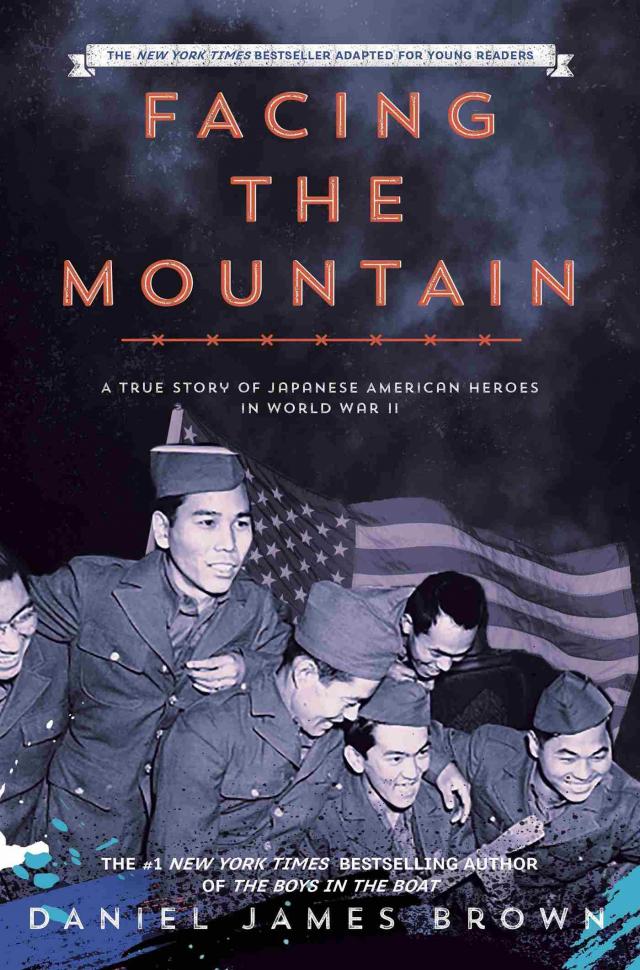
Cover photograph © Library of Congress
Cover design by Lily K. Qian
Edited by Kelsey Murphy
Design by Lily Qian, adapted for ebook by Andrew Wheatley
This is a work of nonfiction. Some names and identifying details have been changed.
The publisher does not have any control over and does not assume any responsibility for author or third-party websites or their content.
pid_prh_6.1_145405616_c0_r0
Also by Daniel James Brown
The Boys in the Boat:
The True Story of an American Team’s Epic Journey to Win Gold at the 1936 Olympics
(Young Readers Adaptation)
For adults:
Under a Flaming Sky:
The Great Hinckley Firestorm of 1894
The Indifferent Stars Above:
The Harrowing Saga of a Donner Party Bride
The Boys in the Boat:
Nine Americans and Their Epic Quest for Gold at the 1936 Berlin Olympics
Facing the Mountain:
A True Story of Japanese American Heroes in World War II
Contents
A Word About Words
Chapter 1
Chapter 2
Chapter 3
Chapter 4
Chapter 5
Chapter 6
Chapter 7
Chapter 8
Chapter 9
Chapter 10
Chapter 11
Chapter 12
Chapter 13
Chapter 14
Chapter 15
Chapter 16
Chapter 17
Chapter 18
Chapter 19
Chapter 20
Chapter 21
Chapter 22
Chapter 23
Chapter 24
Chapter 25
A Final Word
Acknowledgments
Resources
Notes
Selected Bibliography
Photo Credits
Index
_145405616_
A Word About Words
To tell an honest story, a writer must use honest words. As you read this book, I hope you will keep that fact in mind. I certainly have as I have written it.
I mention this for several reasons. For one thing, many of the words that have been used for years to talk about the history described in this book are words that were designed to be deliberately dishonest. When the US government announced that tens of thousands of Japanese Americans were to be forcibly removed from their homes, military and political leaders called this an “evacuation.” They called the fairgrounds and racetracks where Japanese Americans were first confined behind barbed wire “assembly centers.” They called the process of rounding them up and incarcerating them “internment.” They called the permanent camps to which Japanese Americans were later moved and where they were held against their will “relocation centers.” All of these words were chosen to make what was happening to Japanese Americans sound more acceptable to the American public.
I want to call particular attention to that last term. These camps were not “relocation centers.” They were concentration camps. They were created to concentrate Japanese Americans, based entirely on their race, behind barbed wire in order to separate them from other Americans. So I sometimes refer to the camps with this term.
At the same time, it’s important to underscore that in using the term “concentration camps” I do not mean to compare these American camps to the horrific death camps and slave-labor camps created by the Nazis in Germany and Poland during World War II. Those Nazi camps—places like Dachau and Auschwitz-Birkenau—represent an evil that is beyond all imagining.
Another part of using language honestly means recognizing when it is racist. In reading this book, you will occasionally encounter the word “Jap.” It is a racist term, widely used by millions of Americans during the period of history this book discusses. It was used to hurt and demean both Japanese citizens and Japanese Americans, just as the N-word has been used to hurt and demean African Americans and other Black people. It has no place in our society, a society created on the idea, and the fact, that all people are created equal. It appears in this book only for the purpose of showing honestly how deeply rooted racism against Japanese Americans was during this time in history.
Chapter 1
On the beach at Waikīkī, swimmers lay towels on the soft, coral sand and waded into the turquoise surf. Coffee percolated in sunny kitchens, the yellow blossoms of hau trees opened, and mynah birds chattered in the palm trees. All across the island of Oʻahu, people went about the business of greeting another beautiful Hawaiian day—December 7, 1941.
At first, they looked like swarms of insects drifting across the pale, early morning sky. Then they looped around the mountains and spiraled down, in groups of five or six. US Navy and Army personnel and civilians alike stopped what they were doing and peered at the sky, all wondering the same thing. What on earth was this?
The gray steel and roaring engines of the Japanese warplanes drew nearer. At 7:48 a.m., they struck Kāneʻohe Bay Naval Air Station, raking the parked aircraft with machine-gun fire, setting them ablaze. Then they circled back through billowing clouds of black smoke, strafing anything in their path: cars racing toward the scene, men scrambling to find cover, even private homes. About seven minutes later, planes struck other airfields on Oʻahu. Within minutes, the United States’ capability to mount an air defense vanished in a maelstrom of flames, shattered glass, and twisted metal.
Then the attackers wheeled their planes around and turned to Pearl Harbor, where seven battleships were lined up alongside Ford Island and an eighth was sitting helpless in dry dock. On the USS Nevada, a military band was striking up “The Star-Spangled Banner” for the 8:00 a.m. ceremony of raising the American flag. A Japanese bomber roared in and sprayed machine-gun fire across the deck, somehow missing the musicians but shredding the flag halfway up the pole. The band kept playing until the anthem was finished. Then, flinging their instruments aside, they scrambled for cover.
On the USS Oklahoma, a sailor roared, “Man your battle stations!”[1] At that very moment, two torpedoes punched into the ship’s side, and it began to list. Then a third torpedo hit, and the ship rolled over, trapping hundreds belowdecks. Its great gray hull lay turned to the sky like the belly of a dead whale.
At about the same time, seven torpedoes and two aerial bombs hit the USS West Virginia, trapping another sixty-six men belowdecks. Within minutes, all eight battleships and a number of other ships had been hit.
The USS Shaw explodes during the attack on Pearl Harbor.
Then the worst of it: An armor-piercing bomb penetrated the foredeck of the USS Arizona and detonated perhaps a million pounds of explosives stored in its forward hold. A fireball engulfed the ship, and a shock wave pulsed out across Pearl Harbor. Within moments, 1,177 of its crew were dead—nearly half the total death toll for the day.
A second wave of 167 planes was now bearing down on the island, and a deadly hailstorm of Japanese bombs and misdirected US antiaircraft shells fell on residential areas, setting houses on fire, crumpling cars, and taking forty-nine civilian lives.
The planes flew so low that people on the ground could see the faces of the pilots—sometimes stone-faced, sometimes grinning, sometimes even waving as they passed overhead. And those pilots, looking down, must have noticed that many of the faces staring back up at them in astonishment were very like the faces back home in Japan.
In 1941, nearly a third of Hawaiʻi’s residents were of Japanese ancestry. In the 1830s, the islands were colonized by white missionaries who established sugarcane and pineapple plantations. Initially, they employed the Native Hawaiians, but there were too few of them to meet the needs of the sprawling plantations. So the planters, and their descendants, began to import labor. The workers were mostly from East Asia—China, the Philippines, Korea, and Japan. By far the largest group was the Japanese. As the horrors of that December day unfolded, these Japanese residents, and their American children, reacted with the same stunned fury and outrage as other Americans.
Seventeen-y
Defying the broadcaster’s advice, Inouye rushed from his house in Honolulu’s Mōʻiliʻili neighborhood. He saw the Rising Sun insignia—the Japanese national emblem—on the wings of a Zero passing overhead and was immediately overwhelmed by a wave of anger and dread. “I thought my life had come to an end,” he later said.[3] But he got on his bike and raced to a first aid station at a nearby elementary school, where he spent most of the next three days and nights helping treat the wounded and carrying the dead to the morgue.
Katsugo “Kats” Miho was also getting ready for the day, shaving in his room at his university dorm, when a commotion erupted downstairs—a bunch of fellows yelling, heavy footsteps running down the stairs. Curious, he leaned over a banister and shouted down the stairwell, “What’s going on down there?”
Someone shouted back, “Put on the radio!”
Someone else yelled, “We’re being attacked!”[4]
When Kats turned on the radio, an announcer was screaming something about Pearl Harbor. Kats scrambled out onto the roof and looked northwest toward Pearl Harbor. Black pillars of smoke billowed high into the sky.
A civilian home damaged during the Pearl Harbor attack.
He raced back to the radio in time to hear another urgent bulletin. All cadets in the Reserve Officers’ Training Corps (ROTC)—the college program that prepared students to join the military—were to report to the University of Hawaiʻi gym immediately. That meant him. Kats threw on his uniform and sprinted to the campus, joining a stream of young men rushing toward the gym.
Inside the building, five hundred cadets were milling around in noisy confusion. Someone had dragged in crates of old rifles, and the men started cleaning the guns and trying to figure out how to put in the firing pins. Their training hadn’t yet covered handling weapons.
From time to time, they heard aircraft roaring overhead. None of the young men sitting anxiously on the hardwood floor of the gym clutching their guns knew what to expect next or what was happening outside. Then word spread that an invasion had begun and that Japanese paratroopers were landing on the hills right above campus.
They all rushed out and peered up the hill. Sure enough, they could make out figures moving through the kiawe trees up on the heights. Someone ordered the stunned young men to prepare to repel an enemy assault.
Kats stood staring up the hill, clutching his rifle, aghast. That morning, he had been planning his trip home for Christmas, and now all hell had broken loose.
* * *
★ ★ ★ ★
Home for Kats was the small hotel his family ran in the port town of Kahului on the island of Maui. Small and rickety as it was, the Miho Hotel was nevertheless a happy and vibrant home, where guests and family alike enjoyed Japanese dinners, soaked in a large ofuro hot tub, fell asleep to the sound of palm fronds rustling in the trade winds, and woke in the morning to the shrill whistles of the steam locomotives that pulled the sugar trains through town.
The Miho kids on Maui (left to right): Paul, Kats, Fumiye, Katsuaki.
Kats Miho at Maui High.
At the center of the hotel was a lush courtyard where Kats’s mother, Ayano, grew orchids and other tropical flowers—sweet explosions of pink, lavender, and red set among dark green foliage. Kats’s father, Katsuichi, was a thin and dapper man with an impeccably trimmed mustache. A school principal in Japan, he’d become a businessman only by necessity after immigrating to Hawaiʻi. Maui’s large Japanese community held him in high esteem, and he spent most of his time bustling around town, tending to community affairs. He distributed a Japanese-language newspaper, cultivated Japanese culture, kept the old ways alive. That was important to him.
* * *
★ ★ ★ ★
The city of Honolulu was gripped by terror that night. Even though the “Japanese paratroopers” in the hills turned out to be hikers, trying to get a better look at Pearl Harbor, everyone still expected a Japanese invasion. Young men like Kats were stationed along the waterfront, every fifty yards or so. Everyone was jittery, trigger-happy.
Kats stood peering into the dark, armed only with an ancient rifle he didn’t know how to use and five rounds of ammunition. From time to time, he was startled by an unexpected sound—the sudden bark of a dog, someone dropping something into a trash can, a door slamming. But despite everything, he felt proud. After a long day feeling angry and helpless, he was in uniform, armed, and serving his country, protecting it from those who would do it harm.
Earlier that day, Kats and his fellow ROTC cadets—virtually all Americans of Japanese ancestry—were transferred into an entirely new entity, the Hawaiʻi Territorial Guard. Their mission was to guard Oʻahu’s infrastructure—power plants, pumping stations, fuel depots—against the expected Japanese invasion.
Wild rumors spread through the darkened city. That Japanese nationals living in Hawaiʻi had poisoned the water supply. That Japanese plantation workers had cut large arrows in the cane fields to direct enemy planes. That Japanese troops had come ashore. That Japanese Americans armed with machine guns had opened fire on the air force base Hickam Field. None of them turned out to be true.
What Kats didn’t know was that while he stood guard with his gun in Honolulu, over on Maui, other men with guns—FBI agents—were taking his father away. Katsuichi, believing he was about to be executed, turned to Ayano, weeping in the doorway of the hotel, and told her, “Don’t do anything that will bring shame to the family and the Japanese race. Do your best no matter what. Keep your self-dignity.”[5]
Katsuichi was just one of hundreds of mostly older Japanese men taken from their homes that evening and one of thousands arrested both in Hawaiʻi and on the US mainland over the next several weeks. Almost all were Issei—immigrants to the United States. Most of them had lived in the United States for decades, although by law they were not allowed to become citizens.
Their American-born children—known as Nisei—were American citizens and therefore protected by the US Constitution from unwarranted arrest. That protection would soon turn out to be an illusion.
In Honolulu, a bank building was used to process the Issei men as they were brought in. One man, a temple priest so bent by age he could hardly walk, was escorted by a young Japanese American soldier. The soldier stared glumly at the ground, mortified by what he was being required to do. Some of the men being questioned spoke little English and simply did not understand what was happening to them. One asked his son and daughter-in-law, “What means Jap?”[6]
Chapter 2
There were forty-five million radios in the United States in 1941, and on any given Sunday morning most of them were likely to be turned on. That was when life offered working Americans an opportunity to sit down and pick up knitting needles, or a newspaper, or a panful of peas in need of shelling and enjoy a broadcast.
One of the radios turned on that day was in an apartment over a small commercial laundry in the Hillyard neighborhood of Spokane, Washington. The owners of the Hillyard Laundry, Kisaburo and Tori Shiosaki, were relaxing after another long week’s work. It was a cold day—not quite freezing, but just on the edge of it. The apartment was cozy and warm, with the wet heat rising from the big laundry boilers downstairs steaming up the windows, and it was full of comfortable Sunday morning smells: eggs frying, toast browning, tea brewing on the stove. Tori was thinking that she might go downtown to the Methodist church to visit with some of the Japanese ladies there. After a week struggling to communicate with her customers in English, she enjoyed being able to speak Japanese.