High Priest of California & Wild Wives: Two Novels, page 1


HIGH PRIEST OF CALIFORNIA
&
WILD WIVES
TWO NOVELS
Charles Willeford
By Charles Willeford
Novels
High Priest of California (1953)
Pick-Up (1955)
Wild Wives (1956)
The Black Mass of Brother Springer (as Honey Gal, 1958)
Made in Miami (as Lust is a Woman, 1958)
The Woman Chaser (1960)
Deliver Me From Dallas! (as The Whip Hand, 1961)
Understudy for Love (1961)
No Experience Necessary (1962)
Cockfighter (1962, revised 1972)
The Burnt Orange Heresy (1971)
The Difference (as The Hombre From Sonora, 1971)
Kiss Your Ass Goodbye (1987)
The Shark Infested Custard (1993)
The Hoke Moseley Series
Miami Blues (1984)
New Hope For the Dead (1985)
Sideswipe (1987)
The Way We Die Now (1988)
Grimhaven (unpublished initial sequel to Miami Blues)
Story Collections
The Machine in Ward Eleven (1963)
Everybody’s Metamorphosis (1988)
The Second Half of the Double Feature (2003)
Non-Fiction
A Guide for the Undehemorrhoided (1977)
Off the Wall (1980)
Something About a Soldier (1986)
I Was Looking For a Street (1988)
Cockfighter Journal: The Story of a Shooting (1989)
Writing & Other Blood Sports (2000)
Poetry
The Outcast Poets (1947)
Proletarian Laughter (1948)
Poontang & Other Poems (1967)
Introduction
Charles Willeford: New Hope for the Living
OKAY, WHAT WE GOT HERE, BOOK-WISE, is one of those stiff little mini-slabs of sugar-loaded gum, the kind that ejaculates a gushy green surprise into your mouth when you clamp down hard on it with your teeth. Guy-wise, we got Charles Willeford; not one of your better known pulp-jungle Tarzans, but definitely a joe who could’ve modeled for Kurt Vonnegut’s Kilgore Trout line of cement overcoats.
Which means, all wack metaphors aside, that Charles Willeford is yet another underrated writer of the pulp-noir school, a serious practitioner of his craft forced by external judgment to ride the bumpy rear-end of the literary bus. And a damn crowded little area it is back there, too, packed tight with such shabbily dressed second-class citizens as Jim Thompson, James M. Cain, John D. MacDonald, Cornell Woolrich, Horace McCoy, David Goodis, and dozens of others similarly unfortunate. Packaging is what we’re talking about here—how someone else decides to dress you to best serve their interests (which ain’t always harmonious with your own). And business is what we’re talking about, too, the business of exuberantly sleazy, cleavage-cluttered ’50s paperbacks.
The reality of the situation was that no one’s golden prose was immune to this sort of undignifed treatment back in the grunt-and-pant Stone Age of mass-market paperback publishing. Glandular pandering was simply the most commonly utilized sales tool of the era, and everyone was smeared with the same lurid brush. (My personal fave bit of salesmanship is a 1956 Berkley edition of Intimacy by that notorious titan of titillation, Jean-Paul Sartre, depicting on its cover a flirtatious French floozy whose flimsy peasant blouse barely conceals a monumental pair of Tits de Triomphe. Oh, those naughty existentialists!)
Some writers so tarnished were later able to drag themselves from the generic tar pit, hose the slime from their bodies, and with the aid of a little belated “discovery” and grudging mainstream recognition, walk these mean streets with a modicum of self-respect (or, if the poor guys had the misfortune to die first, witness all the retroactive verbal reverence from the spirit realm). The requirements for this sort of resurrection appear to involve at least one of three key factors. First, the existence of memorable film versions of the author’s books. (Question: where would James M. Cain be today without the movies of Double Indemnity, Mildred Pierce, and The Postman Always Rings Twice? Answer: forgotten.) Second, a quixotic editor who’s a fan of the writer’s work, and somehow manages to convince his/her bosses that uniformly packaged editions of the stuff will sell. (Usually they’re wrong, but reissue series like Ballantine’s Cornell Woolrich, Avon’s Richard Stark, and Black Lizard’s Jim Thompson have had an impact far beyond what their unspectacular sales figures would indicate.) And finally, an author who is such a tough and tenacious old bird that he continues to write—and even, my god, get better!—long after any sane sonofabitch would’ve guzzled a quart of Liquid Drano, or at the very least changed careers. (Elmore Leonard is only the most recent finisher of this endurance marathon, while the just-deceased John D. MacDonald is probably the best known and most successful.)
And now, it looks like Willeford’s turn in the rediscovery spotlight. Howcum? Well, now that the validity of the pulp-noir tradition in mid-century American fiction is finally coming to be acknowledged, guys like the aforementioned tough-guy crew are getting some payback for their years of scorn-suffering. At the very least, their fictionalized moans of despair and dislocation are being recognized for what they are—encapsulizations of the times as trenchantly authentic as the more self-consciously constructed, critically praised dark fictions of the period (Mailer, Jones, O’Hara), and, needless to say, a fuck of a lot more fun to read, however roughly-hewn. But Willeford probably would’ve remained in the manual-typewriter graveyard, his books scattered too sparingly to maintain any collective impact, were it not for his leap onto Resurrection Route #3—publication in promotion—friendly rapid succession of three chillingly matter-of-fact, slyly intense, and giddily hyper-real crime novels that serially detail the life of a rather unappealing Miami homicide cop named Hoke Moseley.
These coldly glittering, Leonard-esque entertainments—Miami Blues, which the author wanted to call Kiss Your Ass Goodbye (1984), New Hope for the Dead (1985), and Sideswipe (1987)—aren’t so much displays of new tricks the old guy’s learned in his later years (he’s two notches short of seventy), as they are mastermixes of everything he’s been doing for the last thirty-five, freezing down his accumulated knowledge into one merciless, nipple-hardening ice cube. These are scary motherfucking books, lulling you with blandly innocent faces and then sneaking up behind you with exacto knives to open your spine like a puffed-up fish belly. Nasty.
Consider, for example, a Willeford staple: the asshole protagonist, formerly just another ingredient in the hash and now a blue-plate special tour-de-force that distinguishes his work. This carefully delineated spectrum of scoundrels began with the relatively benign unpleasantness of High Priest’s Russell Haxby (mere sociopathic manipulation), and Cockfighter’s Frank Mansfield (only a stubborn, pathological solipsist). In the Hoke Moseley books, Willeford’s taken off the kid gloves and brought out the real charmers, like psycho-with-a-heart Freddy Frenger of Miami Blues, and Sideswipe’s Troy Louden—a Guinness-worthy piece of sickness—who cheerfully tells us that he’s “What the shrinks call a criminal psychopath. What that means is, I know the difference between right and wrong and all that, but I don’t give a shit.” Thanks for clearing that up for us, Troy.
These creepy characters, all of ’em, are the quintessential villains/products of our time—smiling, kids-next-door who reflexively mimic TV-transmitted behavioral normals while they blithely commit acts of astonishing brutality, without once perceiving a contradiction or experiencing a conflict, moral or otherwise. Forget Stephen King’s IT-things, guys, these are the monsters we have to fear most, because like Jim Thompson’s Deputy Sheriff Lou Ford, they are the killers inside us.
Though Willeford’s doppelganger demonology might put him on common ground with psyche-surgeons like Thompson and Cain (ditto his doom-shadowed world-view with fatalists like Woolrich and McCoy), it’s his complete lack of sentimentality and melodrama that sets him apart from the pack of so-called “tough-guy” writers—romantic, moralistic, soft-boiled wimps to a man. Seething with forbidden sex and pustulent with stomped-down desire, their overwrought prose could barely keep the howling mastiffs of toxic emotion at bay.
Their protagonists were mostly losers, humanity’s rejects, tossed around in the backwash of American post-Depression ascendancy, unable to make the adjustment to the freedoms and responsibilities of prosperity. They were the bugs living under the Statue of Liberty’s skirts. And while these macho specimens—characters and writers alike—were working up a musky sweat defending their manhood against the ravages of their own weaknesses, Willeford sat coolly by in the backyard, playing hardball with a whiplash bat and a deadly pair of baby blues, Clint Eastwood to their Eli Wallachs. His guys might’ve been rejects, but they’d made a point of assimilating themselves into the American fabric, cloaked with the leisure suits of normalcy. And Willeford’s prose is as flat-toned and evenly cadenced—as emotionally neutral—as the blank visages of his feigned-human socio/psychopaths. The narratives are not dramatized, hyped up, played out, or affected as one would a literary gesture—they’re just plain told, the careful accretion of detail adding up to an incontrovertible truth of insight. It’s a flat, sunlit terrain, as American as the Bob’s Big Boy ’round the next bend; the same terrifyingly banal landscape you find in the works of Philip K. Dick and David Lynch.
J
Willeford is as laconic about his wartime experience as he is in detailing his characters’ murderous eccentricities. “The abnormal becomes normal in combat,” he offers by way of explanation. “You do lots of things without thinking—if you thought at all about getting hit, you wouldn’t be able to function. I just walked around over there and didn’t think about it—I felt I had a kind of charmed life, even after I was wounded. You become something of a Schopenhauer fatalist; if it’s your time to get hit there’s nothing you can do about it, so that’s that. I was actually enjoying what I was doing. I was a professional soldier, so I was getting to put into practice stuff I had been learning for years. And like most everybody else at the time, I bought the whole bill of goods—we were fighting a “good” war against an enemy who was evil, making the world safe for democracy, fighting by the rules of war. Now I know better; there are no such things as “good” wars. Nothing ever changes because of them, ’cept some people make money and lots of good young kids are killed for nothing. It’s always for nothing.”
Willeford, at least, got some novelistic raw material out of the experience. “A good half of the men you deal with in the Army are psychopaths. There’s a pretty hefty overlap between the military population and the prison population, so I knew plenty of guys like Junior in Miami Blues and Troy in Sideswipe. Like, some of these other Tankers I knew used to swap bottles of liquor with infantrymen in exchange for prisoners, and then just shoot ’em for fun. I used to say, ‘Goddamn it, will you stop shooting those prisoners!’ And they would just shrug and say, ‘Hell, they’d shoot us if they caught us!’ Which was true, they used to shoot any Tankers they captured. So that sort of behavior became normal to them, and I used to wonder, ‘What’s gonna happen to these guys when they go back into civilian life? How are they gonna act?’ You can’t just turn it off and go to work in a 7-11. If you’re good with weapons or something in the Army, you’re naturally gonna do something with weapons when you get out, whether it’s being a cop or a criminal. These guys learned to do all sorts of things in the Army that just weren’t considered normal by civilian standards.”
After the war, Willeford found himself half-way toward a full pension and nowhere near a civilian job opportunity. He decided to stay in for another ten years and keep writing. He’d been doing poetry since he was a kid (Proletarian Laughter, a 1948 collection of poems published by Alicat Bookshop Press, was his first book), as well as the odd magazine piece and short story. Finding himself in Tokyo in 1948 with access to a radio station and a shitload of free time, he began writing a soap opera serial, The Saga of Mary Miller, and his devotion to narrative fiction was cinched. The following year, after moving to Hamilton Air Force Base in California, about thirty miles north of San Francisco near San Rafael, he started writing High Priest of California.
Willeford remembers well the push that got him going. “I’d been talking about it for a long time—writing a novel—and my roommate finally just got sick of hearing me gabbing. ‘Aw,’ he said, ‘You ain’t never gonna do it, so just shut up!’ So, I had no choice after that, I had to start writing!”
Weekends, Willeford would drive his powder-blue Buick convertible into San Francisco and take a room at the Powell Hotel, located at the foot of Powell Street where the cable cars turn around. There he’d take a room for the weekend, and divide his time between writing and enjoying himself. “Being thirty years old, with a blue convertible, blue uniform, and blue eyes, I was just having the time of my life in San Francisco.” It’s amazing that the damn book got done. But it did, and Willeford mailed it off to a service in New York City that humped your manuscript around to different publishers for a buck a throw. First on Willeford’s list was Gold Medal, probably the premier paperback-original publisher of the time (launcher of guys like John D. MacDonald, Richard S. Prather, David Goodis, Charles Williams, Bruno Fischer, and many, many others). Not surprisingly, they rejected it, as they did several of C. W.’s novels over the next few years, culminating in an editor’s letter to the author’s agent, saying: “I don’t like this guy Willeford’s hero. I don’t like this guy Willeford’s novel. In fact, I don’t like this guy Willeford! Don’t send me anymore of his books!”
Ridiculous as this response might seem, it’s not really hard to understand, considering how against-the-grain most of Willeford’s books were. High Priest was short (about 35,000 words, or a little more than half the length of most full-length novels of the time), carefully written, and lacking in the bloody-action climax most Gold Medal readers demanded. Paydirt was hit with the third publisher on the list—Beacon Books, a low-rent operation specializing in salacious sleaze (Hitch-Hike Hussy) that had begun operating in 1951. Beacon was owned by Arnold Abramson’s Universal Publishing and Distributing, an outfit that survived through the midseventies, putting out novels under a dizzying assortment of names (“Intimate Novels” were digest-sized softcore porn, “Uni-Books” were also digest-sized and did stuff like Loves of a Girl Wrestler, while “Bronze Books” did so-called “negro” novels like Hot Chocolate); the Beacon imprint lasted into the early sixties, to be succeeded by Award Books, the closest UPD ever came to respectability.
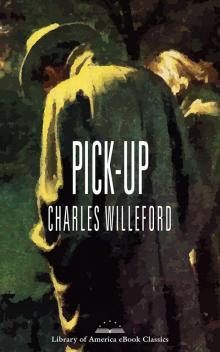
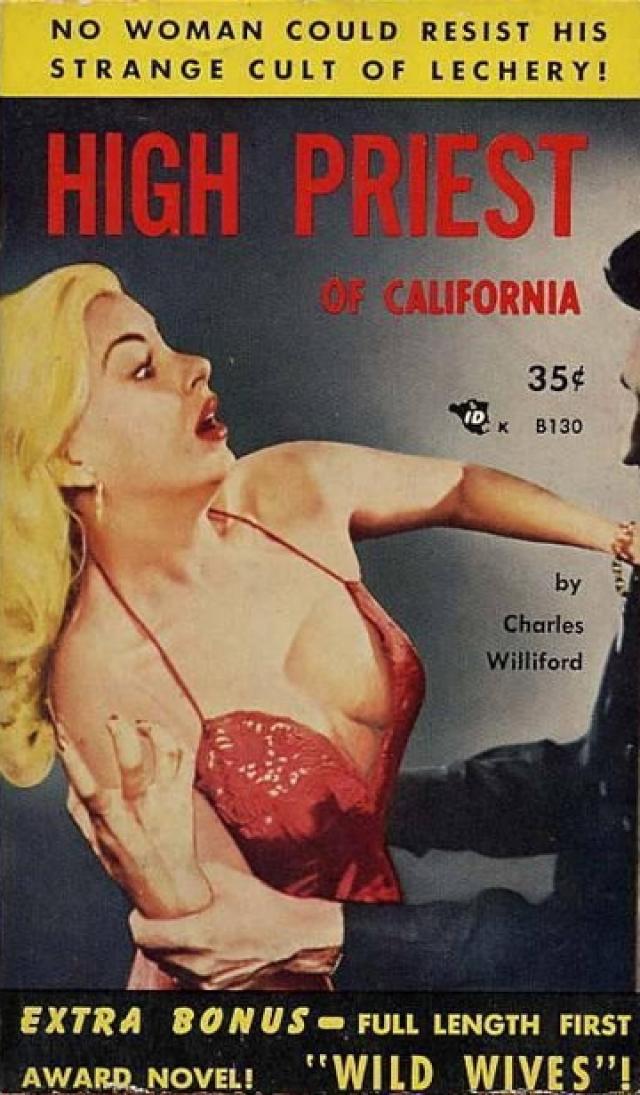
The first edition of High Priest came out in 1953, as the second part of Royal Giant #G-20, a digest-sized (which means wider than regular “rack”-sized paperbacks) double-novel which featured Talbot Mundy’s Full Moon (“Bold men fought and tortured—and so did their lovely women ...!”) as the opener. The cover copy for High Priest panted: “The world was his oyster—and women his pearls!” While over on the back we were told it was “A strange, shocking novel ... as true as a Federal Reserve Note.” (huh?) Pick-Up, Willeford’s second novel (recently reissued by Black Lizard), came out under Beacon’s imprint in 1955, sporting a cover painting UPD had already used for Royal Giant #G-21, something called Highway Episode by George Weller. This sort of thing was commonplace at UPD—books, covers, and even a few particularly lurid cover blurbs were all used and re-used until the last possible bit of profit could be squeezed out of them.
When Beacon published Willeford’s third novel, Until I Am Dead (1956), they changed the title to Wild Wives and slapped it on the end of a second edition of High Priest.[*] This time, the cover copy screamed: “No woman could resist his strange cult of lechery!” and “Blind date with blonde bait!” (Hubba-hubba!) They also rechristened the author Charles “Williford,” and misspelled the names of two of the main characters on the page-one blurb. Class.
Wild Wives/Until I Am Dead is a most uncharacteristic C.W. novel, in that it’s the closest he’s ever come to fulfilling the conventions of the hard-boiled detective genre. Smartass private dick Jacob Blake (a name that turns up again in The Machine in Ward Eleven, a 1963 story collection) is another dickhead Willeford hero, one who falls for a classically Cain-ian poison dame, and goes down in flames for his sin of weakness. The contrast it makes with High Priest is stark—Willeford calls that one “a reluctant lover” scenario, which he says is the predominant mode of modern American fiction, where the male will do anything to avoid commitment. Which is true enough, except Russell Haxby is a little spookier than your average red-blooded American male. There’s a line past which reluctance becomes something a bit worse (though he’s got a ways to go before entering Troy Louden’s league).