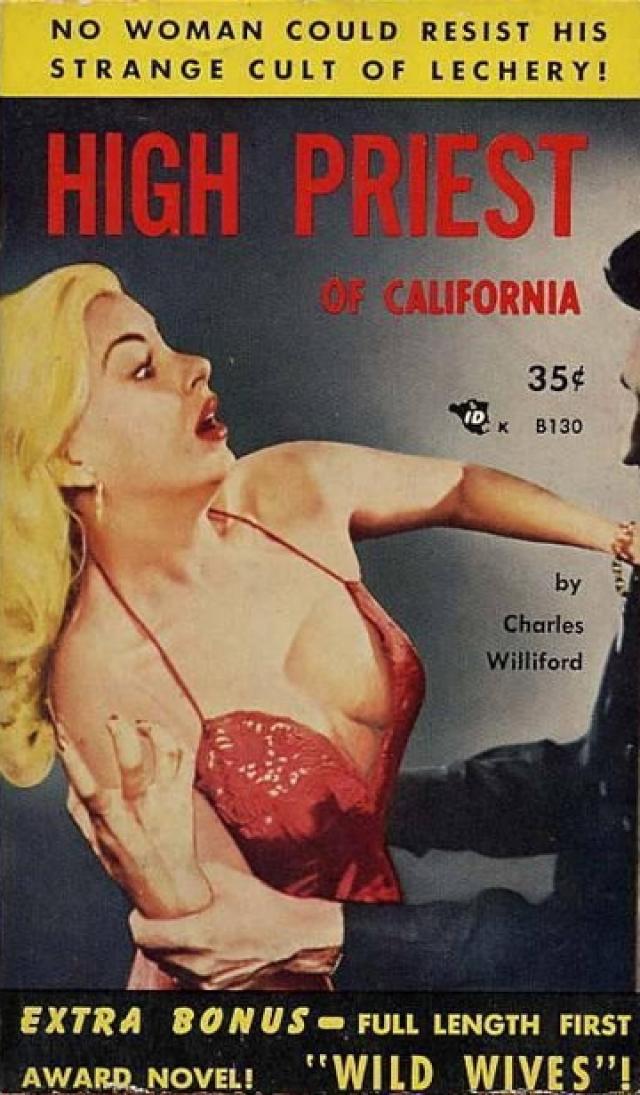
High Priest of California & Wild Wives: Two Novels, page 14


“How do you like them?” he asked, handing me a glass of orange juice and gin. He wore a wine-colored smoking jacket, gray slacks and red leather slippers. Somehow, without a hat, his long grayish hair looked natural. To cut it would have been a shame—in this exotic setting.
“Frankly, Mr. Davis, I’ve never seen anything like it before. You said you had a few Klee’s, but I didn’t expect to see a room covered with them.”
“He’s my favorite painter,” he replied, sipping his drink.
“He must be.” I tasted mine. Cold and good.
“Sit down, sit down, Mr. Blake.” Davis graciously waved me to the sofa. I sat down, looking at the walls with my mouth partly open. The pictures must have cost him a fortune.
“What did you want to see me about?”
“Well, I didn’t ask you here just to look at my art, I admit. . .” He sat beside me on the sofa, although there was a comfortable armchair directly across from me.
“Get to the point, Mr. Davis. I can’t stay too long.”
“Now, now, don’t rush me.” He put his hand on my knee and squeezed gently. “You must spend the night with me sometime, Mr. Blake.” He smiled horsily.
“I’ve got my own room, Davis.” I laughed. “And I’m too old for that sort of thing. I’m in my thirties. What you need”—I laughed again, and poured more gin into my glass—“is a youngster.”
Davis’ smile was a trifle annoyed. “That’s the crux of my problem, Mr. Blake. I’ve got a youngster and I’m trying to get rid of him. I haven’t actually thought things out yet—but, I suppose, that’s one of the reasons I wanted to cultivate your friendship.”
“We don’t have to be friends,” I grinned. “I charge twenty-five bucks a day and expenses.”
“You wouldn’t be interested in . . .”
“No. But I might be able to help you, after I find out what you want to do. I’m smarter than I look. I know, for instance, that your young boyfriend is Freddy Allen.” I let that sink in. I had remembered Barbara Ann telling me she was waiting for her brother who was visiting Mr. Davis.
Davis was startled. “Don’t tell me we’ve been that obvious?”
“How old is Freddy now?” I asked the question casually, as though I knew Freddy Allen well, but couldn’t remember his age.
“Twenty,” he lied. “And I have no control over him whatsoever.” He sighed. “You know Freddy, then?”
“I know of him. And although I’m not certain I’ve heard that he was spreading the word around about your relationship.”
Davis jumped up from the sofa and paced the floor several times.
“Are you sure?” he asked worriedly.
“No. But then if I know, there might be others.”
“I can’t afford to let anything like that get around, Mr. Blake. Not in my position. I know he’s jealous as hell, and he might not stop at anything.”
“You haven’t been true to him, then?” I thoughtfully pursed my lips.
“Of course not! Why should I be?” He spoke bitterly.
“Maybe he’s true to you and he expects the same kind of treatment.”
“He’s nothing but a spoiled brat!” It was odd to hear Davis speak that way. His voice was a rolling bass, and somehow, a voice like that is never associated with a homosexual. I didn’t laugh, however. I was as grave about the situation as a young priest hearing his first confession.
“Do you think he wants to marry you?” I asked seriously.
“My God! I wonder if something like that is in the back of his mind! It’s never come up, but such things are done, as you know . . .”
“He’s only eighteen, actually, so that might be it,” I said. “And you should have it out with him, at any rate.” I finished my drink and made another. I enjoyed the conversation and I’d given the old boy something to think about. It was asinine to me, but it was very serious to Jefferson Davis.
“I thought I knew Freddy,” Davis said softly, “but maybe I don’t know him at all. I’ve given him money, clothes, and only last week I gave him an early Picasso drawing for his . . . our anniversary. He was the one, now that I think of it, who remembered the anniversary of our, ah, relationship, and he surprised me with a gift of my favorite English preserves. Gooseberry, imported from England, you know. In my surprise, I retaliated with the drawing. He appeared pleased, and I know he was, although we had a terrible scene before the evening was over—”
“What was it about?”
Davis blushed; his crimson face was as bright as the pictures on the walls. “It was nothing of interest to you, I assure you. Just a foolish argument.”
I got up from the sofa, finished my second drink on my feet, and placed the empty glass on the low table.
“To sum up, Mr. Davis, you have a problem. You’ve got a jealous lover and you want to get rid of him. He’s cramping your style, or rather, he’s limiting your time. You’d like to get rid of him and you don’t know how. Am I right or wrong?”
“You’re right, that is, in a way, but I’m not so sure I want to get rid of Freddy. I’m rather fond of him, you know.”
“Then I’ll be running along. Thanks for the drinks, and I’d like to look at your paintings again some time. I don’t know much about modern art and maybe you could explain some of it to me.
“I’d be glad to. Come in again, later tonight if you like.” He squeezed my arm affectionately.
“Do you make a pitch for every man you meet?” I laughed. “I can see right now why Freddy’s so jealous.”
“I’m just trying to be friendly, Mr. Blake,” he said sternly. I had hurt his feelings.
“Thanks again for the drinks,” I said. I opened the door and left the room. I felt greatly relieved to be free of him. Davis closed the door quickly and bolted it with the chain lock.
I walked down the carpeted hallway to the elevator and pushed the button. I waited patiently, watching the moving loops of cable through the glass of the door. Suddenly, from behind, a heavy blow struck me between the shoulder blades, and the force of the blow threw me against the door of the elevator. The wind was knocked out of me and I was partially paralyzed. I saw that I had been hit with a large fire extinguisher, and the nozzle of its rubber hose was spewing forth a frothy mixture over me as I lay on the floor. It was a brew of water, sulphuric acid and soda and it was ruining my blue gabardine suit. But until I could catch my breath I couldn’t do anything about it.
A blond, chubby-faced young man, wearing gray slacks and a yellow sweater, was standing against the wall across the hallway. There was a sullen, righteous, frightened look on his fat face. His arms were spread, and the palms of his fleshy hands pushed hard against the wall behind him.
Chapter Seven
MY WIND CAME BACK TO ME all at once and I took a deep grateful breath. With an effort I got to my feet and a sharp fiery pain seared my back. The handsome, chubby young man against the wall didn’t attempt to run, but he didn’t try to attack me again either. I approached him slowly, reached out quickly, and grabbed a handful of his yellow sweater with my left hand.
“You’re Freddy Allen, aren’t you?” I asked him, twisting the sweater a little more to get a better grip.
He nodded his head, once, and then, without warning, tears overflowed his pale blue eyes and rolled down his baby-fat, dimpled cheeks.
“You’ve taken him away from me!” He blubbered through his tears. “He doesn’t love me anymore and it’s your fault!”
Now, I don’t really object to homosexuals. It’s a big world and there is room for everybody. The way some men prefer to make love is their business, not mine, but it seemed to me that I was being used as a short blunt apex for a crazy triangle. I didn’t like it and I didn’t like Freddy. Davis was one type of homosexual and Freddy was another. . . Davis, at least, earned his own living, and he spread a certain amount of beauty in the world by selling art, explaining it, and enjoying it himself. But Freddy was nothing. He was a filthy leech. He had attached himself to Davis so firmly that the older man was desperate to break away. As I held Freddy against the wall and watched the juicy tears boil out of his eyes through his girlishly long lashes I was filled with loathing and aversion. And in addition to being an overly pretty, petty-minded kept boy, he had ruined my suit with a fire extinguisher. . .
I smashed my right fist into his face. His nose crushed noisily and blood spattered and smeared against his skin. His nose would never be termed aristocratic again. I hit him again in the face several times. After each blow he tried to scream, but before he could get it out I would hit him again. I didn’t try to knock him out. I wanted him conscious; I wanted him to feel it. He covered his face, or tried to, with his left hand. I hit him again and the bones of his hand splintered. He dropped his hurt hand, screamed shrilly, and I loosened my grip on his sweater. He slumped weakly to the floor, cuddled his broken hand against his chest, and whimpered like a kicked dog, interspersing short, sharp yelps of pain between the whimpers. Without letting up any on his weird noises he put his right hand in his pocket, pulled out a knife with a spring button, pressed it, and the blade flipped out. He was fast with his leap to his feet. His legs had been gathered beneath him and he came up off the floor like a cat. The point of the long blade narrowly missed my throat. This was the excuse I needed to really clobber him.
Freddy whirled quickly after the missed thrust, crouched, and held his knife low at his side, looking for an opening. Patiently, flat-footed, I waited for him to make up his mind. He jumped forward, bringing the knife up awkwardly. I sidestepped his rush and chopped down on his wrist with the side of my right hand. The knife dropped to the rug and his rush carried him across the hallway. Following him up, I jerked his broken hand away from his chest and crushed it between both of mine. His whimpering ceased, the blood drained out of his face, and he turned white as a clown’s makeup. He pitched forward to the floor. Unconscious.
I left Freddy lying in the hallway and ran up the stairs to the seventh floor instead of taking the elevator. I unlocked my door, entered, and undressed as quickly as I could. I didn’t want to get burned by the sulphuric acid seeping through my suit. I showered again, using plenty of soap and hot water. As I toweled myself I examined my body carefully for red spots or burns. There weren’t any, but there was a new blue bruise on my back where Freddy had hit me with the fire extinguisher.
If he had planned his attack with care I could have been seriously injured. In my life I’d been hit and nearly hit with a variety of weapons, but this was the first time anybody had ever used a fire extinguisher on me.
My blue gabardine was ruined. I felt more than a little unhappy about it. It was the first suit I’d bought when I got out of the army, and every time I wore it I was reminded of my freedom. I could never wear it again. I put on a white shirt, blue knitted tie, and my gray flannel suit. I wrapped the damp blue gabardine, pink shirt and cream necktie in a sheet of newspaper, put the bundle under my arm and left my room. I rode the elevator down to the lobby and left the hotel.
Walking up Powell Street, looking for a trash can, I was stopped by the red light at the corner. A maroon Ford was waiting for the light to change and I wedged the bundle between the rear bumper and the body of the car. The Ford moved out with the light change and took my suit with it. At the hack stand I dropped wearily into the rear seat of a cab and told the driver to take me to the Seal House.
The Seal House is at the beach and it overlooks a pile of rocks in the ocean. Seals spend a lot of time on that particular pile of rocks. And people interested in seeing seals over rocks flock to the Seal House restaurant to eat, drink, and look at the seals. I got a table by the window, ordered a drink and looked at the seals. It was almost six and the sun had gone down behind San Francisco. It still reflected its light on the ocean and turned the water into a flaky, shifty mirror. The seals, sprawled carelessly on the rocks, moved listlessly from time to time. Music by Muzak played softly over the speakers set in the four corners of the large dining room. My gin concoction arrived and I ordered another before the waitress got away from the table.
I was draining the dregs of my second drink when Florence sat down across the table from me. She was breathing hard and it added freshness to her beauty. She was wearing a plain cobalt suit with two huge gunmetal buttons. She smiled, expelled a long breath, smiled again.
“I was looking for you in the bar,” she said.
“When I come to the Seal House I watch the seals.”
“Am I late?”
“I don’t know. I haven’t got a watch.”
“Did you order dinner?”
“No. How do I know what you want to eat?”
“I always get the mixed seafood platter. Out of a mixture there’s bound to be something good.”
I ordered two mixed seafood plates, and two more drinks.
“Your father sent your bodyguards to see me today,” I told her, to make conversation. “One of them said your old man wanted to talk to me.”
Florence wore a puzzled expression. “He lied then. Father is in L.A. tonight. He flew down this afternoon to address a builders’ association of some kind.”
“Did you see him leave on the plane?”
“No, but I saw him leave the house. He left right before I called you at 2:30.”
“It isn’t the same. He might still be around. Of course, they might have lied as an excuse to take me somewhere and work me over again.”
“Did they hurt you very much last night?” Florence asked solicitously.
“Not much. By the way, how did you get away? Or did you?” I looked over my shoulder with a mock terrified expression. Florence laughed, showing tiny sharp teeth.
“They’re fired. After I told Daddy about you and I getting away last night he called them in and fired them.”
“That may have been a blind . . .”
“No.” She shook her head emphatically. “What good would it do?”
“I don’t know.” I grinned. “But if you aren’t being followed anymore, I’m out of a job.” I finished my drink.
“You’ve still got your job, Jake, if you insist on calling it that.”
We both laughed. The seafood arrived and we let the conversation drop to pick around on the platters. The crab legs were good, but the sauce smelled like spoiled mayonnaise and olive oil. It tasted like spoiled mayonnaise and olive oil. I ordered coffee and lit a Camel.
“Want a dessert, Florence?”
“No.” She lit one of my Camels with her Zippo lighter. “I want to take you home with me. We can have dessert there.”
“Suits me.” We left the Seal House, walked to the parking lot, and climbed into her Buick.
“Where did you find your car?” I asked her.
“It was in the garage. I looked for it right after I called you this afternoon.”
She drove across town, driving expertly, squeezing the big car in and out of places I didn’t think it would fit in. I admire a good driver. I’m not a good driver myself and I’ve never owned a car. My sole driving experience has been limited to driving cars belonging to others, and not too much of that. When we reached her house she drove through the wrought iron gate and stopped in front of the entrance, putting the brakes on so hard the car skidded for three feet in the gravel of the driveway.
“It’s the power brakes I had put in the other day,” Florence said self-consciously. “I’m not quite used to them yet.”
We entered the house. The living room was high-ceilinged, and an enormous, cut-glass chandelier lighted the farthest corner of the room like daylight. The room was of no particular period or design. Provincial chairs were mixed with mid-Victorian, and there was a low cocktail table carved out of a granite block and fitted with a polished marble top. It was about eight feet square and its legs were carved into griffin’s feet. A set of Noh masks were on one wall, placed in imperfect alignment, and on another there was a scattering of swords, dirks and cutlasses. A Degas hung above the fieldstone mantel, depicting ballet girls in blue chalk, and the far, remaining wall was completely covered with a tapestry showing a crimson Roman army marching across a golden land.
It was an interesting room and I liked it. Florence mixed Martinis from a tray of bottles on the enormous stone table. I sat down on a seven-seat sofa that curved halfway around the table.
“I like your house, Florence.”
“I hate it. It’s too gloomy. Now, try this: I call it a Desert Wind. Nine-tenths gin, one-tenth vermouth. No olive. No onion. Nothing, just a toothpick.”
I sipped the Desert Wind. “It’s fair,” I said, smiling, “only next time, skip the toothpick. The wood absorbs too much of the gin.”
She sat down beside me and I put my arm around her. I finished my drink, took her glass, and set both of the glasses on the table. I picked her up and put her on my lap. She put her arms around my neck and I kissed her. We held the kiss until it got sloppy. I pushed her away from me.
“I’ll have another Desert Wind,” I said. My voice was dry.
“Me too.” Her voice was high and small.
She poured the cocktails and as I reached for mine, a man came through the doorway from the hall. He was in his fifties, with powdery white hair, and an enormous, beakish nose. His skin was tight over high cheekbones, but it gathered and fell in folds on his chin and beneath his neck. His eyebrows were black and very heavy, and beneath his eyes there were huge blue-black circles. His hands looked too delicate for his short, thick-set body, and they were trembling. He wore a black tie, white shirt, and a white linen suit. He resembled a giant panda bear in reversed shades of white and black.
“So you’re the private detective, Jake Blake—” His voice was shaking with an anger that was barely under control.
“Yes, sir,” I said carefully, and I got up from the couch. “You must be Mr. Weintraub . . .” I stuck my hand out to shake hands, but he ignored it completely and turned to snarl at Florence.