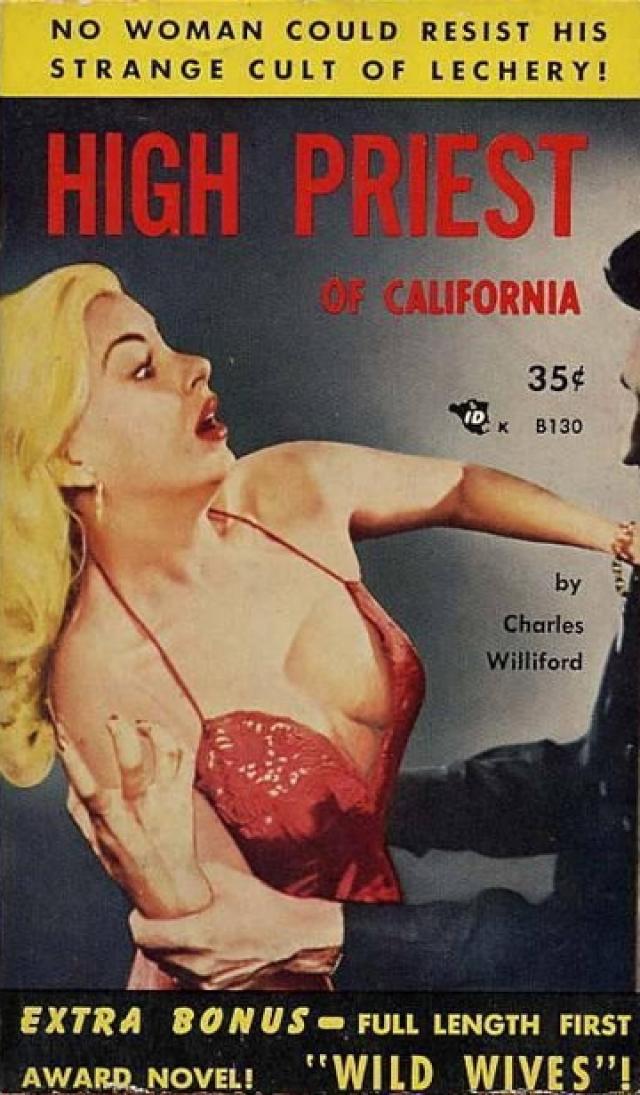
High Priest of California & Wild Wives: Two Novels, page 13


I waited until noon, and still no call from Florence. After deliberating whether to call her instead, I thought better of it and went out for lunch. I ate the special hot roast beef sandwich at Moar’s cafeteria and returned to the hotel. When I opened my office door, Barbara Ann got up from the chair she was sitting on, flew across the room and did her best to claw me with her fingernails. I caught her wrists in time and held onto them, turning sideways to avoid being hit in the crotch by her pumping knee.
“Hold on,” I said to her. “What’s the idea?” I was holding her so that she couldn’t do anything, but it didn’t prevent her from spitting in my face until she ran out of saliva. I shoved her roughly into a chair and wiped my face with my handkerchief.
“You liar, you!” she shrilled at me. “You big, big, big, big fibber, you!”
“What’s the matter? What are you talking about?”
“Ostrich-skin handbags!” she shouted. “That’s what I’m talking about! There isn’t any such thing at the Emporium. I looked all over the store. Everywhere. Finally, I talked to the assistant manager, and he told me he’d never heard of ostrich-skin handbags. You made it all up just to get even with me for shooting you with the water pistol. Didn’t you? And there probably isn’t any shoplifter, either!”
“What store did you go to, anyway?”
“The big ‘E.’ Just like you said.”
“I didn’t say the big ‘E’, I said the May Company. You’re confused, that’s what’s the matter with you. You’ve failed me on your first assignment. The shoplifter’s come and gone by now. . .”
“You did so say the big ‘E’!” I could detect the small doubt in her voice. I pressed my advantage.
“No, I couldn’t have told you that.” I shook my head sadly. “The May Company is where the sale is, so why would I tell you the Emporium?”
“I don’t know, but that’s what you said.”
“No, Barbara, I didn’t. You made a mistake and then you try to blame it on me. I suppose now I’ll have to do the job myself, as I should have done in the first place.”
“I’m sorry, Mr. Blake,” Barbara said contritely. “Really I am, but I’ve got an awful temper and—”
“You’ll never make a detective if you can’t control your emotions any better than that. I’ll give you one more chance. Go on over to the May Company and look through the store. You might catch the shoplifter stealing something else. Maybe it wasn’t ostrich-skin handbags after all. Maybe it was plastic handbags—”
“They’re too cheap to steal.”
“You might be right. My stoolies may have been wrong. But go ahead and see what gives at the May Company. I’m giving you another chance.”
“Yes, sir,” she said happily. Barbara got up from the chair and kissed me. I pushed her away from me.
“Where did you learn to kiss like that?”
“We girls practice kissing at school sometimes. Why? Don’t you like it?” She smiled mischievously.
“Beat it.” She left the office, first putting her dark glasses over her eyes. Whew! I sat down behind my desk and lit a cigarette.
At 2:30 I had a telephone call. It was Florence.
“Did you think I wasn’t going to call, Jake?”
“I was beginning to wonder.”
“Can you pick me up at the Paramount Theatre on Market at six?”
“I haven’t got your car anymore. Your two impetuous friends caught me with it last night and worked me over.”
“They did?”
“They did.”
“Where’s the car now?”
“I don’t know.”
“Are you hurt bad?”
“Not that bad.”
“Oh. Well, how about the Seal House, at the beach. I’ll get away somehow and meet you there for dinner at six.”
“Fine.” She racked her phone.
There was no reason to hang around the office any longer. I had only waited for her telephone call. I took my hat and raincoat out of the file cabinet and put them on. The door opened and Florence’s two bodyguards walked in.
“Going somewhere, Mr. Blake?” The tall man asked the question. He was wearing blue serge instead of gray today. Double-breasted was still wearing his double-breasted. However, there was a pistol in his right hand. A large one. He handled it carelessly, pointing it in the general direction of my stomach. He smiled out of the side of his mouth.
“No. I wasn’t going any place in particular,” I said.
“Then we’ll take you with us, if you don’t mind. Mr. Weintraub wants to talk to you. He wasn’t happy about Florence going out to dinner with you last night, Blake.”
“And I didn’t like it either.” Double-breasted put in his two cents.
“What are you going to do with that automatic?” I asked. “Shoot me, for Christ’s sake?”
“Oh, no, nothing like that,” the tall man said. “Would we, Melvin?”
Melvin shook his head. He was the one in the double-breasted.
“He didn’t say to shoot him. He said to bring him in.”
“Come on, Blake,” the tall man said, all business now, “let’s go. And don’t try anything. Melvin wouldn’t want to shoot you, but sometimes he gets nervous.”
I preceded them out of the office and down the stairs. There was something odd about this. Weintraub must place a high value on his daughter to guard her into her twenty-sixth year. I walked slowly across the lobby trying to think of a way to get out of going along with the two gorillas. After all, there are limits to how many times a man should be worked over for one mistake. I didn’t relish the prospect of another beating—I looked toward the entrance and a brief happy laugh escaped me. An old acquaintance of mine was coming through the door.
Detective Sergeant Ernest Tone.
Chapter Five
SERGEANT TONE STOPPED INSIDE the doorway, looked us over, and rubbed his chin with his left hand. After he eyed Melvin and the tall man suspiciously, he looked at me.
“What are you doing with these two creeps, Blake?”
“I was walking them to the door. I wanted to make sure they didn’t steal anything on their way out.”
“When did you get out, Ferguson?” Sergeant Tone asked the tall man.
“I’ve never been in, and you know it,” Ferguson said defensively.
“When are you getting in, then?”
“I’m not. Let’s go, Melvin.” Ferguson and Melvin hurried out of the lobby and I remained with Tone. He was a little guy, not much more than 5’5”, but he was a tough policeman. He rubbed his chin, cocked his head to the right like a bird.
“They wanted you for something, Blake. Something was up, and I could smell it.”
“They were taking me somewhere to work me over, I believe. And then you appeared and they changed their mind.”
“I’d like to pick them up—”
“Melvin’s got a gun on him. Is that a reason?”
“I wish it was, Blake, but it ain’t. He’s got a license for it.”
“That hood’s got a license?”
“That’s right, and don’t ask me how he got it.”
“Okay. What are you doing at the King Edward? Slumming?
“In a way. I’m taking you in.” Tone grinned.
“What for?”
“Ever heard of the Child Labor Act?”
“Yeah, what about it?”
“Come on.” I followed him outside. A uniformed cop was sitting at the wheel of a police car by the curb and we climbed into the back seat. I was puzzled, but it was useless to pry any information out of Tone. If he wanted to tell me, he would; if not—and that was more likely—I could wait until we reached headquarters. I settled back comfortably in the seat.
“What’s the story, Blake, on Melvin and Ferguson?”
“It’s a case I’m on. Nothing confidential, I suppose. I’m working for Florence Weintraub—”
“Don’t tell me you’re mixed up with her!”
“Do you know the girl?”
“No, thank God!”
“Why? What’s the matter with her?”
“Don’t you know?”
“Well, I—”
“Everybody else does,” he said grimly and tightened his thin lips.
“I’ve got an idea, maybe, but business is lousy, Tone. I need the dough.”
“That’s your concern. I’m not giving advice to private investigators. Right now, you’d better worry about your license, anyway.”
“What’s this all about, for Christ’s sake?”
“I’ll let Lieutenant Pulaski tell you about it. He thinks he’s got your license this time, Blake. And maybe he has.”
Nothing more was said. At the station we ducked under the stairs, entered the basement and walked down the hollow-sounding corridor to Lieutenant Stanley Pulaski’s office. Pulaski was the Number Three man on the detective force, and was gradually working his way up to the Number One spot. He didn’t like me very much. The newspapers had given me the credit instead of him on an attempted kidnap case about eight months before. I had done the go-between work and deserved the credit, but he didn’t think so. Some people are that way . . .
Pulaski grinned at me when we entered his office. He was more than a little paunchy and liked to sit behind a desk. His desk was covered with various objects with which he fiddled as he talked. There was an ivory paperweight carved into the shape of a lion. There was an old-fashioned pen-and-ink stand in brass, with a container of sand, which he used instead of blotting paper. And there were several pictures of his wife and five children, each framed in heavy leather, and lined up across the desk like football linemen. The dark walnut desk was oversized, but Pulaski was large enough himself to overpower it and the many ornaments. His dew-lapped, blotchy face was happy as he pointed to a chair.
“Sit down, Blake,” he said cordially. “I’ve been expecting you.”
I sat down in the indicated chair. Sergeant Tone leaned against the wall and concentrated on stripping a wooden match into splinters. Slowly, maddeningly slow, Pulaski took a cigar out of his desk drawer and removed it from its glass tube. He sniffed the cigar with enjoyment, rolled it back and forth between his enormous hands, then very carefully cut the end off with a pair of tiny scissors. He lighted the cigar with a kitchen match, rolling it around in his mouth to insure an even light. He inhaled deeply, expelled the smoke with sensual satisfaction.
“Your business hasn’t been too good lately, has it, Blake?”
“So-so,” I said.
“More business than you can handle by yourself?”
“No. Not that much.”
“Then why did you hire a teen-aged girl to work for you?” He shot this question angrily and the blotches on his face joined forces, making his face completely red.
“I didn’t,” I replied calmly.
“Bring her in, Tone,” Pulaski ordered sharply. Sergeant Tone left the office and returned in less than a minute with Barbara Ann Allen. She was still wearing her brown coat and beret, but she had taken off her dark glasses. She was visibly frightened.
“All right, dear,” the lieutenant croaked pleasantly, “tell us again about your assignment.”
“Yes, sir.” Barbara Ann looked to me for encouragement, but I kept a deadpan. “Mr. Blake hired me, without pay—just for the experience, he said—to watch for a shoplifter in the May Company. Well, I didn’t know exactly what department to look for her in and I didn’t know what she looked like, but I thought to myself that the best place to look was where there were little things around that a woman could put in her purse or coat pocket. So. . .” She hesitated.
“Go on, dear,” the lieutenant encouraged her.
“I’ve told you this before.”
“Please tell it once more.”
“Well, first I looked in the book department. I don’t know why, but books are small, and people might want to steal a book, and there were a lot of people in that section of the store. I was standing by the counter where they sign people up for the Book-of-the-Month Club and I saw this woman slip a copy of The Robe under her coat. She pushed it up under her arm inside her coat, and I could tell she was stealing it because it wasn’t wrapped. So I grabbed her around the neck and called for help. The floorwalker came running over and I told him I saw her take the book. The woman was screaming like everything, but the floorwalker acted real nice and polite and took both of us into the little office in the back. I told him again that I saw her take the book. The woman said she didn’t steal it. She claimed she was looking for a salesgirl. It was a lie, but when she paid for the book they let her go. But he kept me there and called the police . . .” Barbara Ann was almost in tears, but she shook her head and bravely continued. “I told you already that I was hired by Mr. Blake, and you’ve kept me here ever since. I was just doing my duty and you’re trying to make it look like I’m the one who’s in the wrong!” She turned to me. “Tell them to let me go, Mr. Blake!”
“Well, Blake,” the lieutenant said pleasantly, “what about it? Shall we turn your operative loose?”
I grinned. “What are you trying to pull, Lieutenant? I’ve never seen this girl before in my life.”
Barbara Ann’s eyebrows raised with amazement. “Why, you liar, you! You great big fibber, you! You did so tell me to go to May’s and look for a shoplifter!”
“Not only do I don’t know what you and the lieutenant are trying to pull,” I said, “but I don’t even know what you’re talking about.”
Barbara Ann made for me with her fists clenched. Sergeant Tone reached out quickly and caught her by the wrist.
“Take it easy, kid,” he said quietly.
“You’re lying, Blake,” the lieutenant said. “A story like Barbara’s can’t be made up successfully, and you know it. It’s screwy enough to be the truth.”
“Okay,” I said, shrugging, “charge me with it. See how far you get.”
Pulaski thought it over. He looked sharply at Tone and Tone shook his head and shrugged. Holding his cigar like a dagger, Pulaski smashed it out in the ashtray on his desk.
“All right, Tone,” he said, “get ‘em out of here! Drive the girl home. You’re a rotten bastard, Blake! I can’t figure out what your purpose was, but I do know it was a cheap trick. I’d like to kick your teeth in!”
“Go ahead and hit me, Lieutenant,” I said quietly. “I’ll have you suspended.”
Sergeant Tone opened the door for Barbara Ann, but she didn’t budge. She stood motionless, both feet planted, still staring at me with amazement and anger.
“You’d better keep away from this man, Barbara,” Pulaski told her with a kindness in his tone that was surprising. “We’ll take care of him for you. Go on with the sergeant.”
Tone and Barbara Ann left the office. I stood up, fished a cigarette out of my package and lighted it with one of the kitchen matches on the detective’s desk.
“You’re going to have to dream up a better frame than that to get my license, Pulaski,” I said, putting as much disgust into my voice as I could under the circumstances. “You aren’t even trying hard.”
I left the office, slamming the door on my way out.
Sergeant Tone was leaning against the guardrail outside, puffing on a handmade brown cigarette. He raised his chin as I climbed the stairs and reached the sidewalk.
“What is the story, Blake?” he asked, hooking his short arms over the railing.
“There is no story,” I replied. “Where’s Bobby?”
“I sent her home in a police car. How did you know her name was Bobby if you’ve never seen her before?”
I laughed. “She’s a teenager isn’t she? Bobby-soxer? Bobby is short for bobby soxer.”
“Pulaski wants your license pretty bad, Blake. I’ve got a hunch he’s going to get it one of these days.” Tone threw his cigarette into the street, turned away from me and ducked down the stairs into the basement.
At the next corner I caught a cab for the hotel.
Chapter Six
I RODE THE ELEVATOR UP to my room, removed my clothes and got under a shower as hot as I could stand it. A visit to a police station makes me feel dirty all over. After I looked at my face in the bathroom mirror I decided I could get by without shaving again. I dressed carefully, selecting a shirt with a Mister “B” collar, and my one-button-roll, blue gabardine suit. I pulled on a pair of white clock sox and my gray suede shoes. It was hard to select a necktie. My wine-colored bow didn’t look so good so I exchanged it for a cream-colored knitted tie. More contrast. I looked in the mirror admiringly for quite awhile. I really looked sharp.
As I started out of the room, the telephone rang. It was Jefferson Davis.
“My, I’m glad to catch you in, Mr. Blake,” he said. “I thought you might like to come down for a drink.”
“What time is it now?”
“Oh, a little after four.”
“What’s your room number?”
“Six-twenty-four.”
“All right, I’ll be right down. I want to see those Klee paintings.” I hung up.
Without waiting for the elevator, I took the corner stairway down one flight to the sixth floor. It was quicker. I knocked on the door and it opened immediately, as though Davis had been standing inside with his hand on the knob.
“What can I fix you, Mr. Blake?” he asked pleasantly.
“Something with gin in it,” I gulped. I could hardly talk.
The sight of his room had done something to my voice. It was a riotous blaze of varied color. His room was no longer than mine, but it seemed so; it did not have my dull, cocoa walls. Every available space contained a picture by Paul Klee, either an original or a print. It was similar to being caught up in the midst of a child’s nightmare. The colors were breathlessly hot.
The room was furnished with new, modern furniture, and instead of a large double bed there was a two-seat, hide-a-bed sofa pushed up against the wall. It helped make the room look larger than mine, but the pictures closed the gap by appearing to leap out from the walls. Davis was fixing drinks on the coffee table and there was an amused smile on his face.