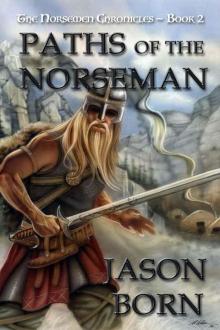
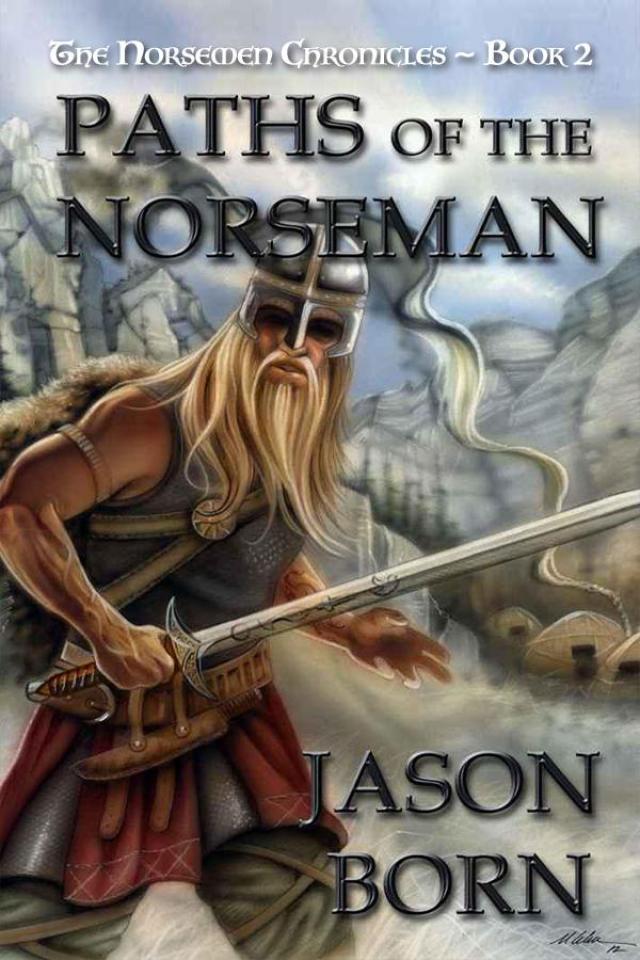
Paths of the Norseman, page 31
part #2 of The Norseman Chronicles Series


In their language I groaned, “Your son?”
A little surprised at how well I spoke their tongue, she said, “Yes. Fourteen winters he has seen. Normally he would have gone with the others this time, but our chief allowed him to stay behind to help me.”
“And your husband, is he with the other men?”
The woman’s look turned stern and strong. Sad, but not angry. “I have lost two husbands to your people. I have no husband. No more talking.”
She adjusted her position to apply her salve, and we were both silent for some time. I wanted to apologize for her suffering for her losses. Maybe it was my own sword that brought her men down. But my energy was nearly completely consumed. I think I slept then.
When I felt and heard her stirring to leave, I woke up, saying the first thing I thought to say, “Thank you for helping me.”
The woman walked over from the other side of the home, bending down to me. Again she patted my head with its sweating, matted hair. “The chief and his council will decide your fate. You may yet be tortured and killed when they return in two days.” No malice. No sadness. She spoke with the assuredness that comes with facts. No opinion. No worries. She spoke like a woman who had gained experience by living, receiving gifts and loss. She was a woman resigned to fate. The striking woman patted my head once more, rose to her full height and left through the open doorway.
And I lay there, immobilized, a man resigned to the Providence that would be mine. A man who would be sentenced to a hideous death by the father of Megedagik, the chief of Ahanu’s people.
THE END
(Dear Reader, See Historical Remarks section to help separate fact from fiction.)
Historical Remarks
My goal while writing this tale was to make a compelling story, but also keep as true to history as possible. If you’ve read The Norseman, Halldorr’s first yarn, you know that much of the action takes place in Europe, Ireland, Wales, England, and Norway to be precise. It turns out that such geographies made it quite easier to find ample volumes of recorded events of the time.
Not so with Paths of the Norseman. Many of the events in this work were only recorded in The Greenland Sagas or the Erik the Red Sagas, collectively known as the Vinland Sagas. You will see from the discussions below that these two distinct works record many of the same events, with broad differences that can only be expected from histories written down separately from oral traditions two hundred years after the fact. Since the Vikings did not have a written word tradition and neither did the peoples with which they came into contact in their new world discoveries, we are left with no other documented verification of the events.
However, the reader should not fret. We are not left with fun, heroic stories of an allegorical nature only! Archaeology, especially in the latter half of the Twentieth Century, confirmed many of the accounts which the sagas discuss. Where there is disagreement, I made my best attempts to note them below and to make them make sense in Halldorr’s story. Characters such as Erik, Leif, Thorstein, Thorvald, Thjordhildr, Freydis, Gudrid, Thorhall, Bjarni, Thorfinn, little Snorri, Helgi, and Finnbogi were real people. Putting feelings and action to the cold facts of history bring them alive for me and hopefully, allow you to feel a closeness or better understanding of lives they and their peers led.
Our hero, Halldorr, is a fictional character, meant to not only follow the action of the famous characters written in the sagas, but also to embody the Norse spirit of adventure, to show the confusion any of us would have endured when a new foreign faith is thrust upon us, when we have comfortably followed our old gods for generations. His ability to read and speak multiple languages makes him an enigma to be sure.
Leif Eriksson is famous for making his way from Norway all the way to Greenland in the first nonstop transatlantic sea journey in history following his stay with King Olaf. Leif paid a visit to the king, shortly before Olaf fought the overwhelming sea battle of Swoldr which was portrayed in The Norseman. King Olaf so liked Leif that he gave him two Scottish thralls, or slaves, as a gift so that the travelling Greenlander could more easily spread the newfound Christian faith among his countrymen. Please read The Norseman for a more complete understanding of Olaf and his faith in the One God.
Leif was bestowed the name Leif the Lucky after rescuing a band of stranded men on a rock in the icy waters of the seas surrounding Greenland. The good fortune that followed Leif wherever he went allowed him to successfully convert the Greenlanders to the new faith with ease, because like many of us today, his people wanted to follow a god of affluence and luck, answering to our whims. The sagas say that Leif rescued the men on a return trip to Greenland from his Vinland travels, but I had to move the event to his transatlantic crossing so that Halldorr could be in the right place at the right time in order to record it.
I have been unkind to Bjarni Herjolfsson. In the sagas, he was not shown to be traitorous and was not, as far as anyone knows, among the dead in the mass grave at Thjordhildr’s church. The idea for Bjarni as a cowardly villain came to me as a lightning bolt as I read the account of his initial voyage to Greenland. How could a man be in such dire straits and still not stop in to the foreign shores for a respite? I still shake my head at his obtuse view today. If you are interested in the account, read The Norseman.
Next to the ruins of Thjordhildr’s Church in Greenland, a mass grave was discovered in the 1960s, containing the bodies of twelve men and one nine year old boy. No women were in the original grave, but were in the grave in my tale. All the individuals had been buried at the same time and were completely disarticulated with their crania arranged neatly in a row on the grave’s eastern side. The scene when Halldorr boiled the bodies and bones of Bjarni’s family members was meant to be horrifying, but conveys a bit of historical insight. Many archaeologists surmise that when their comrades fell on foreign shores far from home, the Norse Greenlanders would boil the remains to make transporting them back for burial more convenient. The sagas themselves confirm such events.
Erik did become despondent following his youngest son’s death, and so Leif badgered him to again go adventuring or a-Viking. He was on his way down to the boat on the day they were to leave when he was thrown from his horse and badly injured. Erik, who never converted to the new faith, viewed the injuries as a bad omen and refused to go along. He withdrew further into his shell and Thjordhildr’s decision to withhold sex from her husband until he converted likely hastened his bitterness.
Helluland is the name Leif Eriksson gave to the first land he came to from Greenland on his famous journey of exploration. It is commonly thought to be Baffin Island and I have kept with tradition but chose to be more specific in my selection. I chose what is now called Resolution Island which is at the southernmost tip of Baffin. It made the most sense to me given its proximity to Eriksfjord and given Bjarni’s description of an island that he and his men were able to circle in short order. Baffin itself is just too large, extending far north of the Arctic Circle and its pack ice, to think that they circumnavigated it.
Markland is thought to be part of today’s Labrador, Canada. Since Leif and his men did not tarry there, we do not have any archeological evidence to corroborate this inference generally. Neither do we have evidence of the specific location. I described an area that is known as the Okak Islands today. The reader should not assign any special significance to the place with regard to Leif Eriksson as I selected it based purely on its position on a map.
Even though the Norse did not build any shelters, permanent or temporary, in Markland according to the sagas, we must assume that for many years after Leif’s voyage, Greenlanders came to the shores of Markland to harvest timber. Its proximity to Eystribyggo made it an ideal location, certainly better than either Norway to the east or Vinland to the south.
Leif’s ship did find itself beached with the falling of the tide when they were discovering Vinland – a rather ignoble beginning to a European’s first settlement in the New World. Today Vinland is a rather barren, cold place, wind-swept from the surrounding sea, but 1,000 years ago the conditions were quite different. The Medieval Warm Period was in full swing allowing for many of the journeys and conditions written about in the sagas. Forests and swamps covered Vinland, today’s Newfoundland.
I am clearly not an American-Indian anthropologist, archaeologist, or historian. My research tells me that the most likely inhabitants of the Vinland at the time of Leif Eriksson were the Beothuk peoples. However, the last surviving member of the tribe died in 1829 and so as a people, they are officially extinct. They were never a people who existed in great numbers, perhaps several hundred at most. Their demise came from the encroachment of Europeans after Columbus’s rediscovery of the Western Hemisphere, but also their cultural isolation. They did not interact nor form many alliances with other Native American nations and so adapting a thriving trading culture with the scores of bearded European sailors proved too difficult.
Four vocabulary lists, totaling approximately 400 words were written down in the Eighteenth and Nineteenth Centuries. However, there is no example of connected Beothuk speech and those who made the wordlists did not use any consistent method of recording what they heard. Therefore, deciphering the sound system of the Beothuk language is a daunting task. Since the 1860’s it has been suggested that the Beothuk language was related to Algonquin, one of the Algonquian languages. Therefore, any references to speech I used for the Beothuk peoples in this work were Algonquin, itself only spoken by a few thousand people in the entire world. I offer my apologies for any errors noticed by any linguists or native Algonquin speakers in my reading audience. Please forgive me.
The sagas disagree on who gave Kjalarnes its name. The Greenlanders’ Saga proclaims that Thorvald named it after repairing his damaged keel and burying the old one in the sand. The Erik the Red Saga, which is very complimentary of Thorfinn Karlsefni, says that Karlsefni came ashore and discovered the buried keel, thus naming it Kjalarnes. Comparing the two works, I thought it most likely that Thorvald buried and named the land. Thorfinn simply found the land later on, after Thorvald’s death from the arrow of a skraeling. Thorvald, Erik’s oldest son, was taken by his new faith, and as he died requested a grave marked by two crosses.
In my telling of a small portion of Thorfinn Karlsefni’s tale, I have been liberal with the histories. In Halldorr’s quest to find a woman and settle down, he had to once again see Gudrid, Thorstein Eriksson’s widow, and become a father to the first European baby born in the New World, Snorri. The sagas are clear that Thorfinn and the widow Gudrid were Snorri’s parents, this scrap of Halldorr’s tale is presented with artistic license.
As with much of the history of the period in which our story takes place, scholars disagree on many of the particulars. In their readings of the sagas, some have come to the conclusion that the discussions of Straumsfjord and Leifsbudir (literally meaning Leif’s booths or homes) actually refer to the same physical location. Other researchers say that they are two different sites as a simple reading of the texts suggest. I have read the reasons for both accounts and find each to have its merits and each to leave unanswered questions. Ultimately, it should not surprise the reader at this point that I do not have the same requirements as my learned historian counterparts. As has been my preferred method, I have chosen the simplest explanation and put the two settlements in two separate places.
Our explorers had an exceptionally difficult winter in Straumsfjord with hunger throughout. Thorhall, who, like his old friend Erik, never converted to the new faith, left the encampment to offer a prayer to his old gods. Rescuers found him mumbling as described in the novel and soon thereafter discovered a whale that had washed ashore. Their troubles were answered, with no more discussions of scarcity in the sagas. It was after that terrible winter that Thorhall and nine of his men left the company of Thorfinn, but I will leave the details of what became of Thorhall for another book.
There remains much disagreement among learned and amateur scholars alike as to the location of Hop as discussed in the Vinland Sagas. For a host of reasons I have chosen to assume that Hop was somewhere in what is present day New York, specifically the Hudson River. In Vikings: The North Atlantic Saga, Gisli Sigurdsson contributes a chapter which, in my mind creates a logical argument for this location. However, the reader should always remember that as of this writing, the only archaeological evidence of a Norse civilization in North America remains at Leifsbudir on the northern tip of today’s Newfoundland.
Thorfinn and Halldorr’s trip south all the way to the Outer Banks of today’s North Carolina is pure fiction. However, no one knows how far south along the coast of America the explorers traveled. They were, by their very nature, adventurers and so I merely attempted to show that as they spent the summers exploring around their main encampments, there is a very good chance that some of their longboats sailed further than many scholars give them credit. The archaeological evidence does not support such trips, but the human element, I think, does.
Thorfinn’s encounters with the skraelings are well documented in both of the Vinland Sagas. The natives would come to them in the mornings swinging wooden poles while standing in their canoes. The two peoples had modest success for a short time trading for cheese, red cloth, and hides or ivory. Unfortunately for everyone, misunderstandings involving the trading of weapons in general and a frightened, bellowing bull in one instance did precipitate bloodshed.
Soon thereafter, the skraelings attacked in a larger number and were summarily beaten back after they chased the Norsemen into a clearing in the forest. My story assumes that this was all part of the battle plan. The sagas are less clear, though they tell of Thorfinn’s worry and preparations for a response from the skraelings.
Eventually, Thorfinn took his small family, Gudrid and Snorri, away from Vinland. They returned to Greenland, eventually settling on a farm called Glaumbaer in Iceland. Many years later, following Thorfinn’s death, Gudrid became famous for making a pilgrimage to Rome, even being called Gudrid the Wide Traveled in the sagas. Their offspring had in their lines, many men who served as bishops of various Norse or derivative settlements through the years.
The sagas speak on Freydis’ foray into Vinland with the brothers Helgi and Finnbogi with an air of condemnation and bewilderment. Her husband’s name was actually Thorvald, like her older half-brother who died at Kjalarnes, but to simplify the story and make it slightly easier for the reader to follow I changed his name to Torvard. You’re welcome.
The character of Freydis is quite fascinating, likely among the most interesting in all of the Vinland Sagas. She caused much enmity among the inhabitants of Greenland and so her half-brother, Leif, the new jarl did not seek to prevent her from leaving. Freydis and Helgi agreed to populate their crews with thirty men each, but from the start Freydis broke the bargain, taking more along. We may never know if she had evil intentions from the start. The brothers, Helgi and Finnbogi arrived at Vinland first, having enough time to unload their goods into Leif’s house, but when Freydis came, she sent them away. Helgi responded by saying they would never be a match for her ill-will. He could not have known how correct he was, for even after the brothers arranged games and entertainment over the winter, the parties began arguing, splitting further apart.
Freydis went to offer peace, but beat herself up on her way back, convincing her husband and his men to kill the brothers and their household. When none of her men would kill the five women, Freydis said, “Hand me an axe,” one-by-one cutting the defenseless women down outside their longhouse. She took their longboat as her own, stocking it with all the goods that Vinland had to offer, taking them back to Greenland. Leif soon heard stories of her wicked actions, even torturing some of her men to get the truth of all that happened while she was away, but could never bring himself to order her death.
Before leaving for Greenland, there was another skraeling attack with which to deal. However, this time the Norse chose not to fight. In my tale, I assumed it was because they were unprepared or badly outnumbered, though the true reason escapes me. The sagas do, in fact, state that while the Norsemen retreated away from the skraeling warriors, a man named Thorbrand Snorrason was killed with a slab of stone to the head. A very slow and pregnant Freydis shuffled out toward the attackers, picked up Thorbrand’s sword and stripped to her bare breasts. According to the sagas, she did slap her breasts with the sword, all the while accusing her men of weakness and cowardice. The skraelings were afraid of her actions and fled. Segonku or Megedagik was a fictional character, but I used his death to help explain why they took flight.
One of the last major scenes in this work involved the torture of Halldorr at the hands of his skraeling captors. While the events are fiction, I used the memoir written by John Gyles, a hostage beginning in 1689 of the tribes of what is today Maine. While they were likely a different clan and a different tribe altogether, easily separated by hundreds of years, I appreciate the first-hand account for its honesty. The simple methods also appear to be more legitimate than the elaborate torture techniques devised for film. Mr. Gyles witnessed each of the methods I describe and more.
Halldorr has many more adventures to experience, many more peoples to see. I hope he is able to escape his current predicament! We will find out by following Halldorr’s tales which come to us from his mythical memoirs. He has a woman to find who will bear him children as the soothsayer Leif and the Son of the One God have told him. I hope you enjoyed this part of his story and are willing to follow along with his further escapades in his next book. Turn to the “About the Author” section to see what you can do to ensure that there are more novels to come.
About the Author
Jason Born is the author of the first two volumes of The Norseman Chronicles, The Norseman and Paths of the Norseman. He is an analyst and portfolio manager for a private Registered Investment Advisory firm in the United States. Jason lives in the Midwest with his wife and three children. He loves learning in general, especially history. If you enjoyed this work and would like to see more, Jason asks you to consider doing the following: