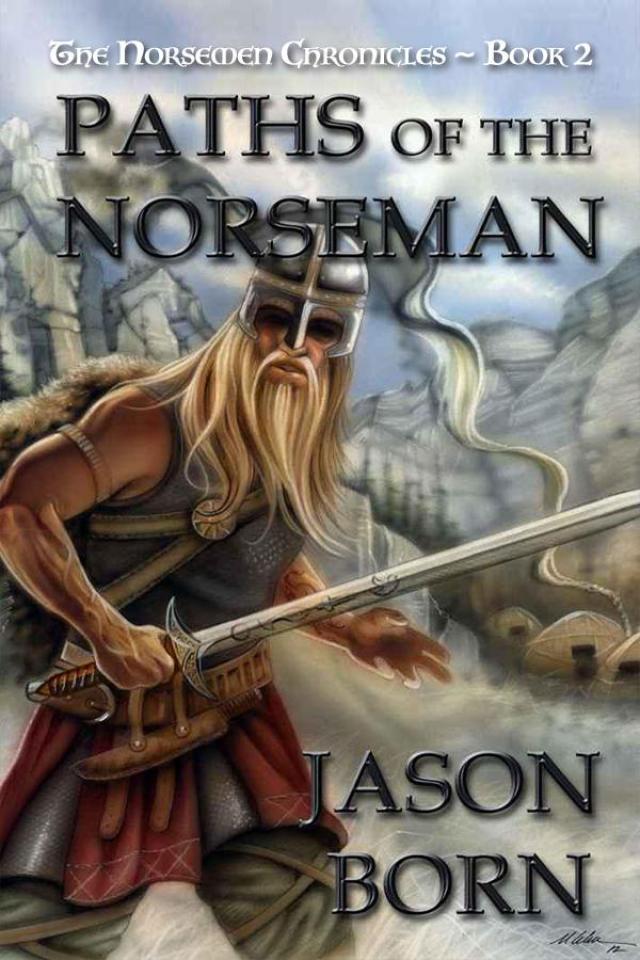
Paths of the Norseman, page 18
part #2 of The Norseman Chronicles Series


The next morning was filled with a lonely, bright sunshine for there were no clouds in the blue sky. After a breakfast of ale, grapes, and fresh fish, the biggest salmon any of us had ever seen, we allowed the tide to lift the keels from the shore where we had camped. God provided another day of fair winds and soon our entourage was skimming over the waves once again. The sight off our starboard bow was magnificent though later when I spoke to Thorhall the Huntsman about the subject he said, “The sight was bleak.” At any rate, extending for miles upon miles to the west was a string of sand beaches. They were interrupted by the occasional cliff or grove of deep green pines that reached directly to the sea, but the sight of such a line of white sand was nearly as impressive as my first view of Dover’s towering white cliffs before the Battle of Maldon many years earlier. Gudrid, demonstrating much more originality than any of the men had during our explorations, named the length of coastline Furdurstrandir which means “Wonder Strand.”
So immense was the Furdurstrandir that we travelled along it for over two full days before the land, and therefore The Merchant, again turned northward. Soon we came to an area of the sea with strong, forceful currents at the mouth of a wide fjord. An island rested just outside this fjord and so we called the island Straumsey which simply means stream isle. I guided our small fleet into the bay, now aptly named Straumsfjord, and found a place to rest for the night, sliding the ship into the shore.
As we came to a halt at the shingle, we scared the nearest members of a vast colony of ducks from their own sleep so that they flapped noisily around us. Some were so confused by our presence they crashed into our sails which made it much easier for our women to grab the fowl, ringing their necks for a succulent supper later in the evening. The beasts’ eggs, too, littered the shore. In fact, as we walked across the sand we could not take a step without smashing some beneath our feet.
This was to be a land of plenty.
. . .
My, that winter was harsh. Most of the cattle died from exposure to the elements shortly after our humble Christmas celebration. We immediately butchered those that died of the cold, smoking the meat, but we could not put up much because most of them died of illness. I have seen men eat of animals who died of some illnesses, and they themselves subsequently became sick or even died. After their deaths, we were left with just two bulls, two cows, and a heifer calf to provide milk or meat for nearly one hundred fifty souls. Three sheep and twenty-one chickens remained alive to supply further sustenance, but they would be gone within the week if we simply slaughtered them to feed us all.
Many of the men, especially Thorhall the Huntsman, braved the ruthless wind and snow by leaving one of the two temporary longhouses we had built before winter to hunt for wild game among the forests surrounding Straumsfjord. However, I cannot explain why, our success was severely limited. There were no deer. We killed three rabbits in three weeks. The entire colony of ducks which cluttered the beach at our landing had moved on, leaving only their droppings behind. It was as if our prey had been lifted out from among the trees so that even their tracks disappeared. Even our attempts to fish were utter failures. Poles broke, hooks were lost, nets torn. The Huntsman began to curse the One God even more than normal in new, imaginative ways in his everyday speech for allowing such a malady to befall us.
So within one moon of our Christmas merriment, we began to ration what remained of our food. The chickens were fed pebbles and some dried grasses to keep them laying eggs. This worked to a point so that three-quarters of the hens continued producing an egg every two or three days. Gudrid was given a daily cup of milk and a slice of meat because she ate for herself and for Snorri, who still nursed at her chest. Even though she received more food, Gudrid lost weight at roughly the same rate as the rest of us. Within two full moons of Christmas, or nearly one month before the equinox, our eyes were dark sunken pits, our cheeks pronounced, and our clothes several sizes too large.
All of us were concerned for our very lives by now. Each day I awoke expecting to kill a moose, but it never occurred, so Gudrid organized a mass prayer vigil in the main longhouse to ask the God to provide for us.
“One God!” declared Thorfinn, who spoke for the crowd that huddled toward the hearth as they knelt to pray. “You, like our Norse kings, are mighty. Priests have told me that if I ask you for something, you give it to me. Well damn it, I want food so that I can once again be mighty. Have you seen my wife? Her tits aren’t as full as they should be. I don’t want my boy to grow up to be a runt because he doesn’t get the milk he needs. I have heard something about this Job character who loved you, who served you, but you saw to it that he suffered. What kind of king does that? And I have been told that you killed your own son. What kind of king does that? I say, show me that you are great and give us some food, damn it!” With that, an uncomfortable silence ensued. Most of the listeners were still new to the faith and had never seen a book, much less read the Word of God, but they were familiar enough to know that a certain reverence to the One God was expected. For my part, I was too hungry to laugh at his gross mischaracterization of the Word, so I drew my shoulders in a little closer to pray quietly.
Thorhall the Huntsman, of course, was not there and I never expected to see him at any of the other prayer vigils which followed, but by the fourth day of supplication, someone noticed that he had not been seen for many days. Since I loved that rotten malcontent I volunteered to lead a party out to find him.
In full battle dress we left the encampment within an hour while Gudrid led another prayer in the longhouse. Her words were more soothing than anything her husband had uttered the previous several meetings, so I hoped that, at least, the assembly would leave feeling better in spirit if not in stomach.
We found no trace or track of our quarry and were, therefore, forced to begin a methodical search by splitting up into three groups of three to make concentric sweeps around sleeping lodges with ever-wider diameters. This was grueling because of the fresh, deep snow and because we fatigued quickly due to lack of strength. The first night all nine of us huddled together under the bottom branches of a fir tree next to a cold, weak fire that sputtered from melting snow falling from the bowing branches above.
I awoke the next morning hugging one of the men for warmth. So weak was I that I didn’t immediately move away from him, but tarried there trying to continue to steal further warmth from his body. He didn’t move either for he was dead. We left him there frozen under the tree, and the eight of us continued our methodical search for the Huntsman, hoping to avoid a similar fate.
That day I killed a squirrel. Even though it was not time for a meal we abruptly struck our stones amidst some dry leaves we brought with us to start a fire to cook the meat. I am ashamed to say that our work on the fire was for naught because before the flames grew to the size of the squirrel itself, we had already eaten the animal’s raw flesh. The tiny beast had warmth remaining in his muscles as the flesh slid into my belly.
Even though the quantity of meat was little to spread among eight men, we all instantly had more energy and moved quickly the rest of the day. It is truly amazing what hope men can find in the littlest success of eating raw scraps of squirrel meat.
After the sun fell and the stars shone brightly above on the cloudless night, one of our groups shouted that they found something. The rest of us ran toward the sound so that we now stood at the foot of a rise of land. There above us in the midst of the woods was a barren hill except for the silhouette of a large flat rock which was perched atop the crest like a vigilant watchman. From below where I stood, I saw what the search party pointed to. In the middle of the rock I could see two arms meandering back and forth slowly. They appeared to rise straight up from the stone like someone lay prone on it. Then I heard a quiet mumbling of nonsense in the voice of Thorhall, but using words I had never heard.
“Why did you not retrieve him?” I asked.
The men looked at me with uncertain eyes. Finally one said, “We were frightened. We were afraid he had been possessed by the One God for all his blasphemy! I’m not going up there.”
“What is blasphemy you idiot? You don’t even know what you are talking about.” With that, I strode up the hill alone toward my friend.
I climbed up onto the rock where Thorhall lay. His eyes, mouth, and nostrils were agape. He stared at the stars as if in a trance. Thinking that being closer to him now, I would be able to decipher his words I leaned my ear down to his mouth. Alas, I could understand none of it. He took no notice of me so I shook him. Still he went on.
I spread myself out on the rock in a similar position to look up at the stars. After some time of silence he said, “I miss my friend Erik.”
“As do I. He raised me.”
Ignoring my comment, Thorhall continued, “He was the only one left who understood the old gods.”
“I still understand the old gods,” I responded.
“You? Humph!” Thorhall retorted. “You are among the worst of them with their love of the cowering god.”
Changing the subject now, “What are you doing out here?”
“That’s no concern of yours, Halldorr, you dry chicken turd.”
I smiled at his obvious fondness for me. “It does concern me because I have been looking for you out in the snow for two days. A man died.”
“No one told you to sit with me like an addled old fool. Maybe next time you’ll tie me to a heavy rock like we would the village simpleton,” he complained.
“Are you coming back with us?”
“Of course I am!” exclaimed an exasperated Huntsman. “But you are a dense one! Do you expect me to stay out here and freeze?”
We camped at the foot of the hill that night, trying to stay warm. Despite the men’s initial fears of a devil inhabiting Thorhall, our discovery of the man renewed our spirits to make the daylight seem to come more quickly. We walked straight to the village instead of taking the zigzagging systematic route we used for our outward journey. It was time for another sparse mid-day meal when we walked into camp, but it was deserted – both houses were empty.
Then the nine of us heard a loud series of cheers and shouts down at the shore where the tide climbed and fell dramatically each day. It sounded like a celebration. With a knowing smile, Thorhall merely sat down to rest his old bones on a short stump while the others and I ran to the noise.
We burst from the trees to see nothing short of a glorious gift from God. A mass of our people teemed over a great whale that had been beached as the tide ebbed away that morning. It was wedged between two large sheets of ice that jutted vertically from the shingle, also left behind when the water fled toward the sea. Even as they butchered the beast, men and women alike greedily shoved its blubber into their mouths. More than one found the richness more than their wanting, thin bellies could handle and promptly vomited it back out. Nonetheless, I hadn’t seen smiles like these in months.
While Thorhall’s other rescuers began to scavenge the creature’s remains for themselves, I pulled my saex and used its razor sharp Frankian blade to cut out a large steak to share with Thorhall and walked back to the camp. There he sat tilting, half asleep, on the stump when I walked by and kicked him in the leg. “By that frozen bitch Hel, what do you think you are doing?” he shouted while falling to a knee.
I merely bade him to follow me to one of the longhouses where we fried the steak in a small pan over the hearth, using its own blubber as a grease for the pot. When the meat was cooked, we sat alone on crude stools which had hastily been assembled over the winter and silently enjoyed the first real food we’d eaten in months.
“It’s stifling really,” he said to the floor while repeatedly licking his teeth to capture as much of the flavor and nutrition as he could. When I didn’t say anything back Thorhall continued, “These people, our floating town, their faith, I mean, it’s all so stifling. I need to escape. I feel hemmed in.”
“Aye, but we’ll likely explore again in the spring,” I said, wishing I had cut off a bigger steak.
“No, since the One God came back with Leif, I don’t want to be with these people,” he protested.
“So?”
“So I’m escaping. I aim to return to Leifsbudir with several invited men. You may come if you like, you worthless ram nut.”
I gave it honest thought for Leifsbudir was a fine place. I could lead my own small village. Thorhall would be a very reliable aid. No women would be there to further disappoint me. Yet I said, “No friend. I will go exploring as Thorfinn’s captain. But I’ll likely return there soon, perhaps in a couple years.”
With a huff from Thorhall our conversation was done and our paths were decided.
Soon thereafter the weather broke, and all of our fortunes changed. Fish seemed to jump into our boats, we could row out to the island and gather eggs from geese, and the land-borne wildlife returned. The camp gave the credit to their consistent prayers to the One God. Thorhall swore about the Christian God and gave the credit to Red Beard, which was the name he used for Thor to whom he had prayed on his solo adventure into the snow.
. . .
“But you’re a great fighter, and I can’t stand to lose these men,” argued Thorfinn, pointing to the nine Greenlanders who desired to travel away to Vinland with the Huntsman as the first drops of rain began splashing onto us. Thorfinn stood on the windy beach following our first hungry winter in Straumsfjord while the Huntsman and his small crew finished packing up Valhalla with supplies.
The ducks were slowly returning to their place on the sand, but this time stayed some ells away from where we kept our ships. When Thorhall didn’t respond to his plea, Thorfinn shook his head in disgust, but Snorri the Elder picked up a stray small speckled duck egg and threw it at Valhalla, shouting, “Don’t you see Karlsefni? We don’t need these men and their tired old Huntsman! He’s a heathen anyway.” In stride, Thorhall reached over the side of the ship and scraped the fracture egg debris from the strakes with his palm, then after taking a taste, wiped the rest onto his jerkin. Droplets of rain began to fall at a more pronounced angle that continually flattened as the wind picked up bringing a true, rolling storm toward us.
“Quiet down, Snorri,” said Thorfinn. “These are good men, with good heads on their shoulders. They would be missed.”
Ignoring his leader and friend, Snorri cried while extending a thumb in my direction, “They should take this piece of the devil’s shit with him so that they can all live like the womanless hermits they are!”
“I said shut up Snorri!” yelled Thorfinn who seemed to grow a few more inches as he blustered in anger at his somewhat estranged friend. “You’re acting more and more like a jealous woman than a trusted friend! So shut up!” I openly chuckled at the exchange which caused Snorri to storm off through the growing puddles like the woman he was. “You shut up too, Halldorr, you’re not helping,” finished Thorfinn, again shouting to be heard over the loud storm.
“I’ll make you a partner in our profits if you stay with us,” pleaded Thorfinn while the men aboard Valhalla already began threading the oars through the holes to pull the ship from its resting spot and into deeper water.
The knarr began to slip away into the growing surf of the fjord as the Huntsman said to Thorfinn, “We’ve made our decision, Karlsefni.” Then to me he said, “See you in Vinland again someday.” He turned to guide Valhalla through the fjord using its sturdy rudder before I was even able to give him a weak wave goodbye.
I stood there for some time watching the boat disappear into the storm after Thorfinn walked back to camp. Even though it was the middle of the morning, the darkness soon swallowed up my grumpy friend the Huntsman, or my father’s friend at least, but I remained. Eventually I dropped among the pebbles and received a thoroughly wet ass for my troubles, but did not care. I felt aged as the abrupt change in the weather caused the old wound from the skraeling spear to burn in my leg.
My thoughts wandered while I tossed stones into the white-capped breakers which now collapsed around my feet. My mother was dead. I can’t say that I ever even knew her name. At least I couldn’t remember it. My true father, Olef, was dead. Why did I even care anymore? After all, I killed his killer, Bjarni. My second father, Erik, dead. His oldest son, Thorvald, dead. His youngest son, Thorstein, dead. Fife, the Scot, dead. Kenna, dead.
For thirty-nine years I had fought in Midgard, the realm of men. I was so old – well I thought I was old then, but now as I pen this writing, I know what old truly is. What did I have to show for any of my toiling to that point? A beautiful chest of wealth. Two books. A son who starved to death wanting for his mother’s milk and her touch. Another son who may never know me as his father. Most of the people I loved were dead. Leif remained living, but ruled in far away Greenland. King Olaf lived in self-imposed exile after our thorough defeat on the seas.
Thorhall had tied me to my past due to his friendship with Erik. But now he left and I served Thorfinn, who had taken Gudrid as his wife. How would I ever find a woman now at this age? Most men had slept with a woman for over twenty years at this season in their lives. What woman would have me? No land. Though I suppose I could return to Europe and buy land, I could use my wealth to buy respect.
God, I was foolish to ask such things. Crevan, the old priest, would say, “May fides rector vos.” “May faith be your guide.” But after making a mistake when learning my Latin for the first time, I interpreted the saying as, “May fortune be your guide.” Even now as an old man, I think my mistake carried more real-life wisdom than Crevan’s wishful thought. My fortune, my fate was being spun by the three norns living among the roots beneath the Yggdrasil tree. It was clear that they too served the One God, as I now did. They simply switched their allegiance when I was forced to change my own. They chose to torture me so. Did they laugh while they did these things to me?