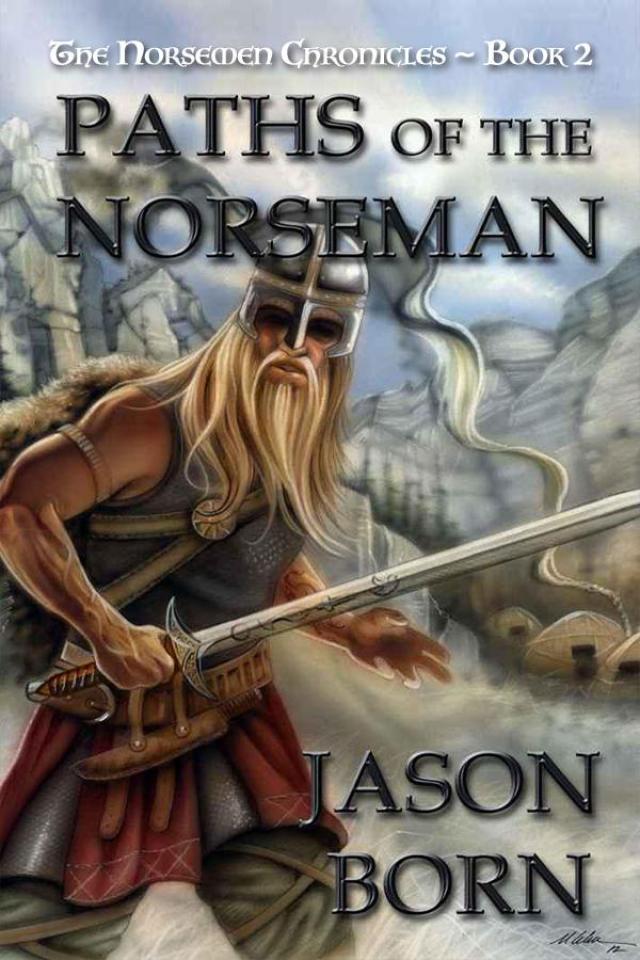
Paths of the Norseman, page 29
part #2 of The Norseman Chronicles Series


Soon Freydis rolled over to her back, slapping the sand while swearing at the One God. No one else was close by, so I sauntered over to the woman, standing above her in a reverse of how she towered over me the day she killed Lifa and the others. She didn’t notice me at first for her eyes were clenched tightly in one of the massive bouts of pain that come with childbirth. I remembered my Kenna for a moment. I even saw her perspiring face with its fine features as it flickered in my mind. I remembered the pain and joy we felt those days. For a moment I felt nothing but sadness and pity for Kenna, for myself, and even Freydis. I recalled the supreme ache that welled in the hidden depths of my being. Why did Freydis live with all these bastard children, when my own Kenna died after the birth of one baby? I knew the answer, it was those wonderful hips. Those lush hips that drew me to Freydis when we were both young, allowed her to spring forth baby after baby and live. Kenna was too narrow in the hips, but she was wide and deep in knowledge and life.
I was lost in my thoughts for these moments, even looking out to the sea as the canoes fell further away. Freydis howled again, bringing me to my senses. I looked down just in time to see that she swung the sword at my legs. I hopped out of the way, but she caught me below the knee, cutting my trousers and drawing a bit of blood.
Anger steamed inside me like the steam that rose from the rocks of Iceland. I could kill her here and not a soul would know I had done it. I would say I killed the Segonku after he had killed Freydis. My hand even went to my father’s saex, gripping the hilt so that my skin made a squeaking sound against the handle. Revenge against this woman would feel sweet, certainly lightening the burden that was Freydis from the shoulders of entire world. I would not be blamed; here was my opportunity. Even Leif would be relieved upon hearing the news.
The saex blade was halfway drawn from its scabbard when I hesitated. I don’t know why I stopped, I just did. Freydis saw what I had done and laughed between the swelling pain attacks, “I’ve known you to be a coward your whole life, you bastard!” She panted heavily, ignoring the fact that she too was a bastard. “I lay before you, weakened, and still you do not kill me!” Freydis tossed the sword into the rhythmic surf, “There, kill me now you feeble simpleton. I am completely defenseless.”
She was so right, Freydis would die. I again began to slide the saex out, but again I halted. I looked at her sweating, gasping bare chest, heaving from exhaustion. I scanned the area behind me toward the village and forest. I scanned the sea again. Freydis laughed and laughed.
Then I slapped the blade back into its resting place, stepped toward her face and crouched down, still standing upon my feet in the sand. I took my right hand and raised it high into a balled fist. Freydis laughed but instinctively closed her eyes to cover them from the blow.
But, of course, the blow never came. Her laughing died. She slowly opened her eyes while I carefully brushed her wild hair back behind her ears, dabbing her forehead with my shirt sleeve. Her confused countenance was worth many times more than her empty dead face would have been. I leaned down and kissed her forehead tenderly.
It was many minutes before any other man came down to the shore. In the intervening time, I helped Freydis give birth to the two bastard pups, using what I had learned from Sif, the midwife who swore and assisted Kenna all those years before in my home in Kaupangen. They were both healthy, strong boys, both with piles of red hair matted on top of their heads. They both had many of their features from Freydis and Erik before her, but they were not Tyrkr’s children. I did not recognize them, but whoever bred the woman, must have had fun for there were two of them, and must have been of some importance for Leif to banish her.
But that all happened several months ago. Within a week Freydis announced that she and her family would go back to Eriksfjord with the rest, preferring to leave me behind to deal with the skraelings and hopefully die here alone. I did not intervene with her escape by suggesting that Leif intended for her to be banished, never returning. Instead, I preferred to allow them go. Freydis would be my adopted brother’s problem once again.
So like Thorfinn before her, the tide came in, her boats crept up from the sand, and the lot of them rowed away, leaving me to my own devices. Right Ear sat at my side scratching at a flea that bit at his damaged ear, thumping the sand with his rear leg at each pass. A man and his dog, I was the Enkoodabooaoo Ahanu proclaimed me to be.
Throughout the summer, I harvested the bounty of Vinland, from her grapes, to her berries, to her roots, and animal life. I gave no thought to when or if I would ever return to Greenland or my people or any people. My giant moose antlers that hung in Freydis’ house soon hung in my own, for I claimed Helgi’s home next to the pond for me, deciding that to live where that woman lived would guarantee bad fortune.
Twice that summer I know I was watched by skraeling. They were quiet, skilled trackers, finding me whenever they wished, but I was as adept at discovering them. A small band of them could have cut me down, carving off my scalp as I had seen them do in battle. Yet they did not. Their men did not even try to talk with me. I paid no attention to them, simply strapping on my belts and weapons each day as I tread upon my land. At night I slept soundly, secure in the fact that Right Ear would warn me of their presence and that if attacked, at least three of them would be killed before I drew my last breath.
With time, however, the solitude became too much for me to bear. A day, a week, a month, I had been alone for even longer times, yet I grew restless. At last, one morning as I walked through the forest to the place where Tyrkr first discovered grapes while thinking of my friend Ahanu, I realized how close in proximity he really was to me. Why should I force myself to be alone?
I would go to them, I decided. They could view my coming as an affront, or worse, as an attack. Then my death would be certain – but perhaps not. Perhaps Ahanu could talk sense to his brother, the chief, and I could be welcomed as an ally. I had killed several of their men, but I was sure that they understood the difference between war, battle, and murder. They were good, honorable men if Nootau and Ahanu were at all representative.
How would I get to them? I had no boat, and if I did, I had no crew. I could build a boat as I had done twice in Kaupangen, but that would take years without the aid of other strong backs. Then I thought about my skraeling friends and their canoes, those bark covered boats I admired so much for their near weightlessness. I could take what I learned from Skaffhog about a boat’s dimensions, its length and width, and apply that to what I observed in the birch bark canoe.
That was a mere three days ago.
I hurried back to my longhouse, pulling out my woodworking tools, nearly jogging with excitement back out to the nearest stand of birch trees. I was comfortable with skinning a birch tree while she still stood proud, for we used birch bark layers under our sod roofs many times to make them waterproof. Done properly, the tree would survive to produce more bark in the future.
Once to the stand I hastily lashed together a ladder from small saplings, propping it up against a broad, straight birch without any low branches. The tree would already have its winter bark and so peeling it would be more difficult than if I had done it in early summer, but with that trade-off came a higher quality, durable bark. I scampered to the top of my ladder, scoring a horizontal cut around the circumference of the tree, climbing up and down two or three times to move my ladder around the base of the tree. Because of my excitement I had forgotten to cut the lower horizontal slash, so had to lumber down to do make it. Then I climbed to the top again, finding the vertical section that would score the easiest and began the long upright etching.
By the time the mid-day meal came, I had peeled off the bark, taking the long rectangular section, spreading it upon a soft bed of pine needles, outside up, keeping it flat with rocks I set gently on top. In no time, I built a lightweight frame of cedar to form the bottom of the canoe’s shape. I made two stems, one for the bow and the other the stern, and the gunwale out of the same species, suspending them about an ell over the bottom frame with stakes.
I had seen the skraelings used spruce roots to lace the pieces all together, so even though dusk was fully upon me, I waded into the nearest swamp that had a grove of spruce surrounding it and pulled the roots up that lay upon the floor, cutting them off with my saex. Sopping wet, I marched back to my work site with my quarry, resting upon a rock while I split the roots into a mounting pile of cord. It was only Right Ear’s whimpering that reminded me that darkness now surrounded us and we had not eaten. We camped there next to a warm fire for the night, careful not catch the needles and my new boat ablaze, sharing small portions of the dried meat I carried in my rucksack.
It rained the next day, with a bit of thunder and lightning, but I stayed on task in the dripping forest, stretching the bark up around the bottom frame to the gunwale. I soon discovered my original bark section would be too short on its own so I found another tree, using its bark to create patch strips above the waterline to piece up the sides. To form the bark in the shape of the canoe, I cut vertical gores in the bark, gathering the two sides of the cut in an overlapping manner.
Now I was ready to lace it all together with the split spruce roots I had harvested the previous evening. By now Right Ear was so terrifically bored with my task and miserable in the rain that he ran off. I found him the next day chewing on a half-eaten squirrel outside the heavy, closed door of my longhouse. Yet despite the tedium and repetitious task on which I toiled, poking the bark with an awl, threading and tying the roots over and again, I was energized by the thought of being on the waves again, even though I would be paddling a canoe and not commanding a fantastic longboat with blowing sails, flapping banners snapping in the wind. For dinner, I ate a literal heap of wild mushrooms warmed by the glowing coals of the fire.
It stopped raining sometime during the night which further invigorated me and my mood. I remember feeling this much excitement when I was a very young man on the eve of Erik’s journey of exile from Iceland while I wiggled my feet beneath my hide covers on the floor of his longhouse. We left the next morning for the unknown. Erik said only that we would go west, to the very edge of the world. I did not worry then, as a child, just as I did not worry as a grown man, about the unknown. I slept beneath the tree canopy on the damp soft needles next to my nearly-finished craft.
My spirits were so high that I ignored the ominous fog lying thick like fat upon the back of an old bull well past his days of glory when he would mount every heifer enclosed in his pasture. With my lacing completed, I ran, or jogged rather, to Helgi’s home, found Right Ear and his squirrel, snatched a large black kettle with its lid, some stray iron, a sac full of smoked cheese, a pot of ale, and quickly returned to my project next to my unlimited supply of trees.
The kettle and iron, I set in a neat stack while I used my whetstone to sharpen my axe, eating cheese and drinking ale like the ravenous hound I was. Right Ear pounced with his dirty feet all over my lap until I shared most of the food and drink with him. He made me laugh out loud many times, and I recall to this day that after eating the rich cheese, the dog had a blinking look on his face that was as clear as if he said, “I don’t think I’ll shit for a week.” I laughed joyously, patting his head.
Soon my axe brought down a small cedar tree. She split easily as I used all the techniques Skaffhog taught us in the oak grove on the gentle hillside outside Olaf’s Kaupangen. I worked diligently, breaking only to sharpen or re-sharpen my axe. The chilly fog did not stop me from sweating profusely, so that even though it had been over twelve hours since it stopped pouring on me, I was still wet. Just after mid-day, when the sun finally began burning through the mist, I had cedar sheathing and ribs neatly stacked in two piles between my fire and the canoe.
Since I forgot a bucket, I had to carry the kettle to the nearby swamp, lugging the massive beast back, filled with water. Above the flames, I hung it from the iron rods I drove into the ground with the back of my axe head, stoking the fire, stacking the excess cedar around the pot. The arrow-straight cedar ribs were set into the quickly warming water, still jutting out the top, with the lid set awkwardly on the rim to hold in steam and heat.
While they cooked, I set the sheathing in place, lining the bottom and sides of the boat up to the gunwale, holding them in place temporarily with bending twigs wedged between the walls. Several of the plank linings required trimming to fit snugly which added enough time for the boiling water to perform its duty on the ribs.
When the boat was properly lined, I took my outer tunic off to use it like a potholder, grabbing one of the hot ribs from the boiling kettle. Working swiftly, I bent the wet board around a nearby tree to get the basic shape then drove it down into place in the canoe, trimming just a bit off one end so that it could be wedged beneath both gunwales. One after another I pulled a rib, bent it, drove it down against the sheathing, fitting them all securely in place. Only one snapped from a knot I had not seen while splitting them earlier.
She was nearly done. The pot bubbled with steam, and water spurted out, creating hisses as it hit the burning embers below, and I nodded to no one with self-satisfaction. She was going to be a beautiful boat, slicing through the waters. She was better suited to rivers, ponds, and lakes, but I would try her on the open sea. I thought about my trip, vowing to leave tomorrow regardless of the weather.
I hiked her over my head, piling as many of my tools as I could into a sack slung across my shoulder. The canoe was light as I anticipated, but even I, someone who had grown used to possessing massive strength all my life, became tired by the time I reached my home. The dog happily nipped at my heels the entire walk back which made him uproariously cheery, but made me quite angry. Rather than kick him like I wanted to do, I just let him continuously knock my rearward foot into the back of my forward foot’s ankle, causing me to nearly fall and the boat to crash to the ground more than once.
I set the boat upside down between two stacks of firewood for it to receive a heavy coat of pitch from buckets we had gathered and stored some time earlier. This time the dog brought laughter to me again. He ran again and again under the canoe, brushing his back on the sticky pine tar. When Right Ear finally noticed what was happening to his back, his fur was packed and matted into an uncomfortable mess. He attempted to fix the situation by twisting his face to gnaw at the jumble, but received at mouthful of repulsive filth. This caused him to recoil, smacking and pulling his lips back, his tongue lapping everywhere. Right Ear tipped over to the earth while he struggled, rolling his back into the dirt, picking up heaps of broken grass, wood chips, and muck. As I said, I laughed and laughed at him, feeling a little sorry for his troubles, but avoiding offering any aid nonetheless.
That night, after gathering all of my implements from the forest and while sitting next to the blazing hearth, I carved a paddle in the style I had seen used by Ahanu’s people. I made a monumental fire, needing to thaw or dry out my bones from so many hours in the damp chill. Several times, I had to inch my stool even closer to the flames to capture warmth even though I had endured much colder temperatures most days in my life. A quick batch of oil from my supply of walnuts, coated the blade, then I was off to sleep, staying on the floor next to the hearth for extra warmth. Three times Right Ear nudged me with his nose to curl up next to me, but I demurred, preferring to not become glued to the beast and his pine-tarred back.
We slept in, catching up on much needed rest. When I did open my eyes, returning to my senses, I saw that it rained in a miserable, steady downpour. But I would not be dissuaded from my adventure. Rising to make us a hearty breakfast before our travels, I scowled at the hair on my left harm which was matted with pine tar from Right Ear who had at last stealthily managed to lie next to me. I took out a supply of smoked fish and refried it in seal fat, salting it with salt I gathered from pans of evaporated seawater during the summer.
Then after puttering back and forth to the shore several times with the canoe, paddle, food supplies, navigation equipment such as my notched stick and a sunstone, weapons, blankets, et cetera, Right Ear and I latched closed the doors of Leifsbudir then hopped aboard the canoe for its maiden voyage. Did the skraelings name their ships, I wondered. While this was not a ship, but more like a rowboat we would have stowed aboard one of our longboats, I considered it my own ocean-going vessel, absolutely name-worthy. I pondered the question while I learned the subtleties of the craft, how she handled waves or wind, how she responded to different movements of my paddle, how she sat in the relatively calm water now that she was laden with goods. I was so pleased with her performance that day that I decided to call my new canoe Sjor Batr, which means, quite simply, sea boat. I have always had a gift for giving vessels a proper name.
So I paddled, taking my time, conserving my strength for the long voyage on such a small craft. I paused after a short time to cover Right Ear from the rain using a portion of an old sail that had been left behind in Vinland. The new warmth allowed him to stop his whimpering and fall into a peaceful sleep, lulled to boredom by the constant slap of raindrops on our supplies. I paddled on to what I thought would be either a delightful short visit, or an immediate death. Despite the uncertainty, peace welled inside me while I hummed an old song from the old gods while simultaneously thinking of the mysteries buried in my books, themselves now buried safely in their leather purses deep within my pile of supplies, about the One God.
So I paddled.
. . .
I paddled down the west coast of Vinland for several days, camping on the shore at night next to a small fire started with jasper, until I reached the southwestern-most corner of the island. After resting there and gathering two flat sticks as spare oars in case of an emergency, I struck off straight southwest toward Kjalarnes and Ahanu’s people.