

Star Gate, page 8
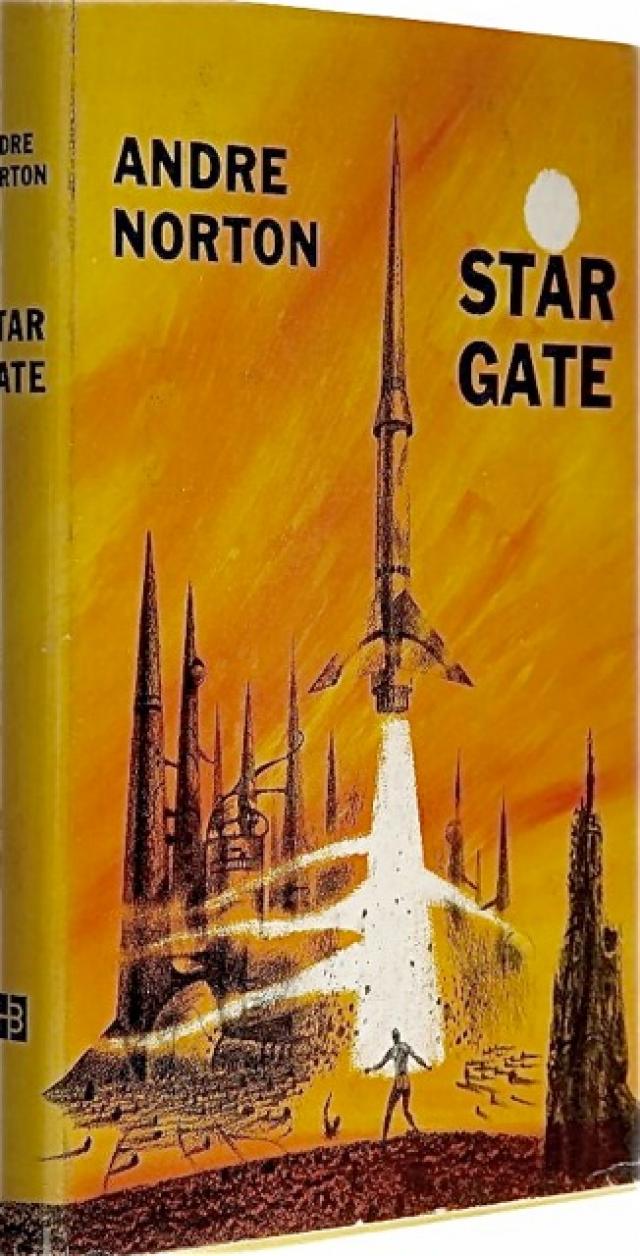


Later Kincar sat in the ring of warriors, half-blood and Star Lord gathered together, listening to Lord Dillan.
"That is the way of itl In this Gorth our kind brought a worse fate than the one we were fleeing from. Here our breed landed in arrogance and seized the country, making the natives slaves. All our wisdom was used to hold Gorth with a mailed fist. Only a few bands who have escaped to the wastes—or are native to those sections as are Ospik's people —are free. This is the evil Gorth that ours might have been."
"We are a handful against many." Lord Jon spoke musingly. "Yet this is in a manner our ill—"
"Aye, a handful. And this I say—which is only good war wisdom—we must make no moves until we know more of what lies here." That was Lord Bardon. He alone among the Star Lords in the hold had been born in the Star ships before the landing on Gorth. He had chosen to remain with this party because he had Gorthian children and grandchildren —a daughter sat in the circle of women to the left, two boys of her bearing were among the children.
Kincar was only half listening, being more set upon estimating the fighting strength of their party. Fifty in all had essayed the adventure of the gates. Twenty of these were women and young maids, ten were children. Of the remaining males eight were Star Lords, ranging from Lord Bardon to the young Lord Jon—Sim, Dillan, Rodric, Tomm, Joe, and Frans. It was difficult to know their ages, but none of them had the appearance of a Gorthian past his fortieth summer. The mysterious change that had come upon their kind during the voyage across the void had set its seal heavy upon them.
The twelve swordsmen of half-blood were all young, but all tested fighting men, and Lord Jon's eldest son could soon be numbered among them. A good tough force—with such behind him no man would hesitate to foray. And the Star Lords had their own methods of fighting. Aye, had he been faced with an attack on a hold, Kincar would not have hesitated to raise his banner for a spear-festing.
But they were not going up against any hold or Gorthian force, they were to front Star Lords, twisted, vengeful Star Lords who used all of their secret learning to hold the rule of this world. And that was a very different thing. None of them here were so unblooded in war as to vote for a spear-festing before the full strength of the enemy could be ascertained.
However, they had won Ospik's support. The mountaineer, at first without comprehension, was at last forced to accept the evidence given him. Now he was eager for-an alliance between his people and the hold party. It had been hard for him to think of Star Lords as friends, but once he could believe that comradeship possible, his agreement was wholehearted. And it was decided that he must return to his own hidden stronghold and promote a meeting between his Cavern Master and the others.
Before nightfall Ospik was on his way. But Kincar had a private puzzle of his own keeping him silent. He was in Cim's stall, spreading dried grass he had brought to bed down the larng, when a brighter gleam of light by the door told him he was no longer alone. Lord Dillan noted with a nod of approval his efforts to make his mount comfortable.
"That is a good lamg." There was a hesitancy in that opening. The Star Lord had come to speak on a subject far removed from the care of mounts, and Kincar sensed it.
"He is Cim." Kincar ran his hands caressingly about the pointed ears of the kneeling beast, stroking the callous spots where the reins rested. "I found him in the trapping pens, and he has been mine only since then."
Inside he was as shyly hesitant as Lord Dillan. Since that hour in Wurd's death chamber, when the tightly ordered existence that had always been-his world had broken apart, when all security had been reft from him, he had tried to push aside the truth. It had been easier to accept exile from Styr, the prospect of outlawry, than to believe that he was not wholly Gorthian.
Now he did not want to face the fact that his father had been a man such as Dillan—perhaps resembling Dillan closely, since they had been brothers. Why—because he was afraid of the Star Lords? Or was it that he resented the mixture of blood that had taken from him the sure, ordered life of Styr? He never felt at ease in their company as did Jonathal, Vulth, and the others who had associated with the aliens from birth.
Perhaps his reluctance to acknowledge his mixed bloods was fostered by the fact that of all of them here in the hold, he alone had no outward marks of non-Gorthian heritage. Some of the others were taller than natives, others had eyes of a strange color, hair, features— And at a moment such as this, when he was forced to realize his bond with off-world kin, his first and strongest reaction was a wariness, the wariness of a man compelled to imposture and foreseeing exposure.
Dillan set the lamp he carried on the floor and leaned back against the stall partition, his fingers hooked in his belt.
"Rud's son," he said quietly, giving the proper name the same unfamiliar turn of pronunciation he had given it at their first meeting.
"You do not see him in me!" blurted out Kincar.
"Not outwardly." When Dillan agreed so readily, Kincar had a pinch of nameless discontent. "But in other ways—"
Kincar voiced the question that had been in his mind all afternoon.
"Ospik says that a Lord Rud rules this district for the Star Lords. Yet how can that be? For if the Lórd Rud who was my father is dead these many years— Another Lord-maybe a son of full Star blood?"
Dillan shook his head. "I think not. This is a tangle we had not thought to find. Perhaps in this Gorth there are counterparts of us—the selves we would have been had chance, or fate, or the grand design taken another road. But that would be a monstrous thing, and we would indeed be caught up in a nightmare!"
"How could a man face himself in battle?" Kincar had followed that thought to its logical end.
"That is what we must discover, youngling. Let it suffice that the Rud who rules here is not he who fathered you— nor could he be—"
"Aye, Ospik made it plain that in this Gorth. Star Lord and native do not mate—"
"It is not that only." Dillan brushed the comment aside impatiently. "Nay, it is that the Rud who, by his way of life, his temperament, is content with things as they are in this world is not the Rud of our world. They would have no common meeting point at all. Rud was born in our Gorth three years after the landing of our ships, thus being my elder by a full twenty of warm seasons, the son of another mother. He had four ladies to wife—two of Star blood, two of Gorthian inheritance. Anora of Styr was his last, and she outlived him by less than a full year. He left behind him two sons and a daughter of full blood—they departed on one of the ships— and one of half-blood, you. But of you we were ignorant until Wurd sent us a message three months ago when he foresaw what might be your fate under Jord's enmity. He had kept you apart from us, wishing to make you wholly Gorthian that you might serve Styr the better, so that you have none of the common memories that might help you to adjust now. But Rud, your father, was rightly one to stand sword-proud, and glad we are that his blood lives on among usl" "But you are of Rud's blood."
"Aye. But I am not as Rud. He was a warrior born, a man of action. And in a world of action that means much." Dillan smiled a little wearily. "I am a man of my hands, one who would build things I see in dreams. The sword I can use, but also do I most readily lay it aside. Rud was a mord on the hunt, ever questing for adventure. He was a sword-smith rather than a song-smith. But it is hard to describe Rud to one who knew him not, even when that one is his son." He sighed and picked up the lamp once more. "Let it rest that the Rud we knew was worth our allegiance—aye, our love. And keep that ever in your mind should fate force us to foray against this other Rud who holds false wardship in this Gorth-"
He lingered at the door of the stall. "You have made Cim comfortable. Come back to the hall now—we hold warrior-council in which each swordsman has a voice." a They ate in company, sharing the fruits of hunting and portions of their dwindling supplies with scrupulous accuracy. A hungry mord, Kincar recalled, was always the best hunter. No one here went so filled that he could not move mord-swift in attack. He chewed a mouthful of suard meat deliberately, savoring its fat-richness to the fullest extent.
The war council had come to a decision. They would hunt for the present, work to stock the hold with what supplies they could gamer, perhaps trade with the inner men for extra foodstuffs. For the moment they would not venture forth from the valley guarded by the hold. They were far, Ospik had assured them, from the lowlands where the Star Lords of this Gorth kept control, where the might of strange weapons held slaves in hard bondage. But the thought of those who were their counterparts using such perverted power had driven the Lords into a brooding silence. And Kincar suspected that even were Lord Dillan to produce another gate, a new road to still another Gorth, he might not discover any among his peers willing to use it yet. They felt a responsibility for this world, a guilt for what the false lords did here.
Now they mounted a sentry in each of the watchtowers on the hold, marked.out patrol paths for the morrow, divided duties between hunting and scouting among all the company, so that a man would alternate in each type of service.
When the meal was done, the Lady Asgar came to Kincar, in her hands one of the small singing-string boards of a traveling song-smith.
"Kincar, it is said that you have in song memory the saga of Garthal and his meeting with the 'inner men.' Since we have this day proven a part of that story to be no tale but the truth, do you now let us hear all of Garthal's spear-festing and the Foray of Loc-Hold."
He took the frame of the singing-strings on his knee shyly. Though he had played song-smith in Styr Hold, he had never thought to do so in such company as this. But "GarthaTs Foray" was a song not too well known nowadays, though it had been a favorite of Wurd's and Kincar had had good lessoning in its long swinging stanzas. Now he struck the two notes and began the rising chant—the tale of how Garthal went forth as a holdless man and came to Loc-Hold, and how he was later cheated of his fight-due so that he fled to the mountains with anger in his heart. Those about him, Lorpor, Vulth, Lord Jon, Jonathal, drew their swords and kept time with the sweet ting of blade against blade, while eyes shone in the lamplight and there were the voices of women bringing in the hum of undersong. Not since he had ridden out of Styr had Kincar known that sense of belonging.
FIRST FORAY
They had their meeting with the chief of the "inner men." He came warily and armed, with a covering guard who prudently prepared an ambush. All of these precautions proved to the men from the hold the deep-seated distrust of, and hatred held for, the alien rulers of the plains by the native Gorthians. But at the conclusion of their council, the chief had been forced to admit that there were now two kinds of Star Lords in his land, and the later-come variety were not the wrathful "gods" he had always known. He did not go so far as to reveal any of the details of his own keep, though he did agree to a measure of trade—to supply dried fruits and coarse meal for one of the inexhaustible star torches.
The "inner men" were by long training fire workers in metal. They produced, for the admiration of the hold, coats of ring mail, fine, deceivingly light in weight—but, unfortunately, fashioned only to fit the small bodies of their own race, as were their beautifully balanced swords, which were too light and too short of hand grip for the newcomers. Lord Bardon, surveying these regretfully, went on to other plans. And the next day when he was in the hunting field with Kin-car, he suggested that Vorken be set about the business of marking down game, while the younger man aid ,him in a different search.
"A sapling?" puzzled Kincar. "For a new kind of spear shaft, maybe? But such as we seek now would be too slender, would break at the first thrust which had any power behind it."
"Not a spear. It is intended for another weapon, one from the older days on the Star world from which our fathers came. It was a favorite there of primitive men, but it was so well used that the old tales say it gave him an advantage over warriors clad in mail."
At the end of the day they returned to the hold with a good selection of different varieties of tough yet resilient wood lengths lashed upon the larng-burden of meat for the pot. Vorken, not being under obligation to consider the worth of saplings, had proved a more alert hunter than the men.
Since Lord Bardon had only hazy memory to guide him in the manufacture of the new weapon, they spoiled many lengths of wood, choosing others badly. However, at the end of three days they produced crude bows. Arrows followed. They learned, mainly by mistakes, the art of proper heading and feathering. Now three quarters of the population of the hold had taken a hand in the work, and the hall after the fall of night was a fletcher's workroom.
They discovered that the pull of the bows depended upon the strength of an individual—that the mighty six-foot shaft that served Lord Bardon could not even be strung by any half-blood, while Kincar—with a smaller and lighter weapon —could hit the mark in the trials just as accurately and speedily, though perhaps with not the great penetrating force of the Star Lord.
Oddly enough, only Lord Bardon, Lord Jon, and Lord Frans among the full-bloods showed any proficiency with the bow, and there was much good-humored banter aimed at their fellows who were unable to turn marksmen by will alone.
"Too long at machines," Lord Bardon observed as Dillan's arrow went woefully wide of the mark for the third time in succession. "This is no matter of pushing a button; it needs true skill."
Lord Dillan laughed and tossed the bow to its owner. "A skill not in my hand or eye it is certain. But we cannot say that of our brothers."
For, as the full-bloods found it something to be laboriously learned, the half-bloods took to archery with a readiness that suggested that the Three must have given them the gift at birth, to lay dormant waiting this moment. From practice at a stationary mark set up in the courtyard, they advanced to hunting, and the rewards came in an upshoot of meat supplies and the growing pile of suard skins to be plaited into cloaks and robes against the chill of the storm winds.
The cold weather had closed in upon them with true harshness. There was one period when they were pent for five days within the hold, the snow-filled blasts sealing the outer world from them. Any plans for scouting into the lowlands must wait upon more clement days.
Lord Dillan and his assistants had to set aside their work on the machine intended to open a gate upon another Gorth. Too many essential elements had been destroyed with the other gates. And, in spite of their questioning of the inner men's smiths and metal miners, some of those could not be rediscovered even in the crude state of unworked ore. They did not speak of this within the hold, though it was generally known. Instead, men began to plan ahead for a lengthy stay there. Talk arose of working the fields in the deserted valley. Surely land that once had supported a large community would provide a living for their own limited numbers.
At last came a lull between storms, when the sun was dazzlingly reflected from the crusted snow and the trees cast wide blue shadows across the ground. It was a day when the crisp air bit at the lungs as a man inhaled, but at the same time set him longing to be out in the open.
Kincar stood on the crown of one watchtower, with Vorken marching back and forth along the waist-high parapet before him, stretching wide her wings and giving harsh voice to her own private challenge. This was the season when the mords of the hatcheries took mates, and Vorken was lonely as she had never been. It would seem that in this Gorth her kind were either uncommon or had never evolved from the large and vicious menaces of the mountain heights.
She was so restless that Kincar was worried. Should she go out in search of her kind, she might well never return. Yet he knew that if he tried to restrain her by caging, her restlessness would develop into a wild mania centered only upon escape, and she might beat herself to death against the walls of her prison. In order to keep her, he must leave her free, holding to the hope that she would come back at some time of her own choosing.
With another eerie cry, she gave a leap that carried her up and out, climbing in a tight spiral until he could not see her at all. He beat his cold-numbed hands against his thighs, striding back and forth to keep his feet free from the frost-deadening chill as he waited. But there was no Vorken planing down wind, no shrilling whistle. It was as if the mord had gone out through some hole in the sky.
"She is gone?" Snow crunched under Lord Bardon's boots. "I thought the wild fever must be on her when I saw her this morning."
"I couldn't cage her," Kincar argued in his own defense. "Without a hatchery she would have gone mad in a cage."
"True enough. And, though we have not sighted any of her breed here, boy, that is no reason to think that they do not exist. Perhaps in the lowlands she will discover a hold with a hatchery."
That was poor comfort, but it was the only hope he had to hold to. And he knew that in setting her free he had saved her life.
"To lay bonds upon any unwilling living thing, whether it be man or beast, is evil." Lord Bardon rested his hands upon the parapet and stood looking down the cleft of the entrance valley toward the plains. If all they -had heard was true, there lay a bondage far worse than the alliance between trained mord and hunter. "Service must be rooted in the need to form part of a pattern. In that way it is security of mind—if not always of body. Vorken serves you in some ways, and you in exchange give her the returns she wants. At present she must be left free for what is important to her, as is right. And now, Kincar," he glanced down with a smile, "I have a service to offer you. Aftr many delays our friends of the inner mountain have decided that they may offer us a measure of trust. They have sent a message that they will show us a sheltered and secret way to look upon one of the main highways of the lower country and assess the traffic that passes there." "In this weather?"
"It would seem that the cold season does not hit so heavily in the plains as it does here. Also the Lords of the lowlands have their reasons for keeping the lines of communication open. Where men live in distrust and fear, speedy travel is oftentimes a necessity. But, at any rate, we shall be able to see more than we do from here. And if you wish, you may ride with us."


