

Star Gate, page 5
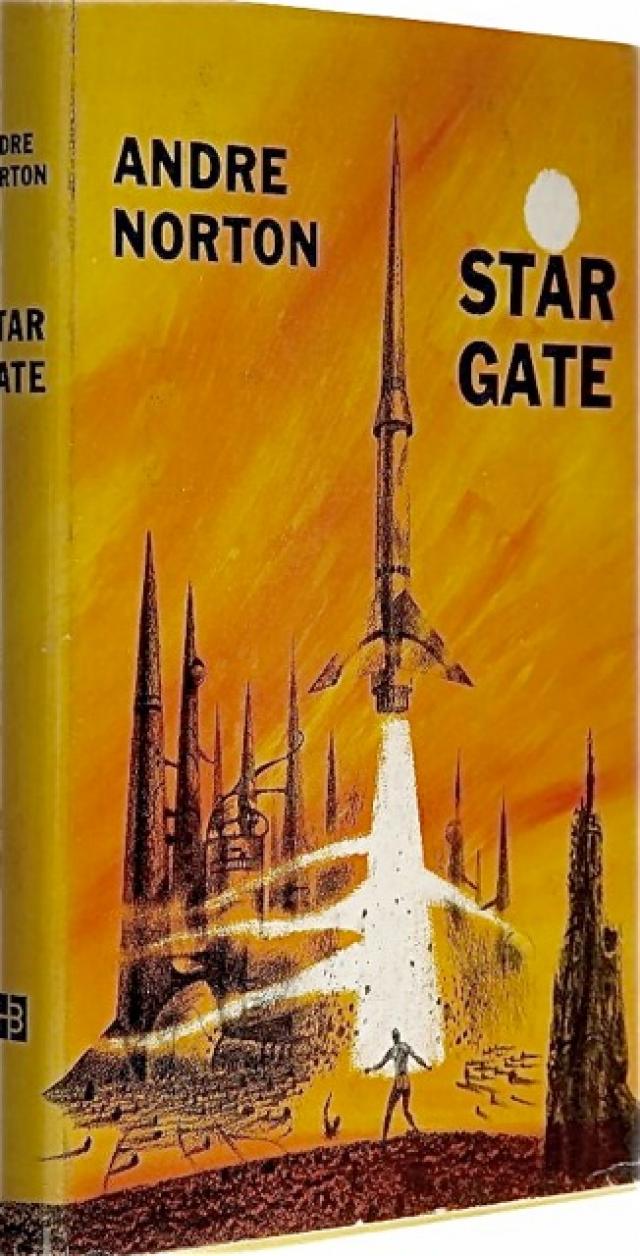


Kincar could not understand his surprise. Of course he had spent the night with Cim. Where else did a warrior sleep on the trail but with his larng? The stone was hard, aye, but a warrior did not notice such discomfort—he must be prepared to accept as a matter of course far worse.
The half-Gorthian with the Star Lord set down his two buckets and chuckled. "Lord Bardon, he but follows custom. In enemy territory one does not separate willingly from one's mount. Is that not so, youngling? But this is not enemy territory now. Tend to your beast and then in with you to the hall. There is no need to freeze in the line of duty." Then he added with the bluff good humor of a captain of guardsmen to a new recruit, "I am Lorpor s'Jax, and this is the Lord Bardon out of Hamil."
Hamil—another far distant district in the west. Indeed this in-gathering had caught up those from odd corners of the world. Having fed Vorken, Kincar fell to and helped the others care for the line of larngs. The animals, used to sparse feeding during the cold months, were given slightly larger rations of journeycake because of their recent hard usage. But most of them were already settling into a half-doze that carried them through the short days of snow-time, unless their services were needed. Cim's upper eyes were fast closed when Kincar returned to his stall to collect bags and Vorken, and his lower ones regarded his master with a dull lack of interest.
Vorken allowed herself to be picked up, but scrambled out of his arm to cling to his shoulder, balancing there a little uncertainly, her injured wing trailing down his back. Lorpor inspected the burn on the leathery skin and whistled softly.
"Best show her to the Lady Asgar—she has healing knowledge. Perhaps she can cure that so this one may fly again. A good mord—of your own training?"
"Aye. From the shell. She was the best of the hatchery at Styr."
Lorpor had fallen into step with him as they crossed the snow-drifted courtyard toward the middle portion of the hold. And now Lord Bardon shortened pace so that they caught up with him.
"You came in with Dillan?" he asked Kincar abruptly.
"Aye, Lord. But I was not of his following. I am from Styr Hold in the mountains—" Kincar volunteered no more information. He found Lord Bardon's sharpness disconcerting—hinting that he had no right to be there. Yet Lord Dillan had received him readily, so perhaps this brusqueness of speech was peculiar to Lord Bardon. Never having been among those of the pure Star blood, Kincar could only watch, listen, and try to adapt to their customs. But he felt no ease in their presence as did the other half-bloods such as Jonathal, Vulth, and Lorpor. In fact, that ease of manner between them and the Star Lords in turn made him oddly wary of them. And for the first time he wondered about his father. Why had he, Kincar, been sent away from Terranna, back to Styr, when still a baby?
True, it was the custom that Hold Daughter's Son lived where he was heir. But neither was such a boy kept so great a stranger to his father's clan and kindred. Kincar had always thought of his father as dead—but— His boot sole slipped on a patch of snow, and Vorken hissed a warning in his ear. What if his father still lived? What if he was to be found among the lords of this company? For some reason Kincar, at that moment, would rather have faced a ring of swords barehanded than ask information concerning the "Rud" whose name he had always borne.
"Styr Holding—" Lord Bardon repeated that as though trying to recall some memory. "And your mother was—?"
"Anora, Hold Daughter," Kincar returned shortly. Let this Lord know that he was not of the common sort.
"Hold Daughter's Son!" If that had not registered with Lord Bardon, it did with Lorpor. His glance at Kincar held puzzlement. "Yet—"
"Being half-blood," Kincar explained against his will, "I could not raise Styr Banner. There was Jord s'Wurd, Hold Daughter's brother, to dispute."
Lorpor nodded. "With the trouble hot about us, that would be true. And to set brother fighting brother is an evil thing. You did well to seek another future, Hold Daughter's Son."
But Lord Bardon made no comment, merely lengthened his pace and was gone. Lorpor drew Kincar through a doorway into a hold hall that was twice the size of any he had ever seen. Huge fireplaces at either end gave a measure of heat, not from any pile of well-seasoned logs, but from small boxes set on their hearths to radiate warmth—some more Star magic. Riding pads were stacked to furnish seats, huddles of traveling bags and cloaks marked the occupancy of individuals or families, and there was a babble of sound through which the deeper voices of the Star Lords made an underthread of far-off thunder.
"Leave your bags here"— Lorpor pointed to a place on the pads—"and bring your mord to the Lady Asgar."
Kincar shed his cloak in the heat of the chamber before Lorpor guided him out of the main room of the hold into a side chamber, which jutted out like a small circular cell. The half-blood halted at a cloak hung curtainwise and called.
"Lorpor, with one who has need of healing skill, my lady."
"Let him enter and speedily," came the answer, and Kincar stepped through to face a woman.
She wore the short divided skirt of a traveler, but she had put aside all head and shoulder wrappings, except for a gold and green shawl caught over her plain green bodice. It was her face that startled Kincar close to forgetting all manners, for this was the first Star Lady he had ever seen.
In place of the long braids of a Gorthian woman, her hair was cropped almost as short as his own, and it lay in waves of gold as bright as the threads of her shawl, doubly bright about the creamy brown of her skin. The eyes she turned toward him were very dark, under level brows, and Kincar could not have guessed at her age, except that he did not believe her to be a young maid.
She saw at once the purpose of Kincar's visit and held out her hands to Vorken, giving a chirruping cry. Knowing the mord's usual response to any touch, Kincar tried to ward her off. But Vorken surprised him by climbing down along his arm and reaching her long neck, her hideous head, to those brown hands.
"Do not fear, boy." The Lady Asgar smiled at him. "She will not savage me. What is her name?"
"Vorken."
"Ah—for the Demon of the Heights! Doubtless it suits her. Come, Vorken, let us-see to this hurt of yours."
The mord gave a short leap, beating her good wing to the lady's grasp.
She carried the mord over to the full light of the window, examining the drooping wing without laying hand upon it.
"A blaster burn. But luckily only the edge of the ray caught. It can be restored—"
She held Vorken close to the wall, and the mord, as if obeying some unspoken order, caught at hollows in the store with all four of her feet, clinging there while the Lady Asgar went to some bags and brought forth a tube of metal. This she pointed at Vorken's hurt and held it so for a long second.
What she did or why Kincar did not know. What he was acutely conscious of was the Tie, again awakened to angry life against his flesh. And, perhaps because this was the fourth time he had known such torment, he reeled back against the wall, unknowing that his face was a haggard mask, that Lorpor was watching him with a surprise close to horror. Only dimly did he feel an arm flung about his shoulders, was only half aware of being brought back against a sturdy support that kept him on his feet, while the Lady Asgar spun around, her astonishment altering to deep concern.
V
A QUESTION OF BIRTHRIGHT
Only for a moment did Kincar remain so steadied, and then, the stab of the Tie less, he pulled away, glancing up to see that it was Lord Dillan whose hands still rested on his shoulders. The rigid brown mask, which, to his untutored eyes, served all the Star Lords for a face, had a new expression. And Dillan's voice, when he spoke, was warm with concern. "What is it, Kincar?"
But the young man freed himself with a last twist and stood, one hand at the breast of his scaled shirt, schooling his body, his nerves under control. He who carried a Tie was honored above his fellows, as well as burdened, but his guardianship was not for the knowledge of others—certainly not for the outland-born Star men. So he fronted all three of them with the same wariness he would face a company of strangers in a time of clan feud when enemy was not yet sorted from friend.
When he made no answer, Lord Dillan spoke to the woman.
"What happened?" He used the common speech, purposely Kincar suspected. Kincar himself wanted nothing more than to be out of that room and away from their prying eyes.
"I used the atomar on the mord—it has a ray-burned wing."
"The atomar," Lord Dillan repeated, his attention once more fixed on Kincar, as if by his will he could force the truth from the young man.
"He fears the Star machines—" That was a newcomer speaking, and there was contempt in his voice. Vulth stood in the door, eying Kincar as he would some wood creature
brought in by a hunter. "It was so that he flinched upon passing the gates—as well I saw. Doubtless at his hold they held to the old belief in night demons and howling terrors—"
Kincar was ready with a hot retort to that, but he did not give it voice. A good enough explanation for his behavior if they had to have one, one that made him less of a man, that was true, but it was better to shrink in the regard of these (though that in its way carried a hurt also) than to reveal what he carried.
A brown hand closed about the wrist of his sword hand, keeping him where he was, and the Lady Asgar was beside him. Something in her manner must have relayed an order to both Vulth and Lorpor, for, after glancing from her now impassive face to that of the Lord Dillan, they went out, Vulth unhooking the upturned corner of the cloak door and letting it fall to give the remaining three privacy.
Kincar tried to follow, but that hand still gripped his wrist. Short of forcibly twisting free, he could not leave. But when the Lady Asgar spoke, he lost his desire to do so.
"The Tie of the Three is a heavy weight for the bearing—"
His hand flattened convulsively against that weight. Mechanically he gave the proper response.
"To the bearer it is no weight, it is a lightener of loads, a shortener of ways, a brightener of both day and night."
Now her hand dropped, away. "So did I think!" Swiftly her fingers sketched a certain sign between them in the air, and he stared at her wonderingly.
"But"—that was half protest, half unbelief—"you are wholly of the Star Blood. You do not tread the Rod of the Three!"
"To each race there are certain beliefs granted." She spoke as she would to a child under instruction. "We, too, have our powers—though they may not take the same form for our worshiping. But all who follow Powers of Light give faith and belief where it should be. I, who am counted as a wise woman among my people, share in part the learning of the Three. Could I give you these signs were that not so?" Again she cut the air with brown fingers—those ten fingers so alien to his own twelve. "But, Kincar, this you must know for your own protection. Some forces which we bend to our use can in turn make a Tie serve as a transmitter, should one be within the range of their influence. And the greater the volume of that force, the greater its focus upon the Tie. To cross the web—" She shook her head. "You must bear wounds now as deep as if a sword had struck you down. Those must be treated before evil comes of them." "As you treated Vorken?"
She shook her head. "That force would only add to your torment. The healing of Gorth, not the healing of Star lore, must be brought to your flesh. But that healing is also mine. Will you suffer my tending?"
He could accept her knowledge; she had given him good proof of what she knew. But Lord Dillan? She might be reading his thoughts, for now she smiled and said, "Did you not know that Lord Dillan is also a healer—of our clan? Though his healing reaches out into twisted minds instead of serving lamed bodies. He has taken the Inner Path, been a disciple of the Forest, with the Seven Feasts and the Six Fasts behind him these many years."
"I was a man of Gormal sVarn." Lord Dillan spoke for the first time. "Though that is indeed now many years behind us—"
Gormal sVam! The leader on the Path who had lived many years before Wurd's grandmother! Again that oppressive feeling of the past that clung to these walls and was also a part of the Star people lapped about him. But in that moment he surrendered his will to the two, given confidence by their learning.
It was the Lord Dillan who aided him with the buckles of his scale shirt, helped him draw off the jerkin and soft shirt under it, while the Lady brought out from her bags small jars, two of which she opened, spreading a rich fragrance of dried summer flowers and grasses in the cold, too ancient air of the place.
The Tie swung free, but at the point where it had been cradled tight to his flesh, there was a deep scored mark of angry red, a brand of burning as deep as if white-hot metal had been held there to his torment.
The Lady Asgar produced a skeleton of leaf, which lay like a cobweb across her palm. On this with infinite care she spread creams from her pots, first dipping from one and then the other, blending the oils into the wisp of thing she held, working with the care of an artist applying the last touches of color to some masterpiece. Vorken climbed down the wall and crawled to her feet. The mord's head swayed to and fro on her long neck as she savored the scents that came from the pots. And now and again she gave a beseeching chirrup.
Lady Asgar laughed at the mord's excitement. "Not for you, winged one." But the mord continued to crouch before her with hungry eyes upraised.
The web-leaf with its healing salves was applied to Kin-car's breast, adhering there as tightly as if it were another layer of skin. But neither Lord Dillan nor the Lady touched the Tie. But she studied it carefully and asked, "Are you a Looker, Kincar?"
He made haste to deny any such power. "I am nothing, Lady, save Kincar s'Rud, who was once Hold Daughter's Son to Styr and am now a landless man. This came to me from Wurd who was Styr. And it came secretly. I found it among my gear when I was quit of the Holding. I have no power of its bestowing, and I think that Wurd gave it me because by right I was Styr and only ill chance took my inheritance—"
But Lord Dillan shook his head slowly, and Kincar could read the dissent on the Lady's more expressive face.
"A Tie does not pass by chance, Kincar, you know that. If Styr was a guardian, then his was the need to select the one who came later, and the man he chose would not be fitted by birth or kinship, but by what lay within him. Also the Tie is always given secretly, lest evilly disposed ones intercept it and corrupt its use to their own purposes. You may not yet have the powers, but who can say that you will not—"
It was the Lady who interrupted. She stood rubbing her ringer tips slowly together and so dispensing a flowery scent to the cold room. "The Tie is of the Gorth we know. I wonder whether it will function in this Gorth also—"
Kincar had picked up his swordbelt. The plaster had not only soothed the burn, he was feeling more vigorous than he had since he had passed through the web gates. "The Gorth we know—this Gorth—" Those two phrases rang oddly. As he hooked the belt about him, he puzzled over their meaning.
"This is Gorth?" he ventured.
And he was relieved when Lord Dillan nodded. But then the Star-born continued bewilderingly, "This is Gorth, but not the Gorth into which you were born, Kincar. Nor is it the Gorth we would have chosen to enter. It is a Gorth strange to us and one in which we are friendless and alone."
"You mean—by your magic, Lord, we have been transported over the bitter water seas to the far side of the world?"
The Lady Asgar sat down on one of the riding pads, and straightway the mord climbed into her lap. She sat there, allowing Vorken to nuzzle her scented hands, and now and then stroking the mord's grotesque head.
"We have been transported, aye, Kincar. But not across the seas. Explain to him, Dillan, for as he joined us so late, he will know nothing of what we have done, and we must all face what comes to us with understanding."
"It is this way." Unconsciously Lord Dillan began with the phrase of a song-smith, but his frowning seriousness said that this was no account of fancy. "When it came time that we must go out of Gorth—"
There Kincar found the courage to ask a question that had puzzled him since the news of the Star Lords' withdrawal had come to Styr. "But, why, Lord, was it necessary for you to go from Gorth? Aye, men of ill will have raised their voices. But we never heard such talk until the Lords first said they were going. You have brought the people of Gorth up from forest-dwelling barbarians. Why do you leave them without the shield of your protection when you have so much to give them? Your magic—could it not be shared?"
Again both of them shook their heads. "Instead of being a protection to Gorth, we may have been its bane, Kincar. When a man-child stumbles about the hall, still unsteady on his feet, do you set in his baby hands a war sword and leave him to his own devices? Or, worse still, do you give him such a weapon and strive to teach him how to use it before his thoughts are formed to know good from ill? In our own world we are an old, old people with a long and dusty trail of years between us and the beginnings of our history. We are the warriors of mature years, though still with many failings in judgment, and in Gorth we have put sharp swords into the hands of little children. We thought we were aiding Gorth to a better life wherein man could have many things he had not. So we taught and wrought with our hands and spread out the fruits of our learning for the plucking of those who wished. But, as children, they were attracted by the hard bright things, the metal which could be forged into blades, the mind-turning which could set one man against another. Had we not landed upon Gorth, had we not meddled, perhaps it would be a happier world, a greater world—"
"Or there could have remained just beasts," Kincar said.
"That is an argument-answer which has come readily these past years," the Lady Asgar answered. "But it is a too ready one. And we have it on our hearts that we may have guided children's feet into false paths. Aie, sadness, sadness—" The words of her own tongue came from her, slow and heavy as tears, and Lord Dillan took up the tale once more.


