

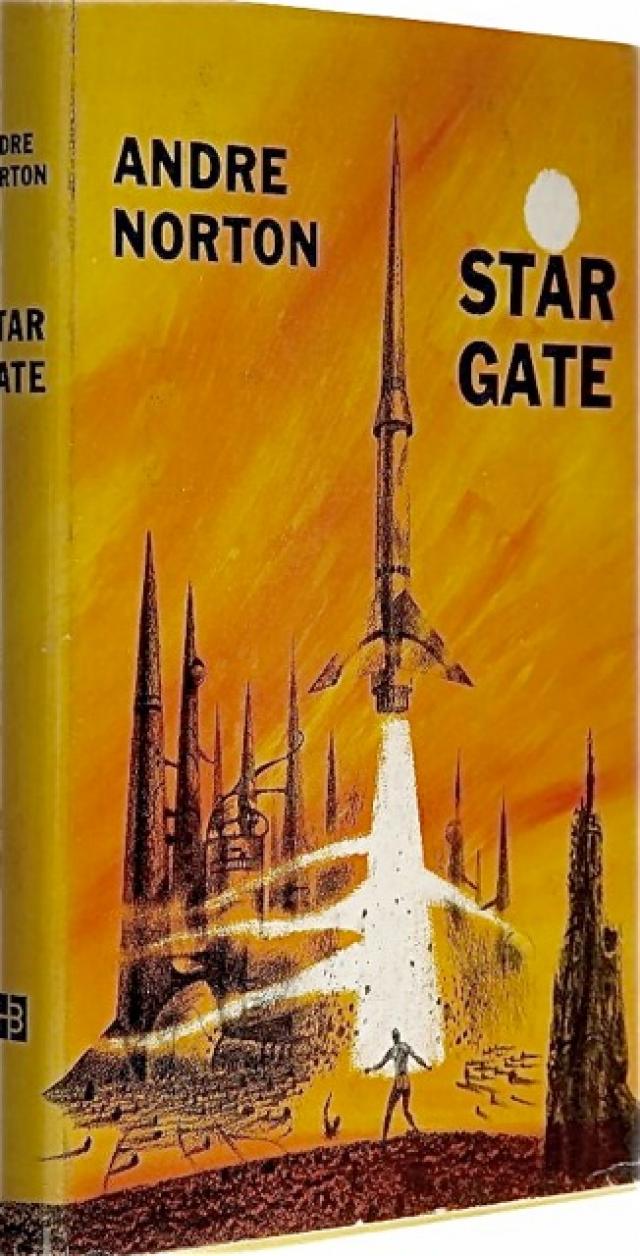
Star Gate, page 3


His own kind, the mixed blood. Kincar studied them curiously. The two guardsmen, at first glance, seemed no different from well-born holding men. And, though they showed Lord Dillan a certain deference, it was that of clansman to close kin and not underling to hold chief.
The physical difference between Lord Dillan and the others was so marked that the longer Cim picked his way behind the leader's mount, the more Kincar came to suspect that he now rode in company with no half-blood but with one of the fabulous Star Lords in person. His great height, the very timbre of his voice, betrayed an alien origin, even though his helm and face mask and the tight silver clothing concealed most of his body and features. Yet neither Jonathal nor Vulth acted as if their leader was semidivine. They displayed none of the awe that kept Kincar silent and a little apart. Perhaps they had lived all their lives in the shadow of the Star-bom and knew no wonder at their powers. Yet in the battle the Lord Dillan had not slain his enemies with shooting bolts of fire, as legend said he might do, but used a blade, longer and heavier than the usual to be sure, but still a sword much the same as that now girded to Kincar's own belt. And when he spoke, it was of common things, the endurance of a larng, the coming of full day, matters that any man riding in company might comment upon.
Vorken whistled her warning from above their heads, and all of them glanced aloft to where she skimmed, wings stretched, gliding on the unseen currents.
"You are well served, Kincar," the Lord Dillan addressed him for the first time since they had left the meadow. "That is a fine mord."
"Aye, a battle bird of pricel" Vulth chimed in. "She is quick with her beak where there is need. Of your training?" he ended politely.
Kincar warmed. "I picked her from the egg. She has had two years of coursing. The best of Styr's hatchery for five seasons at least."
Those whose presence Vorkens' scream had heralded now came into view ahead. The three women on their weary larngs, their escort trailing a length behind with an eye to the rear. He flung up his arm in welcome at the sight of their party and pulled aside to wait, but the women took no heed, keeping on at the best pace their larngs would rise to.
"You have drawn teeth?" the warrior hailed them.
"We have drawn teeth," Vulth replied with grim satisfaction. "They will press us again, but there are now fewer to answer the drum."
As if his words had been a signal, again that ominous roll of sound struck their ears from the back trail. But it was muffled by distance. The hunters had dropped well behind their quarry. Lord Dillan pushed his mount ahead to fall in with the women. They exchanged words in a low voice, and one of the women pointed in a westwardly direction. The Star Lord nodded and brought his lamg to one side, letting the women pass. With a wave of his hand he sent their guard pounding in their wake, while the remaining four slackened speed once more—to provide a rear guard.
Kincar saw with woodswise eyes that they were following a marked trail that had been in recent use, its dust churned by lamg claws in ragged lines. Lord Dillan must have noted his examination, for he said, "We are the last of the ingathering. We have come from Gnarth."
From half the continent away! No wonder their mounts showed bones through thin flesh and the women rode with the droop of weariness in their cloaked shoulders. But certainly they had not been hunted along all that distance? To underscore that • thought, the hunt drum rolled again—this time closer. Vorken sounded her war call, but when Kincar did not wheel to face the enemy, she circled over their heads in widening curves, spiraling up into the new day, her keen eyes on the ground, her attention ready for any move from Kincar that would send her once more in a vicious dive against his foes.
The clumps of leafless brush that had narrowed their path since they left the river banks dwindled into patches of small twisted scrub, arid as dried bones in the now waterless land. And the blue earth under foot was pied with patches of silver sand. They were plainly heading into one of the true deserts of the waste. Yet the spoor of those before them was plain to read, and those with whom Kincar now rode appeared certain of the route.
A sun arose, bringing with it the sickly, warmish wind that was so out of season. And, with the wind, the sand came in thin clouds to plague them. Kincar improvised a mask. He was inured to the usual wind grit that bothered city dwellers traveling, but this was something else. Cim closed two of his eyes and veiled the others with his transparent inner eyelids but showed no other signs of discomfort as he trotted along. Vorken soared above the worst of the eddies.
Outcrops of rock, carved by wind and the tempest-bome sand grains into weird sculptures, rose along the trail, as if they were the ruins of some long-sacked holding. And the track wound about among these pillars and towers until Kincar found himself losing his sense of direction, the more so since he could not pick landmarks ahead through the quick flurries of wind and sand.
He was reduced to following Lord Dillan blindly, and only confidence in that leader kept him in control of a growing uneasiness. He was hungry, and water—the thought of water—was a minor torture. They must have been traveling for hours. How much longer would they shuffle on across this barren waste?
Kincar dragged on the reins, forcing Cim to rear up. The roll of the drum had sounded in his very ear! Yet Vorken had given no warning! Then he heard Vulth's voice, muffled by the mask.
"It is the echo, younglingl They stamp yet far behind us— not now have they outflanked our path. But loose your blade in its sheath; it will drink again before sundown—if we find us a proper battleground."
Ill
NO SHIP-BUT-
The WErRD echoes of the drum made Kincar edgy. To have it blast from one side and then the other grated on his nerves, and he longed to draw his sword and ride with the blade bared across his knee, ready for attack. But those with whom he rode made no such preparations, and he was ashamed so to betray his own uneasiness.
At the same time he speculated concerning their goal. A sky ship berthsd here? Among all the rumors that dealt with the secrets of the wastelands, there had never been one that hinted at such a thing. Those ships at which all of Gorth had marveled had been in the great landing place outside the gates of the now forsaken Terranna. And they were gone, through the pale rose of Gorth's sky, never to return. Had one ship been set here, apart from its kind? When, from time to time, there came short breaks in the force of the grit storm, Kincar held his head high, trying to catch a glimpse of the shaft of metal of a sky ship, which would dwarf all about it.
But, though they bored steadily into the desert land, using the track winding among the pillars, there was no sign—save that same faint road—that man had ever gone that way before. The pillars were growing fewer, and, now that they did not hem in the road, there was the danger of going astray in the fog of wind-driven sand. Lord Dillan slackened pace, sometimes halting altogether for a moment or two, one hand close to his chest, his head bent over it, as if he consulted a talisman. And after each such move he altered their course to the right or left.
Then, as quickly as it had arisen, the wind died, the sand lay once more in dust-fine drifts, and the land about them was clear to the view. They were on an upslope, and far ahead Kincar sighted moving dots of figures, which must be the women and their guard. Those bobbed to the skyline and then were suddenly gone. They might have been sucked down in the sand. A downgrade lay beyond, Kincar surmised, and a steep one or they would not have vanished so quickly.
Jonathal brought his larng up beside Cim, wiping the matted dust from his mouth mask with the back of his hand before he commented thickly, "That was a dry coursel And I've never relished a fight without a cold draft to sweeten the throat—"
"A fight?" Kincar had not heard the drum for a time. He had hoped that the storm had shaken their pursuers from the trail.
"They must attack now." Jonathal shrugged. "This is the last throw of tablets in the game. Once we are over that ridge"—he jerked a thumb at the rise—"they will have lost. We are the last of our kind. With us through, the gate will close—"
Kincar did not understand that reference to the gate, but he understood very well the scream from Vorken's long throat, her skimming dive that carried her black shadow back over the sand dunes toward the pillar-studded land from which they had' just emerged. And now, at last, he drew his sword, rolling his cloak about his left arm as a shield, ready to snap it into an opponent's face if the need arose.
Figures slipped from pillar to pillar, silent, dark, misshapen. Kincar watched that sly, noiseless advance, set his„ mouth hard. For five years or more he had ridden in holding spear-festings aimed against outlaws, and once he had served in a real foray against Crom's Hold. In the last two festings, in spite of his youth, he had taken out Styr's banner as Wurd's deputy. He had known such warfare since his small boy's hand had first been fitted to an even smaller sword hilt under Regen's patient teaching. But this was something else—he was sensitive to a change, wary under a threat he did not understand.
Vorken wheeled back above him, shrilling her battle cry, but not attacking since he had not advanced. Cim shifted foot under him. They must feel it, too, this difference, this odd threat that promised worse than slash of sword, thrust of footman's spear, clash of mounted man against his kind.
His sword dangling from his wrist cord, Kincar brought up his right hand to jerk off his dust mask, drawing in more freely the air for which his lungs felt a sudden need. Jonathal was on his left, sitting at ease on the pad of his gaunt larng, a smile curving his mouth as he watched the pillars with a sentry's eye. On the right Vulth was making a careful business of adjusting his cloak about his arm, testing each fold as he laid it ready. But Lord Dillan, his one hand laced in larng reins, his other still held to his breast, had not drawn his weapon at all or shed his travel mask. Above the strip of silver stuff that matched his garments, his odd light eyes were on the pillars and what moved in their shadows.
"Ride slowly," he bade them. "We do not fight unless they push us to it—"
"They will not let us away out of their jaws," warned Vulth.
"Perhaps they will—unless he who leads them gives the order—" Lord Dillan did not relax his watchfulness or turn his larng after them as the other three followed his orders and headed on.
Kincar was last, reluctant to leave. And at that moment Vorken went into action on her own. Whether the mord misconstrued Cim's movement as an advance, or whether her natural wildness sent her in, Kincar was never to know. But she gave vent to one last whistle and snapped down in a glide toward the nearest pillar.
He did not see the bolt that caught her in mid-air. No one could have sighted the silent, swift stroke. But, as Vorken shrieked in pain, one of her wings collapsed, and she hurtled down toward the sand. Without pausing to think, Kincar sent Cim skimming back to where Vorken lay, beating her good wing in a vain attempt to win aloft again. Her cries were growing hoarser in her pain and rage, and she was hurling spurts of sand into the air with her four feet as she dug fruitlessly with her claws.
Kincar was off Cim. He hit the ground already running, his cloak whipping out to net the frenzied mord. To take her up barehanded was to court deep tears from claws and beak. Somehow he scooped up cloak and struggling creature, cradling her tight against his chest while she snapped and kicked in fury.
There was a shout of triumph from the pillars; a shaggy wave came out of hiding, heading straight for Kincar. He retreated, watchful. His sword was ready, but .Vorken's struggles hampered its free use. He was facing spear points, clubs, in the hands of lithe-moving footmen, and in that moment he realized that the uneasiness he knew was truly fear. The openness of their attack was so removed from their usual methods of battle that it alarmed him as much as the stench from their unwashed bodies made his empty stomach chum.
He gave the cry to summon Cim. But, though the larhg obediently trotted to his side, Kincar could not scramble up on the pad, not with the still-fighting Vorken pressed against him. Yet he would not abandon the mord.
"Yaaaaa—" The shout of the outlaws echoed about him in a worse tumult than the beat of the drum. And behind the footmen, better clad and armed, mounted men were joining in the rush to ride him down.
Then a larng dashed between him and that advance, the sand fountaining about mount and rider. Vulth thrust and raised a dripping blade for a second stroke. More men boiled from the pillars to get at them both.
With the fraction of breathing space, Kincar had gotten up on Cim, his sword banging from its wrist cord. He let the reins hang. The larng was well enough trained to need no guidance during a fight. The mount was snarling, pawing at the sand, and he reared when he felt Kincar's weight on the pad, clawing down one of the spearmen.
Vorken must be half stifled. She had ceased to struggle, and Kincar was grateful for that as he fell to such sword work as would cut a path for Vulth's withdrawal.
A voice shouted incomprehensible words. Lord Dillan replied in the same tongue with a single bitten-off sentence. His blade was out,.and he rode beside Jonathal as if they were the two arms of a single warrior. The outlaws broke, snarling like the beasts they were, and ran, but the mounted men behind them were of a different breed. Jonathal's larng snorted and spun around despite the efforts of its rider to control it. Then it fell with the slack-legged force of an already dead animal and Jonathal was crushed under it, only the soft sand saving him from mortal injury.
Kincar brought Cim up to split the skull of the bareheaded outlaw who had his point at Jonathal's throat as the other fought to pull free of the larng. Then, above the hum of the drum and the cries of the fighting men, there struck a peel as shrill as Vorken's calls. Up over the rise, toward which they had been headed, boiled a group of riders. There were only five of them when Kincar could at last sort them out, but somehow the fury of their charge magnified their numbers into double that score.
They swept past the four, scooping up the outlaws and bearing them along by the force with which they struck into the melee. But they did not pursue past the line of the pillars, wheeling there so shortly as to make their lamgs rear and totter on their hind legs. Then they pounded back. One paused to let Jonathal scramble up behind him before they went on, drawing the others with them, over the ridge and down into a deep cup of valley, a bare valley that lay like a giant pockmark in the desert waste.
As they swept across the crest, Kincar reeled, his knees almost losing their grip on the riding pad. The sensation of bursting through an unseen barrier was part of that shock. But with it, and worse, had come a thrill of white-hot pain. So sure was he that some chance-thrown spear had found its target in his body that he stared stupidly down to where he still clasped the muffled Vorken, expecting to see metal protruding from his breast and wondering vaguely how he had survived a blow of such force. But there was no spear point showing, and, as he straightened again, he knew that he had not been hit. Only—what of that stab of agony, the pulse of heat and pain that he still knew beneath scale coat and underjerkin?
The Tiel For some reason beyond his knowing, its unique properties had been aroused in that second when he had topped the ridge. The why of it he could not guess, and he dared ask no questions. Those who were guardian of a Tie in the Name of the Three held that honor secretly, a secrecy accepted without complaint as one accepted the other burdens and rights such a duty laid upon one. He did not dare to touch the place above his heart where that throb beat as if in promise of worse to come.
In the heart of the valley was a camp—a hasty affair of small shelters put together with blankets and cloaks. These were not being speedily dismantled, men throwing rolls and bundles on the backs of lamgs. Beyond the camp stood something else, as different from the primitive shelters as one of the Star ships might be from a trader's wain.
Two pillars of bright blue metal had been based in piles or rocks, the supporting stones being fused into a stability no storm could shake. They were erected some five feet apart, and suspended between them was a shimmering web of some stuff Kincar could not name. It was bright; it glittered with racing lines of rainbow fire that ran ceaselessly crisscross over it—yet it had so little real body that one could see through it to the opposite wall of the valley.
Kincar shifted Vorken's weight upon his arm and regarded this new marvel intently. He had come here expecting to discover a Star ship. He had found a web strung between metal poles. What had his trust in his chance-met companions drawn him into? As far as he could see, they were now trapped. The outlaws need only make one last rush to wipe them out—for there were no more than six men waiting here.
Of those six, four were wearing the silver dress of Lord Dillan, and they were of the same giant stature. They had put off their travelers' masks, and he could see the alien darkness of their hard faces, the features of which lacked the mobility of those he had known all his life. One of them now raised his hand in a salute, which Lord Dillan answered. Then that other lord took in his big hands the leading lines of three of the waiting larngs and moved toward the shimmering web. As they watched, he stepped between the supporting pillars.
There was no discernible break in the web. For a moment the rainbow lines rushed in to outline the figure of the Star Lord—then those colors fled again to the far corners of the screen. But the Star Lord and the larngs he had led—were gone! They did not reappear on the opposite side, and Kin-car blinked at the wavy sight of the rocks beyond where no one—no thing—walked at all!
Vorken gave a faint chirrup in his arms; the tip of her beak pushed forth from the wrappings that netted her. Cim blew noisily, clearing the sand grit from his wide nostrils. But at that moment Kincar could neither have spoken nor moved.
It would appear that the tales of the Star Lords' magic, the wildest tales of all—at which sensible men had laughed indulgently—were true! He had just seen a Star. Lord walk into nothingness, which perhaps a Star Lord might safely do—but what of the rest of them?


