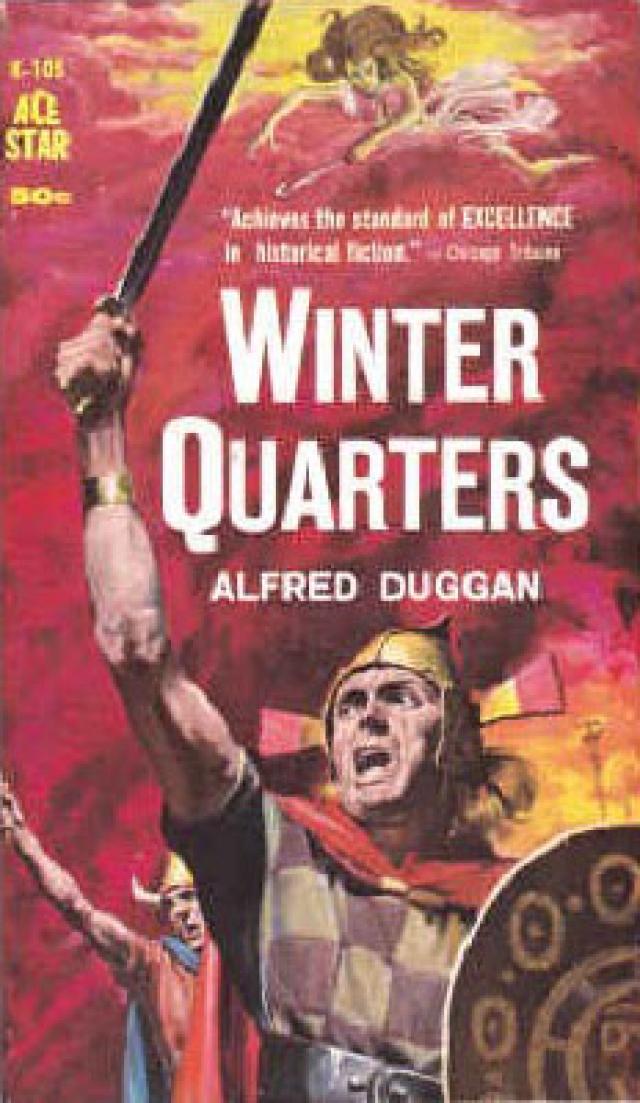
Winter Quarters, page 23


Slowly we surmounted the ridge. At the top I had a brief glimpse to the front, over the heads of our men descending the slope. Before us stretched a wide and shallow valley, with an awkward dry gully at its lowest point. Then the ground rose again to another ridge, perhaps half a mile away. There stood the main Parthian army.
There may have been seven or eight thousand horse-bowmen sitting quietly in loose order. Their front made an extended half-moon straight ahead of us, and they were waiting until we came within range. They seemed quite calm. We heard no war-cries and saw no weapons brandished; whatever happened our dismounted swordsmen could not harm them. Their quiet confidence was most unnerving.
As our van struggled across the gully the enemy advanced to long arrow-range, giving ground again as our foot tried to get to close quarters. The dry stream-bed was a difficult obstacle; we got our horses over with a scramble, but the baggage animals had to be pushed and pulled. At the height of the confusion other Parthians approached our rear, who must turn about to march backwards. These Parthians rode very close, but they did not actually charge.
Their short light arrows seldom killed, but already our wounded were becoming a problem. We could not leave them where they fell. The only solution was to place them on the baggage animals – but that meant throwing away something we needed very badly, or we would not have brought it so far across the desert. There could be no question of jettisoning waterskins, but we had to abandon reserve weapons and the last of the officers’baggage.
When at last the whole army had clambered over the gully we began to plod up the next slope. I had my eyes on the ground, and most of my weight leaning on Starlight, when I was forced to an abrupt halt as the men before me surged backwards. For a minute the whole army stood swaying in its own dust-cloud, until I heard trumpets and shouted commands.
Publius himself loomed over me, calling for the Gauls to get mounted and file to the front. In the saddle I was able to see the obstacle that had halted the Roman advance.
Ahead of us the horse-bowmen had withdrawn well out of range, splitting into two wings to disclose a solid block of stationary lancers. There were certainly a thousand of them, Parthian nobles clad in mail and mounted on great Nisaean war-horses. They held their lances upright while their horses stood still. But our foot would not advance against them – and I was not surprised.
After leading us through gaps in our front line Publius formed us carefully in two ranks. Then, still facing us, he began the speech before battle which is a convention of Roman tactics; though it is not a Gallic custom. On this occasion it did no good; in fact it did harm, for the longer we looked at that motionless line of enormous animals the more frightened we felt.
‘Nobles of Gaul,’ he cried in an exultant shout, ‘to us has fallen a great honour. That little band of lancers is all that stands between us and the plunder of Seleucia; and we, out of the whole army, have been chosen to overthrow them. Never before have Gallic warriors fought in these eastern lands; even the names of your glorious ancestors are here unknown. Today you will make them famous. When I give the signal, follow me to glory and splendid booty.’
He urged his horse into our ranks, and spoke to me privately, in an undertone. ‘Camillus, bring in the second rank immediately behind the first. We shan’t bother with fancy tactics, reserves and delayed shock. We must break those fellows at the first impact, or the whole army will be stuck. If it comes to a standing mêlée the legions can join in, and then we can’t be beaten. But we must go in hard to start with. See there is no flinching in the second line. Acco, you will ride on the left flank, to keep that end of the line from edging clear of the enemy.’
‘No, my lord,’ said Acco stoutly. ‘You are my oath-bound war-leader, and when you charge I guard your bridle-hand. Gallic nobles will not flinch. But don’t keep us waiting. Those Nisaean horses grow bigger every minute.’
‘Very well. We three will ride together in the centre. My father is watching, and he rewards courage more splendidly than any barbarian can imagine. Make for the purple pennon of the Surenas. If we knock him over the battle is won.’
All this suggested to me that we were taking a desperate chance, which Publius himself hardly expected to succeed. Romans despise as barbarous a direct attack on the enemy leader; if Publius was trying it now he must have despaired of finding a better plan. A moment later we were galloping, and there was no time for thought.
My eyes were fixed on that line of huge beasts. I saw their outline change as the lances came down into rest; then they charged, downhill, to meet us.
I was leading the second rank, as close to the first as I could get without striking into the horse in front; near me our men kept up, but on both flanks there was a little understandable reluctance. When we met the foe our formation was a wedge, with Publius and Acco at the point and myself directly behind them.
There is no telling with Gauls. Since the Romans have conquered us I suppose they are the better warriors; but sometimes some Gallic nobles will fight with more than human courage. Publius led us, but we followed Acco – Acco the son of the Wargod, his blue cloak flying behind him, the Raven gleaming above his head, the war-cry of his noble house dinning in our ears. Our wedge broke into the line of huge Nisaean horses.
Then our charge was spent, and we were hacking about at a standstill. I was directly behind our leaders, my sword clean; though a Parthian lance, coming from nowhere, had scored a furrow right across my shield. I could not reach the enemy while Acco and Publius rode before me.
At first the Parthians were hampered by their great poles of lances. Then they dropped them to draw the biggest broadswords I have ever seen. Our Gallic swords were more nimble, and our unmailed bodies swifter; some Parthians tumbled from their saddles, though their heavy mail preserved their lives. The first man I saw killed was Publius himself, who was badly equipped for such a fray. Like other Roman officers of high rank, he carried no shield; and his short Roman sword had little reach. A great Nisaean charger shouldered his horse nearly off its feet, and as he lurched in the saddle a broadsword clove his linen corselet to the waist. He and his horse went down together.
We might have been children fighting against grown men. Those Nisaeans must weigh twice as much as an ordinary horse, and their riders were in heavier mail than any western soldier can carry. We were pushed backwards and hustled off our feet; many of our men were overthrown and trampled flat without ever being wounded.
For a moment Acco alone guarded my front; then he rammed little grey Poplar against the mighty beast which had overthrown Publius. There was one man he had to kill, at any cost; I saw him drop reins and sword as he grasped his adversary round the waist. In his hand was the little ivory-hilted dagger Publius had given him long ago in Gaul; as he strove to stick it under the skirts of the Parthian’s mail he was lifted clean out of his saddle. I am sure he killed his man; but in the same instant another Parthian broadsword bit into his backbone. That was the last I saw of him. I had made no effort to save him, for I knew that he could not survive the fight in which his oath-bound lord was slain. Honour forbids it.
But I had never sworn. I served the Romans for pay, and I thought our charge had been enough to earn our wages. Straight ahead of me rode two Parthian nobles and behind them I could see the empty desert; for the point of our wedge had pierced almost through the enemy’s ranks. Remembering the weak spot in Parthian armour, I dropped my hilt low and thrust upward at the thigh of the man on my right, my shield fended off the broadsword on my left, and when I raked outward with my spurs the two great chargers edged away. Starlight was so terrified that I could not have stopped him even if I tried; but as I galloped free I told myself that the only man to penetrate the Parthian line had done enough for honour.
There was still a cloud of horse-bowmen between me and the Roman legions, but my horse was galloping at full stretch and I came at them from an unexpected direction. They shot arrows after me, but most of them flew wide. I had almost reached the Roman line when a long shot lodged in Starlight’s foreleg; as his other leg blundered into the shaft he turned head over heels as though he had tripped over a rope.
I hit the ground hard, and rolled over and over. The Mare shot out of my hand, and my shield-straps broke. A moment later, completely unarmed, I was staring stupidly at the arrows thudding into Starlight’s ribs; then I scuttled on all fours to the line of linked Roman shields only a few paces away. I nearly reached it unscathed. At the very last moment an arrow nicked the calf of my leg, but I went the faster for it.
Perhaps it was as well that I arrived in that dishevelled condition. If I had galloped up waving a drawn sword the Romans might have killed me first and recognised me after. As it was they hauled me to my feet inside the square. A legionary was binding my wound with wool from my tattered sleeve when the nearest centurion came up to question me.
I told him at once that I had news for the Imperator, and he sent me hobbling off to headquarters. I could walk more easily than I had expected; Parthian arrows are very sharp, and this one had made a neat slit in my calf without damaging either muscle or vein.
The Imperator sat on a pack-saddle, where a little rise in the ground enabled him to see most of the stationary square of Roman infantry. I could hardly make out his expression, for his face was thickly coated with dust and sand; that happens when you sweat and there is no water for washing. He kept his bloodshot eyes almost closed against the glare, and he moved his head very slowly like the tired old man he was. But his mind was alert.
As I drew myself up to salute the legate Octavius brushed past me. He spoke urgently: ‘My lord, you must see this immediately. It’s bad news, though I am sure not unexpected. A few minutes ago a Parthian threw this into our front rank.’
He pulled out something from under his cloak and displayed, as reverently as one can handle such an unpleasant object, the severed head of Publius Crassus.
The old Imperator heaved himself to his feet, gasping and swallowing. ‘Thank you, Octavius. If there is a fire going anywhere will you burn my son’s head on it? That may count as proper burial, and give rest to his spirit. What is the conventional thing one says in these circumstances? I remember. “I never supposed that my son was immortal.” It goes better in Greek…. Well, the battle still rages, and I must direct it. You may return to your post.’
Then he turned to me. ‘Do you also bring bad news? You look like a Gaul. Were you in the Gallic charge? Did you see my son killed?’
‘Yes, my lord. I was close behind him. He rode in front of all his men, and broke the Parthian ranks. He died from one blow of a broadsword, without pain. A good death, such as any warrior would desire.’
‘Yes, a good death. But it came too soon. He was a leader whom men would have followed against even Caesar or Pompeius. He would have been Consul and Imperator…. That’s enough about my family affairs. What happened to the Gallic horse?’
‘They are dead, my lord, behind your son. I made a gap and charged right through, but no one followed. One or two stragglers may get away, but your cavalry has been destroyed.’
‘A thousand horse, and all destroyed? But those Nisaean chargers are more than flesh and blood can face. How many are there of these heavy lancers? Do you think they will charge the legions?’
‘We were not outnumbered, though the great horses outfought us. They cannot be more than a thousand – less, now that they have fought with Gauls. Steady foot ought to beat off even those great horses.’
‘Then the horse-bowmen are still our main adversaries. Their quivers must be nearly empty. Soon we shall get the square moving, and continue towards the Tigris until every Parthian arrow has been shot away. It may work out. Who knows? Perhaps we shall soon see Seleucia.’
As he turned away he spoke to me again, over his shoulder. ‘You are hurt, and I suppose tired and shaken. But there is room in the ranks for every willing fighter.’
He spoke most graciously, as though to an equal. I was so encouraged by his courtesy that I limped off to the nearest cohort, where they quickly found me the sword and shield of a wounded man.
They posted me in the third rank of the second line, so that there were five ranks between me and the enemy; that was all to the good, for I still felt very shaken. But even the men in the front rank stood quiet, their swords sheathed, hiding behind their shields. So far, no legionary had struck a blow, though the rain of arrows continued.
The Parthian horse-bowmen hovered a javelin-cast away; but the Romans had already thrown the two javelins every man carries, and we had no more. There was nothing to be done but to stand in our ranks, where the enemy could do us little harm behind our shields. I wondered what we would drink when night fell.
Beside me stood an elderly man in a shabby civilian tunic, though like me he was armed with a borrowed sword and shield. A rope headstall was tucked in his belt, and I placed him as one of the retired veterans who often take service as transport drivers. He was hot and tired and dirty, but not a bit flustered; his calm radiated a little glow of confidence in our dejected ranks.
‘Hallo,’ he said cheerfully, ‘wasn’t your horse fast enough to escape from the bodyguard? We must be short of reserves, if they are shoving stray Arabs into the ranks. Oh, I apologise. You’re a Gaul. You people can fight, as I know very well. Here we shall have a fine view of the battle, when it starts. It ought to begin in about half an hour. I remember these horse-bowmen. Years ago I marched all through Armenia behind Lucullus. There was a leader! We ought to have stuck by him when he called on us to march against the Senate. Then I would be captain of the guard to the Tyrant of Rome, instead of a broken old muleteer with both my beasts dead in action. But about these horse-bowmen: any minute now they ought to finish their quivers. Then they must either charge or run away. Whichever they do we march to the Tigris, and if we don’t drink tonight we shall wallow in the river by tomorrow. So just take things easy, and save your strength. So long as you keep your shield up they can’t hit you.’
That was what they had told us when we trained during the winter; in an hour or so a horse-bowman must shoot away all his arrows, and then the infantry can chase him. It seemed very simple.
Meanwhile, centurions were trying to get this side of the square to move to a flank. This was the southern face of the formation, and the Tigris lay to the east; so we must turn to our left. But that would mean presenting our unshielded right shoulders to the foe; the men were reluctant, and moved slowly.
I had lost enough blood to make me very thirsty, though now the bleeding had stopped. I was also very tired. But it seemed that our ordeal must soon end; every Parthian arrow fell within our ranks, so that the enemy could not pick them up to use again.
Then from the eastern face of the square came a confused uproar, and the jostling in the ranks that showed something had gone wrong. Orders were passed, with trumpet-blasts and a great deal of shouting. The nearest centurion bellowed that we were to turn about and march westward.
This order was obeyed at once, for it placed our shields towards the enemy. We were worried; in battle nothing is more frightening than a sudden change of plan, which indicates that the high command are trying to counter an unforeseen danger. But Roman legions obey orders and never break their ranks. We moved smartly.
All this time we had been breathing a disgusting mixture of sand, dust, sweat, and the stink of blood, while the thick cloud stirred by our feet made it hard to see farther than a furlong. Now I noticed a fresh ingredient in the stench, something animal but foreign, something I had never smelled in Gaul. The veteran beside me identified it at once.
‘Where are those camels?’ he suddenly asked. ‘They say some Arabs ride camels in war, but I never heard of Parthians doing it.’
Close at hand we could hear the ugly bubbling cry of camels. A dead mule lay in my path, and I stood on it to see over the heads of the front ranks. Camels mingled with the horse-bowmen who still shot at us; mounted Parthians led them, and each of the ungainly beasts was festooned with bundles of arrows. As I watched, three horse-bowmen reached over to replenish their quivers.
‘They won’t run short of arrows,’ I said to my companion. ‘What can we do now?’
‘Make for the nearest walled town, and then go home to Italy,’ he grunted in answer. ‘We can’t beat them, especially now that we have no cavalry. But they won’t do us much harm unless we break.’
From that moment I accepted the fact of our defeat. Until the camels came I had not really bothered about the outcome of the battle. That was something for the high command, who fed us daily and paid us punctually; if they were rebuffed today they would find a way round tomorrow. Now I knew we had lost the war. But I still did not suspect that I myself was in any danger, in the second line of a Roman legion, one of seven Roman legions marching together.
Presently Parthian lancers, and a few horse-bowmen, began charging into our rear. Whenever this happened the whole square had to halt while the rear faced about; but they never broke in.
My leg throbbed as the wound stiffened, and at every step I felt more lame. I looked towards the centre of the square, where baggage mules were carrying wounded men. But we had very few mules, and all were heavily burdened. The setting sun flayed our peeling faces, and every time I stumbled I groaned aloud in agony. There was nothing to do but keep on.
The next thing I remember is the legate Octavius riding up on a three-legged mule. He seemed quite composed. He was telling the whole army our new plan, which was to march through the night until we reached Carrhae, where there were strong walls and plenty of water. Inside the town we would be safe.
Probably I had a touch of fever. The veteran from the transport helped me over some rough patches, and then he was no longer beside me. I hope, for his sake, an arrow found his heart; that was the best ending to that nightmare march. One other incident sticks in my memory. A centurion with a broken leg lay in my path, waving his money-belt and offering all sorts of rewards to anyone who would carry him; no one had the energy even to cut his throat and take his savings. That was the first time I knew for certain that we were abandoning our wounded.