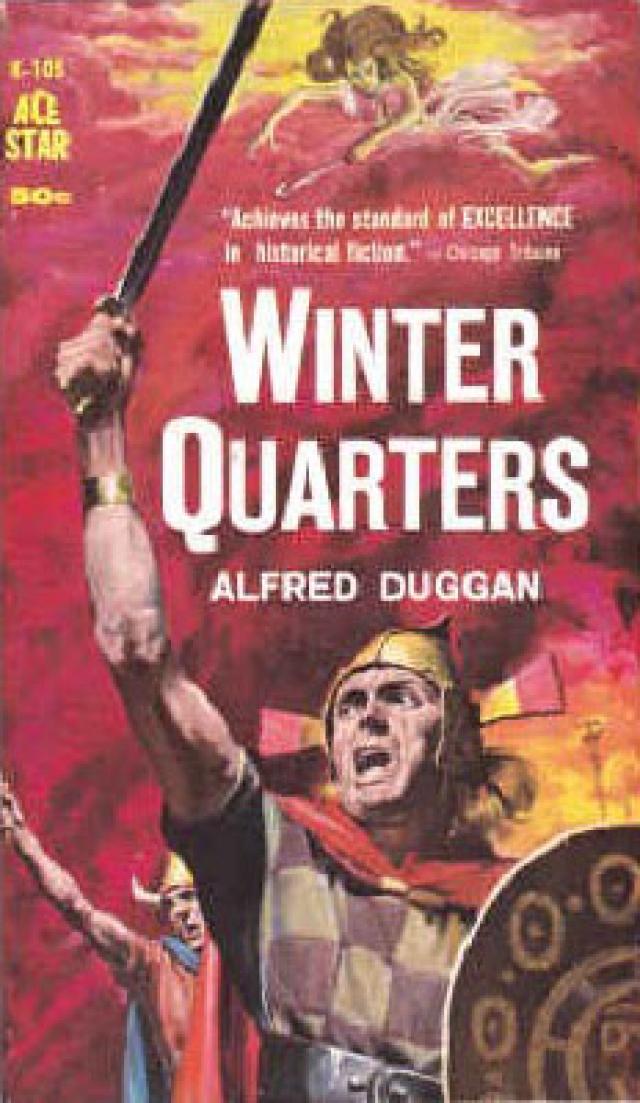
Winter Quarters, page 2


Marcus faced me, and spoke formally in Latin. ‘I, Marcus Sempronius Capito, of the Scaptian tribe, a citizen, hereby take to wife Gaia, daughter of a citizen of unknown gens and tribe, in the presence of Marcus Licinius Camillus, citizen.’ Then he relaxed, smiling.
‘There,’ he said cheerfully, ‘you don’t often get so many legal fictions in one sentence. Her name isn’t Gaia, her father is no citizen, and you are not a citizen either. But it’s the best I can do. Perhaps my children will be legitimate.’
At last I understood. ‘Then you are staying for the rest of your life? You won’t try to escape? Then why bother about the status of your sons, if you have any?’
‘Because Rome never forgets. With Caesar dead we shan’t be rescued for years, probably not before I have died of old age. But rescued we shall be, in the end. My sons will grow up Parthian soldiers, and their native tongue will be Margian. Yet if they want to go back to civilisation when the time comes, perhaps they may claim citizenship.’
He wrote a few words on a scrap of sheepskin, and asked me to seal it by pressing my finger-ring on a blob of clay. He wrote so easily and quickly that it gave me an idea.
‘I also shall stay here,’ I said, ‘and my girl has already borne me a son. He cannot be a citizen, but one day he might return to his father’s people, if rescue comes. Yet if I am dead he will know nothing of his rightful inheritance far in the west. Marcus, will you write down my story as I tell it? Then if my son ever gets free any Roman can read it to him.’
I had made up my mind on the instant. I would live and die in Margu. I had intended, one day, to run away and join the Red Riders; that was why I had taken a Scythian concubine, who could teach me the language. The Red Riders are treacherous and cruel, but strangers who can ride and fight are sometimes permitted to enter their tribe.
Now that I am staying, I see that there is something to be said for Margu. You get enough to eat here, and the horses are magnificent. But the best thing about it is the absence of the Goddess. Since even his mother worships only the North Wind and the naked sword, my little Acco will grow up a true warrior, never pestered by the things of the women. He is named for my best friend, whom the Goddess and the things of the women hunted right across the world; it will be my revenge on her and them to see him a man all through, bowing only to men’s gods.
‘That will be one way of getting through the winter,’ answered Marcus. ‘You may dictate to me here in the evenings. Say what you like about the men of my City, who have left me here to rot. I shall write out fairly exactly what you tell me.’
As I walked home the frozen mud and straggly trees looked more friendly. This was now my home, and the North Wind was now my protector; the naked sword has been my protector for many years.
Here follows my story.
1. The Hills of Pyrene
My true name is long and complicated, and if strangers know it they will be able to cast spells on me. I shall only say that I am a Gallic noble, born thirty-one years ago, and that my friends call me Camul. My father’s name is not important either, but his position in our nation must be mentioned; he had inherited the office of horse-master to all the cavalry of the Elusates.
My people live among the northern foothills of the great range which separates the Gauls from the Spaniards. These mountains are the domain of the nymph Pyrene; but our valley, and the slopes which enclose it, are especially her home. West of us, among the high crags, live the Basques. No stranger can learn their tongue, their idea of fighting is to throw stones from a distance, and each of their tiny hamlets is a sovereign state, bound by no ties to its neighbours. We were not always at war with these queer people, but we did not often visit their land.
On the south we have no neighbours, until you cross the range and come down among the Spaniards; to the east and north live other Gallic tribes, our cousins, rivals, and friends. Farther to the east the Roman strangers hold sway, though their own land is a long way off. They held the country only because through it runs their great road to Spain, which they rule; so they did not bother their neighbours to the west. We heard a great deal about them, especially about their invincible power in war; and we took great pains to keep on good terms with them. This was easy, for as they marched up and down their great road they were always buying food and military supplies. We sent them grain and cattle, and the iron ore of our mountains; they were glad to get it, and paid honestly in coined silver, every piece of the same weight and fineness. We were free to use their great road, in small numbers; but these trips were not very enjoyable, for their soldiers despise all foreigners.
Our own land is a fertile grassy valley, hemmed in on three sides by mountains; though we also rule narrower valleys to east and west. Most of our land is stony and steep, and too rough for horses. But Gallic nobles must fight on horseback, so in the main valley we keep a herd of mares and a few stallions; these are national property, supported by the grain of every landowner. My father managed this herd, as his father had done before him; and when he died the post would come to me, his only son. So you see that only twelve years ago I, Camul of the Elusates, held a considerable position in the world. My father knew all the lore of horses, and by the fire at evening he taught me his wisdom, as was proper.
That was the first winter which I spent on my own. My father had recently brought home a second wife, a pretty young girl; and of course I regarded this as a slight on my mother. Perhaps my father also feared that I might get on too well with my new stepmother, for in those days I was considered handsome and gallant. For whatever reason, he announced that I was old enough to set up my own household, and too old to hang round his cook-hut teasing the maids. He gave me three servants of my own, and a little knob of land on the upper slopes where I might build a cabin. Before the snow came I was living there, alone except for the servants and a friend of my own age.
My friend was named Acco. His family was poorer than mine, almost disgracefully poor; but his blood was very noble. He was then what we call an Ovate, a student learning how to be a Druid; in the summer he went away to some centre of learning in the far north-west, and I never knew what he did there because it was all done under an oath of secrecy. But he came back to his own people for the winter. He and I had been born in the same year, and we had been close friends since we were old enough to walk. He was so poor that his parents had been unable to betroth him; but he used to meet a girl in secret, and they were very much in love. He had no hope of marriage until he became a full Druid, and the tests are so stiff that most Ovates never get any further. That was one reason why he studied very hard. Though I never said so, I thought privately that dear Acco was wasting his time; for he was not very clever. But perhaps the Druids who would presently examine him in magic and divination would be influenced by his noble descent and honourable character.
The autumn, when frost has hardened the ground but snow has not yet hidden the paths, is the best time for hunting in the high mountains. Acco and I went out every day before sunrise after ibex or deer. Near my cabin was a cave where ice lingered all summer, and meat stored there kept sweet; if we were lucky we would eat fresh game at midwinter, while our parents down in the valley made do with salt beef. When we climbed high we went always together, for my father had taught me that a man should never journey alone among the peaks. But on the wooded ridges we did better alone, for a companion tempts the hunter to talk when he should be silent. That is Acco’s saying; he was fond of such sententious scraps of wisdom. But I guessed that he really wanted to hunt alone so that he might stumble by accident on Grane, the girl he was courting. She was a little slip of a thing, perhaps pretty but not beautiful. Acco loved her, I think, because she was poor and neglected, so poor that she had to herd cows every day. Acco must always have someone weak to protect.
So far I have not mentioned my gods. That is because until I was nineteen religion had not bothered me. The Druids and their magic are a thing apart, which spreads from the western isles and is not really a Gallic business; though Acco was interested I was not. For the rest, the Elusates as a nation honour the Wargod and Skyfather, under names which I do not propose to make public; and my family knew certain rites which give pleasure to Epona, Lady of the Mares. (Her name is known to every Gaul, and her images can be recognised because men see her as a woman with the head of a horse; so I reveal no secret.) In spring and autumn there were public sacrifices, to please the Great Gods; and every day I, and the members of my family, remembered Epona. But no public ceremonies appeased the nymph Pyrene, though everyone who ventured among the hills kept her in his thoughts.
We did not worship Pyrene because we did not know how to go about it. We are newcomers. It is only five generations since we conquered the Basques who used to live in this valley. Their warriors did their duty, and were killed; but our lower classes intermarried with the widows, and we kept some of the children as slaves. That is how we know that Pyrene rules here. But the women would not tell us what we must do to please her, and in consequence she is not pleased with us. However, we have the Wargod and Skyfather on our side; and so far we have dwelt in her valley in spite of anything the nymph can do to us.
So on the day when our adventures began Acco and I performed no particular rites. When the dog-boy called us Acco threw aside his furs and stood facing west while he whispered a poem; that was part of his duty as an Ovate, though at the time it seemed to me rather like showing off. To keep level I in my turn went apart and muttered a prayer to Epona; my father had told me to do this every day, but if Acco had not spurred me I might have forgotten it. Then we sat down together on the threshold of the hut, watching dawn tinge the sky and discussing how we should pass the day.
We might work a ridge with the hounds, driving the deer to open ground where we could use our bows. That was what we had intended the night before. But Acco, who fancied himself as a weather-prophet, said the day would be very hot, and better spent on the high peaks. He suggested that we take our slings after ibex among the rocks. He often suggested that, partly because his Druid teachers recommended frequent meditation far from the haunts of men; I found it excessively dull when he stood staring at the sky and trying to work himself into a trance, so I answered that I did not feel like scrambling. I would hunt downhill with the hounds, after whatever I might find; and if he wanted to stay on the heights he might take his javelins after hares on a grass slope I knew; it was steep but smooth and open, and should be safe for a man alone. As we talked the cook brought our porridge; she interrupted to say that this was a most unlucky day for hunting on the heights, and that Acco had better come with me. That confirmed our plans. The cook was my old nurse, who thought anything I wanted to do must be dangerous and inadvisable; and an Ovate studying magic does not like old women to tell him which days are unlucky. She went back to the cooking-hut, muttering that Pyrene did not like Gauls on her mountain; and I shouted after her that the Elusates had driven the servants of Pyrene from all this countryside, and that if the nymph did not like it she could argue with the Wargod.
Soon after breakfast I went downhill alone, and Acco, with a couple of javelins, climbed a shoulder westward to look for hares. I grinned as I watched him go, for I recalled that yesterday I had seen the spoor of a stray cow heading in that direction; he might run into Grane as she searched for it.
Acco was right about the weather. The day was unpleasantly hot, and my hounds would not draw cover properly because they were always stopping to drink. Pushing through dense thickets in the windless valley was more like work than pleasure, and by midday I had had enough. I reflected that no one had ordered me to hunt deer in this heat; I was not a serf, who had to work every day. I coupled my hounds and climbed back. When I had left the hounds with the dog-boy the sun was still high, and there was nothing for me to do alone in the cabin. I decided to see how Acco was getting on with his hare-hunt.
It was a stiff climb to begin with, along a narrow path. The path wound among high rocks, and I heard the clatter of someone scrambling down at speed before I could see who it was. Then round a corner I came face to face with Acco, blundering from boulder to boulder so fast he could hardly stop.
At first glance I took him for a demon of the hills. He was covered in blood, which had dried and stiffened all down his sheepskin tunic; as far as I could see he had no wound, but he had wiped a bloody hand over his face. Worst of all was the look in his eyes, staring, the pupils dilated. He carried no weapons, and his shoes had been scored by the rocks. He staggered to a halt, staring at me without a word.
‘Gently does it,’ I said quietly, to calm him. ‘If you want to raise the alarm I can get home quicker than you. If someone is after you I have arrows and a hunting-knife.’
‘You can see me, then?’ he gasped. ‘I feared I might be a ghost, already dead. Someone is after me, but your bow will not check her; she will hunt my trace over any ground. You must come back with me to the high meadow, and help me carry down poor Grane.’
‘Is Grane hurt?’
‘No, she’s dead. Pyrene killed her. But I think I have killed Pyrene.’
‘Then let us carry down Grane for burial. You and I can do that without the servants. If you have started a blood-feud you need a free man to help you, not unarmed slaves. Here, take my knife, in case we meet your enemies.’
He was in no state to be trusted with a bow; his arrows would have gone all over the place.
As we scrambled up the path I went first, my bow bent and an arrow on the string. We had no breath for talking; I imagined, naturally, that Basque raiders had caught Grane, and cut her throat after all of them had raped her. It is one of their customs.
When we reached the open meadow I could see no enemies. The ground was covered with long grass, in which an army could be hidden. But Acco had just come down alone, and where he had been I must go. I set my teeth and followed his trail, plain in the trampled hay.
Suddenly I reached a place where the grass lay flat. First I saw the carcass of a cow, her neck broken; then beside her the body of poor Grane, her whole head and shoulders a mess of blood and flies, so that I recognised her only by her bracelet. Once before I had seen such wounds, and I knew no man had dealt them. But I had always thought Grane a poor snivelling creature, and though she was of my own people I felt no particular grief.
‘What a death, and for one wretched cow!’ I exclaimed. ‘But we can take our time about carrying her down. The danger is past, for a fat autumn-fed bear will never attack two men together.’
‘Don’t worry about the bear. It’s dead. I killed it. But this place is deadly to Gauls, and to all male creatures. Take her feet, and let us get away as quick as we can.’
‘What? You killed the bear? You had two javelins and no sword, for I saw you set out. You must tell me the whole story. But why are you afraid, after such a deed of arms? Lurking Basques will not attack a man who has killed a bear single-handed. I suppose you really killed it?’
His tale was so unlikely that I wondered for a moment whether grief had driven him crazy.
‘Follow the track. You will see,’ answered Acco wearily. ‘The bear is dead, and so is Grane. And I am under the curse. All these hills are subject to the Goddess. I must get down to the plain as quick as I can.’
Through long hay I followed the track. The ground was too hard for footprints, but a creature bigger than a man had galloped across the meadow. Then I saw something else.
‘Here’s blood on the trail,’ I called.
‘Yes, that’s where I caught it with a javelin-cast behind the shoulder. It missed the heart, and I could only follow.’
‘H’m. You had two javelins. You threw one, stoutly enough to pierce the hide of a bear. Then you followed up, with a solitary javelin and no sword. Acco, you have lost your sweetheart, but the bards will sing of your hunting.’
‘Who cares? Grane is dead. But since you still don’t understand let us follow the trail to the end.’
We went on, at an easy trot. The trampled track led straight to a rock-face bounding the meadow on the south. When we were close I saw a crack in the rock, just wide enough for one man at a time. But the blood-spoor led through it, and I followed.
I crept gingerly through the narrow passage, my bow bent. After less than a hundred yards the cleft suddenly widened into a grass-floored clearing, walled by sheer cliff. I had never seen it before, but I recognised what had made this secret hiding-place. The roof of a great cave had long ago fallen in, and grass had spread to cover the floor. It was a strange and secret place, and even the smell of the air was hostile.
In plain view lay a great she-bear, with a javelin in her side and another in her breast. I saw she was a female, for she lay flat on her back, an enormous parody of a woman.
‘You see,’ muttered Acco, still in the same weary unemphatic voice. ‘Here was her lair, and there is no other way out. When I followed and she could flee no further she turned to rear on her hind legs. Then I came close and stabbed with my javelin, as though it were a spear.’
‘And that’s the deed of a great warrior. You will be famous while you live and remembered after death. You must tell me all about it, every detail; for there was no one here to see your exploit.’
‘It was seen,’ he answered slowly, as though to utter each word was an effort. ‘When I had stabbed her I jumped clear so fast I fell down. As I picked myself up I heard someone speak behind me. “Young man, you have killed the she-bear. The Goddess will be angry!’”
‘You mean someone lives in this bear’s den?’
‘Perhaps no one lives here always, but your cook told us that this is a special day in the mountains. I turned and saw what I think was an old woman. But she wore a queer headdress, a tall pointed hat coming right down over her face, like a basket upside-down; and her body was covered by a long gown girt at the waist. The skirt was one flounce over another. So I could not make out the shape of her figure.’