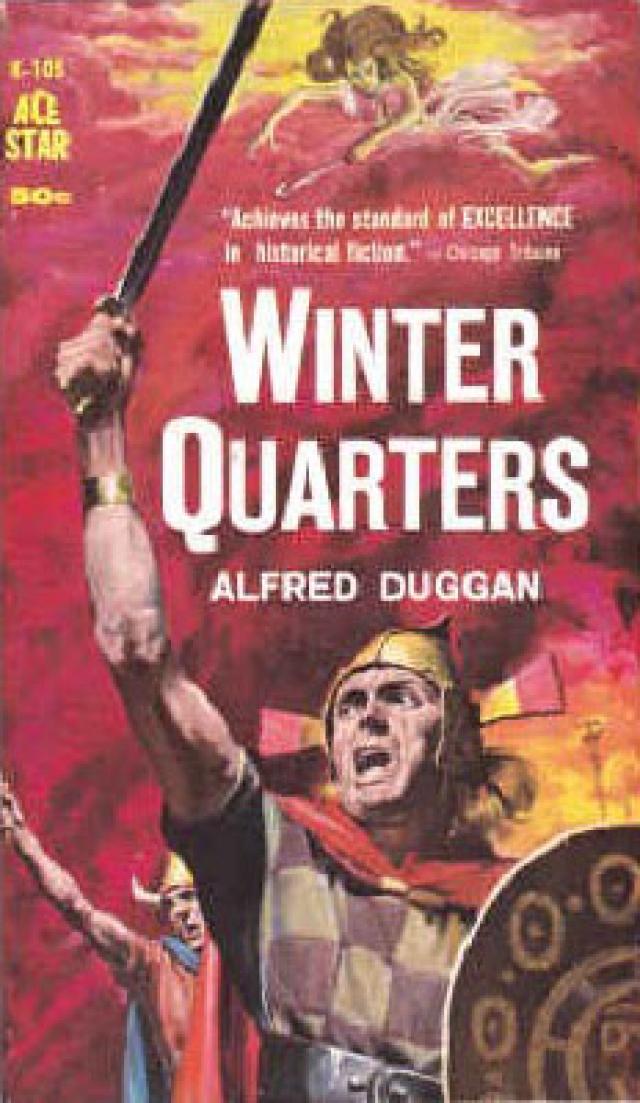
Winter Quarters, page 11


But there was no interpreter to explain this to the elephants. They were excited by the uproar, and presently decided they were among foes. Just as the hunters were about to retire, gratefully, through the door by which they had entered, three elephants charged them, trumpeting. The armed men defended themselves, the crews of the elephant-castles joined in, and the fight was on. Someone with a battle-axe, who had thought out his tactics beforehand, dodged round to hough one animal with a cut to the hindleg. The victim’s scream roused all his comrades to action.
I was watching the interesting spectacle with close attention when I became aware of a tumult behind me. The mob had issued its command, and the Consul had failed to comply with it. The dregs of the amphitheatre, who consider themselves the sovereign People of Rome, felt insulted at this disobedience. Sturdy gangsters and tough ex-soldiers were climbing over the stone benches, intent on bringing the great Pompeius to a properly submissive frame of mind. When a shoe whizzed past his ear, and a man with a broken jaw tumbled into his seat, Marcus Crassus called to his followers and led us swiftly from the building.
Closed up for safety, we crossed the City to the Licinian mansion. Behind us the clamour from the riotous theatre filled the sky, and as we passed merchants closed their shops. Then we smelt smoke, and Publius Crassus halted us to hear his orders.
‘Tonight you will all be armed, and divided into watches. We must guard the mansion as though it were a fortress. Tomorrow or the next day Pompeius will restore order. Recruits for his Army of Spain are training near the City, and they will obey his orders. But until trained soldiers arrive the mob is in control, and they will crown this day of festival by plundering the houses of the rich. They may also plunder the homes of the poor. But Crassus guarantees full compensation for losses incurred in his service; while if Crassus is plundered you also are ruined.’
This renewed harping on the wealth of his father struck me as vulgar in a young man of noble birth; but the other clients saw nothing wrong in it, and we did as we were told.
By afternoon of the next day things were back to normal, which in Rome is not saying much; the City is most disorderly. We heard from eyewitnesses that the riot in the Theatre had proved a splendid finish to a brilliant and costly festival. In the course of the fighting all the elephants were killed, as well as the huntsmen and a large number of the audience. The Theatre itself, built throughout of dressed stone, would not burn; but several large houses and well-stocked shops had been sacked and destroyed. Some wiseacres held that the whole thing was a cunning Caesarian plot to weaken the effect of Pompeius’s lavish generosity, but I was there, and I am sure the riot was spontaneous. Romans enjoy a riot; they like killing, and don’t mind very much if they get killed themselves.
There was no business for us to do on the day order was restored, for of course the horse-dealers had left the City in fear of being plundered. Acco and I planned to spend our free afternoon in a tour of the wine-shops, since now we had plenty of money; but we found them all closed by the legions of Pompeius.
As we turned away from the fourth tavern, the sentry on the door took pity on our disappointment. Without thinking I had received his orders standing at attention, and he spotted us as ex-soldiers.
‘If you want only a skinful of wine, with no funny business after, why don’t you try our canteen? You might meet a few old comrades. Which was your legion, citizen?’ he added, to me.
‘No legion, soldier,’ I answered, knowing that among veterans I could not pass as a Roman. ‘My friend and I both served in Caesar’s auxiliary horse, and I was lucky enough to be granted my citizenship on discharge.’
‘Fancy soldiering, eh? Peacocking about on horseback when honest Romans are too sore to sit down anywhere, what with the centurion’s cudgel and one thing and another? No, don’t take offence, my good barbarian,’ as Acco frowned. ‘In Caesar’s army everyone fights, even the cavalry. I know, my brother’s in the Thirtieth. Well, any soldiers of Caesar who find themselves in Rome deserve a party, even if we have closed the taverns. That house on the corner is now our guardroom. Say I sent you, and save a cup for me when I come off guard.’
In the house on the corner a dozen legionaries dozed in their blankets. In the court at the back the regimental sutler had set up his casks, and an odd crowd of semi-military hangers-on were drinking seriously. It was not what we had come out for, since it was not typical of Rome; but I was quite pleased to be back in the atmosphere of the army.
A burly man in a plain tunic insisted on paying for our drinks. He was standing treat to all comers, and explained that he had just enrolled a big batch of recruits and been paid the usual bounty. A retired centurion, he was now employed in the baggage-train; and he spent his spare time ‘reinforcing the army’, as he called it.
He was interested to hear that we were bound for the Army of Syria. ‘Though why on earth you want to leave Caesar beats me. Why, if you stuck to him you might visit the Hyperboreans, in their warm home at the back of the North Wind. And next year, for sure, his men will fill their helmets with British amber and pearls.’
‘You forget, sir, that we are Gauls,’ I answered politely. ‘We come from a land very like Britain. I have met British traders, and they seemed no richer than anyone else. Caesar also led us into Germany, and after one look I want to see no more of that beastly country. But Crassus marches to the wealthy east. How many cartloads of treasure did Alexander find in Persepolis? It’s time that country was plundered again.’
‘Oh yes, the east’s worth plundering. I hope you and your comrades can plunder it. But you will find those comrades a queer set of men. Caesar offers glory and Pompeius offers ease. No one volunteers for the east unless the other armies won’t have him. After all, though Crassus is Consul, what has he ever done? Crucified a lot of slaves, while his rivals were conquering provinces.’
‘We follow his son, a gallant captain of horse. I know that, for he led us in Gaul,’ I answered, still with politeness.
Luckily Acco was not listening, or his honour might have flared up. ‘Besides, sir, we must all begin somewhere. If our great leader has not yet won famous victories, it may be because he has never served in great wars.’
‘You may be right, and I am glad to see you loyal. Let’s hope you carry all before you in the east. But in the old days I served under Lucullus, and I tell you these new legions for the Army of Syria are not the right stamp. Besides, in those days we were defending our own from the ravages of King Mithradates, and the gods favoured us. You will attack peaceful neighbours without provocation, or so they say in the Forum.’
‘That’s as may be. We are men under orders, fighting where our leader bids. My friend is a foreigner, and it happens that I have never voted. So we are not to blame for the foreign policy of the Senate and People of Rome. Now it’s my turn. What will you drink, sir?’
He took the hint, and turned the conversation. We passed the rest of the evening drinking quietly, and listening to stories about the difficulty of keeping order in the tumultuous City.
All the same, next morning I remembered this conversation. We were busy now, since at last the expedition was getting under way; but I found time to stroll through the Forum in the afternoon, when official business was over and private speakers harangued the citizens. The veteran had told the truth; on every side I heard denunciations of the wickedness of this unprovoked attack on the blameless Parthians, who wished only to live in peace with Rome.
I was not convinced. We Gauls also had no quarrel with Rome, but no orator maintained that Caesar should stay in his Province until Roman territory was attacked. For two hundred years the Romans have invaded their neighbours without waiting for an excuse, merely because the neighbours are weaker. If now some of them held such conduct wicked it was because they opposed Crassus, not because they thought barbarians have a right to freedom.
I mentioned the matter to Pyrrhus the steward, when he called on us with money for the horse-dealers. Nowadays we were too busy to attend the morning assembly of clients, and I did not wish to bother our patron with what might prove an unnecessary alarm. Pyrrhus told us not to worry. He explained that a clique of elderly Senators had for years carried on a feud with Marcus Crassus, whom they hated because he had made money for himself instead of inheriting it from his ancestors. They had delayed the Parthian expedition as long as possible, and now that all their efforts had failed, and the army was at last mustering, they were putting up hired speakers to give the whole enterprise a bad name.
Though they knew it was nothing but a political move, many citizens were persuaded. Our horse-dealers complained of a hostile public opinion, which was spoiling the pleasure of their visit to the City. But Acco and I could go anywhere in comfort; we were always taken to be followers of Caesar, who was immensely popular with the lower classes.
The veteran in the canteen had been right about the new legions, as I realised when I delivered the first draft of remounts to the camp in Etruria. The centurions and rear-rank men were ordinary Roman soldiers, who would do their duty in a tight place and shirk fatigues if there was no enemy about. The new recruits I saw drilling were not so impressive. Some had the shifty deference that is the indelible mark of the slave-born; others were clumsy farmhands, too slow and loutish to be made into good swordsmen; many were obviously petty thieves. They were proud to be soldiers, which sounds a good quality. But their pride had in it a trace of surprise that anyone should have trusted them with weapons.
I had visited the camp alone, but Acco was beside me a day or two later when we watched a cohort march in for the ceremonial parade which would officially open the campaign. Though I had not prompted him he thought as I had. ‘This is a new kind of soldier,’ he said in a whisper. ‘They are not like the men who beat the Nervii.’
‘They are Romans, all the same,’ I answered. ‘Perhaps the Parthians are worse. Among the Gallic horse we shall be in good company, and Publius will lead us bravely.’
As the autumn deepened into winter that was our consolation. We were both tired of Rome, tired of these proud, cruel, thieving strangers who would never accept us as equals, tired of the noise and the smells and the echoes bouncing back from steep hot walls, tired of the jostling and the lack of dignity. Soon we would be riding among Gallic cavaliers, men of honour with ceremonious manners. We were loyal to Publius Crassus, but we did not like his friends and fellow citizens.
At last the day came when the army was to march out. This formal marching-out was an important ceremony, for it marked the end of the Consulate of Marcus Crassus. Detachments of the best men from every legion (not very good men, all the same) had been specially sent into the City as escort for the new Proconsul of Syria.
Even now the memory of that procession can give me nightmares. I have seen more terrible sights, but none more ominous; and though we knew that political trickery was at the back of the evil omens, still they were evil omens. There could be no arguing about that.
Acco and I, foreign auxiliaries, had no place in a parade of Roman legions. We waited by the city gate among a crowd of sightseers, ready to join our drove of horses as soon as the troops began to march at ease. We had a fine view of everything.
We had early learned to recognise the insignia that mark the Tribunes, a thing foreigners in Rome must know if they are not to break the law. For these sacred officials may never be touched, or hindered in anything they set out to do. (But they hold office for one year only, and may be prosecuted after, which keeps them within bounds.) We saw an elderly Tribune come down the road, and we were among those who got out of his way when he announced that he wanted a clear view of the parade. Someone told me his name was Ateius Capito, an opponent of both Crassus and Caesar. He looked a decent, respectable man, though not perhaps noble, as we reckon nobility in Gaul.
Then we heard the bellowing of brazen trumpets, and knew the troops were on the march. Everyone looked up the street, forgetting the old Tribune. The first standard came in sight and the crowd fell silent; for these eagle standards rank as the most holy gods of the Romans.
When the marching column had nearly reached us old Capito darted out into the middle of the road, followed by a slave bearing something on his head. The something turned out to be a small bronze tripod. As soon as it was set down, the Tribune busied himself with lighting a pinch of incense with flint and steel (he was clumsy, but energetic, and he soon got it smoking). He crouched by the tripod, cowering down to the earth; and he drew his toga over his head.
At last I understood what he was at. He was praying, presumably for the success of the expedition. Romans always cover their heads to pray, and since they hardly ever cover them for any other reason you can be sure that a man with his toga over his head is calling on the gods. No one else was doing anything except cheer, and the army had just come from the solemn state sacrifice; but many Tribunes grow eccentric, since no one dares to check their actions. Presumably Capito thought another prayer would do no harm.
The troops began to march by, and the Tribune continued to pray. The crowd was peering at the soldiers, trying to recognise friends or criticising the marching. There was a lot of noise, and no one could hear what the devout Capito was saying.
Cheers rose to a roar as the commander came in sight. Marcus Crassus stood upright in a two-horse chariot. He wore the dress of his military rank: a cuirass of gilded linen from neck to hips, swaying strips of thick leather over his thighs, and tall bronze greaves from ankle to knee. On his head was a splendid bronze helmet embellished with a tall horsehair crest, and his long scarlet cloak fell behind him in one sweep from the shoulder. A trusted guardsman standing beside him in the chariot held an antique shield worked with many little figures in combat. The full dress of a Roman commander is a most impressive costume.
But it did not suit Marcus Crassus. I had seen him often during the past summer; but always wearing the ample toga of a Consul, in which he looked a statuesque figure of benign statecraft. Now he seemed a crapulous and bloated old man. The cuirass was moulded to suggest the muscles of a Hercules; but it could not suppress his prominent belly. Behind the bronze greaves his spindly legs seemed too fragile to support such corpulence. His bare arms were skinny with age, and he peered from under his helmet as though he were extremely short-sighted. He was in his sixties, which for a statesman is the prime of vigour; dressed as only a young warrior should dress, he looked a silly old dotard.
The crowd gave him a cheer because he was the leader of their army; but among the hurrahs were sniggers and catcalls. The officers of his staff, including his son Publius, marched on foot immediately behind his chariot; they looked worried, and I guessed that throughout the procession there had been a constant risk that encouragement might turn to mockery. All crowds are cruel, but a Roman crowd is utterly ruthless. I nudged Acco, and cheered at the top of my lungs to set an example.
Suddenly I heard my own voice against a background of silence. The old Tribune by his smoking tripod had commanded quiet, and in Rome a Tribune is obeyed without question. Squatting in a complicated position, as though every movement was ordained by ritual, he inclined his face to the ground and began to speak.
Even I, a stranger, knew at once that he was addressing the Gods Below; for the underworld lies below every land, and all men are aware of it in much the same way. Even I could guess that it was contrary to ritual to shout as he was shouting; I knew he was addressing the People of Rome as well as the gods of death. ‘This is politics, not enchantment,’ I whispered to Acco.
But the people were impressed, for old Capito performed his ritual with conviction. He began by calling over a long list of what were to me meaningless words; they were the old names of the old gods, seldom heard by modern Romans. Then he pronounced what was very nearly the ritual dedication of the sacrifice I had heard when the Consuls slew their daily ox for the good of the City. It was not quite the same, for that was a thank-offering, and this was not given in gratitude but in aversion. Last of all he named the thing he was sacrificing.
‘Take, ye powers,’ he chanted, ‘take Marcus Licinius Crassus and all his host. We devote them to early death, to turn away the vengeance. Innocent blood will be shed without cause. Impute it not to the People of Rome; impute it only to that Crassus and his infatuated following. Even now they leave the City, bearing their pollution with them. Suffer them not to return!’
The troops had halted to hear the Tribune, as is the duty of all Romans. Now the Tribune had finished. Overturning his tripod, he stamped out the smouldering incense with a gesture of complete finality. In dead silence he returned to the crowd beside the gate. Crassus, in a clear expressionless voice, gave the order to march on.
In silence we watched until the last mailed legionary had marched forth under the carven arch. Then Acco turned to me with a thin smile.
‘The old man might have spared his breath. I am an Ovate, and I knew it before he spoke.’ He bent down to pat the earth. ‘So, my masters, you expect us. But we all come to you in the end, by one road or another. My road runs through the ancient cities of the east, where man first learned wisdom. I shall see the greatest beauty man has ever made. Then you will take me. That is my fate, and I would not have it otherwise. Come on, Camul. We must get the remounts moving before those grooms lose them and find wineskins in exchange. The army has marched and we are on campaign.’
He was quite self-possessed, and I think quite happy. But he had already journeyed a little way out of the sublunary world of ordinary men.
4. Greece
It was pleasant to be back in the army. I was now quite accustomed to Romans, and no longer felt shy in their presence. I had lived among them long enough to share some of their background, and, though neither Acco nor I ever thought or felt as Romans, we knew enough about them to understand how they would think and feel.