Wakefield in the Great War, page 16
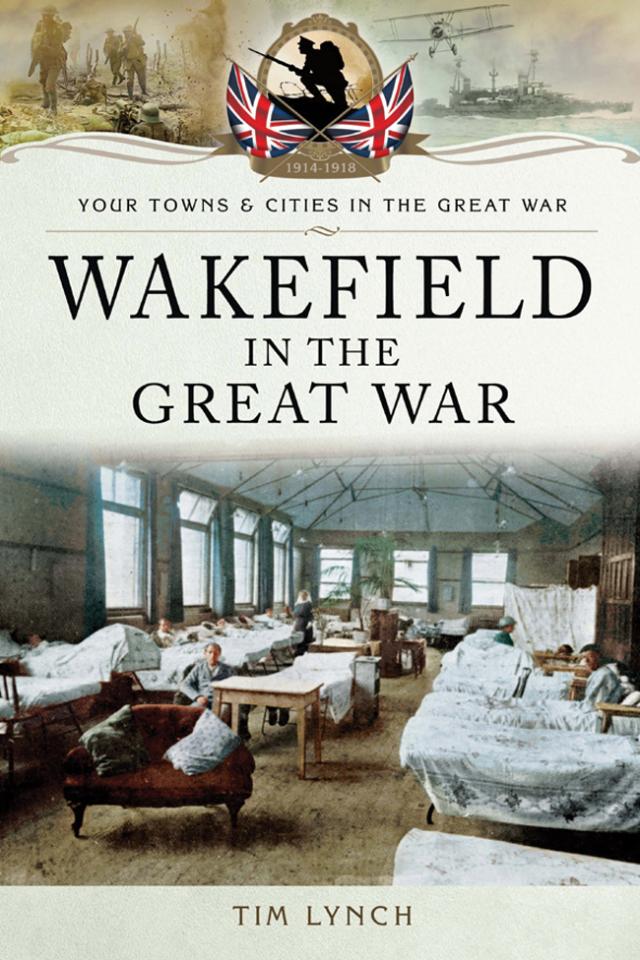


VAD nurses and some of their charges, 1917.
That month two representatives of Northern Command, Colonel Dunscombe and Colonel Littlewoood, inspected the Georgian mansion at Wentworth House in Wentworth Street and declared it ‘excellently suited’ for a hospital with only minor alterations to create two more lavatories. It had been the home of Wakefield Girls High School since its foundation in 1878 and had over 400 pupils in seventeen forms occupying a total of thirty-eight rooms. At a special meeting with Stonehouse, the governors agreed to hand the building over for use as an auxiliary hospital, and in return Wakefield’s Technical College would find rooms for many of the classes. A public meeting followed in April when Stonehouse broke the news that the War Department would provide nothing more than the standard rate which had risen to 3s per patient per day. Wakefield people and the local branch of the Red Cross would therefore need to find £1,000 to equip the building and £2,000 a year to run it. The headmistress of the High School, Gertrude McCroben, was given no say in the decision but found herself landed with the task of organising everything instead of taking a break over Easter. In early April, pupils of the High School and Grammar School removed all the desks and other school items, leaving only a piano. From then on, until the summer of 1919, the girls were taught at 8 St John’s North, 4 St John’s Square, rooms at Wakefield Technical College, or in marquees erected on the school playing field in Blenheim Road. A room in the Cathedral vicarage, then in Sandy Walk, became the school office.
Commandant King took charge of Wentworth House, now known as St John’s Auxiliary Hospital when it was formally opened on 8 May 1917 and the nursing staff were, again, those who had trained under the VAD. Dr J.W. Walker, better remembered today as the author of A History of Wakefield, offered his services as the hospital’s Medical Officer. Mrs King seems to have been efficient, but not necessarily popular. When another military hospital, known as Park Lane Auxiliary Hospital, was established in a part of the Wakefield Union Workhouse in Park Lodge Lane, the Board of Guardians, who had responsibility for the Workhouse, were keen to assure locals that there would be no additional call on the rates. But although the Guardians had decided at the outbreak of war that they could accommodate some wounded soldiers, for some reason they refused to give Mrs King charge of them.
Already under pressure to treat a growing number of wounded soldiers, the managers of Clayton Hospital were asked in November 1917 to provide medical care for the Conscientious Objectors housed in Wakefield Work Centre, but agreed they would not do so. A month later, an approach was made to Clayton Hospital by Dr Littlewood, from Leeds, for Northern Command to discuss medical care for interned civilian prisoners from Lofthouse Park Camp. The suggestion was that where necessary prisoners could be admitted to Clayton as in-patients. The offer was that the hospital would receive 5s a day to cover their care but no guard would be provided, and the Hospital would be responsible if any of their prisoner patients staged a miraculous recovery and escaped. Perhaps not surprisingly, the Hospital committee minutes simply record, ‘Request declined’.
Then, in January 1918, Wakefield’s mayor was asked if the city could provide another hospital, this time for convalescent soldiers who would be transferred from the Heavy Woollen District Military Hospital housed in a former workhouse infirmary at Staincliffe, Dewsbury. There was considerable reluctance to ask for yet more support from Wakefield people, but the indefatigable Lady Catherine Milnes Gaskell seems to have been determined that the city could cope, immediately obtaining promises of £2,000 from prominent local citizens. Colonel Smythe offered Heath Hall at a nominal rent and workmen moved there in April 1918 to convert the elegant mansion into the White Rose Military Hospital, with beds for 100 soldiers. Appeals again went out for furniture, bed linen, dressing gowns and pyjamas, whilst students at Wakefield and Dewsbury technical colleges made bedside lockers.
Throughout the war, the War Department allowance for the care of the wounded, at 3s a day, was only enough for only a very basic diet, especially when prices continued to rise. Individual Wakefield people, local organisations and schools regularly supplied additions – bacon, sausages, ham, brawn, cakes and fresh fruit, as well as flowers, newspapers and magazines. A group of people led by Mrs Thornhill Simpson, of Walton, began a regular collection of spare eggs, usually over 1,000 a week, from local poultry keepers to keep the local hospitals supplied throughout the war and beyond, with even enough to spare to send to other military hospitals. More appeals brought in playing cards, a gramophone and gramophone records and frequent donations of packets of cigarettes.
Wakefield people, and particularly local schoolchildren, organised concerts to entertain the patients. At Christmas 1917, one of the wards at Park Lane Hospital was converted into a theatre, with scenery provided by the proprietors of Wakefield Theatre Royal and Opera House. Patients and nurses put on a musical play written by one of the men, Sapper Tusker of the Royal Engineers, and somehow each man in a Wakefield hospital was provided with a Christmas stocking. At other times, occupational therapy for the wounded came in the form of making rag rugs. In November 1917 Lady Catherine was again out calling for materials for them such as unwanted flannelette.
Where they were able to walk, they had the freedom of local cinemas. One or two car owners, notably Major Howard Hall of South Parade, and Miss Tew, a leading member of the VAD from Heath, took men out for drives. Just occasionally there was the chance of a mass outing such as the time fifty patients were taken to Charles Roberts’ wagon works at Horbury, where they were shown round and given a substantial tea. Another, perhaps more attractive excursion was provided by the Yorkshire Tramway Company who took men from Park Lane Hospital to Roundhay Park.
Patients of the Wakefield Asylum.
Wakefield Asylum Staff, 1917.
Sheffield, too, was making arrangements for the creation of auxiliary hospitals and one building taken over was the former West Riding Pauper Lunatic Asylum at Wadsley Bridge. In order to turn it into the Wharncliffe Military Hospital, nearly 1,700 inmates had to be relocated to other institutions, at Menston, Storthes Hall and to Stanley Royd Asylum in Wakefield where, by December, there were some 1,260 male and 870 female patients, many, but by no means all, funded by the Board of Guardians. Some were mentally ill but fifteen were simply classified as ‘vagrants’. The numbers of patients remained stable over the coming year but the introduction of conscription raised questions about the level of care being provided. In 1916, questions were raised in Parliament concerning the safety of female staff who were increasingly having to cover for their male colleagues who had been called up along with calls for a halt to the conscription of male attendants until asylum authorities were able to replace them with other men. The Home Office Under-Secretary replied that there were female nurses in four of the twenty-four male wards but that they were employed to manage ‘quiet cases which can be properly attended by women, boys, sick cases or chronic cases of a quiet class.’
To these were being added a new type of patient. It was not until April 1917 that the Asylums Board received notification from the War Office of a new policy towards ‘soldiers and sailors who have become insane during the war.’ Until then, any man suffering ‘shellshock’ or any other mental condition triggered during his service was treated as a ‘pauper’ unless he had been awarded a disability pension. From then on, though, servicemen were to be treated as private patients with a budget of 3s 6d per week for their upkeep and 2s 6d extra for ‘special comforts’. A suggestion that special suits, like the ‘hospital blues’ worn by physically wounded soldiers, should be provided was rejected, the Asylums Board refusing to pay 15s 6d and arguing that the military authorities should be responsible for providing the cloth free. The same meeting went on to award the Board a war bonus of 2s per week.
Typical of the type of patient now coming to Wakefield was 28-year-old Beech Jennings from Pontefract and formerly a private in the King’s Own Yorkshire Light Infantry. Discharged on 1 July 1918, he was admitted to an asylum in Glamorgan a few days later. His notes record: ‘Patient is excited, very loquacious & noisy, incoherent & rambling, exalted & defectively orientated. Does not realise his position, is untidy & unable to look after himself. He shouts loudly & has exaggerated movements in all joints, stares in hostile manner at everyone, is impulsive, emotional & extravagant in ideas. He is a native of Yorkshire, father alive, mother dead, 2 brothers & 2 sisters are alive, 2 brothers were killed in the war, has 2 children. He joined the Army in 1914 & was 2 years in France, has been in Whitchurch.’ The record goes on to note that he was ‘transferred to York W Riding Asylum, Wakefield – 13 Nov 1918’.
Demand for hospital beds increased during the winter of 1917–18 to the point where marquees had to be erected at both Wentworth House and Park Lodge Lane to take additional patients, and by May 1918 Wentworth House had 256 patients and Park Lane had 147. Gaskell Ward at Clayton Hospital was taken over again to hold servicemen who had been discharged but still needed medical attention before returning to civilian life and consideration was already being given to the long-term needs of rehabilitation. Local company G.E. Appleyard undertook to furnish two wards which were to be set aside for a period of three years to accommodate discharged soldiers and bought in special massage and electrical equipment for physiotherapy at a cost of £20.
In December 1918, Mrs Longley, of Thornes Lane, sent £50 to part endow a bed in memory of her son, Sergeant George William Jubb, formerly of the Yorkshire Dragoons, who had been killed on 5 September while serving with the new Royal Air Force. In April 1919, Nellie King wrote to offer £500 from monies left over and told them that the VAD wanted to endow a bed. The committee noted that £500 was ‘about right’. Whatever the committee and the Board of Guardians thought of her, Commandant Nellie King went on to be honoured with the Royal Red Cross Medal and was invested at Windsor Castle, afterwards going with other recipients of civilian medals to have tea with Queen Alexandra at Marlborough House. Miss Percy Tew, the VAD who arranged outings was awarded the Royal Red Cross Medal (2nd Class) as were her colleagues Miss Pilkington and Miss Walker. Captain Walker, the medical officer, was awarded an OBE for his services. From almost nothing, between them they had created a hospital with a fully equipped operating theatre where 230 major operations had been performed. In all, 3,131 in-patients and 297 out-patients had passed through Wakefield’s auxiliary hospitals and almost all had been treated by staff who gave their time freely. In the summer of 1919 the high school girls were able to return to Wentworth House. Heath Hall stood empty until it was used as a military hospital again in the second world war. At Clayton Hospital a roll of honour was started to commemorate nurses who had been on war service and the idea evolved into a more lasting memorial in the form of a new nurses home.
CHAPTER 7
Law and DORA
At 7.00pm on the evening of Thursday, 30 July 1914, 26-year-old Tom Harris left home for a ride on his treasured 4hp motorcycle, telling his father he planned to go up to Leeds to pick up some tools. An enthusiastic and experienced rider, Tom had only owned his own bike for six months and was on his way home when he collided with a dray on Lower Road at Oulton. He was taken to hospital with compound fractures of his arm and leg and injuries to his face. He never regained consciousness and died 2 hours later of a fractured skull. An inquest was opened the following day and adjourned until Tuesday, 11 August. His grief stricken father ‘expressed his thanks for the uniform courtesy and kindness the police and everyone associated with the case had shown.’ As Chief Constable of Wakefield, Tom’s father, Thomas Middleton Harris, barely had time to begin to grieve for his son before being overwhelmed by the massive task of maintaining a sense of order when war broke out just days later.
In 1914, the City of Wakefield police were responsible for patrolling the city itself, with the West Riding Constabulary covering the outlying areas and the Grand Central Railway Police operating out of Wakefield Westgate railway station holding responsibility for any offences linked to the railways. All three forces regularly employed ex-servicemen, and within days of the outbreak of war forty-three reservists had been recalled, leaving their stations undermanned. Among them was William Hall, a Wakefield policeman for three years before being ordered back to rejoin 1st Battalion of the Scots Guards, who would be among the city’s first casualties when he was killed on 14 September, leaving a widow and two young children. Hall was just one of sixty-three West Riding policemen who would never return.
As the recruiting drives went on, the county’s Chief Constable found many of his men, many of them experienced ex-soldiers whose reserve commitment had ended, were increasingly determined to swap police blue for army khaki. He finally gave in to pressure and gave his consent for 318 serving officers to volunteer for the military. James Crease of Sandal had served seven years with the Grenadier Guards and had spent nearly three years deployed in the South African War. After leaving the forces he joined the Railway Police and his commitment to the reserve had ended by the time war broke out. In 1915 at the age of 36 he volunteered for the army and enlisted into the Military Foot Police where he was posted to a Traffic Control Company, responsible for keeping the flow of supply trucks to and from the front moving. The job involved him cycling from post to post and a report in the Wakefield Express suggested that this contributed to the hernia that caused him to be admitted to hospital in August 1918. As he waited for treatment he was visited in hospital by an old friend from Wakefield, Sergeant J. Ernest Harris (son of Chief Constable Harris and brother of Tom), who reported finding him comfortable and well cared for. Unfortunately, the operation for a strangulated hernia went wrong and he died of peritonitis on 10 August. According to a newspaper report, ‘Mrs Crease has been the recipient of very kind and sympathetic letters from Sergeant Harris, Captain Davison, Lance Corporal Beresward, Lieutenant Eastman, the Sister in Charge of the hospital and the Church of England Chaplain. In the course of his letter Captain Davison said Crease “was the finest and most reliable Sergeant it has ever been my good fortune to have met. He was held in high esteem by all the officers and men”. Writers of other letters stated that “he was an excellent soldier, who by his devotion to duty and good fellowship won the confidence of the officers and all Company” and “he was a man of fine character, and a true and noble Englishman”’.
Wakefield City Police.
With reservists leaving to rejoin their regiments and other officers keen to enlist, chief constables were forced to expand the use of volunteers and the Special Constable’s Act of 1914 was hurriedly passed at the end of August. Back in 1820, a law had come into force that allowed magistrates to order citizens to become Special Constables in time of public disorder. Another act in 1831 created a new power for local authorities to appoint Special Constables to help preserve the peace if they felt that existing police numbers were too low to cope. The Act gave Specials all the ‘powers, authorities, advantages and immunities’ of serving full-time constables and even allowed for a fine of 5s for any man who refused to serve if called on. On the other hand, it also granted for reasonable expenses to be paid when on duty. From the middle of the century special constables were sworn in on a semi-permanent basis to police the railway and canal construction industry, which was booming at the time. So the 1914 Act built on the existing service and at the end of August, Parliament heard that ‘special constables are being enrolled as a volunteer force, consisting of persons who, being unable to undertake military service, are desirous of rendering useful service to their country in the maintenance of public order. In almost every case they have undertaken to serve without pay, but out-of-pocket expenses will in some cases, at any rate, be paid, and this House yesterday passed a Bill which will enable the police authority to grant them allowances in case of injury on duty.’
An account of one unit of special constables in London described a shift parading for duty: ‘they were clad in every variety of overcoat and hat; some were armed with truncheons, some with walking sticks, and some were leading or being led by dogs.’ The idea was to use Specials to guard ‘vulnerable points’ likely to be attacked by the roaming groups of German agents that rumours insisted were ready to rise up at any moment. In Wandsworth, the inspector sent his keen amateur policemen to guard a site he described as having ‘an astonishing pungency’ that regular officers refused to patrol.
Special Constables set out on patrol.
At first, Specials were provided with just an armband but as time went on a uniform was issued. So great was the contribution they made that in 1917 even the tight-fisted West Riding Standing Joint Committee agreed to spend £15-4s-6d on twenty-one new caps for Divisional Commanders and £25-10s on 120 silver badges for Sectional Commanders. Alderman Booth declared that he was not a great believer in what he called ‘man millinery’ but even he admitted ‘these men were spending a lot of time on this work and devoting a lot of energy to it and under the circumstances he thought they might agree to the suggested purchases.’
The regular police force continued with the routine duties of law enforcement, investigating, for example, the suicide of a prisoner in Wakefield prison in September 1914 to avoid a flogging ordered by the prison’s Visiting Committee as punishment for ‘two very violent assaults upon warders.’ Asked whether ‘the Home Office is unable to devise some less degrading method of dealing with passionate and refractory prisoners?’ the Home Secretary responded that the ‘method of dealing with passionate and refractory prisoners is not free from difficulty, but as now advised I see no reason for reconsidering the law.’ Punishment was intended to be swift and harsh, whatever the impact on the offender. In the years to come, the same attitude would spread to affect even the most law abiding citizens as they struggled to weave their way through a mass of wartime legislation that made it all but impossible not to break some law or other on a daily basis.